A DC cell phone or mobile phone charger is a device which charges a cellphone from an available DC supply source. The device converts the unregulated DC source into a constant current and constant voltage output which becomes safe for any mobile phone charging.
In this article I have explained how to build DC to DC cell phone charger circuits using 6 unique concepts. The first concept concept uses the IC 7805, the second concept works with a single BJT, the third idea uses a IC M2575, in the fourth method we try LM338 IC, the 5th circuit shows how to charge multiple mobiles from a single source while the last or the 6th technique shows us how to use PWM for implementing an effective charging of a mobile phone.
Warning: Although the concepts are all tested and technically correct, the author does not take any responsibility of the results, please do it at your own risk.
Introduction
A simple DC cell phone charger circuit is one of those mates of cell phone that cannot be ignored because a cell phone would be dead without a charger.
Normally a DC cell phone charger circuit come as an integral part of a cell phone package and we use it in conjunction with our AC mains supply.
But what happens if your cell phone gasps for power in the middle of a journey, probably when you are driving or biking away on a middle of a highway?
How it Functions
A very simple yet reasonably effective DC to DC cell phone charger circuit is discussed in this article, which can be easily built at home even by a layman.
Though the proposed charger circuit won't charge your cell phone at the rate equal to a normal AC to DC charger, nevertheless it will complete the function without fail and won't betray you for sure.
The proposed DC cellphone charger circuit can be understood with the following points:
We all know the general specs of a cell phone battery, it's around 3.7 volts and 800 mAH.
It means the cell phone would require at around 4.5 volts for initiating the charging process.
However a Li-Ion battery which is employed inside cell phones are pretty sensitive to bad voltages and may just blow off causing serious life and property issues.
Keeping this in mind the cell phone internal circuitry is specifically dimensioned very strictly.
The parameters just won't permit any voltage which may be even slightly out of the range of the battery specifications.
The use of the versatile IC 7805 in the circuit answers the above issue just perfectly, such that the charging voltage at its output becomes ideally suitable for charging the cell phone battery.
A high wattage resistor connected at the output of the IC makes sure that the current to the cell phone stays well within the specified range, though this might have not been a problem anyway, the cell phone would just refuse to charge if the resistor was not included.
1) Circuit Diagram of the DC cellphone charger
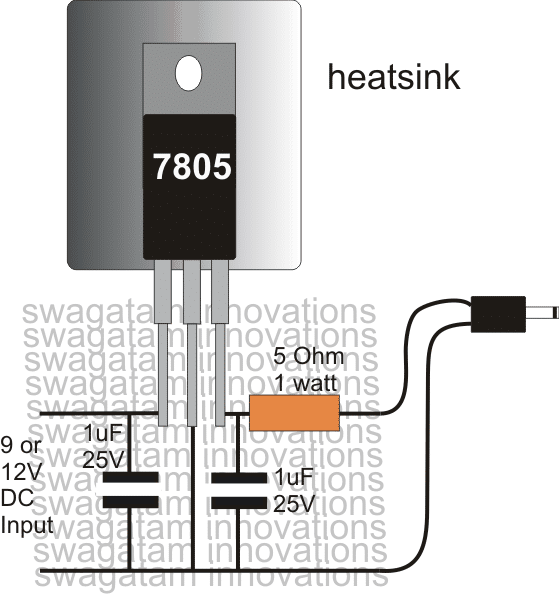
Pictorial Diagram
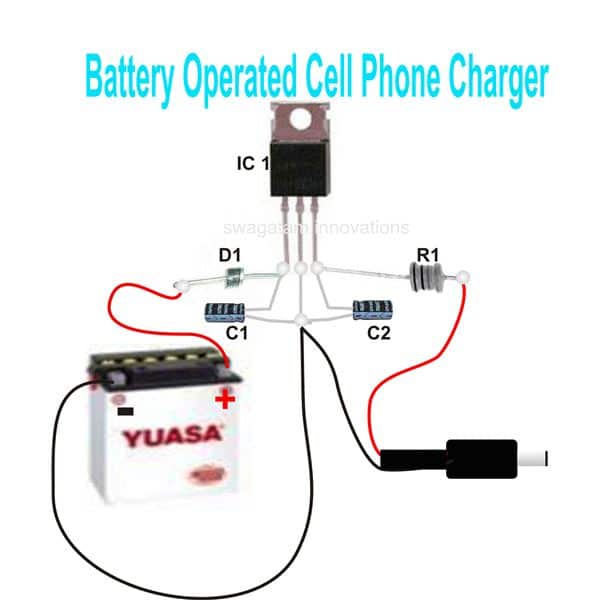
You can use this DC cellphone charger circuit for charging you cell phone during emergencies when there's no mains AC outlets, the circuit may be powered from any 12 volt lead acid battery or similar DC power source
Parts List
R1 = 5 Ohm, 2 Watt,
C1, C2 = 10uF/ 25V,
D1 = 1N4007,
IC1 = 7805, mounted on a heatsink,
Battery, any 12 volt automobile battery
Using LM123/LM323
In the above concept a 7805 IC is used for charging, which can deliver a maximum of 1 amp. This current may not sufficient enough for charging smart phones, or cellphones with bigger mAH rating in the range of 4000 mAh. Since these high current batteries may require current up to 3 amps for charging at reasonably fast rate.
A 7805 might be completely useless for such applications.
However, the IC LM123 is one candidate which can fulfill the above requirement, by providing a precision 5 V output with a good 3 amp current. The input can be from any 12 V source such a car/motorcycle battery, or a solar panel. The simple 3 amp mobile phone charger diagram can be seen below:
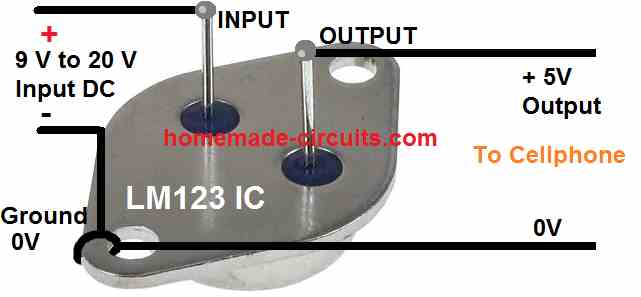
As can be seen above the 3 amp charger circuit requires no external components for implementing the procedures, and yet is extremely precise with its output voltage and current regulation, and is virtually nondestructive due to it many internal protection features.
2) DC Cell phone Charger using a Single Transistor
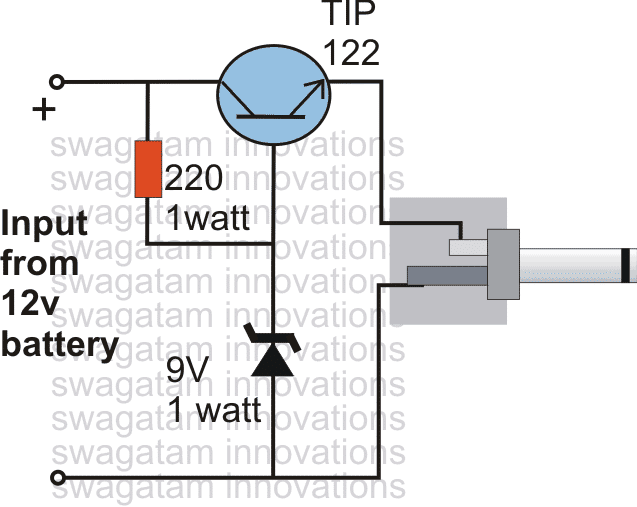
The next design explains a DC cell phone charger using a single BJT is probably the simplest in its forms and may be built very cheaply and used for charging any standard cell phone from a DC 12 volts external source.
Circuit Operation
The circuit diagram illustrates a rather straightforward design incorporating very few components for implementing the proposed cell phone charging actions.
Here the main active part is an ordinary power transistor which has been configured with another active part, the zenet diode for forming a nice little DC to DC cell phone charger circuit.
The resistor is the only passive component other than the above couple of active parts which has been associated in the circuit.
So just three component is to be used and a full fledged cell phone charger circuit is ready within minutes.
The resistor acts as the biasing component for the transistor and also acts as the "starter" for the transistor.
The zener has been included to inhibit the transistor from conducting more than the specified voltage determined by the zener voltage.
Though, a cell phone ideally requires just 4 volts for initiating the charging process, here the zener voltage and subsequently the output voltage has been fixed at 9V, because the current releasing ability of this circuit is not very efficient and presumably the power should be dropping to the required 4v level once the cell phone is connected at the output.
However the current may be decreased or increased by suitably increasing or decreasing the value of the resistor respectively.
If the cell phone "refuses" to get charged, the resistor value nay be increased a bit or a different higher value may be tried for making the cell phone respond positively.
Kindly note that the circuit was designed by me based on assumptions only and the circuit has not been tested or confirmed practically.
Circuit Diagram
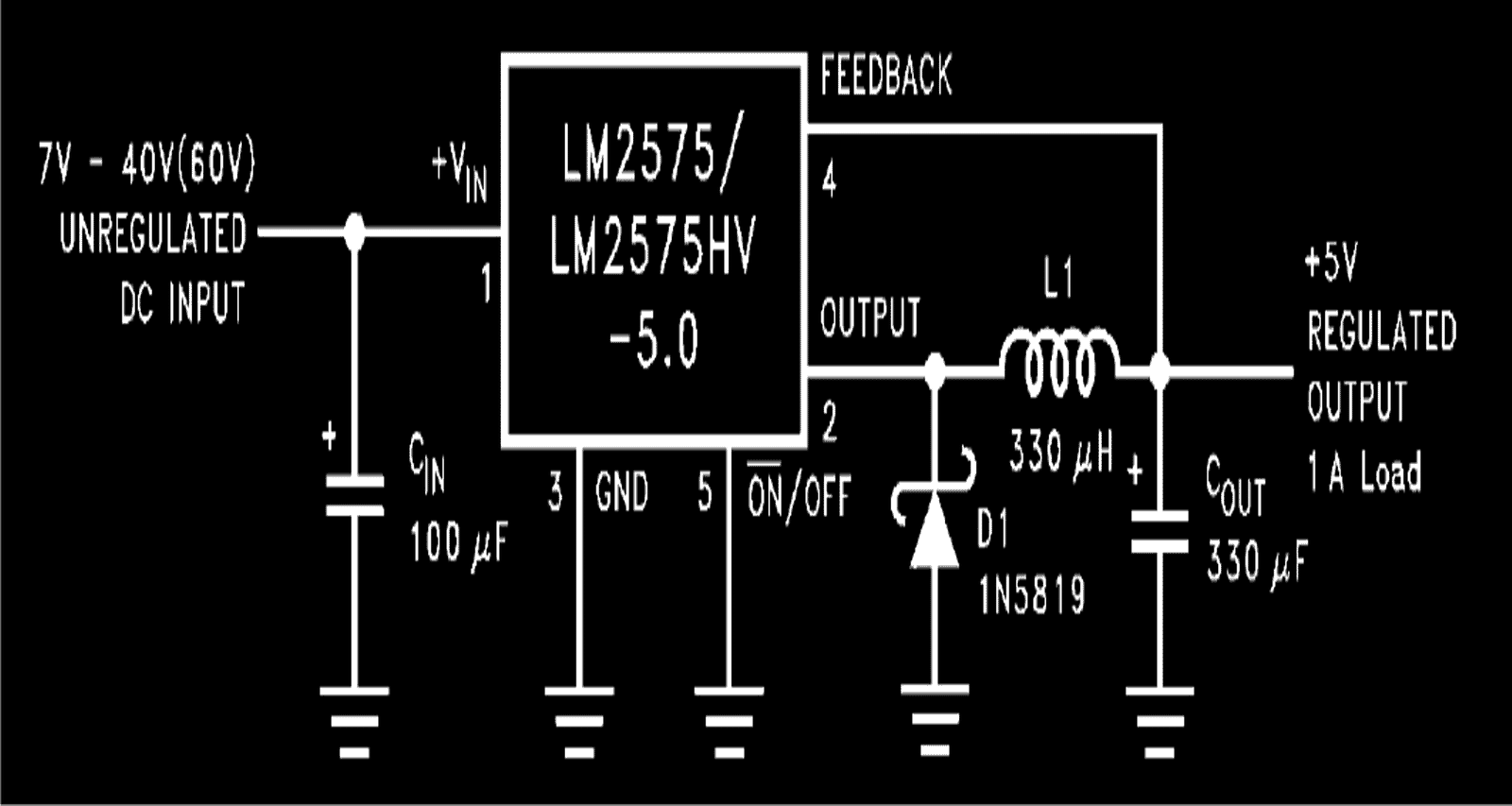
3) Using 1-A Simple Step-Down Switching Voltage Regulator
If you are not satisfied with a linear regulator charger, then you can opt for this 1 A simple step-down switching voltage regulator based DC cell phone charger circuit which works with a switched buck converter principle which enables circuit to charge a cell phone with great efficiency.
How it Works
In one of my previous posts I have explained about the versatile voltage regulator IC LM2575 from TEXAS INSTRUMENTS.
As can be seen, the diagram hardly utilizes any external components for making the circuit functional.
A couple of capacitors a schottky diode and an inductor of all that is needed to make this DC to DC cell phone charger circuit.
The output generates an accurate 5 volts which becomes very much suitable for charging a cell phone.
The input voltage has a wide range, right from 7V to 60V, any level ma be applied which results the required 5 volts at the output.
The inductor is introduced specifically for obtaining a pulsed output at around 52 kHz.
Half of the energy from the inductor is used back for charging the cell phone ensuring that the IC remains switched only for half the charging cycle period.
This keeps the IC cool and keeps it effectively in working even without using a heatsink.
This ensures power saving as well as efficient functioning of the entire unit for the intended application.
The input may be derived from any DC source like an automobile battery.
Courtesy and Original Circuit: ti.com/lit/ds/symlink/lm2575.pdf
4) DC Double Cellphone Charger
A recent request from one of my followers Mr. Raja Gilse (via email), prompted me to design a DC double cellphone charger circuit that is able to facilitate charging of many cell phones simultaneously, I have explained how to make the circuit.
I have already explained regarding a couple of DC to DC cellphone charging circuits, however all these are designed for charging a single cell phone. For charging more than one cell phone from an external DC source like an automobile battery, requires an elaborate circuit.
Technical Specifications
Dear sir. Please tell me that what alterations should i do, to charge two mobiles at a time from your "12V BATTERY OPERATED CELL PHONE CHARGER CIRCUIT".(from bright hub) I am using the circuit from last 8 months, it's fine. Please post that article in your new blog also.
Dear sir, i tried so many time to post this comment in your blog in the "simple dc to dc cell phone charger circuit" but in vain. Please answer here~ Sir, i used another 10 ohm 2 watt resistor in parallel with the existing one, as i don’t have the higher watt resistor. It’s working fine. Thank you very much, i have one doubt, earlier, in bright hub in the same article you told to use 10 ohm resistor, but here it is 5 ohm which is suitable ?
I have another question out of this article; please guide me could I use three 1N4007 silicon diode instead of one 1N5408 silicon diode? My aim is to allow 3A current in only one direction. But i don’t have diode of 3A i.e. 1N5408. As 1N4007 is of 1 amps capacity could use three 1N4007 in parallel and like wise for 5A five 1N4007 in parallel, because i have number of 1N4007
rajagilse
Solving the Circuit Request
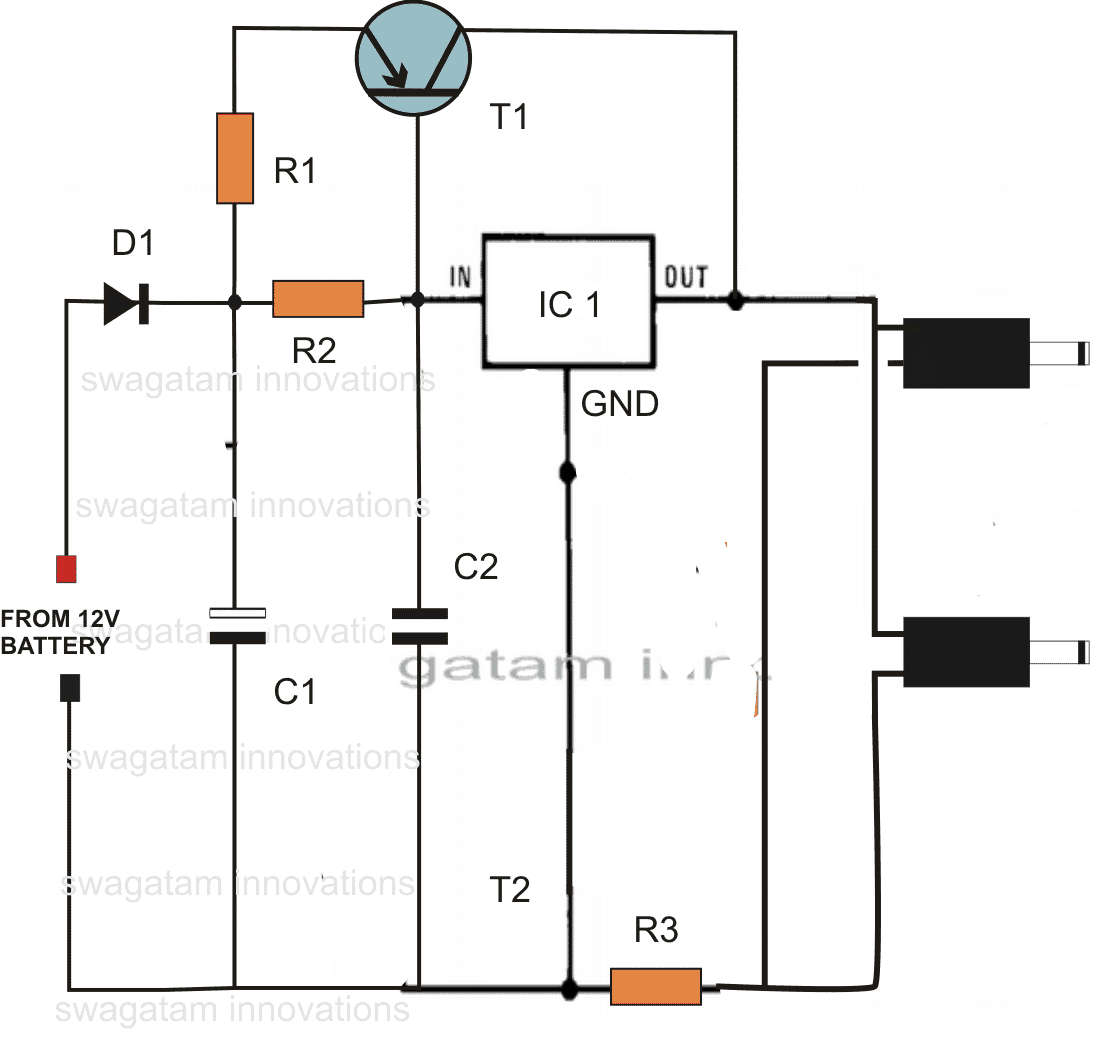
Hi Rajagilse,Use the following DC double cellphone charger circuit given below:
Hi Raja,
As you increase the limiting resistor value, the charging becomes slower, therefore a 5 Ohm resistor would charge the cell phone faster than a 10 Ohm, and so on. I'll check the problem with the commenting in my blog...however other comments are coming normally as usual! Let's see. Thanks and Regards.
Parts List
- R1 = 0.1 Ohms 2 watt,
- R2 = 2 Ohms 2 Watt
- R3 = 3 Ohms 1 watt
- C1 = 100uF/25V
- C2 = 0.1 discT1 = BD140 D1 = 1N5408
- IC1 = 7805
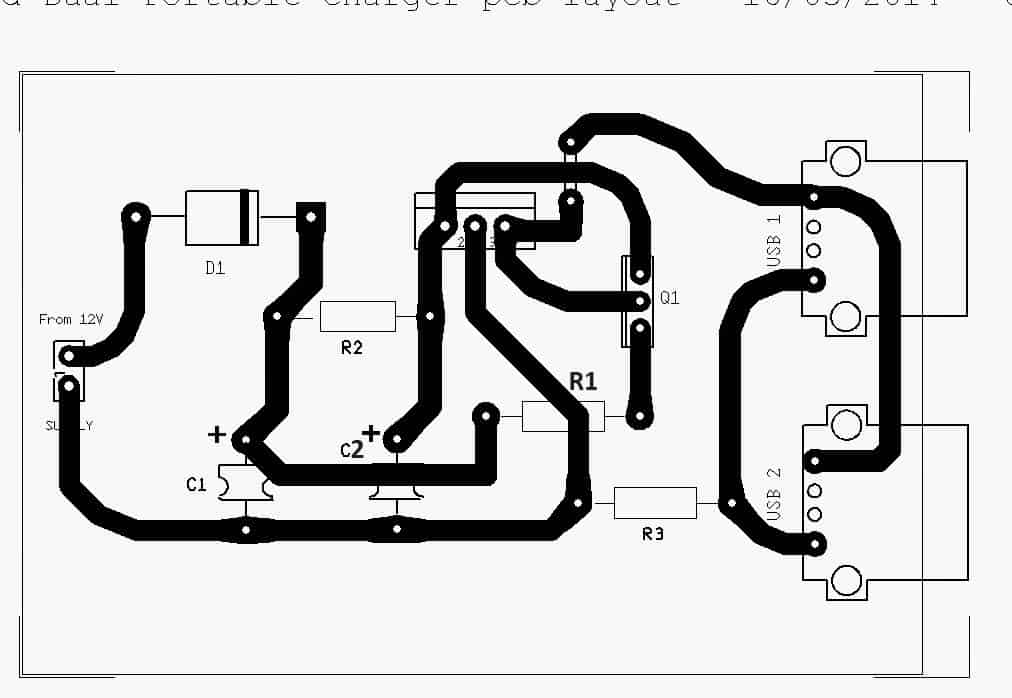
PCB Design
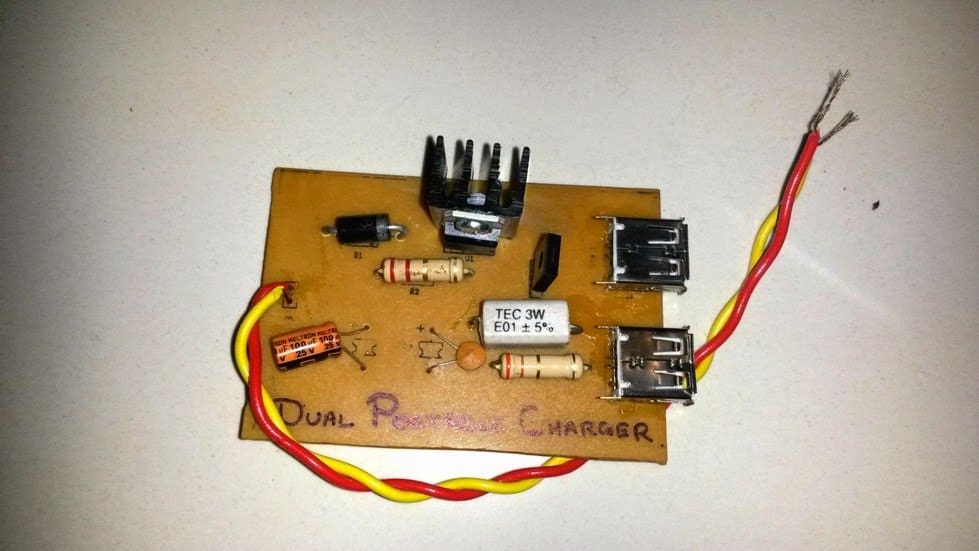
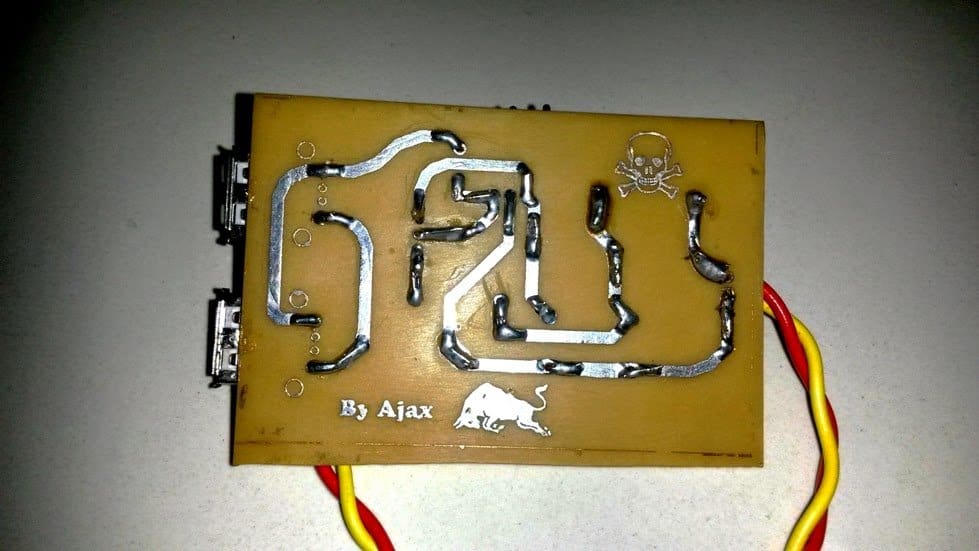
The circuit of the double DC cell phone charger was successfully tried and built by Mr. Ajay Dussa over a home designed PCB, the following images of the PCB layout and the prototype were sent by Mr. Ajay.
5) LM338 Based Cell Phone Charger Circuit
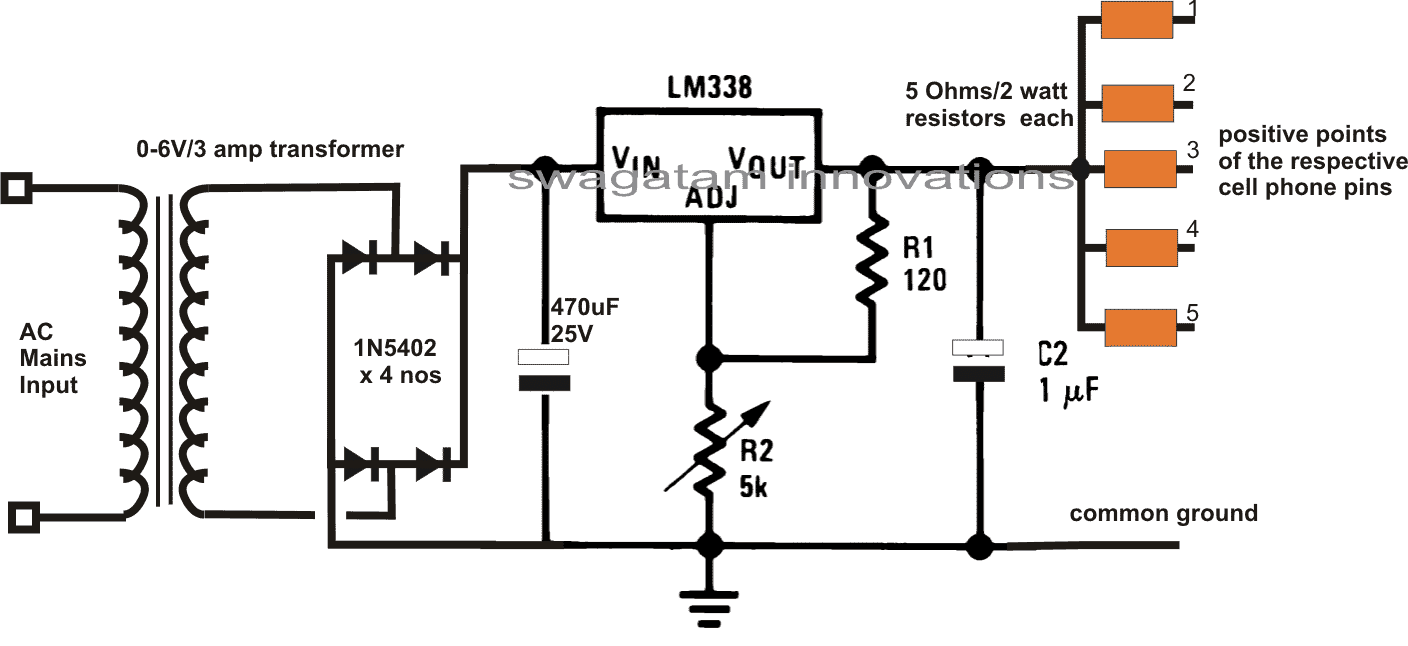
The following circuit can be used for charging as many as 5 cell phones at a time. The circuit employs the versatile IC LM338 for producing the required power. The input is selected to be a 6V but can be as high as 24V. A single cell phone can also be charged from this circuit.
The circuit was requested by Mr. Ram.
Multiple Cellphone Charger Circuit using IC 7805
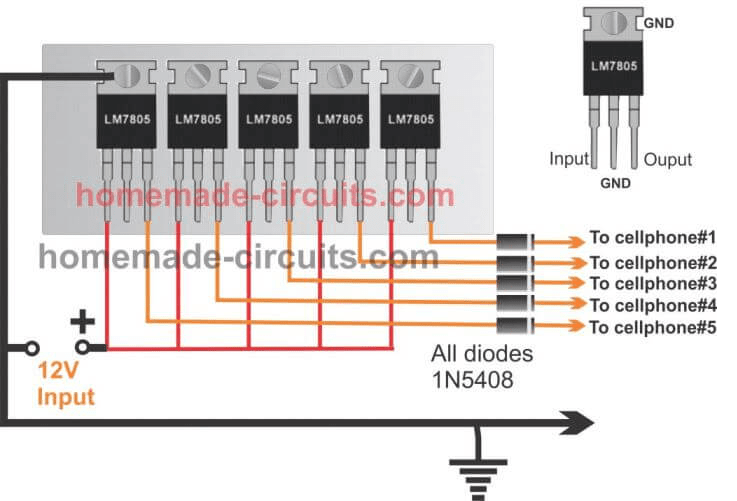
Any desired number of cellphones can be charged by using IC 7805 in parallel as shown the following figure. Since the ICs are all mounted on the same heatsink the heat among them is uniformly shared ensuring a uniform charging across all the connected multiple cellphone devices.
Here 5 ICs are used for charging by medium sized cellphones, more number of ICs could added to accommodate more number of cellphones in the charging array.
6) Using PWM For Charging Cellphone Battery
This circuit can be easily made at home by any school kid and used for displaying in his science fair exhibition. The circuit is a simple cell phone charger that may be operated in conjunction with any DC source, from a car or a motorcycle battery or from any ordinary 12 V AC DC adapter.
Nowadays we find most of the vehicles have their in built cell phone battery charger units which surely becomes very handy for travelers who mostly remain outdoors travelling in their vehicle.
The proposed cell phone charger circuit is as good as the conventional chargers which come fitted inside the cars and bikes.
Moreover the circuit can be simply integrated to ones own vehicle if the feature is not originally available in the vehicle.
Alternatively one may think of manufacturing the present unit and selling them in the market as an automobile cell phone charger and earn some hard bucks.
Circuit Operation
Cell phones as we all know are highly sophisticated gadgets by nature and when it comes to charging cell phones the parameters no doubt also needs to be of very high standards.
The AC/DC cell phone chargers which come with the cell phones are all SMPS based and are extremely good with their outputs and that’s why the cell phone gets so efficiently charged by them.
However if we try to make our own version, it may fail altogether and the cell phones may just not respond to the current and display a “not charging” on the screen.
Cell phone battery cannot just be charged by supplying DC 4 volts, unless the current is optimally dimensioned the charging won’t initiate.
PWM vs Linear
Using voltage regulator IC for making a DC to DC charger, which I have discussed in one of my earlier article is a good approach, but the IC tends to become too hot while charging the cell phone battery and therefore requires adequate heatsinking for remaining cool and operative.
This makes the unit a bit bulkier and moreover some significant amount of power is wasted in the form of heat, so the design cannot be considered very efficient.
The present PWM controlled DC to DC cell phone charger circuit is outstanding in its respect because, the involvement of PWM pulses helps to keep the output very suitable to the cell phone circuitry and also the concept involves no heating of the output device, making the entire circuit truly efficient.
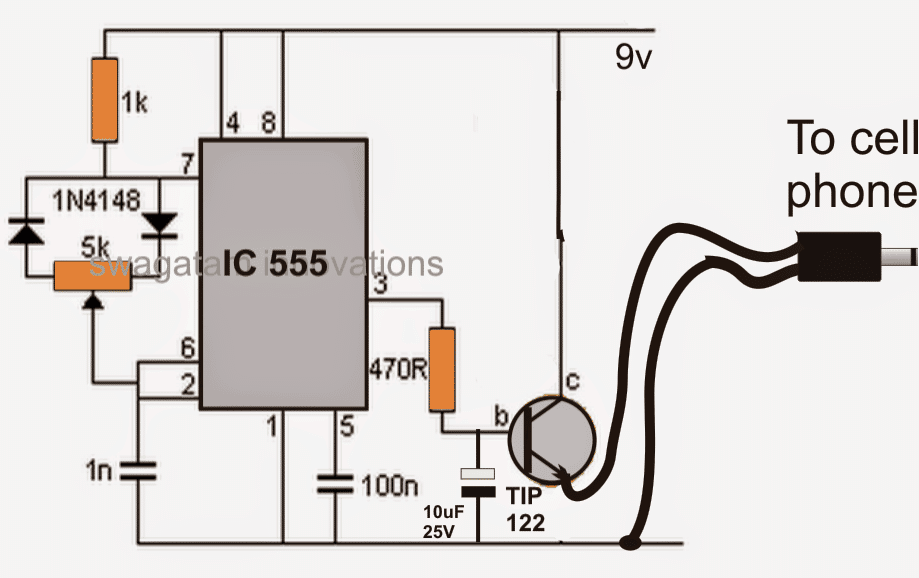
Looking at the circuit we find that again the work horse IC 555 comes to our rescue and performs the important function of generating the required PWM pulses.
The input to the circuit is supplied through some standard DC source, ideally from an automobile battery.
The voltage powers the IC which instantly starts generating the PWM pulses and feeds it to the components connected at its output pin #3.
At the output the power transistor is used for switching the DC voltage at its collector directly to the cell phone.
However only the average DC voltage is finally fed to the cell phone due to the presence of the 10uF capacitor, which effectively filters the pulsating current and provides a stable, standard 4 volts to the cell phone.
After the circuit is built, the given pot will need to be optimized perfectly so that a well dimensioned voltage is produced at the output which may be ideally suited for charging the cell phone.
Circuit Diagram



Comments
Hello sir,
I was trying to construct a charging indicator circuit. I want the circuit to work like this: when a load (output) is connected, I want it to change the indicator from the initial colour (LED) to a different colour and vice versa.
Martins, which charging circuit are you using for interfacing the mentioned indicator? Please provide me the charger circuit then I will tell you how to integrate the LEDs in it…
I am very impressed with your work and will want to learn from you. I am new in it but passionate about electronic design. Thank you.
Sure, you can ask your questions here, and I will try to solve them asap…
I have a problem. I an trying to build a cell phone charging battery bank for my wife. I will do a few things. I have used a few over the counter circuits to connect to get what I want. I can not get a cell phone charging circuit that will run on 4.5v. they all need 5v. its has 3 Ni-MH 1.2v Id I put 1 4th battery to get it to the 5v range the charging circuit stopped working.
Please measure the output voltage from the battery after connecting to the cellphone, it should be 5V or slightly above 5V. If not, then your cellphone will reject the charging and the charging supply will not be accepted.
Dear Sir: I have purchased a 12vdc – 5vdc Buck converter module and intend to use the (former) cigarette lighter.supply for power. That line is fused at 15A which I am keen to reduce to a safe level. The Buck module is rated Max 15W (5V @ 3A) but it is intended to draw only 1A in operation. I noticed none of your designs show fusing, and wondered how to protect the module & subsequent circuitry if something goes south? My thought is to focus on W not A and go for 12v/ 1A or 12W fast blow, if such a fuse exists. Your thought please?
Many thanks for the fine work,
ldervish
Hello Idervish,
In DC circuits fuse is not crucial, because fuses are not accurate and if something goes wrong your circuit component can burn even before the fuse blows. On the other hand most modern ICs today have built-in over current and short circuit protections.
For your application, if you want to safeguard your load from an over current situation you can simply select a fast blow fuse rated at the peak current which you consider unsafe for your circuit.
Hello sir
I want to construct a mobile phone charger that can charge my phone, its battery capacity is 5000mah.
Hello Martin, you can try the last circuit from the following article. Make sure to adjust the output zener diode value to suit the charging of your mobile phone optimally:
https://www.homemade-circuits.com/how-to-make-simple-12-v-1-amp-switch/
Hello sir,
How can I know the accurate rating of amps and watt of a mobile phone charger that I construct?
Martins, the wattage of the following mobile charger circuit will be 5 * 1 = 5 watts, if the zener diode is adjusted to 5V or 6V:
https://www.homemade-circuits.com/wp-content/uploads/2012/03/12V-1-amp-smps.png
Hello sir please which circuit should I try here that will output 5v 2A from a 3s lithium battery
Audu, you can try the tip122 circuit. Make sure to use a large heatsink on the transistor and use a calculated zener diode to get the precise amount of voltage on the emitter of
Of tip122, for your battery
Looking for transformerless version . 120vac to 5v charger.
Please the above circuit of PWM requires more elaboration on how cell phone voltage of 4v is obtained from 9v supply without a reliable regulator.
4V is the average DC of the PWM, the peak will be 9V
I really appreciate you for the update
Good day sir
Please how possible to manufacture a 12volt to 5 volt phone charger that has an outlet of 40 charging port?
Hi Victor,
You will need a buck converter design for this.
You can try implementing the designs explained in the following article with some modifications.
https://www.homemade-circuits.com/5v-pwm-solar-battery-charger-circuit/
Hello sir,
can you recommend a circuit component or part number for a breadboard that represents the output connector (to plug a phone cord into) for your simple design #1 with 7805 regulator and 1A, 5V output?
I apologize if you have already answered this question, but with almost 270 comments already present when I read your designs I was hoping to avoid reading them looking for the answer.
thanks!
Hello Dave, the output connector shown in the first diagram is not critical. It is actually an old and obsolete NOKIA phone connector….you can replace it with today’s any modern phone connector such as the Micro USB Type B 5
thank you sir. On your diagram for the first circuit you have 1 microfarad in the pic but 10 microfarad in your parts list, and a 1-watt resistor in the pic but 2 watts in parts list. I am going to purchase parts according to your list, not the pic, unless I hear otherwise. BTW, can you describe why you need the specific capacitance chosen for this system? What is the formula you used to figure that 1 (or 10) microfarads is needed?
thanks very much
Hello Dave, the capacitors are not critical at all. you can use any capacitor above 1uF/25V
Hi Sir,
Hello
please give the circuit or information for ac 230v or dc 12 or 24v input but i want variable output from 2v to 20v …
for example : if i connect laptop or mobile or any other should device should charge or run in the same output terminal…
please give the information on this…
Hi Avinash, you can build separate circuit modules using the following configuration:
https://www.homemade-circuits.com/wp-content/uploads/2012/08/simplestDCcellphonechargercircuit.png
The zener diode will decide the maximum output.
After this, you can connect the supply DC to the inputs of all these modules and use their respective outputs for the desired applications.
Thank you Sir.
along with variable voltage current will also important.
what i want to say is….
for Ex: if i connect cell phone it should give the required voltage and current ,if i connect laptop it should provide required voltage and current…..Etc/
like C-type.
what C-type will do…depending upon load it will provide the output….in that logic i want.
please help me in that.
You are welcome Avinash,
You can try the 3rd or 4rth diagrams from the following article, and use it for your specific applications:
https://www.homemade-circuits.com/how-to-design-a-stabilized-bench-power-supply-circuit/
Please sir, which charger circuit can I use with 9V Hi-watt battery to output 5V, 2A for charging phone?
Godfrey, 9V hi watt battery is a dry cell, it cannot be charged, moreover 2 amp or 1 amp is not possible to get from this battery.
Hello Swagatam.Am a newbie in basic electronics. I was given a 5v 2A 4 channel s power supply as my year 3 project. Haven read through many of your circuit post, Am thinking of using a 555 pwm circuit rather than a buck converter module. Am gonna be using a 8 li-ion cells (4 pairs) each being 3.7v(2200mah). Each pair would be connected in series to give 7.4 volt(2200mah). Each of the pairs would then have their own pwm circuit which would help step down the 7.4volt to 5v…For the charging circuit, am thinking of hacking an already made SMPS circuit like one from a mobile phone charger which would supply me at least a constant 8.5v( 8800mah or 9000mah) output…what do you think about this sir??..do you think my idea is feasible or may be too crude?
Hello Ola, the PWM will make the average DC supply lower, but the peak pulses in the PWM will be always equal to 8.5V which can be harmful for the battery. Moreover you will need an auto cut off system for ensuring the battery does not over charge. Instead of PWM using a couple of 1N5402 diodes to drop the supply to 7.4V looks a better option.
Thanks for your urgent response sir, but I don’t really get you sir. I never knew your reply would be so soon. I tried setting up a pwm circuit like the one in this post yesterday. I made it one whose voltage output could be varied using a 50k pot. I was able to tune out a 5v output from a TIP41c while supplying the circuit an input voltage of about 8.5volt from a lithium battery. My phone indicated charging when the voltmeter read a little above 5v. Now the problem is that, although my phone indicated charging but even after leaving for long minutes the battery percent wasn’t increasing and only charged about 1% for over 30 mins. The second problem I noticed was that whenever I tune the pot to around 5.0 v and connect my phone for charging the Voltage from the transistor goes up above 5v (like 6v). I expected that since a load was being connected, there should be a drop in voltage…or do u think I should just get a buck converter module, if I won’tind the cost
And again, how do make a charging circuit for the batteries..pls help me sir
Thank you Ola, if you are using the circuit to charge a mobile then a PWM with 8.5V DC will not have any problems, since the phone internally has a sophisticated over voltage and over current cut off circuitry.
I think your phone is charging slowly due to low current. Instead of PWM you should try using a 7805 or an LM338 circuit set at 5 V and 5 amp current and then check the response….I am sure that will allow the phone to charge relatively faster.
Yes a buck converter would be best option in this situation.
Dear Mr. Swagatam receive a cordial greeting from me, along with my thanks for your generous and selfless dedication.
I am not an expert, I have just begun to study in a self-taught way a little about this fascinating world of electronics, nothing to do with the extensive knowledge that you handle in the various topics, so I would like to ask you two things. Of course, if you consider it appropriate.
The first one is to know if it would be possible for you to send me the PCB board design of one or another circuit that I would like to assemble, and as I have already mentioned, I am a curious beginner, and all possible help will always be necessary to complete a successful learning.
The second concern I have, has to do with the application of these principles to solve a persistent problem in my home, and it has to do with incandescent, energy saving or led bulbs. The problem is, that in my country the electrical supply that arrives by the network, more specifically in my area of residence, the voltage (Voltage) can fluctuate between 115V and 138V, where the normal is that it stays close to 129V to 134V, when it should be 125V máx. This causes that the appliances must be permanently protected, which I do, but not so with the luminaires, that are exposed to these high loads, which drastically reduces the useful life. I have thought of putting a 12V transformer connected to the mains to force the drop to a constant lower level, I also thought of a voltage divider made with resistors, but I am not sure if the latter will work.
I am thinking of something simple and straightforward that can be connected right at the mains outlet and before connecting the bulb socket, the transformer works but it is too bulky for the space available.
According to your extensive knowledge, what would you do to solve a problem like this in the most economical way possible, and of course simple?
Thank you for the time you have dedicated to me, again I express my admiration and respect for your generosity.
Best regards
Adrian.
P.S.
About 40 years ago, I remember there was a device a little smaller than a 1 euro coin and a little taller, which was placed at the bottom of the bulb socket, and then the incandescent bulb, was placed. This device notably increased the useful life of the bulb, giving it 7 or 8 times more duration, I imagine that it was a kind of resistance generator that by reducing the tension and the intensity that circulated towards the bulb, brought as a result the increase of the useful life.
I can remember that it was a circle (like a coin) made of resin with a metallic center that was aligned with the central contact of the base of the bulb.
Translated with http://www.DeepL.com/Translator (free version)
Thank you Mr. Adrian, for writing to me, and trusting my knowledge. However, I am sorry, providing PCB designs may be difficult for me since it takes a lot of time to design a pCB and I may not be able to do it due to the current work load that I have to face.
For your second query, it seems a simple remedy can be a PTC thermister, connected in series with the LED lamp.
More information can be found in the following article:
https://product.tdk.com/en/techlibrary/applicationnote/howto_ptc-limiter.html
Hope this helps!
Hello please, I have a problem with my phone, it has not been able to charge since it went off. I plug it and nothing happens. Someone said it could be the charging ICU that got burnt. Please help me clarify this, thank you.
Hello, that seems to be a battery problem. Try the charger with some other phone, if the phone charges then definitely it is battery problem for your phone…
Sir how can I full charge a 5,000 mAh of mobile phones using 12v Dc motor?
You can do it through a shunt regulator like this one
https://www.homemade-circuits.com/wp-content/uploads/2020/11/alternator-shunt.png
Sir how can identify the image so that I can understand it. and sir what materials do I use including a dc motor 12 v?
Sir can u draw the circuit for charge the Li. Poly battery 5v5100mah
Amar, use a 78L05 IC and use it for charging your cell…
Thanks so much for putting us through this. I am working on a charging hub where up to 30 phones can be charged at a time using a 12V battery of 100Ah. I don’t want to convert the DC to AC, I want to use it directly to charge the phones using voltage regulators to lower the voltage to 5V. Kindly help with the best circuit to use, Thanks a lot.
If you use a 5V regulator 30% to 50% of the battery power will be lost in heat. Instead you can try using mobile phone in sets of two in series, and check the result.
Hello Martins,
Which circuit are you referring to? Please provide the circuit diagram, I will try to solve it for you..
Hello sir,
Thanks for your help.
I’m here with a problem which I know you will help me. I constructed 3.7v lithium battery charger and I want to add indicator(LED) that will show when the battery (load) is connected and when not connected and as well when fully charged . Can you please help me on this.
Thank you Zohaib, you can discuss your queries through comments here, I will try to help!
welldone you are great sir you can done this job I have learned a lot from this can i get your number please give me whatsapp number
Hello Khalid,
The mobile phone internal circuitry has a strict regulator which follows strict criteria for the charging, therefore even a slightest variation will cut off the charging operation.
So make sure the current limiting resistor is correctly calculated, you may increasing the value and see if that helps
Also Replace the R2 pot with a fix calculated resistor such that the output is a fixed 5 V.
And put the LM338 over a large heatsink, otherwise the IC will shut down automatically inhibiting the charging process.