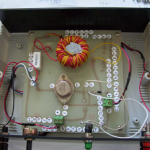
The concept discusses yet another popular joule thief circuit, this time using power BJT 2n3055, improvised by my old friend steven in his own unique way. Let’s get to the core of the developments with the following article: In a few earlier article we covered some interesting theories summarized as given below: Here is the […]
SMPS and Converters
Can we Power a Joule Thief Circuit with a Small DC Motor
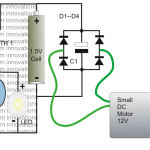
Normally, we use a Joule Thief circuit to illuminate an LED higher than 3V, from a 1.5V AAA Cell, which looks outstanding and very useful. However suppose you don’t have a 1.5V Cell, instead you have an access to a small 3V DC PM motor, then could you use this motor as a DC source […]
Joule Thief Circuit using a Single Winding Inductor
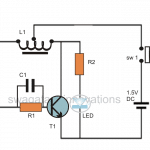
Normally we find Joule Thief Circuits using a toroidal ferrite core with two separate winding, meaning it has a separate primary and secondary winding just like transformers. However, in the article we will discuss about a design which eliminate the requirement of having two separate winding, rather makes use of a single continuous winding with […]
Illuminating four 1 watt LEDS with 1.5V Cell using Joule Thief Circuit
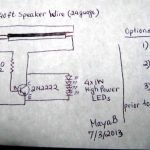
Can you imagine illuminating four numbers of 1 watt LEDs through a a few 1.5V cells? Looks quite impossible. But it can be done simply using a coil of ordinary speaker wire, a transistor, a resistor and of-course a 1.5V pencil cell. The idea was suggested to me by one the keen followers of this […]
Joule Thief Circuit which can Illuminate any 3.3V LED or Higher
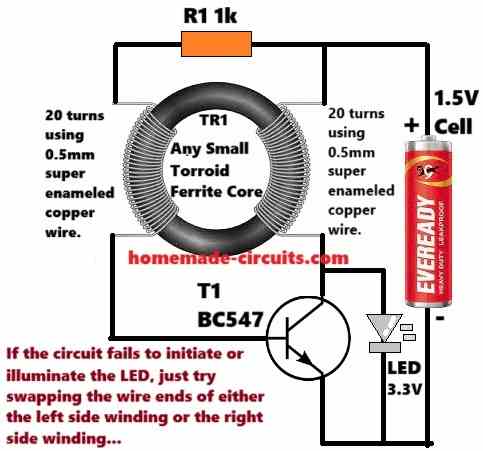
The concept discussed here remains exactly identical to the usual joule thief configuration, we just replace the normally used 5mm LED with a 1 watt LED. Of course this would mean the battery getting drained pretty much earlier than a 5mm LED, but it’s still economical than using a two 1.5 cells and not including a […]
How to Connect Multiple Ferrite Transformers in Series in an Inverter
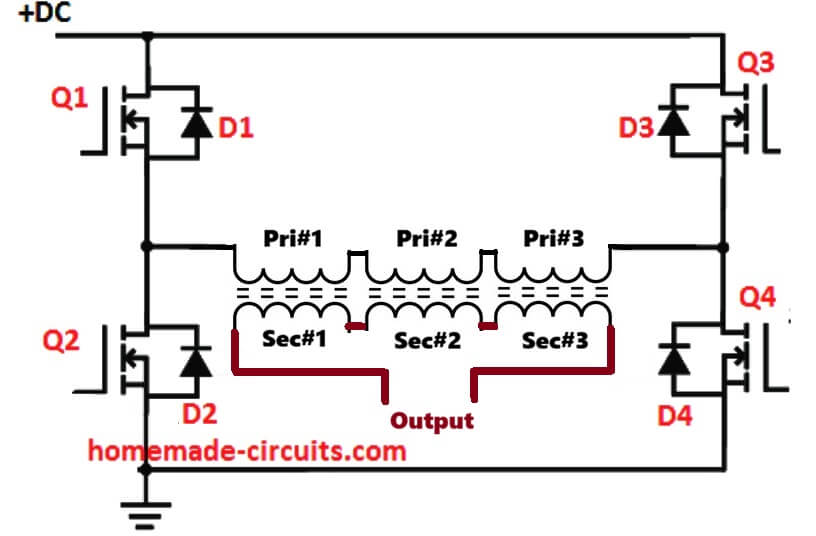
In an H-bridge inverter, we normally use a transformer to convert the input power into the required output voltage. But sometimes instead of using one big ferrite transformer, we may want to use two, three, four, or even more small ferrite transformers. In this type of arrangement, all the primary windings are connected in series […]