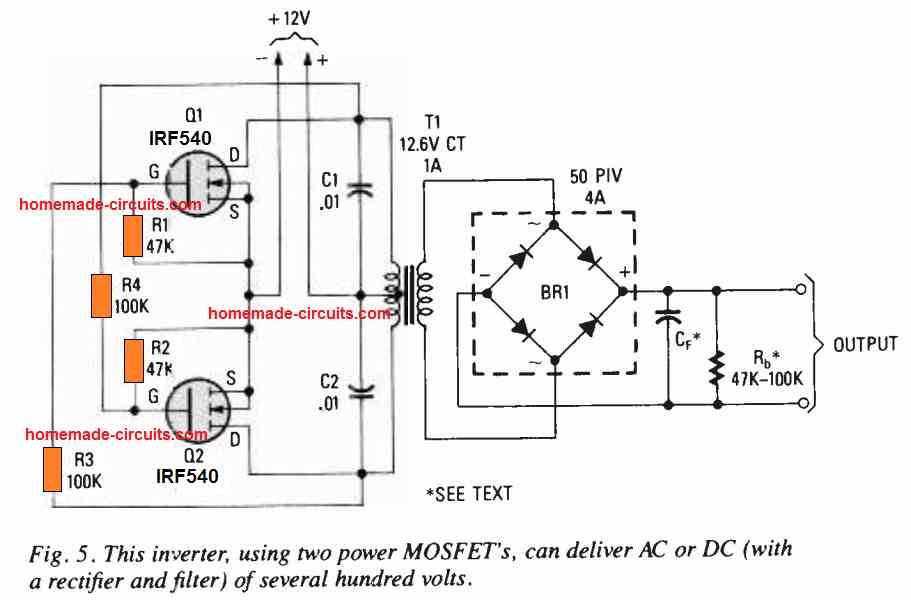
The next design is a cross coupled simple MOSFET inverter circuit will be able to supply 220V/120V AC mains voltage or DC volts (with a rectifier and filter). The circuit is an easy to build inverter that will boost 12 or 14 volts to any level depending on the transformer secondary rating. In this circuit, […]
Newly Updated Circuit Projects:
Simple Inverter Circuit using IC 4047
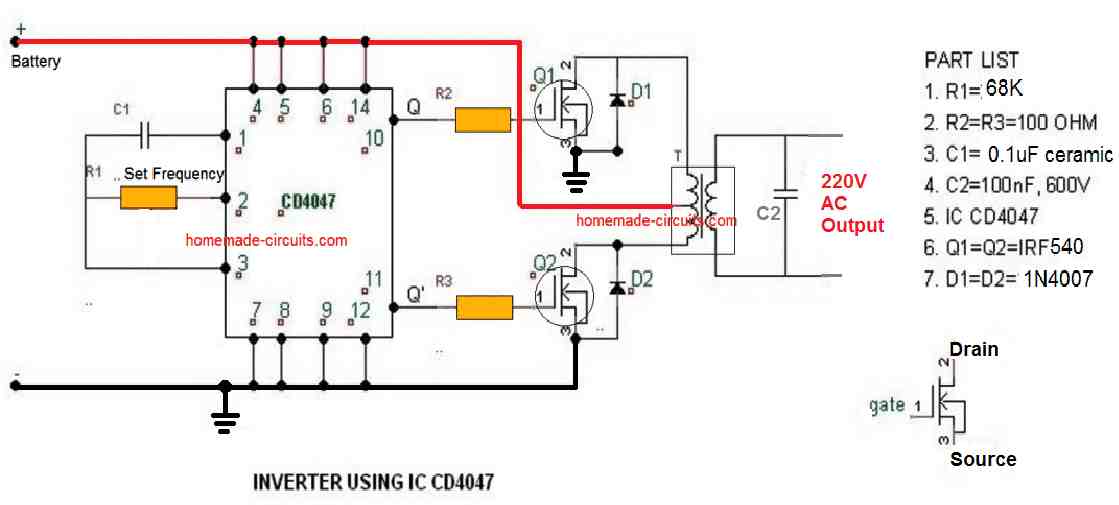
This is a very easy and popular circuit to make a small power inverter. An inverter takes low voltage DC, like from a 12 volt car battery, and changes it into 220 volt AC household electricity. This specific circuit uses a special integrated circuit chip called the CD4047 to do the main job. As shown […]
Simplest 100 Watt Inverter using BJT Astable as the Oscillator
The circuit of a simple 100 watt inverter discussed in this article can be considered as the most efficient, reliable, easy to build and powerful inverter design. It will convert any 12V to 220V effectively using minimum components. However the output AC will be a square wave. Introduction The idea was published many years back […]
Simple Inverter Circuits using CMOS ICs 4049, 4011, 4093, 4060
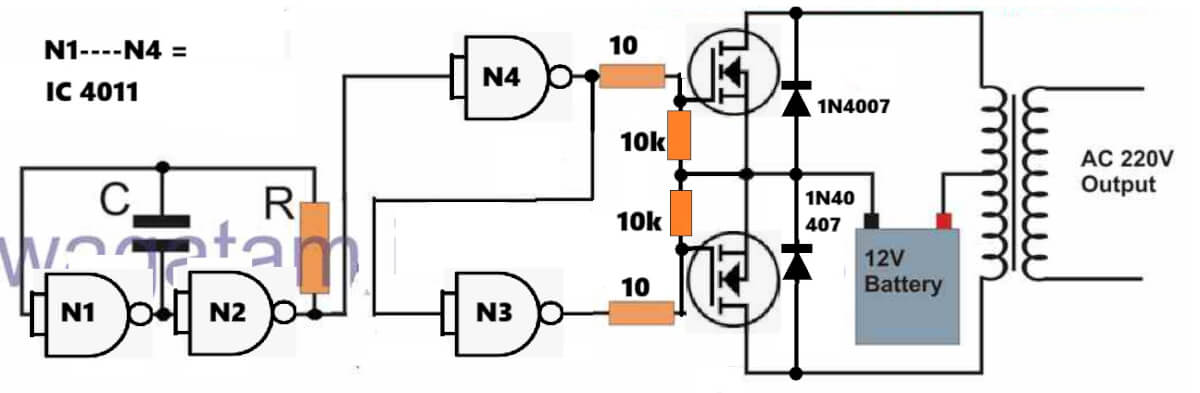
The IC 4049 is a hex inverter chip, meaning it contains six independent NOT gates inside a single 16-pin package. In this inverter design, every single gate is put to work so none of them are left floating or wasted, which prevents erratic behavior or unwanted current draw. How it Works Gates N1 and N2 […]
Joule Thief Circuit using 2N3055 Power Transistor
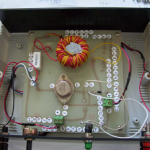
The concept discusses yet another popular joule thief circuit, this time using power BJT 2n3055, improvised by my old friend steven in his own unique way. Let’s get to the core of the developments with the following article: In a few earlier article we covered some interesting theories summarized as given below: Here is the […]
Can we Power a Joule Thief Circuit with a Small DC Motor
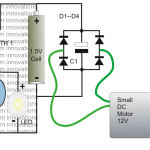
Normally, we use a Joule Thief circuit to illuminate an LED higher than 3V, from a 1.5V AAA Cell, which looks outstanding and very useful. However suppose you don’t have a 1.5V Cell, instead you have an access to a small 3V DC PM motor, then could you use this motor as a DC source […]