The concept discusses yet another popular joule thief circuit, this time using power BJT 2n3055, improvised by my old friend steven in his own unique way. Let's get to the core of the developments with the following article:
In a few earlier article we covered some interesting theories summarized as given below:
- Stevens radiant joule thief battery charger circuit tests and results sunday may 9th 2010.
- The radiant joule thief circuit I built From a circuit schematic featured on a youtube video and here are the results So far
- With a aa size energizer battery, with a Measure voltage of only 1.029 volts left in it I got an output from the radiant Joule thief battery charger of 12.16 volts @14.7 milli amps.
- Test 2 using a small a23 energizer battery With a measured voltage of 9.72 volts in it I got 10.96 volts out from the circuit @0.325 milli amps.
- Test 3 I used a fully charged nimh rechargeable 9 volts battery with a measured charge of 9.19 volts dc in it and I Got 51.4 volts @137.3 milli amps output from the radiant joule thief battery Charger circuit.
- Test 4 I used a 3575a button cell battery With a measured charge of 1.36 volts in it and I got 12.59 volts out @8.30 milli amps.
- Test 5 I used an l1154 button cell battery With 1.31 volts measured in it and I got an output of 12.90 volts @7.50 milli amps.
- With an slr battery with a voltage of 12 Volts left in it I got 54.9 volts output @0.15 amps.
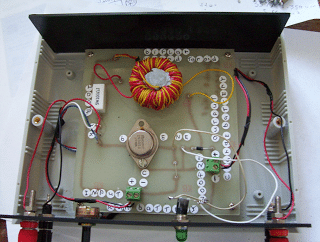
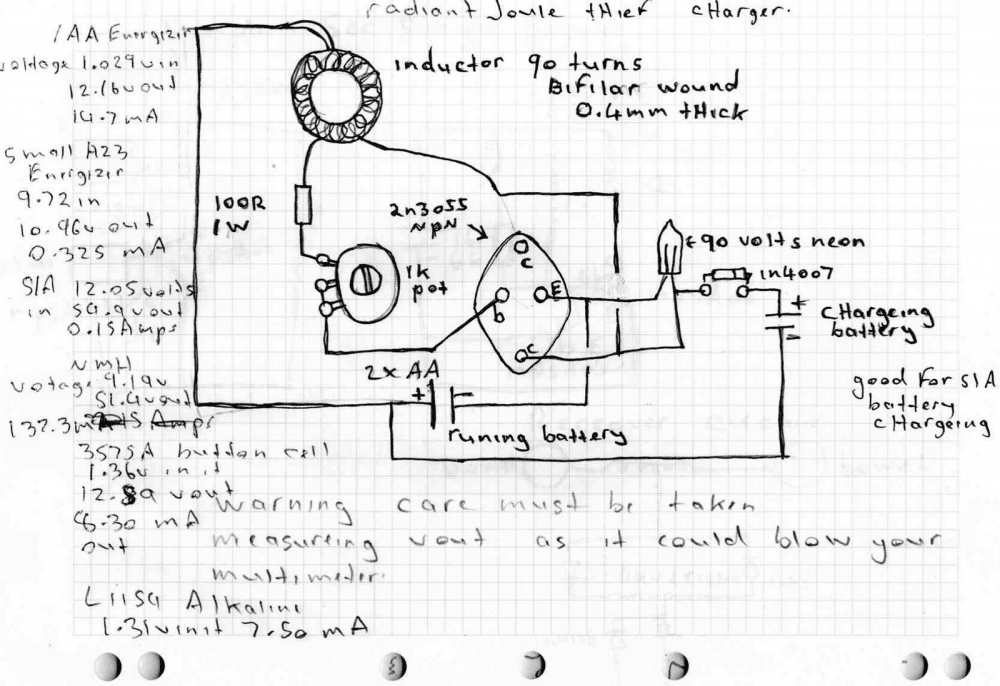
Here is the simplified drawing I built the Radiant joule thief battery charger by. The inductor I wound so many turns till It was to full to wind anymore.
But I brought 2x 5 or 6 meter lengths of Stranded copper wire unknown gauge from dicksmiths electronics insulated wire, and I wound most of it on except I think a few feet left over.
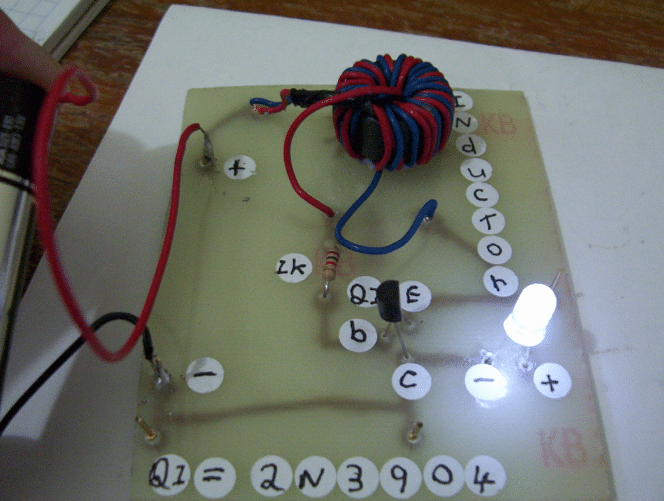
The latest test I used my pencil energizer Battery but I didn't remeasure the volts in it.
I powered the radiant energy Joule thief with it and at the outputs I put a 2200uf electrolytic capacitor Rated at 50 volts.
I ran my multimeter leads from it and got up to before I Stopped 35.8 volts , and that’s the charge being fed into the capacitor to ,
Before that I was getting 27.8 volts but as the capacitor was charging past the half way mark the voltage climb was slowing down, maybe due to the voltage from the battery getting low.
I'll have to remeasure it and do the test again in more detail.
Shorting the capacitor gave a snap noise And sparks. I tried it again charging it so far but This time I dumped the capacitor charge back into the input and this illuminated the neon for a second before the cap charge went down
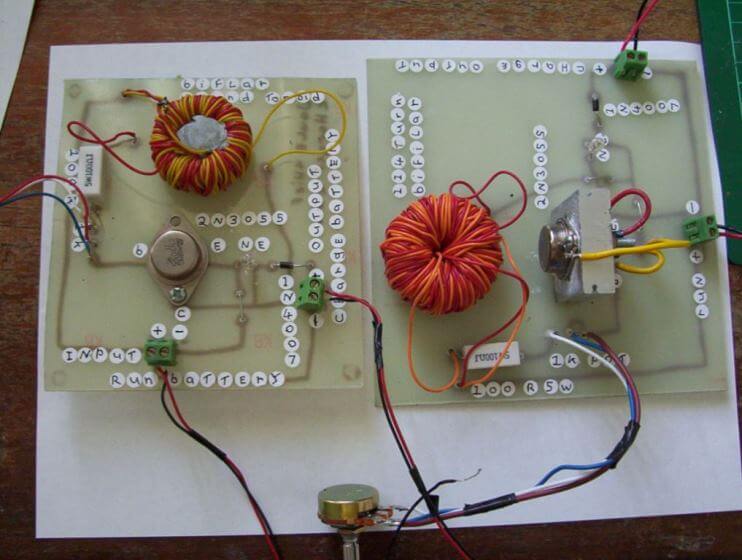
Next experiment was different I had the Outputs to my meter set to 200 millivolts range and the negative input I had my A23 energizer negative sitting on the negative input and the top positive well
My finger was on it only as for the positive input it was run to a rectangle peace of circuit Board on the end of a wire held in the air By an aligater clip.
The reading was climbing at a Faster rate I got o 47.2 millivolts before I stopped it I was getting power at
A good rate from no where with an open circuit here but I was also holding the Battery case to while doing the experiment. I just repeated these tests and got much improved results now.....
My tests will go on, and I'll keep you all updated with the latest, until then keep DIYing.
Well, these were 3 best circuits using the joule thief concept that I presented for you, if you have any more such examples please feel free to post the info through your valuable comments.


Need Help? Please Leave a Comment! We value your input—Kindly keep it relevant to the above topic!