Build a wireless ultrasonic water level controller using Arduino Nano and nRF24L01 to automatically switch your water pump ON and OFF without any rusting tank sensors. It also includes clear LED and buzzer indications to show the exact water level inside the tank. READ MORE:
Ultrasonic Circuits and Projects
Unlike light or infrared sensors that easily get confused by bright sunlight, dark colours or glass, ultrasonic circuits use high frequency sound waves above 20 kHz to sense things around them without touching anything. In this tag collection, you will find practical ultrasonic circuit projects like automatic water pump motor controllers, ultrasonic burglar alarms, motion detectors, contactless hand sanitizers, high frequency sound receivers that pick up noises only animals like dogs or bats hear and even air turbulence fire alarms.
Whether circuit uses a standard 40 kHz transducer pair, an HC SR04 module, or basic oscillator, amplifier and logic stages, every post here explains the working in simple words and shows how to wire and test the circuits yourself.
Select project that matches what you want to build. From tank level control and intruder alarms to touchless switches and get it running on your own breadboard or circuit setup.
Ultrasonic Burglar Alarm Circuit
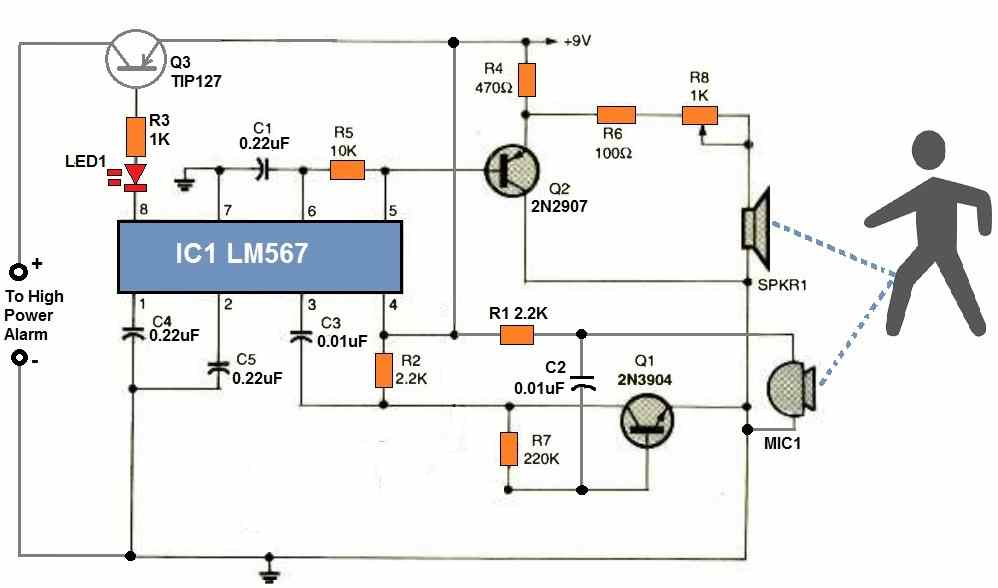
Looking to build a simple motion detector without using any microcontroller or programming? This circuit uses a single LM567 tone decoder IC to transmit high frequency ultrasonic waves through a piezo speaker and catch the bounce back with an electret mic. Whenever someone walks in front of it, reflected signal triggers a loud alarm and you can easily adjust detection range using single preset pot. READ MORE:
Ultrasonic Motion Detector Circuit
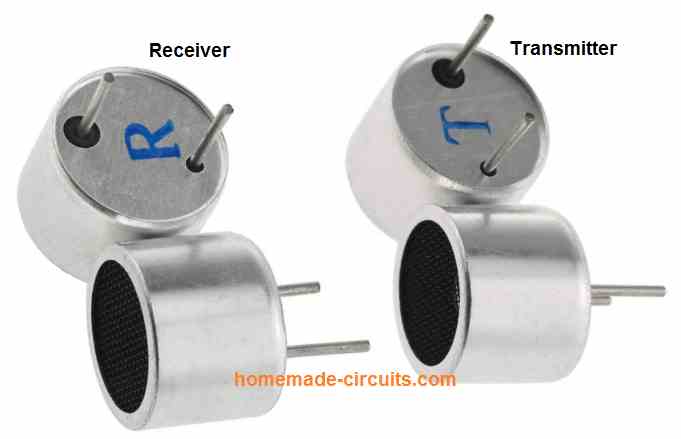
This ultrasonic motion detector circuit picks up movement from around 4 to 7 meters away using matched 40 kHz transmitter and receiver transducers, a 4049 CMOS oscillator, and an LM324 op-amp stages. Whenever something moves in front of it, a red LED lights up at the output, and you can also connect extra stages to drive an alarm, lamp, or relay for security use. READ MORE:
Ultrasonic Detector Circuit [Extend your Ear’s Sensitivity]
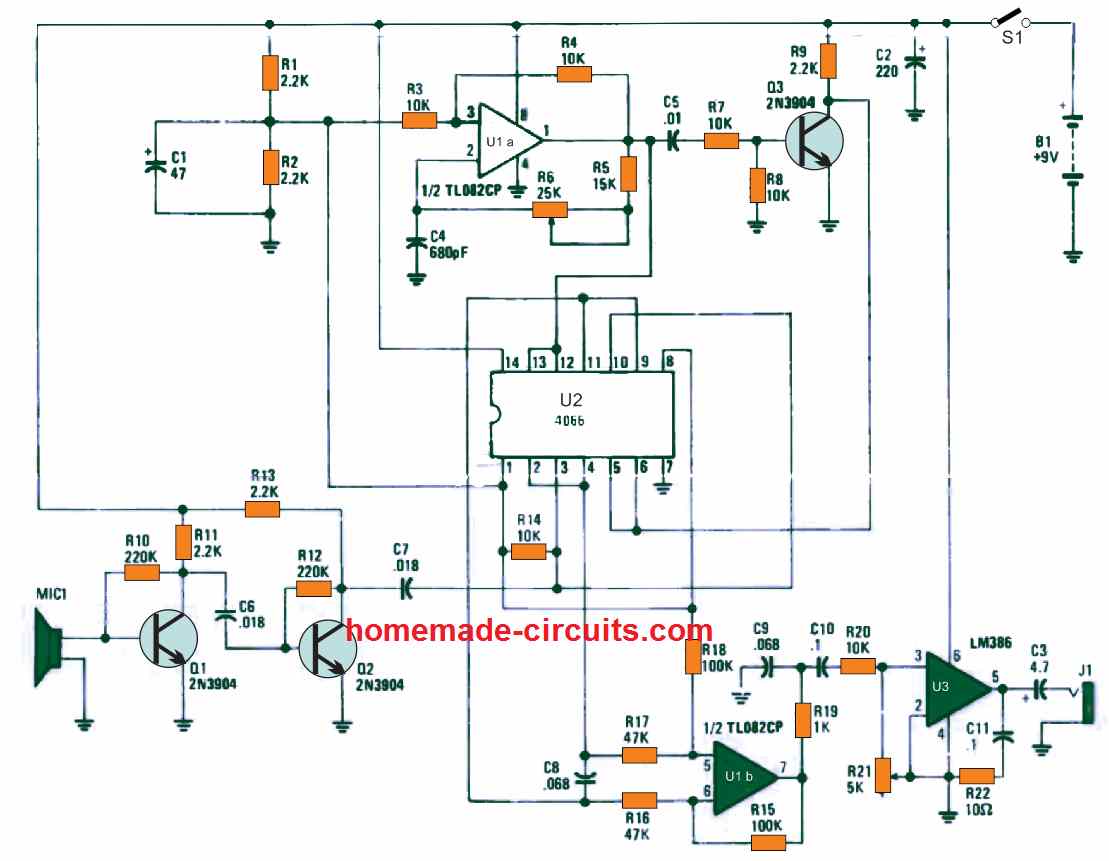
This ultrasonic motion detector circuit senses movement of anything, even people, from around 4 to 7 meters away. Whenever something moves, a red LED lights up at the output to show there is an object or someone coming near. You can also connect extra circuit stages to it if you want more features. READ MORE:
Ultrasonic Hand Sanitizer Circuit
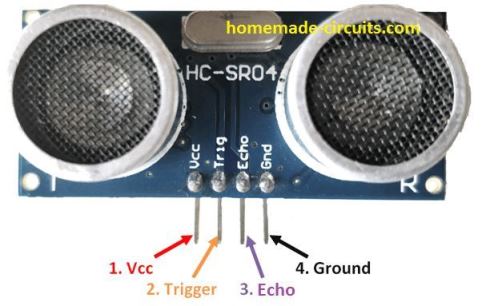
This ultrasonic hand sanitizer dispenser circuit senses when your hand comes near the HC-SR04 sensor and switches ON the pump or solenoid for a short time to spray sanitizer automatically. It uses an Arduino with a relay driver stage and a capacitor setup so the pump turns OFF on its own after a few seconds instead of staying ON unnecessarily. READ MORE:
Ultrasonic Fire Alarm Circuit using Air Turbulence Detection
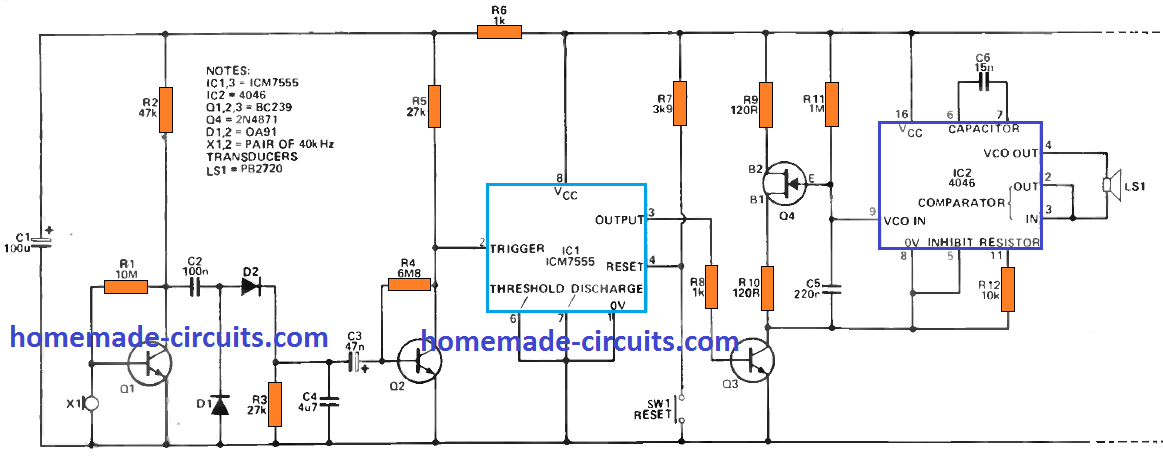
Normal heat and smoke sensors sometimes take time or get complicated, so this circuit catches fire risk by sensing air turbulence using ultrasonic waves instead. A 7555 timer sends out a 40 kHz ultrasonic signal, and when heat from a fire or electrical fault disturbs the air, the Doppler shift changes the received wave and triggers a latching alarm through a 4046 VCO and piezo sounder. READ MORE:
How to Choose the Right Ultrasonic Project
Different ultrasonic applications work on different principles. So, before selecting an article, first decide what you want to understand or achieve.
| What you want to learn | What to look for |
|---|---|
| Measuring the distance of an object | Ultrasonic distance measurement |
| Measuring water or fuel level | Ultrasonic level sensing |
| Detecting a nearby object | Ultrasonic object detection |
| Sending and receiving ultrasonic signals | Ultrasonic transmitter and receiver |
| Detecting high-frequency sound | Ultrasonic detector circuits |
| Operating a device without physical contact | Ultrasonic switching and control |
| Understanding ultrasonic sound generation | Ultrasonic oscillators and transducers |
| Learning about focused sound transmission | Ultrasonic directional sound systems |
Use this small guide to find the type of information you need. After this, we can look at the basic working principles and technical details of ultrasonic technology.
Understanding Ultrasonic Technology
Ultrasonic sound means sound waves having frequencies above 20 kHz, which are normally beyond the hearing range of human ears. These sound waves are used in many electronic systems for detecting objects, measuring distances, checking liquid levels and doing several other useful jobs.
We can generate ultrasonic waves using special transducers. These transducers convert electrical signals into mechanical vibrations, which then produce high-frequency sound waves.
How Ultrasonic Waves Work
An ultrasonic transmitter converts an electrical signal into mechanical vibrations. These vibrations produce sound waves at a particular ultrasonic frequency.
When these waves hit an object or surface, some part of the sound energy gets reflected back. An ultrasonic receiver can detect these reflected waves and convert them into an electrical signal.
Now, if we measure the time taken by the transmitted sound wave to return, then we can calculate the distance of the object.
The speed of sound in air is approximately 343 metres per second at 20°C. So, the distance can be calculated using this formula:
Distance = (Speed of Sound × Time) / 2
We divide the result by 2 because the sound wave travels towards the object and then comes back to the receiver.
Technical Advantages of Ultrasonic Technology
One good thing about ultrasonic technology is that we can detect an object without touching it physically. This makes it useful in many automatic electronic systems.
Some important advantages are explained below.
Non-contact detection: We can detect an object without making any physical contact with it. This is useful when the object is moving, hot or difficult to reach.
Works in darkness: Ultrasonic sensors do not depend on visible light. So, they can detect objects even in complete darkness.
Distance measurement: We can calculate the distance of an object by measuring the time taken by the ultrasonic echo to return.
Liquid-level measurement: Ultrasonic sensors can measure the level of water or other liquids without placing the sensor directly inside the liquid.
Simple electronic interfacing: We can use ultrasonic transducers with oscillator circuits, amplifiers, comparators and microcontrollers, depending on the application.
No direct contact with the target: Since the sensor can remain outside the object or container, it can be useful in certain situations where direct contact is not desirable.
Ultrasonic Transducers and Their Working
An ultrasonic transducer is a device that converts electrical energy into ultrasonic mechanical vibrations, or converts incoming ultrasonic vibrations back into electrical signals.
Most commonly used ultrasonic transducers work on the piezoelectric principle.
A piezoelectric material changes its dimensions when an electrical voltage is applied across it. This produces mechanical vibrations, which can generate ultrasonic sound waves.
The reverse process also takes place. When ultrasonic vibrations strike the piezoelectric material, it produces a small electrical signal. We can then amplify and process this signal using a suitable electronic circuit.
Ultrasonic transducers are available in different frequency ratings, such as 25 kHz, 40 kHz and higher frequencies. We select the correct frequency according to the required application.
Some transducers are designed mainly for transmitting ultrasonic waves, while others are designed for receiving them. Certain types can perform both functions.
Important Factors Affecting Ultrasonic Performance
Although ultrasonic technology is useful in many applications, its performance depends on some important conditions.
Temperature: The speed of sound in air changes with temperature. So, if we use an ultrasonic circuit for accurate distance measurement, then temperature changes can introduce measurement errors.
Air movement: Wind and moving air can affect the propagation and reception of ultrasonic waves, particularly over longer distances.
Surface shape and material: A flat surface facing the transducer may reflect ultrasonic waves properly. But if the surface is inclined, soft or irregular, then the reflected sound may become weak or may not reach the receiver properly.
Frequency selection: Higher ultrasonic frequencies generally have shorter wavelengths and can provide better spatial resolution. But they also tend to suffer greater absorption in air.
Transducer alignment: The transmitter and receiver must be positioned properly. Otherwise, the receiver may not detect the reflected ultrasonic waves correctly.
Background interference: Other ultrasonic sources working nearby may interfere with the receiver and produce false signals.
Limitations of Ultrasonic Technology
Ultrasonic technology also has some limitations, so we cannot use it for every type of sensing application.
For example, if the target surface absorbs sound or reflects it in another direction, then the receiver may not get a strong echo.
The measurement range and accuracy can also change with temperature, humidity, air movement and the nature of the target surface.
Another important point is that ultrasonic waves cannot travel through a vacuum because they need a material medium such as air, liquid or solid material for propagation.
Therefore, while designing an ultrasonic circuit, we must select the correct transducer, operating frequency and receiver arrangement according to the actual application.
Applications of Ultrasonic Technology
Ultrasonic technology is used in many areas of electronics, medical equipment and industrial automation.
Some common applications include industrial distance measurement, object detection, liquid-level monitoring, ultrasonic cleaning, medical imaging, material testing and specialised communication systems.
The operating frequency, transducer type and electronic circuit arrangement can be different for each application.
So, ultrasonic technology gives us a useful way to generate and detect high-frequency sound waves, especially when we need non-contact sensing, measurement or detection.