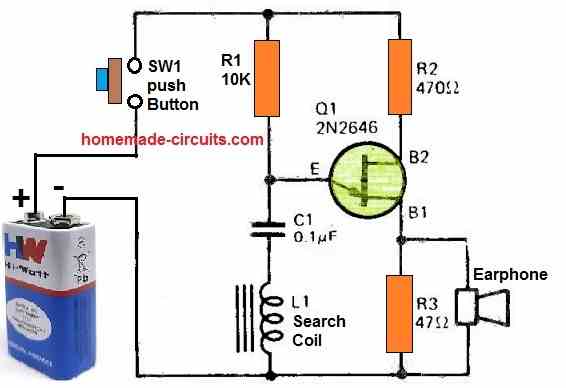
This is a simple DIY metal detector circuit built using a single unijunction transistor (UJT) configured as a relaxation oscillator.
It senses any metallic object brought close to its search coil. Search coil forms the inductor in timing network. When metal approaches coil then it alters the magnetic field and inductance, causing a noticeable shift in the oscillator frequency. This frequency change is heard as a varying tone through a standard high impedance earpiece.
How to Make the Search Coil (1. 5 Henry)
Core: Laminated E core assembly salvaged from a small step down power transformer (such as 0 6V, 500mA transformer core with the center tongue assembled). Wire Size: 36 SWG to 38 SWG (Standard Wire Gauge) super enameled copper wire.
Turns: Approximately 350 to 450 turn (wound uniformly over center pillar of the E core bobbin until the target inductance of ~1. 5 H and DC resistance around 85 ohms is achieved).
Construction Note: Ensure all lamination is tightly interleaved and clamped to prevent mechanical hum or loose inductance drift.
Parts List
| Component | Specification / Description | Quantity |
| UJT | 2N2646 or equivalent standard unijunction transistor | 1 |
| Search Coil | 1.5 Henry inductance, 85 ohms resistance (wound on an E-core from a small step-down transformer) | 1 |
| Timing Capacitor | Stable mica or variable capacitor | 1 |
| Resistors | Standard 1/2 watt timing and biasing resistors | Set |
| Transducer | High-impedance audio earpiece | 1 |
| Power Supply | 6V or 9V DC battery | 1 |
Troubleshooting Tips
No sound in earpiece: Check battery voltage and verify proper UJT pin connections for Emitter, Base 1 and Base 2.
Tone doesn't change near metal: Make sure the search coil is wound correctly to 1.5 Henry and the E core lamination is tightly fixed.
Unstable erratic tone: Loose hand movement or unshielded wires cause stray capacitance keep lead short and mount circuit in small enclosure.
Frequently Asked Questions
Can this circuit detect all kinds of metal?
Yes it responds to both ferrous and non ferrous metals when they disrupt the magnetic field around search coil then.
Why use a UJT for this detector?
It provide a straightforward low component discrete relaxation oscillator without requiring complex IC or microcontrollers.
Can I use readymade commercial inductor?
No circuit relies specifically on the custom E core search coil geometry and inductance to give proper proximity sensitivity.

Need Help? Please Leave a Comment! We value your input—Kindly keep it relevant to the above topic!