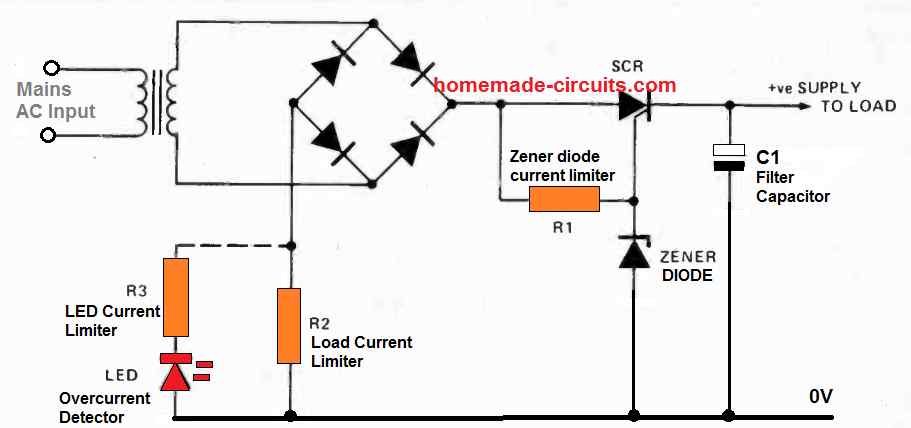
In this article I have explained how to build a highly efficient voltage regulator circuit using an SCR and some other external components. This SCR voltage regulator circuit being a switching kind of regulator is more efficient than the normal 3 pin voltage regulators, or the transistor zener based series pass regulators circuits. How the […]
Voltage
6 Useful Voltage Controlled Oscillator Circuit Explored
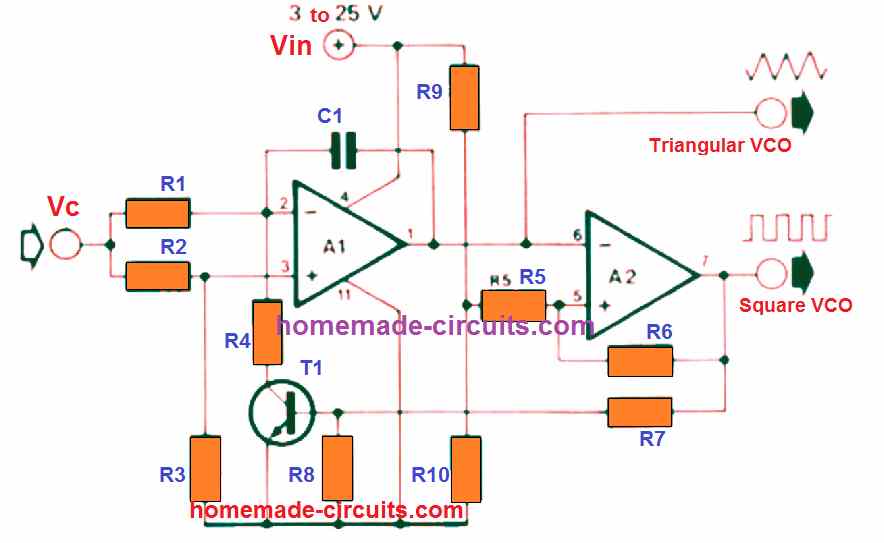
In this post I have explained how to build 6 useful voltage controlled oscillator circuits, using various op amps and integrated circuits. As the name suggests, a voltage controlled oscillator or a VCO circuit is an oscillator circuit whose output frequency can be controlled or varied through an adjustable control voltage input. This means, if […]
3 Terminal Fixed Voltage Regulators – Working and Application Circuits
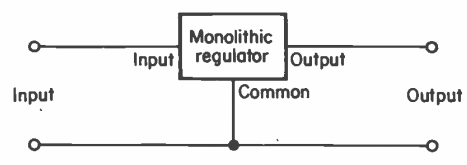
The popular 3 terminal fixed regulators available today are in the form of IC 7805, IC 7809, IC 7812, IC 7815, and IC 7824, which correspond to fixed voltage outputs of 5 V, 9 V, 12 V, 15V, and 24 V. These are called fixed voltage regulators since these ICs are able to produce excellent […]
IC 723 Voltage Regulator – Working, Application Circuit
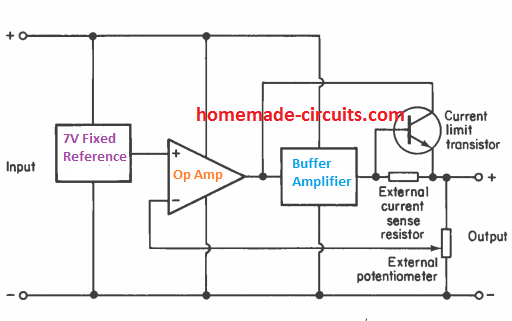
In this post I have explained the main electrical features, pinout specifications, datasheet, and application circuit of the IC 723. The IC 723 is a general purpose, extremely versatile voltage regulator IC, which can be used for making various types of regulated power supplies such as: Main Features ABSOLUTE MAXIMUM RATINGS Pinout Functions Pin 1 […]
Voltage Regulator Circuits and Projects
In this article I will comprehensively discuss how to make customized transistorized voltage regulator circuits in fixed modes and also variable modes. All linear power supply circuits which are designed to produce a stabilized, constant voltage and current output fundamentally incorporate transistor and zener diode stages for getting the required regulated outputs. These circuit projects […]
Voltage-Divider Bias in BJT Circuits – More Stability without beta Factor
Biasing the terminals of a bipolar transistor using a calculated resistive divider network for ensuring an optimal performance and switching response is called voltage divider biasing. In the previous bias designs that I have explained the bias current ICQ and voltage VCEQ were a function of the current gain (β) of the BJT. But, as we […]