In this post I have explained the making of 3 simple yet effective smart laser alarm protection circuit using the IC 555, for securing a specified restricted zone from human interventions. The idea was requested by Mr. Collins.
Circuit Objectives and Requirements
- I just want to tell you what an amazing passion and dedication to electronics you have and thank you for helping others like me. My name is Collin from south Africa.
- We have a huge problem of safety here.
- There are countless number of robberies and house break inns its so unreal. I was hoping you can help me with regards to a circuit for a very cost effective and reliable product.
- I have built a laser tripwire alarm using a 555 IC timer but the circuit design lacks a lot of features.
- I need something that as soon as an intruder enters my property I will be alerted before they even get a chance to try and get into my home.
- The circuit needs the following: Once alarm is activated it needs to sound for a few minutes and then go off
- and arm again automatically. Don't want it ringing for hours in end if I am not at home to reset it.
- It should not be triggered by pets or flying debris in the yard.
- Easy alignment of the sensors. The laser alarm works OK but its very difficult to set the pointer on the LDR that keeps moving off. Any tips if we are going than route?
- It doesn't have to be a laser system I am open to whatever you think will solve my problem.
- Thanks a lot for everything and feel free to add whatever you think I missed out with regards to all the features.
1) The Design
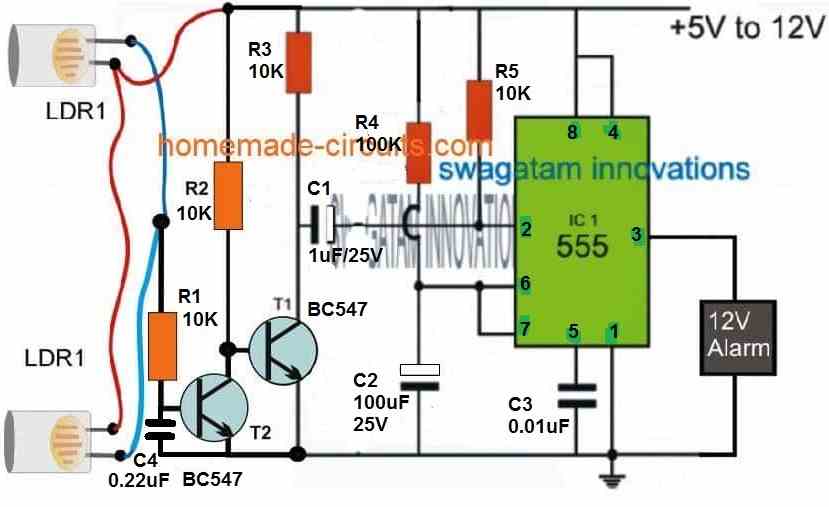
Parts List
- R1, R2, R3, R5 = 10 K
- R4 = 100 K
- C1 = 1 uF / 25 V
- C2 = 100 uF / 25 V
- C3 = 0.01 uF
- C4 = 0.22 uF
- IC = ANY 555 VARIANT
- T1, T2 = BC547
- ALARM = 12V, 200mA PIEZO ALARM.
- LDR = any standard
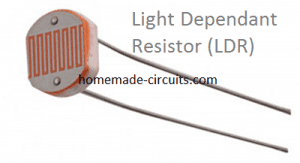
IC 555Pinouts
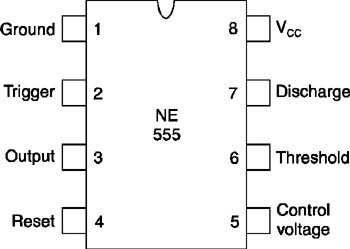
Circuit Operation
The proposed smart yet simple laser alarm circuit using IC 555 can be witnessed in the following image, the functioning can be understood with the following points:
1) The IC 555 is configured in its basic monostable mode.
2) Pin#2, which is the trigger input of the IC can be seen connected with the emitter of a PNP BJT via a blocking capacitor C2.
3) We can also notice a couple of parallel LDRs secured within opaque pipes and their leads hooked up with the base of the PNP BJT, such that as long as the LDRs remain illuminated together through the laser light focus, the BJT remains deactivated.
This happens because in the presence of laser light the LDR's combined resistance drops to around 30K, which keeps the base of the PNP more positive than the ground bias from R2.
4) The inclusion of two LDR ensures a fool proof alarm set-up such that only a human presence is able to interrupt the LDRs, while these remain unaffected by other smaller irrelevant intruders such as animals, birds etc.
The two LDRs could be placed at a distance of around 2 feet so that only taller objects such as a human being gets detected.
5) Therefore whenever an interruption in the laser beam is detected, the LDRs go through a sudden rise in their resistances causing T2 to switch ON, which in turn triggers pin#2 of the IC via C1.
6) This prompts the IC 555 to activate its pin#3, which finally activates the connected alarm unit.
7) Since the IC 555 is configured in its monostable mode, the pin#3 remains activated only for a period determined by the RC network at pin#6 and pin#7 of the IC, or by R3,C2.
These timing components can be appropriately calculated using the IC 555 calculator software for accomplishing the desired length of time for which the alarm may remain switched ON.
How to Set Up the Laser Transmitter Units
The laser transmitter devices could be installed near the LDRs itself and focused back to the LDRs using mirror reflectors as shown below:
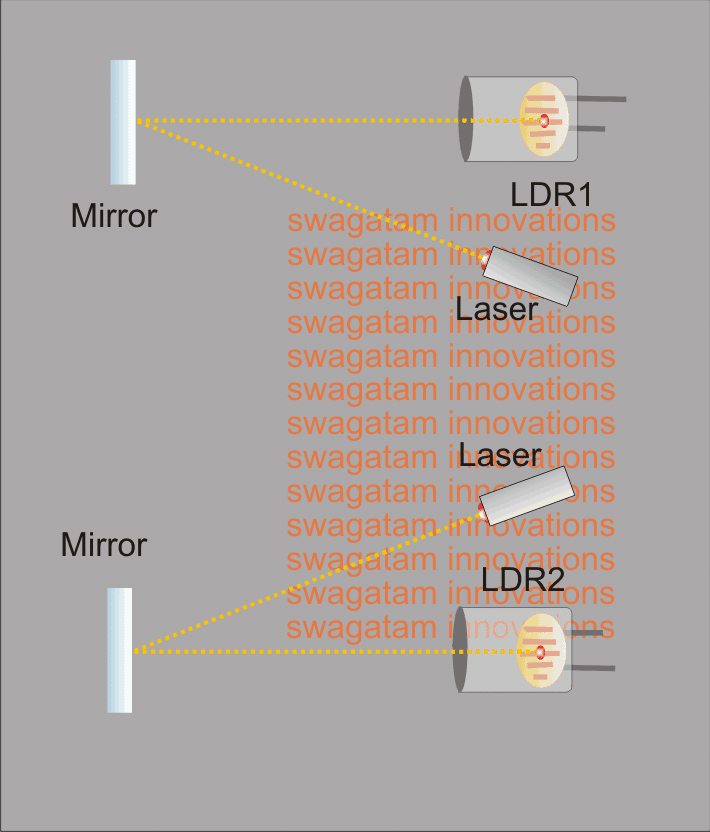
The installing of the laser devices near the LDRs allows the entire unit to be installed inside a single enclosure and also allows the lasers to be powered from the circuit itself.
This also facilitates securing the lasers and the LDR units firmly and accurately so that both the counterparts are unable to move or deviate from their positions even in an event of a mechanical shock or other vibrational interferences.
The mirrors could be positioned at some specified distance, exactly opposite to the laser installation , making sure that the laser beams intersect the restricted zone and the presence of a possible intrusion is detected without fail.
This concludes the making of the proposed IC 555 based smart laser alarm protection circuit, if you have any doubts please feel free to put them forth in the below given comments box.
Video Test Results
Using BJTs for Reducing Current Consumption
The above design can be further enhanced to work with lower standby current, and also with a battery backup during of power failures, through the following upgraded schematic:
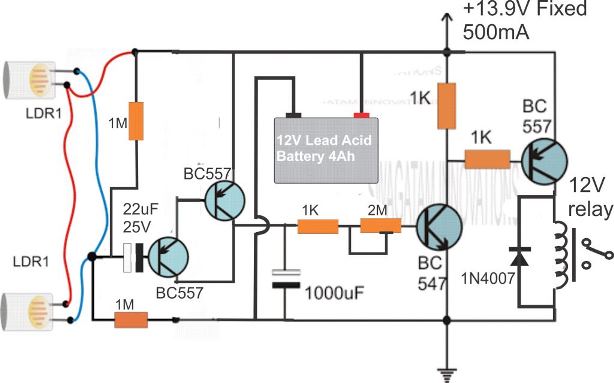
Laser Security using Single LDR
If you intend to simplify the implementation for a single LDR operation, in that case the following concept can be tried:
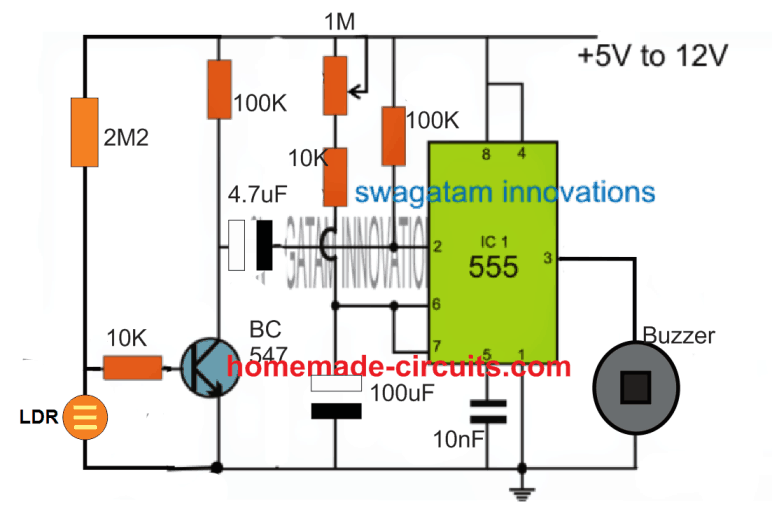
555 Laser Alarm Circuit with Continuous Alarm
The previous alarm circuit was simplified by Mr. Ali and the whole design along with the video was contributed to this website.
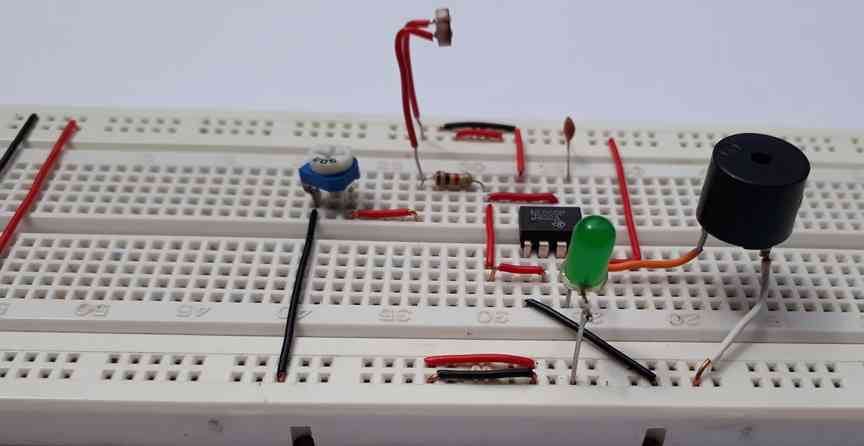
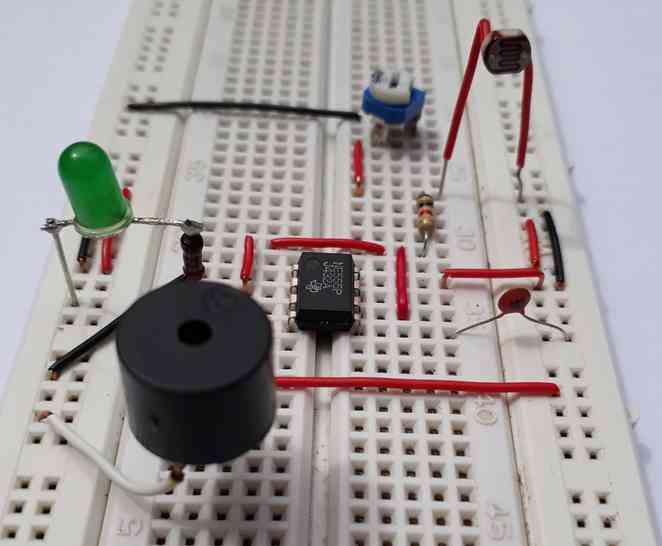
We were fortunate enough to receive a video demonstration and some captivating pictures of this project from Mr. Ali.
Witnessing the system in action was truly remarkable, and we couldn't wait to share it with our readers.
We would like to express our heartfelt appreciation to Mr. Ali for not only creating this incredible IC 555 based laser alarm system but also for allowing us to showcase it on our website.
His dedication, knowledge, and passion for electronics are evident in this project, and we are grateful for the opportunity to share it with our audience.
2) Laser Alarm Circuit for Protecting Field Crops against Animals
The second idea explains another simple laser alarm circuit which can be installed in farms and fields for detecting all possible intrusions, either by a human or an animal and alarming this to the owner, and ensuring an effective protection to the crops against such intrusions. The idea was required by Mr. Mohammed and Mr. Daniel.
Circuit Request#1
Congratulations for all amazing work please give me any circuit for agricultural fields, need to protect the crops from uninvited guests like animals i want to achieve an Active infrared barrier [laser] circuit with distance range of 100 meter or above.
Circuit Request#2
sir please my grandfather is an orange farmer and he is having a problem with thief's so he ask me to do something that to protect the farm or anything that can alert him when any thief's or any person try to take away any thing from the farm so i decided to install a CCTV camera,so i need a circuit without a camera or if you can help me out sir i have said this but you can create something that can help me out thank you hope to hear from you soon
Circuit Operation
The Design
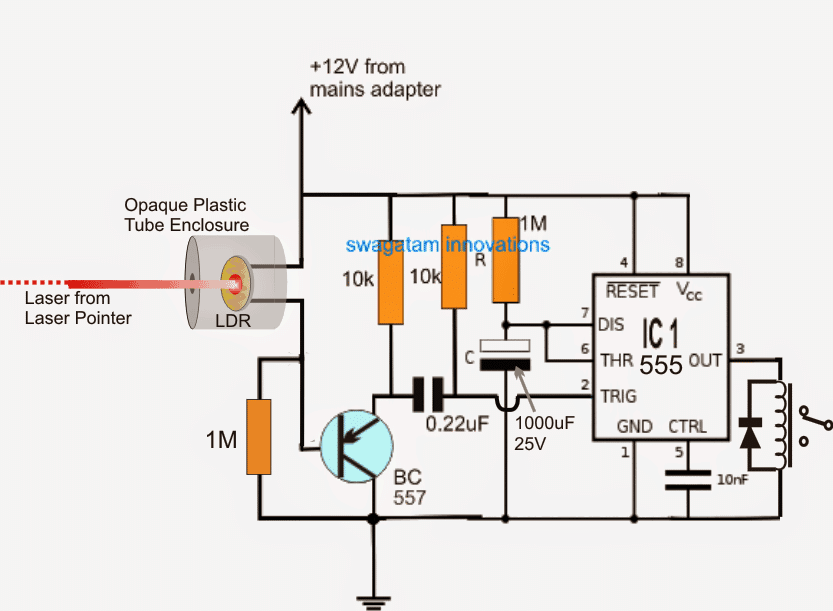
The proposed laser alarm circuit for protecting crops from animals and intruders can be seen in the figure above.
The idea appears extremely straightforward, and employs an IC 555 based monostable multivibrator stage and an LDR detector.
As shown in the design, the laser beam is generated through a laser pointer circuit held at some parallel point across the field fence which requires to be protected.
Since a laser beam has the property of focusing over a given point undistorted and on a straight line, regardless of the distance, the focus in this application is adjusted over an LDR across a specified distance, as indicated in the diagram.
The LDR is enclosed inside a light proof box with a tiny hole which allows only the laser beam to enter while obstructing most of the ambient light around.
As long as the laser beam is held focused over the the LDR, the resistance of the LDR is enabled at a minimum level which could be around 10K to 50K approximately depending on the particular LDR specs.
The low resistance from the LDR ensures a high potential at the base of the associated BC557 transistor rendering it inactive. This in turn keeps the pin#2 of the IC555 monostable at a high potential and the output of the IC at logic zero, so that the relay is held switched OFF.
Now in an even when an intruder (a human or animal) makes an attempt to cross the protected line of fence, cuts or obstructs the laser beam, which instantly causes the LDR resistance to increase and trigger the BC557 device via the 1M resistor.
The BC557 responds to this and conducts grounding pin#2 of the IC and activating the monostable action.
The above procedure forces the pin#3 of the IC to go high and switch ON the relay, the relay contacts possibly being connected with an alarm, sounds the alarm, alerting the field owner regarding the intrusion.
The alarm continues to sound for some moment of time depending on the values of R and C, whose values are directly proportional to the length of the alarm switch ON period.
The above discussed laser alarm circuit can be installed across all the corners of field for ensuring maximum and all round protection for the valuable crops and for ensuring a peaceful sleep to the field owner.
3) Laser Beam Security Alarm Circuit
We have often seen laser alarm system as an integral part of security solution especially for a location which deserves hi-level security.
The Circuit Concept
Right from a museum preserving priceless historical possession; to a safety bank vault; and even in thriller flicks where the protagonist is seen on and often tied in the ray of red light beams, while trying to reach a safe vault; one is well acquainted with the usage of laser light beams.
In fact it is also considered as a security device even in household today to ward off burglary or theft.A laser beam is not a simple beam, but has the efficacy to respond when faced a distraction.
This means that if the light ray gets interrupted with any objects, the photodiode receives resistance which in turn activates an alarm.
The laser alarm system is an economical option when it comes to consumption of power, as the receiver needs power supply less than 10 mA on average.
Setting up a laser alarm system is relatively easier as the laser and the receiver can be setup in one box, on a single power input.
Below is a circuit design diagram which illustrates the flow of a laser alarm system.
How it Works
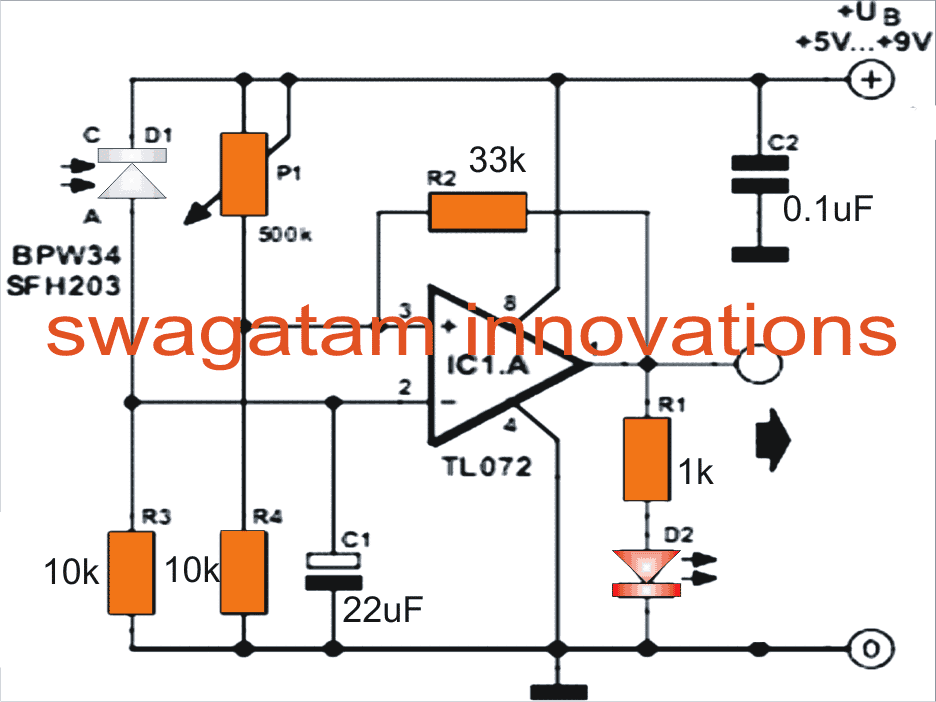
Referring to circuit diagram it is seen that a TL072 op-amp (IC1.A) is configured as a voltage comparator, placed in between the adjustable voltage driver P1/R4 and the light-dependent voltage which consists of photodiode D1 and R3 – a fixed resistor.
As the laser beam receives an interruption from a foreign agent, the beam is cut-off causing the voltage on comparator pin 2 to drop below pin 3.
This instantly enables the output of the op amp to swing to positive voltage supply and enable an alarm situation.
As the laser alarm can detect interruption from any element, so the alarm needs to be set in a more sophisticated fashion, so that it is able to bypass accidental interrupts from elements, like an insect.
This is accomplished as the Resistor R2 provides a level of hysteresis, thereby prevent oscillation when two comparator input voltage rests in almost equal state. Much faster response can be achieved by reducing the value of C1 to 1 µF.
How to Set up the Alarm
A laser beam system is easier to setup, either as a single or a separate entity.
If a single box is maintained to setup the alarm, then it is to be made sure that the photodiode can’t have direct contact with the laser beam.
Assembling the components and the circuit in a breadboard, it should be mounted in a black box having a hole.
A black drinking straw should pass through the hole to enable light flow from the direction of the laser beam to enter. Setting up the system properly makes the laser beam act even with direct sunlight, as it cannot affect the operation of the photodiode.
Article Written and Submitted by Mr. Dhrubajyoti Biswas
The following Circuit was Requested by one of the dedicated member:
l require a circuit to manipulate high-bright LEDs applied as replacement for candles on a wreath at the top of a high altar of a church.
Connecting wires or cables to this is simply not practicable, therefore I would like to have a method to switch it on and off, along with extended battery-life.
Additionally, could I make use of a pulse circuit to prevent the lights from slowly depleting the battery ?
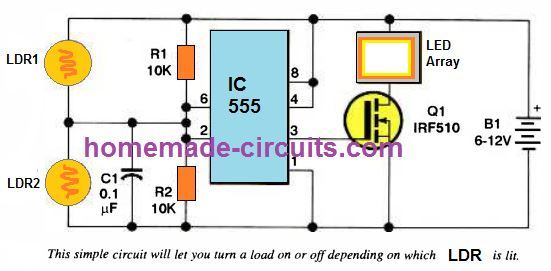
Consider the circuit shown below, driven by a 6 volt rechargeable battery. The load may include LEDs along with resistors or amoureux lamps; you may possibly have a 22 excellent candlestick light effect by operating 12V volt lamps on 6 volts.
How the Circuit Works
Switch the lights on / off by focusing the laser lamp on one or the other LDRs or photocells. In the "off" condition, lower than 1 mA current is pulled from the battery.
The circuit makes use of the hysteresis (latching) characteristic of the LM555 IC, however, it is advised to employ a CMOS model of the chip (LMC555, TLC555, or 7555) to save maximum power.
Depending on the focused photocell, if the input is under 1/3 of the battery supply, the output activates.
Similarly, when the input is over 2/3 of the supply voltage, the output switches off.
During periods the input is in the middle of these states, the output of the IC continues to be in whichever state it had been previously in.
Therefore, if both photocells or the LDRs are held with the identical amount of laser pointer light no matter what the situation might be the load or the LEDs stays unchanged, on or off.
Using High Sensitivity Op amp
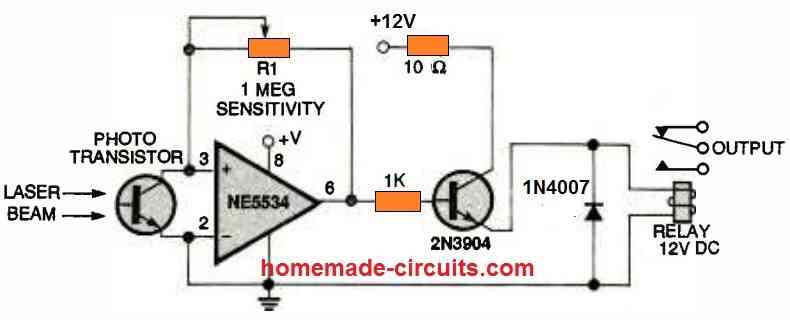
Sometimes an application necessitates the use of a sensor with a greater level of sensitivity. This may be accomplished by connecting an operational amplifier to the phototransistor detector in series.
An NE5534 low-noise op-amp is utilized to enhance the gain in the design below. Lasers may be used in a number of security applications thanks to the high-sensitivity relay circuit.
Unmonitored chambers could also be "watched" for suspicious smokes, which could indicate a fire.
Point the laser, either wholly or partly, at the high-gain relay, and set the sensitivity setting, R1, to just enable the triggering of the relay contacts.
Adjust back the preset just slightly enough to allow the relay to reopen. If smoke enters the path between the beam and the detector, it causes the relay to energize and activate the alarm.



Questions & Answers
Dear Swagatam,
thank you for your contribution to electronics and assisting hobbyist in their project work.
I have some problem with the second circuit posted by Ali. I have constructed the circuit, but it does not work without external touch on pin2 of 555 ic. the alarm only sounds when I tap on pin2. I have checked all components properly and they all OK. please give me your directives on what to do.
Hi Alfred,
Can you please provide the exact link of the circuit diagram you are referring to, I will try to solve it for you.
“Hello and thank you, Sir Swagatam, for creating and administering such an interesting site. I tried your design No 1 more than two months ago and it isstill running well. Thank you for publishing the circuit diagram. I fixed a commercial 4.5-volt laser device and the LDR facing each other on a piece of wood with a length of 1500 cm, and set them carefully. I used a 100μF capacitor for C2 and 100 kilo ohms resistor for R4. With these values, the alarm remains connected for 10 seconds as soon as an intruder cuts the laser beam. However, I have had issues with the deviation of the beam and decreasing its severity.
Is it possible to use IR-based circuits that are practical for a distance of 1500 cm, like your project?” How could you kindly help me?
All the best to you
Max
Thank you so much Max,
Glad you could complete the project successfully.
According to me a laser based circuit will have a longer range than an IR based circuit.
You can adjust the sensitivity of the laser based circuit by suitably adjusting the R1 value and by replacing C4 with a smaller value resistor.
If you still want to try a IR version, I can design it for you. Please let me know
Hello, Sir Swagatam
My answer to your generous proposal is a resounding ‘yes!’ I certainly hope that thecircuit designed by a talented and kind individual like yourself, will prove to be immensely beneficial to your readers. Thank you for considering my input.”
All the best to you
Max
Thank you Max, for your kind words,
I have posted the circuit at the end of the following article. You can check it out. If you have any doubts you can post them under the same article:
https://www.homemade-circuits.com/intruder-alarm-circuit-using-photodiodes/
Hello Sir Swagatam
Thank you so much for dedicating your time and effort to design this project for me. Your website’s informative content and warm hospitality towards visitors is truly exceptional and praiseworthy. I will collect and prepare the necessary electronic components and proceed with the assembly as soon as possible. I am excited to share the results with you. I deeply appreciate your invaluable assistance and I swear to God, I love you kind man. Thank you again for all that you’ve done
All the best to you
Max
You are most welcome Max, I wish you all the best with the project.
Dear Sir Swagatam
Hello. I am going to do your 2nd project. would you please do a favor and answer my questions:
1.How long does it take for the relay to release after it is connected?
2.How much should I reduce the value of the capacitor and/or the resistor that have been connected to pin 6-7 of IC555 so that the relay is remaining connected for only 5 seconds and then disconnected.
3. How much is the value of LDR?
Thank you so much in advance and wish you all the best
Truly yours
Ali
Thank you Ali, You can surely try it!
1) Each time the pin#2 is grounded through the transistor the output pin#3 will switch ON for a period of time determined by the resistor/capacitor values, connected at pin#6/7.
2) According to the calculations , the resistor at pin#6/7 can be 47K, and the capacitor can be a 100uF, to produce an output switch ON period of 5 seconds.
3) You can try any standard small LDR, most of the standard small LDR should work.
In the diagram I have used a single PNP transistor, if you have problems with this transistor then you can try with two NPN transistors, as done by me in the video.
Dear Sir Swagatam
Hello. Thank you so very much for your detailed, useful, and soon reply. I will surely share you the results. would you please tell me which video of yours you mean?
Wish you all the best and health of course
Truly yours
Ali
Thank you Dear Ali,
The video is given in the article itself, under “Video test results”. If you check the whole article you will be able to find the video.
Dear Sir Swagatam
Hello. Thank you very much for your response. I had checked and studied all the particle. The problem is that No VPN could run on my PC and it can not be connected to Youtube. I watched your great video through my cellphone. I will send a picture of the related page through your Email address for more information.
Thanks a lot and God bless you
Scincerely
Ali
Thank you Dear Ali,
All the best to you.
God bless you too!
Dear Sir Swagatam
Hello,
I assembled the components of your 2nd laser alarm project and tried the circuit; it is working well (and the relay disconnects after 5 seconds) but not without a physical trigger to Base or Emitter of BC557 or Pin #2 of IC555 as you can kindly observe on the video which I have sent to your Email address. I can assure you that I have tested all the components and they are all OK. There are no loose connections between the components or the breadboard as well. Moreover, I have used a few BC327 and 2N3906 as substitution transistors for BC557, as well as substituting a few IC555 with the new ones during the past two weeks; still it needs the trigger to start working.I would be glad if you could kindly tell me what else I should do in order to make it work without external assistance.
By the way, I have assembled the components of a circuit diagram which I have sent a picture of, to your Email address, on the same breadboard and it works well. I’ll be glad if you decide to upload it on your site. Adding a transistor to it seems to be a good idea, if possible.
Wish you all the best
Truly yours
Ali
Hi Ali,
I am sorry to hear that you are facing troubles to complete this project.
However, the circuit which you tried is not correct:
https://www.homemade-circuits.com/wp-content/uploads/2023/05/Laser-alarm-circuit-diagram.jpg
Please see the video in the above article, and use the same circuit which is shown in the video. No need of using two LDRs, you can use only one LDR
Dear Sir Swagatam
Hello. Hope you are fine and healthy. Thank you a lot for your response.
As you will kindly notice in the video test that I sent to your Email address just now and refers to the circuit diagram that I had sent it to you the day before (https://www.homemade-circuits.com/wp-content/uploads/2023/05/Laser-alarm-circuit-diagram.jpg ), whenever an interruption in the laser beam to the LDR is occurs, we have output in pin #3 of IC555 and alarm remains activated until the next shining of the beam. If I succeed in adding a transistor to this circuit I will share the results; by the will God. I will also try the project which you addressed, soon.
Sincerely yours
Ali
Hi Ali, thanks so much for the new video and the pictures, I can definitely use it in the above article. Many thanks to you.
I, should thank you dear Sir Swagatam for your favor and kindness.
God bless you
He who always remembers you as a very real man
Sincerely
Ali
Thank you so much Ali,
Please keep up the good work.
All the best to you!
Dear Sir Swagatam
Hello. Thank you very much for publishing what I sent to you. I do not consider myself worthy of so much praise and thanks. I would be very grateful if you could please clarify my questions regarding project No.1 as follows:
1. Could you please confirm the correct values of R1, R4, and R2 by comparing the parts list and the circuit diagram?
2. I have noticed that C4 is not shown on the circuit diagram, although it is included in the parts list, and I can also see in the related video test that there are four electrolytic capacitors used.
Thank you very much for your help.
Best regards
Ali
It’s my pleasure Dear Ali, Thank you very much!
None of the parts are actually critical and have a wide range of selection, however, still I have updated the diagram and the parts list with the most optimal values, which should work in all circumstances.
I can’t remember where those two extra electrolytic capacitors were used in the video circuit, however I can assure you that the 1st circuit is absolutely correct and does not require anything more.
The pleasure is mine dear Swagatam. Thank you very much for your prompt corrections. Wish you all the best.
Truly yours
Ali
You are most welcome Ali, all the best to you!
Dear Sir Swagatam
“Hello! I hope you are doing well. I would like to provide you with an update on the circuit assembly report. As per your instructions, I assembled the components on a breadboard using the specified values. However, the circuit did not work at all.
I attempted to troubleshoot the issue by substituting R3 with a 1K resistor instead of the 10K one, but the circuit still did not function. Then, I replaced C4 with a 1K resistor, and this time the circuit worked perfectly.
I have sent a video demonstrating functioning circuit to your email address for your reference. In conclusion, I have determined that replacing both C4 and R3 with 1K resistors is necessary for the circuit to start working.
Thank you for your assistance and kindness.
Sincerely,
Ali
Dear Ali,
Yes, it is because your LDR, even with its high resistance was leaking some minute voltage to the T1 base and was not allowing it to turn off. After placing a 1K across the base emitter of the transistor T1 could switch OFF completely when the laser light was obstructed from the LDR.
Thank you very much for updating the info, I appreciate it very much.
Thank you very much dear Swagatam for your valuable feedback. It was very useful for me.
Wish you all the best
It’s my pleasure Ali, glad you could succeed with this project. Please keep up the good work.
Thank you Dear Ali, I appreciate your kind feedback.
I will wait for your further response.
All the best to you.
Goodmornig Sir.
Why do you use a photodiode in circuit #3 instead of LDR?
Thanks
Hello Rosario,
you can replace the photodiode with an LDR also, no issues, but then R3 will need to be replaced with a 100K resistor, and P1 with a 10K pot
Thank Sir
Sir i want the project related to communucation for the lab
Simple project
Goodmorning Sir. I reworked your receiver project with BPW34 by adding a transistor driven relay following your post. I am attaching the scheme to you to find out if it is correct. The relay has a coil resistance of 70 ohms and a working voltage of 5V. Thank you
scheme:
Hi Rosario,
It looks OK to me, except the relay resistance which seems too low for the BC547. You must either use a 200 ohm relay or replace the transistor to 2N2222
Goodmornig Sir.
I made this device. Works well. Given the IC TL072 has a part B, is it possible to add another sensor that excites the same relay?
Thanks
Hi Rosario, yes that’s possible.
You can replicate another similar circuit using the second op amp from the TL072 IC, but make sure the outputs of the op amps have separate 1N4148 diodes for connecting with the relay transistor stage.
Thanks Sir.
thank you for your suggestion
Please sir l need the following circuit diagrams for my project students please Sir help thank you. Hope to hear from you
1.Design of a thermistor temperature measurement system
2.Design of a low-pass filter test kit for audio frequency application.
3.Development of a single output multiple input system for industrial application.
Etebong, all these circuits could be already present in this website, please use the search box to find to find the one which suits your application.
I have not seen any related circuit diagram please help
for thermistor you can try one of these:
https://www.homemade-circuits.com/page/4/?s=thermistor
https://www.homemade-circuits.com/energy-saver-solder-iron-station-circuit/
https://www.homemade-circuits.com/car-radiator-hot-indicator-circui/
For filter:
https://www.homemade-circuits.com/make-this-low-pass-filter-circuit-for/
https://www.homemade-circuits.com/design-high-pass-filter-circuit-quickly/
Fr the 3rd you will have to provide more details
Hi.
With regards to the laser security system, is there any other type of common laser that can be salvaged from electronic devices that could be used and the easiest?
Thanks
Hi, I don’t think the lasers found in DVD players or similar gadgets can be used for the general applications. However the lasers in gadgets which can be focused to some distant point could be used.
Ok, thanks boet.
hi, how do i download these articles or tut’s to build and test them?
sorry, there’s no option for downloading the articles, hope I will be able to add this feature someday in future.
very, very, very interesting. Thank you for your painstaking achievements.
Glad you liked it, thanks for the feedback…
Goodmorning Sir. In the part list of the first scheme, a capacitor C4 is mentioned. It is not present in the scheme. Can you tell me what it is? Thanks
Hi Rosario, if it is not present in the diagram, then you can safely ignore it…
Goodmorning Sir.
Thank you for your answer.
I’m sorry to disturb you again. I am a little confused.
I would like to summarize:
R1, R4 = 100 K.
R2 = 1M
R3 / C2 = TO BE CALCULATED
C1 = 4.7 uF / 25 V.
C3 = 10nF
ALARM = 12V, 200mA PIEZO ALARM.
LDR = any standard
IC = ANY 555 VARIANT.
The figure shows the capacitor C1 without value.
Is the value shown in the list correct?
Thakns
Hi Rosario, everything is correct in the list, and as per the diagram specs.
Ok. Thanks.
Thanks for the information and the circuits. I would like to know how to build a laser circuit from scratch, I mean from an old dvd tower or other source. Thanks
Sorry I have no idea about it….
Hi Sir.
I refer to the scheme 3).
Can the output consist of a relay or something else?
Thanks
Hi Rosario, you can simply disconnect D2 end from the ground line and connect it to the base of a BC547 relay driver stage.
I thank you because you are available to answer questions and doubts. it is rare. Compliments.
Rosario
No problem, Glad to help!
Hi Sir.
First of all thanks for the reply to my previous post.
I must apologize if my questions are perhaps stupid or obvious, but I’m a newbie.
I want to ask you this.
1) In Circuit Request # 2 there is a relay and a diode in parallel between them. The relay what voltage does it have? Can the diode be a 1N4007?
2) The outputs of the diagrams in this article are of the pwm type?
Many tanks
Hi Rosario,
the relay coil voltage will be always same as the supply voltage, so here it can be a 12V relay, yes 1N4007 will be fine for the freewheeling diode.
The output is monostable based…or a one-shot delay type.
Goodmorning Sir. In the first diagram the resistor R3 is present twice. You say that its value must be calculated together with C2. Then there is another one connected to the base of T2. Whi?
Thanks
Hi Rosario, yes that’s a drawing mistake. The resistor and capacitor connected with pin6/7 of the IC are the ones which need to be calculated for the output delay.
I am interested in how it may be possible to utilize one of your laser alarm circuits to serve as a switch to start (and if possible to also stop) a timer such as a simple kitchen timer or digital stopwatch when someone momentarily places a hand into the beam. I will greatly appreciate your advice. Thank you very much.
You can try the following circuit:
https://www.homemade-circuits.com/wp-content/uploads/2019/08/4017-IC-flip-flop-circuit-1.jpg
Welcome
Sir,
I got the output . I Changed R3 to 10M and C1 to 2.2pF for a pulsed input of 5hz.
Thankou
That sounds great Mtech, you can also try replacing R3 with 0.1uF capacitor for even better results. Thanks for the feedback.
Sir,
the circuit using tl072 is working with LDR under normal light.. but not with
bpw34 under normal light.
sir,
in 3rd circuit using TL072 , can u say the value to which the 500k pot was set? and what is significance of 33k resistor?
mtech, 33K is for latching the circuit with the LED ON (output high) initially. The LED will switch OFF (output low) as long as the laser is focused on the photodiode. The moments the laser beam is interrupted, the op amp will latch setting-of the alarm.
thank you sir. can u tell me the voltage at pin 2 ? like to what voltage the Comparator is set?
Hi mtech, measuring voltage is not required. You can set it up in the following simple method:
First replace the photodiode D1 with an LDR, and put it inside a tube.
Then disconnect the 33K temporarily.
Now focus laser beam on the LDR through the tube hole, and simultaneously adjust the 500k preset so that the op amp output LED just shuts OFF.
That’s all your preset is all set. Now as soon as the Laser beam is removed you will find the output LED swithcing ON.
Finally, reconnect the 33K feedback.
sir,
Thank you for the explanation. I’m using this circuit to detect IR light with bpw34 photodiode, not for laser.
No problem, the procedure will be still the same as explained earlier…
Hello sir,
I’m not getting output for 2nd case, I have connected as shown in the circuit diagram but it’s not working. But I have not used the relay for the output because I have used a small buzzer. Can you help me with this sir?
Thank you sir
Hello Vijay,
Please use the circuit diagram which is shown in the video, because it is a tested design. Other designs may also work but might require an appropriately sensitive LDR…so please use the the design given in the video.
Sir, but you have used some diodes in that practical circuit. What about it sir?
That is a single 1N4007 diode used for polarity protection, connected in series with the positive input…you can also include it in your circuit.
There are also some capacitors and resistors which you can ignore…
Ok Sir, Thank you
Ok,Thank you Sir
dear sir i want to make laser operated switch i mean relay. first time laser on and pointed to the LDR the relay should activate. the relay to be remain activated position when laser off also. then the laser pointed again to the LDR , the relay should de activated. using single LDR how to make latching on off relay sir? request instructions please. thank you.
Jayanth, you can try this circuit:
https://www.homemade-circuits.com/laser-beam-light-activated-remote/
ok sir thank you
admin . may i ask what is the safety of this circuit need ?
for safety use only 12V as the supply, and use a small buzzer at the output, for high power buzzer you may have to use a transistor driver at pin#3 of the IC
sir, actually I already try to install the circuit like the circuit you show . but the sensor is not working . when i connect the power supply the buzzer make a sound . can you guard me sir until my circuit is work ? i need to send my project in this week . please…
Hi Nurul, yes I’ll guide you until you are are able to complete this project, first tell me how many LDRs are you using, a single or two?
each one independently and separately
admin . the resistor 1M that have arrow, is that potentiometer ?
ye that’s a variable resistor or pot, but you can replace the two resistors with a single fixed one.
okey . i need to buy the components first . tomorrow i will construct it . i will inform you if it success or not
OK, it’ll be a success for sure, there’s no doubt!
can i request the diagram of LDRs to sense and function when both are obstructed together ?
Add one more LDR in parallel to the last diagram…then both will need to obstructed together for activating the alarm
okey . i will waiting for it .
I have updated the diagram at the end of the post, please check it and make it exactly as shown…it will work as required by you.
I’ll show you how to wire the LDR and then you can check it…
2 LDRs for 2 doors
i want the LDRs to sense separately.
I still can’t imagine it . Can you draw the circuit ??
how do you want the LDRs to sense and function, when both are obstructed together, or each one independently and separately? meaning if any one LDR is blocked the alarm will be ON.
In the above diagram both the LDRs needs to be blocked for the action, how do you wish to operate your system? If you wish the alarm to sound if any one of the LDRs are blocked, then the LDR wiring will need to be in series, and the transistor configuration will also change.
admin . did you have the formula to calculate the value of R3 and C2 ? other than use ic 555 calculator software.
yes, here’s the formula:
Time Out Delay (secs) = 1.1 * R1 * C1
thank you admin
hi . i’m still new on this . and i don’t know how to use the ic 555 calculator software . can you tell me what kind of value of R3 and C2 can use ?
If I using 2M instead 2M2 is it Okey ? Cause I can’t find 2M2
yes it is OK
You can try 100K and 22uF/25V..if the delay is not sufficient for the alarm, you can keep increasing them until you find it OK!
dear sir
i want to make mid night lamp which should be on 12 mid night and off at morning 4 o clock. timer or LDR circuits not effective for exact timings (while power off or bad light conditions) therefore i want use a digital clock for time input . please set instructions
Dear Jayanth, you can try the following concept and modify according to your particular needs:
https://www.homemade-circuits.com/making-programmable-timer-circuit-using/
What is the value of R3
and C2
use the first software from this link to calculate it
https://circuitcalculators.blogspot.in/2017/10/ic-555-calculator.html
Hi sir can u give me idea to build revolving search light ,
Sidhesh, do you want it using a motor or without a motor through chasing LED simulation?
Hi im just about to build this circuit for my back yard security, what ohm LDR do i need , havnt done electronics for 15 years im a little rusty! thanks for your time
paul
Hi, you can use any LDR whose resistance is able to drop to approximately 50K in ambient light (not direct light), and rises to infinity in darkness.
In above circuit all leds of first ic glow, the leds of second ic strts glowing ,but leds of first ic also simultaneously glowing, which is not required, kindly solve my problem
no that shouldn't happen? LED sequencing is supposed to start from the first pin of one IC and go on sequencing one after the other until the 18th LED on the last pinout of the second IC is reached, after this the sequence must revert to the initial pinout of the first IC and the cycle must go on repeating in the same way…please first diagnose and correct the fault in your design
Thanks for such a lightening reply. After selecting 4 or 16 position in a selection knob , and pressing of push button , first 4 or 16 LEDs out of 32 should glow one by one then stop, again after push of push button 5 to 9 LEDs should glow with 1 sec gap.
that means each subsequent LED must stays illuminated while they sequence..you will have to employ SCRs at the outputs for acheiving this
sir, i made the above said circuit.kindly guide me to get desired result as said earlier
i mistakenly mentioned 49017…actually i meant 4017
Subhramayam, what kind of sequencing are you getting, I am sure it's one led at a time, do you need this kind of sequencing or do you want the subsequent LEds to latch and glow constantly as the sequence proceeds?
for the second option you may have employ small SCRs at the 49017 outputs so that the LED illumination can get latched while sequencing?
after this you will need selector switches for selecting the desired sequence lengths
Hi sir, i am from india and very much need of undermentioned circuit. Kindly help me.
After selecting 4 or 16 position in a selection knob , and pressing of push button , first 4 or 16 LEDs out of 32 should glow one by one then stop, again after push of push button 5 to 9 LEDs should glow with 1 sec gap. As it is required to teach my students and I have only mechanical background, i could not make it.please help me.
Hi Subramanyam, first I would suggest you to make the last circuit from the article which is mentioned below…and succeed making the 18 LEDs run in sequence, once you make this I will instruct you how to proceed further…
https://www.homemade-circuits.com/2011/12/how-to-make-18-led-light-chaser-circuit.html
Hai sir i am one of the follower in your blog,Can u give homemade led street light drawing.
Hi Muthukumar, you can try the following circuit
https://www.homemade-circuits.com/2016/12/simple-solar-led-street-light-system.html
Can you give me a fluorescent lamp electronic choke design for 36 and 40 watts . Input of 230 v 50 hz supply
you can try the following design
https://www.homemade-circuits.com/2015/11/120v-220v-electronic-ballast-circuit.html
thank u sir
sir
can u give me a simple circuit for charging 12v 7.2ah battery
NVD, you can connect the battery to a 14V/1Amp DC source and allow it to charge for 12 hours and then remove it….
Im the 1 of followers of you Mr swagatam majumdar. I like your circuit diagram.
it's 100K, 100uF/25V and BC557
Mr swagatam I want to know the value of R3,C2,T1. Thank you.
I am glad you liked my circuits, thanks for visiting my site!! and keep up the good work
It is a wonderfull website!!!!
thank you!!
"Smart Laser Alarm Protection Circuit using IC 555"
Sir, what can be the distance between the laser illuminator and mirror in the subject circuit.
Debasis, it will depend on how far the laser is able to travel and reflect back on the LDR without losing the required intensity..as long as it is able to implement this, it will work regardless of the distance…