In this post we study how to convert a rice bulb string light into an LED string light using some simply circuit modification.
Circuit Concept
Whether it's during a festive occasion or for mere decoration purpose, the Chinese rice bulb flashing lights have become hugely popular nowadays
These can be seen as multiple interlaced wire strings consisting of many different colored minute rice shaped bulbs which produce variety of lighting patterns when switched ON. Though these generate stunningly beautiful illuminations, are not much reliable.
The above explained types of rice bulb circuits incorporate triacs, controlled by an embedded automatic sequencing chip (COB) circuit.
How Rice Bulb Strings Work
There may be three, four or five channels controlled by the chip circuit terminated through tiny low current triacs. These triacs are high voltage, low current types, meaning these can handle upto 300 or 400 volts but cannot withstand more than say 10 to 20 mA of current
The bulb strings which are operated through these triacs are all tied up in series, therefore they present high voltage across these triacs, but since they have a very high filament resistance, the current consumption is very low. The criteria perfectly match the triac ratings.
However being in series means if any of the bulb fuses, the entire string shuts off.
Another issue with such products is there low quality wires which often tend to break spoiling the operation of the entire unit.
Though the circuit box often remains in working condition the wired elements tend to get damaged, torn, blown of etc.
Recently one of the keen readers of this blog Mr. PP suggested the use of LEDs in place of bulbs which according to him could make the lights more reliable and long lasting and also more beautiful looking.
Replacing Rice Bulbs with LEDs
LEDs can be used in place of the filament bulb, however these devices have entirely different operating characteristics. First of all they cannot restrict current like filament bulbs, meaning if directly replaced with the bulbs, both the triac and the LEDs will get destroyed instantly.
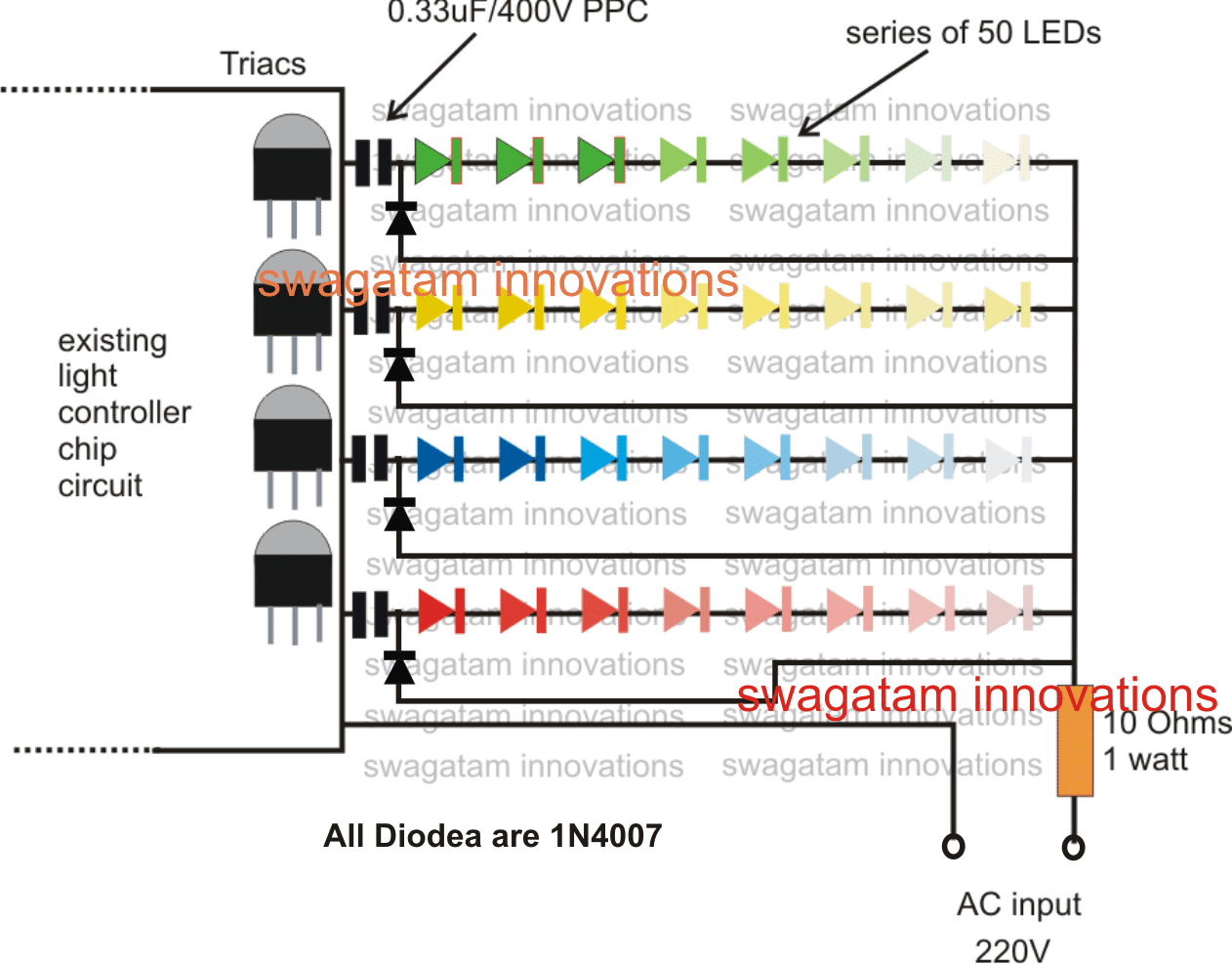
The above issue can be solved by employing a series capacitor reactance for limiting the current to 20 mA or so.
Normally, on opening the circuit box we would see small transistor shaped components lined up in a row terminating the corresponding string's wire ends.
Simply by adding series high voltage capacitors with the subsequent LEDs, the bulbs probably can be replaced with LED strings.
The following diagram shows how it can be done. The idea pretty straightforward just connect the LEDs in series along with the shown capacitors, hopefully all would start flashing and running instantly when switched ON.
The procedure is based on my assumptions and has not been tested practically so kindly be careful with it if you are actually trying this idea practically.........



Questions & Answers
Wow, these landscape lighting installers are very talented! They have completely transformed my outdoor space into a magical oasis. The attention to detail and the stunning designs they created exceeded my expectations. Highly recommend their services for anyone looking to elevate their landscape with beautiful lighting.
Does this circuit really work , has anyone tried it ?
Any idea how two-wire controllers produce patterns, Mr. Swagatam? The power supply is 31 v and the two wires from the led strings go to 2 pins on the IC.
Hello XD, you will have to confirm the polarity of the wires and only then you may be able to connect it to the power supply safely. Check which wire among the two connects probably with a capacitor negative lead directly, this will inform us regarding the negative wire, so the other one could be the positive..
Thank you for your reply Swagatam.
Actually I want to know how the two-wire system works . The terminals are marked + and – only. Voltage is 31, but 8 different patterns can be selected.
The 8 Functions
1. Combination
2. In Waves
3. Steady On
4. Slow Glow
5. Chasing
6. Slow FAde
7. Twinkle
8. Steady On
Hi XD,
The sequencing is controlled by the complex programming code of the IC.
The two wire act as the supply input and also the output for the bulbs. The series bulbs drop the voltage and current for the IC, and the IC then operates by varying the sequences alternately by making and breaking the current to ground wire.
If I use 10leds each channel after replacing BT 136 will I able put 1w LEDs or give me a suggestion to alter this cct
1 watt LED could be used if the 0.33uF is replaced with a 2uF capacitor
Ok thanks sir which traic and wat will be the number of triac
you can try BT136 triacs
Hello sir I have one light chasing circuit but instead of triac there is small transistor so can I try this type of Circuit
Hello basit, yes you can replace the transistors with triacs as suggested above.