• Skip to main content
  • Skip to primary sidebar

Homemade Circuit Projects

Need circuit help? Post them in the comments! I've answered over 50,000!

Blog | Categories | About | Hire Me | Contact | Calculators-online
You are here: Home / Energy from Magnets and Earth / How to Harvest Free Electricity from Your Rocking Chair: The Rocking Chair Reading Lamp Concept


How to Harvest Free Electricity from Your Rocking Chair: The Rocking Chair Reading Lamp Concept

Last Updated on September 23, 2026 by Swagatam Leave a Comment

Editor's Note: The following post shares an original idea and conceptual write-up sent by Mr. Ike Higgins. The original text and details provided in the communication are published below.

Table of Contents
  • Introduction
  • People Power: The Rocking Chair Reading Lamp
  • Rocking Chair Reading Lamp Assembly
    • Electronic Circuitry Specification
    • Using Magnet-and-Coil Linear Generator
    • Using Eccentric Pendulum Mass

Introduction

For a little while lately I’ve been trying to come up with something more practical. I started looking for a new idea. I thought about “People Power”. What to do with people as the input power. This is not new. We already have technology where the clothes you wear while walking will actually charge your smartphone.

People power. I was sitting in my rocking chair trying to think of something that humans just normally do that I could harvest useable power from. Just sitting there rocking back and forth. And it hit me. Talk about irony.

People Power: The Rocking Chair Reading Lamp

Rocking back and forth causes the back end of the rockers to move up and down about 2 inches, depending on how hard you are rocking. 2 inches is at the short end of the possible range.

Relatively relaxed rocking takes about 1 second to complete one cycle (1 Hz). What would happen if the rockers were attached to a magnet? The magnet would move up and down. What can be done with a moving magnetic field? You guessed it. Electricity.

I worked on this for a while, and did some preliminary math, and found that I have another relatively simple electro-mechanical design, and valid chain of physics.

However, when attempting to do the math I found to my detriment that I am just not capable of doing the detailed design work I once was fairly good at. It made my head hurt.

Below are basically my notes of the conceptual design. Just preliminary calculations and ballpark component parameters.

I reached out to my friend Swag, who has proven he can do detailed circuit design to provide an actual circuit that works, to collaborate on this concept.

Here is the basic diagram of the Rocking Chair Reading Lamp.
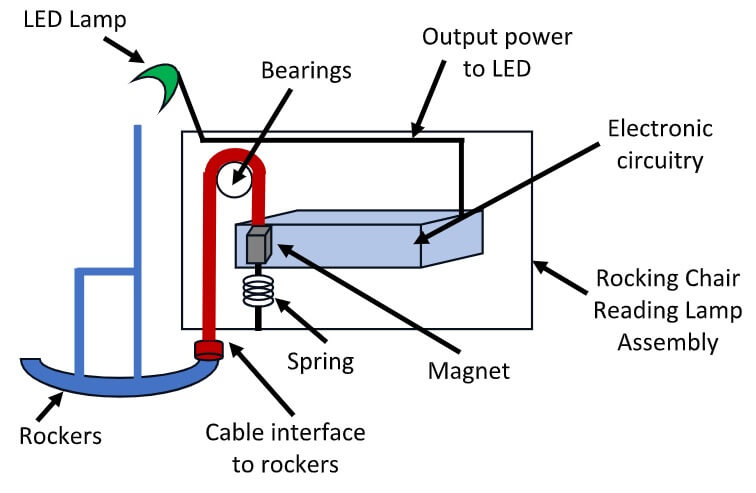
Rocking Chair Reading Lamp Assembly

System components include Rockers, Cable interface to rockers, Bearings, Spring, Magnet, Electronic circuitry, and LED Lamp / Output power to LED.

When you rock backwards, the cable pulls the magnet up 2 inches and stretches the spring. When you rock forward, the spring pulls the magnet down 2 inches and the cycle is complete at 1 Hz.

Electronic Circuitry Specification

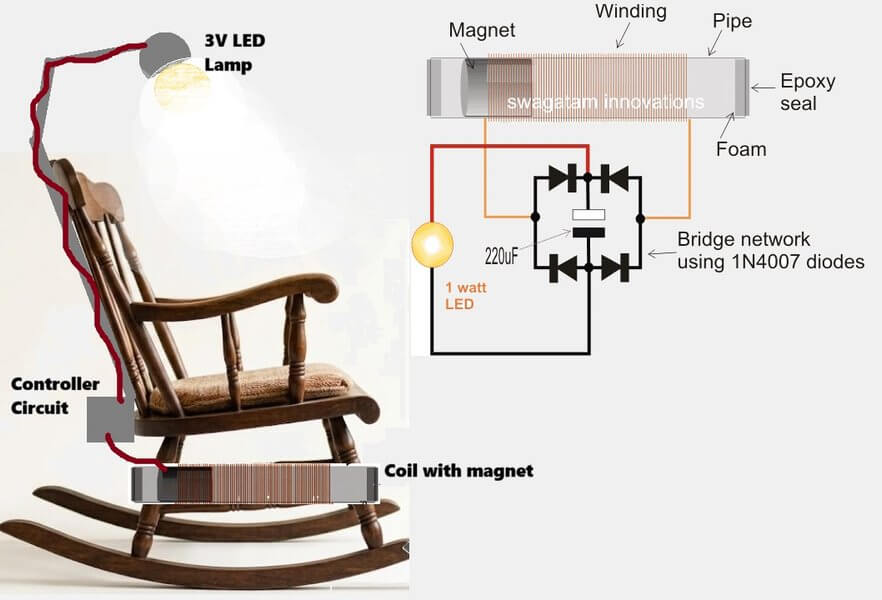
The electronic circuitry consists of a Coil around the magnet, Bridge rectifier, Smoothing Capacitor, LED Driver / resistor, and LED in Lamp.

The magnet that moves through the coil would be a Neodymium of approximately 20mm x 10mm thick, Grade N35-N52, depending on the coil’s distance from the magnet as it passes through the coils. The coil will take approximately 1,000 turns of 30-32 AWG to get to 5V. The Bridge rectifier takes four low-voltage Schottky diodes. At 1Hz the bridge should recharge the capacitor close to twice per second using a 10mA LED load and a 10,000 uF capacitor.

The Smoothing capacitor is around 4,700 to 10,000 uF, rated for 10V or higher. The larger the capacitor, the smoother (continuous illumination) the output.

I believe there should be a 6.8V or so Zener diode across the capacitor for protection if the generator can exceed the capacitor’s rating, and deal with the possibility of the generator’s possible excess power. The LED resistor could start with around 220 ohms. The LED is a normal 5mm white LED, or could also use an Indicator LED.

Using Magnet-and-Coil Linear Generator

Although the rocking chair concept by Mr. Ike offers a practical design, integrating a magnet-and-coil linear generator (shake charger) into the chair's frame presents a compelling alternative. This self-sustaining setup converts the user’s continuous rocking motion into electrical energy to illuminate the lamp
Using Eccentric Pendulum Mass

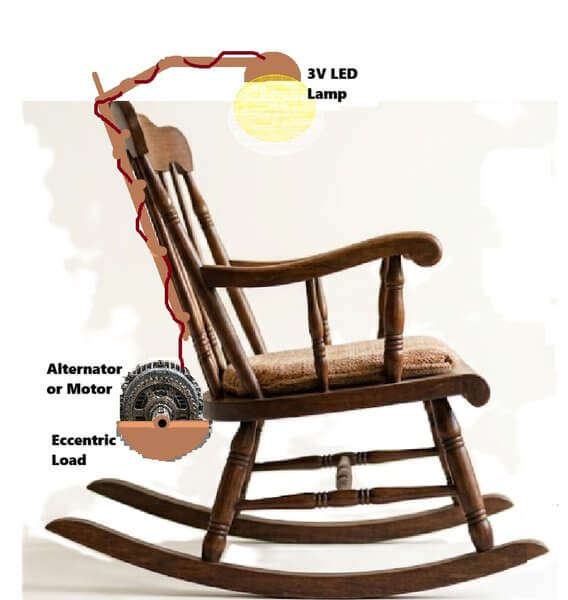
Another approach is to integrate a permanent magnet (PM) motor fitted with an eccentric pendulum mass. As the chair rocks, the swinging pendulum drives the motor shaft back and forth, converting the oscillating motion into electrical energy. The example figure can be seen below:
You'll also like:

  • radiant energyIs this Inductive Overunity? Maybe Not
  • freeenergycollectorcircuit 1How to Collect Electromagnetic Energy from Atmosphere
  • 12V batteryMaking a Self-Powered Generator
  • regenerative motor acceleration set up compressedRegenerative Motor Acceleration Experiment

Filed Under: Energy from Magnets and Earth

About Swagatam

I am an electronics engineer and doing practical hands-on work from more than 15 years now. Building real circuits, testing them and also making PCB layouts by myself. I really love doing all these things like inventing something new, designing electronics and also helping other people like hobby guys who want to make their own cool circuits at home.

And that is the main reason why I started this website homemade-circuits.com, to share different types of circuit ideas..

If you are having any kind of doubt or question related to circuits then just write down your question in the comment box below, I am like always checking, so I guarantee I will reply you for sure!


Previous Post: « Accurate Monostable Timer Circuit using IC 4538 (CMOS)

Reader Interactions

Need Help? Please Leave a Comment! We value your input—Kindly keep it relevant to the above topic! Cancel reply

Your email address will not be published. Required fields are marked *

Primary Sidebar

My YouTube Channel

Circuit Simulator: Draw and Simulate Schematics

circuit simulator image


Categories

  • Arduino Projects (95)
  • Audio and Amplifier Projects (134)
  • Automation Projects (18)
  • Automobile Electronics (104)
  • Battery Charger Circuits (90)
  • Datasheets and Components (109)
  • Electronics Theory (151)
  • Energy from Magnets and Earth (43)
  • Games and Sports Projects (11)
  • Grid and 3-Phase (20)
  • Health related Projects (27)
  • Home Electrical Circuits (13)
  • Indicator Circuits (16)
  • Inverter Circuits (98)
  • Lamps and Lights (161)
  • Meters and Testers (72)
  • Mini Projects (28)
  • Motor Controller (68)
  • Oscillator Circuits (30)
  • Pets and Pests (15)
  • Power Supply Circuits (91)
  • Remote Control Circuits (50)
  • Security and Alarm (65)
  • Sensors and Detectors (107)
  • SMPS and Converters (46)
  • Solar Controller Circuits (62)
  • Temperature Controllers (44)
  • Timer and Delay Relay (51)
  • Voltage Control and Protection (44)
  • Water Controller (37)
  • Wireless Circuits (31)


Subscribe to get New Circuits in your Email


Other Links

  • Privacy Policy
  • Cookie Policy
  • Disclaimer
  • Copyright
  • Videos
  • Sitemap

People also Search

555 Circuits | 741 Circuits | LM324 Circuits | LM338 Circuits | 4017 Circuits | Ultrasonic Projects | SMPS Projects | Christmas Projects | MOSFETs | Radio Circuits | Laser Circuits | PIR Projects |


Recent Comments

  • Swagatam on Adjustable Voltage Regulator Circuit using LM324 IC with Over Current Protection
  • Swagatam on Inverter Circuit with Feedback Control
  • Swagatam on Inverter Circuit with Feedback Control
  • Swagatam on Proximity Detector IC CS209A Pinouts – Datasheet Explained
  • PRAFUL WANDHARE on Proximity Detector IC CS209A Pinouts – Datasheet Explained

Social Profiles

  • Twitter
  • YouTube
  • Instagram
  • Pinterest
  • My Facebook-Page
  • Stack Exchange
  • Linkedin

Calculators

  • ZVS Induction Heater + Tank Calculator Tool
  • Zener Diode Calculator
  • Wire Current and Thickness Calculator (Ampacity Calculator)
  • Voltage Divider Calculator
  • Transistor Base Resistor Calculator
  • Transistor Astable Multivibrator Calculator
  • TL431 Calculator
  • Solar Panel, Inverter, Battery Calculator
  • Ferrite Core Air Gap Calculator Tool
  • Parallel MOSFET Calculator Tool: How to Connect MOSFETs in Parallel Safely
  • LC Resonance Calculator for EV Battery Charger Circuits
  • LED String Series Resistor Calculator
  • PFC (Power Factor Correction) Calculator Tool: 3kW
  • Passive Power Factor Correction (PFC) Calculator
  • LM567 IC Calculator Tool
  • SMPS Flyback Boost Converter Calculator
  • Shunt Resistor Calculator for Ammeters
  • SCR and Triac Gate Resistor Calculator
  • Battery Back up Time Calculator
  • Boost Converter Calculator (Non-Isolated)
  • Bootstrap Capacitor Calculator
  • Buck Converter Calculator
  • Buck-Boost Converter Calculator
  • Capacitance Reactance Calculator
  • DCM Flyback Transformer & Wire Gauge Wire Size Calculator Tool
  • Filter Capacitor Calculator
  • IC 4047 Calculator (Frequency and PWM)
  • IC 4060 Calculator
  • IC 555 Astable Calculator
  • IC 555 Monostable Calculator
  • IC SG3525, SG3524 Calculator
  • Inductance Calculator
  • Induction Heater Inductor and Resonant Frequency Calculator
  • Induction Heater Work Coil Calculator
  • Inverter LC Filter Calculator
  • LC Resonance Calculator
  • LED Current Calculator
  • LM317, LM338, LM396 Calculator
  • NAND/NOT Gate RC Values Calculator
  • NOT, NAND Gate Frequency Calculator
  • Notch Filter Calculator Tool
  • Ohm’s Law Calculator
  • Phase Angle Phase Shift Calculator
  • Power Factor (PF) Calculator
  • RC Filter Calculator
  • Reactance Calculator
  • Sine Table Calculator for SPWM Arduino Code
  • Small Signal Transistor(BJT) and Diode Quick Datasheet
  • SMPS Calculator for Toroidal Ferrite Transformers
  • SMPS Flyback Transformer Calculator – Design by Target Duty Cycle
  • TL431 Calculator
  • Op-Amp Hysteresis Resistor Calculator

© 2026 · Swagatam Innovations