In this post I have explained 3 simple sound activated relay switch circuits which can used as a module for any system that might be assigned to trigger by detecting some kind of sound pressure level. Or simply applications such as a voice activated alarm security circuit.
1) Circuit Objective
Utilizing this basic sound activated switch design, toggling a system by a sound pulse could be done very effectively, not only with a robotic system but as well as for any desired of home automation.
As an illustration the circuit could be used like a sound-activated light bulb to illuminate a porch light in response to a knock on the front door.
This light would then switch off automatically after some delay. An optional implementation may be in the form of a security protection system.
In this system whenever an intruder aspires to break open the front door or steal a thing, the sound vibrations made during the robbery could then light a bulb or sound an alarm, quickly indicating that someone uninvited has visited your home.
The circuit could work from any 5-12 VDC controlled power source as long as a relay with the appropriate coil voltage is employed.
Video Demonstration
How it Works
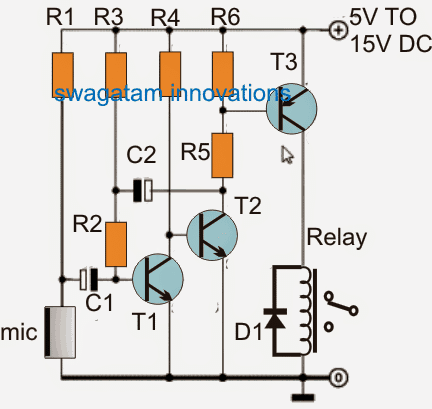
As soon as the sound activated switch circuit is powered ON, you might find the relay activating briefly due to the presence of capacitor C2.
After this, whenever you create a noise in front of the MIC, the relay is going to activate briefly depending on the value of C2 and then switch OFF.
Any AC or DC load connected with the relay contacts will subsequently switch ON and OFF in response to the relay switching.
A couple of seconds must be allowed for the relay to be toggled off. If felt necessary you could to increase or decrease the ‘on’ time period of the relay by modifying the uF C2.
A larger uF contributes to an extended ‘on’ period, and the opposite way round. However, you should not employ a value exceeding beyond 47μF.
Biasing resistor R1 becomes the main part which decides how sensitive the MIC or the microphone can be. Lower values will increase the sensitivity of the MC and the circuit, and vice versa.
An electret microphone commonly possesses just one central FET inside which strictly requires a bias voltage to function.
The best possible R1 value for effective response to audio or noise signal could be determined only through some practical experimentation.
All of the related and essential electronic protection precautionary measures is required to be implemented each time a mains AC powered load is to be connected with the relay contacts.
Parts List
- R1 = 5k6
- R2 = 47k
- R3 = 3M3
- R4 = 33K
- R5 = 330 OHMS
- R6 = 2K2
- C1 = 0.1uF
- C2 = 4.7uF/25V
- T1, T2 = BC547
- T3 = 2N2907
- D1 = 1N4007
- Relay = coil voltage as per the supply voltage, and contact rating as per the load specs
- Mic = electret condenser MIC.
Applications
The concept can be used as a vibration activated LED lighting, for sound triggered recording systems. It can also used as a sound toggled night bedroom light circuit
2) Sound Activated Switch with Customized Sound Frequency
The next project below explains a simple, accurate remote control system through sound vibration that will work on a particular sound frequency.
Therefore it's perfectly foolproof since it won't be disturbed through other unwanted sound or noise.
The idea was requested by Mr. Sharoj Alhasn.
The Sound Sensor Circuit
The figure shows the circuit of a sound detector circuit which can be effectively converted into a remote control, triggered using a sound generator handset.
We have already learned a lot regarding this wonderful frequency decoder LM567 IC.
The IC will lock-on into any frequency that's fed across its input and which exactly matches the frequency fixed across its pin5 and pin6 via the relevant R/C components.
The formula for determining the latching frequency across pin5/6 may be calculated using the following formula:
F = 1 / R3xC2,
where C is in farads, R is in Ohms while F is in Hz.
Here it's set to around 2kHz.
Pin3 is the input of the IC which tracks, responds and locks on an frequency which may be reaching the 2kHz figure.
Once the IC detects this, it produces a zero logic or an instant low at its output pin8.
This low at pin8 sustains as long as the frequency at the input pin stays active, and becomes high as soon as it's removed.
Circuit Diagram
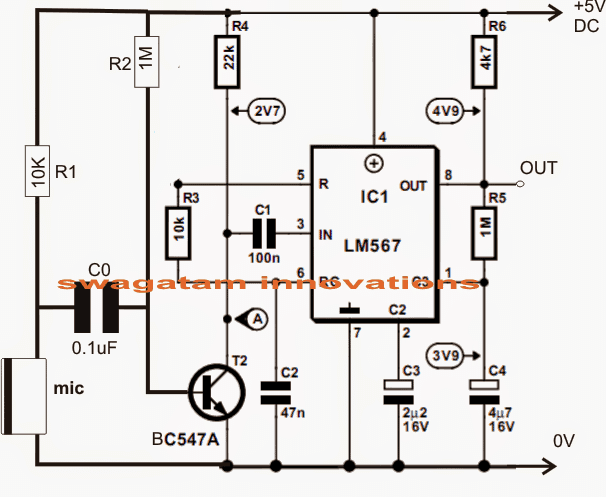
In the discussed sound triggered remote control circuit, a MiC is configured across pin3 of the IC.
An external matching frequency (2kHz) in the form of an audible sound or whistle is pointed toward the mic such that the sound hits the mic starighton.
The mic converts the sound into electrical pulses corresponding to the received frequency at the relevant input pin of the IC.
The IC immediately acknowledges the matching data and reverts the output into a low for the necessary actions.
The output may be directly connected with a relay if only a momentary toggling is required or only for the time the input is active.
For an ON/OFF switching the same may be configured with a FLIP-FLOP circuit.
Sound Activated Remote Transmitter Circuit
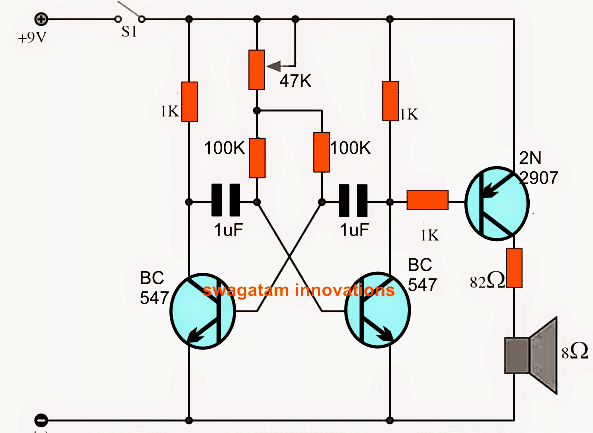
The following circuit may be utilized for generating an audible frequency for the above described sound remote receiver circuit.
The circuit is based on a simple AMV concept using a few ordinary transistors and some other passive parts.
The frequency of this transmitter circuit must be first set to the receivers matching frequency which is calculated to be 2kHz.
This may be done by suitably adjusting the 47k preset and monitoring a latching response from the receiver simultaneously.
Applications
The above explained project which uses foolproof unique frequency for sound triggering can be specifically for remote locks in cars, house doors or safes for jeweler's shops and office entrances etc
3) Alarm Trigger with Sound using Piezo
So far have learn regarding ON/OFF application using noise generation, now let's see how the same could be used for triggering an alarm, whenever a noise or a sound is detected.
A simple sound triggered alarm circuit is a device which is used for triggering an alarm on detection of a sound vibration. The sensitivity of the unit is set externally according to the requirement of the user.
The circuit discussed in this article can be implemented for the above purpose or simply as a security device for detecting an intrusion. For example it can be fitted in a car for detecting a possible intrusion or a break-in.
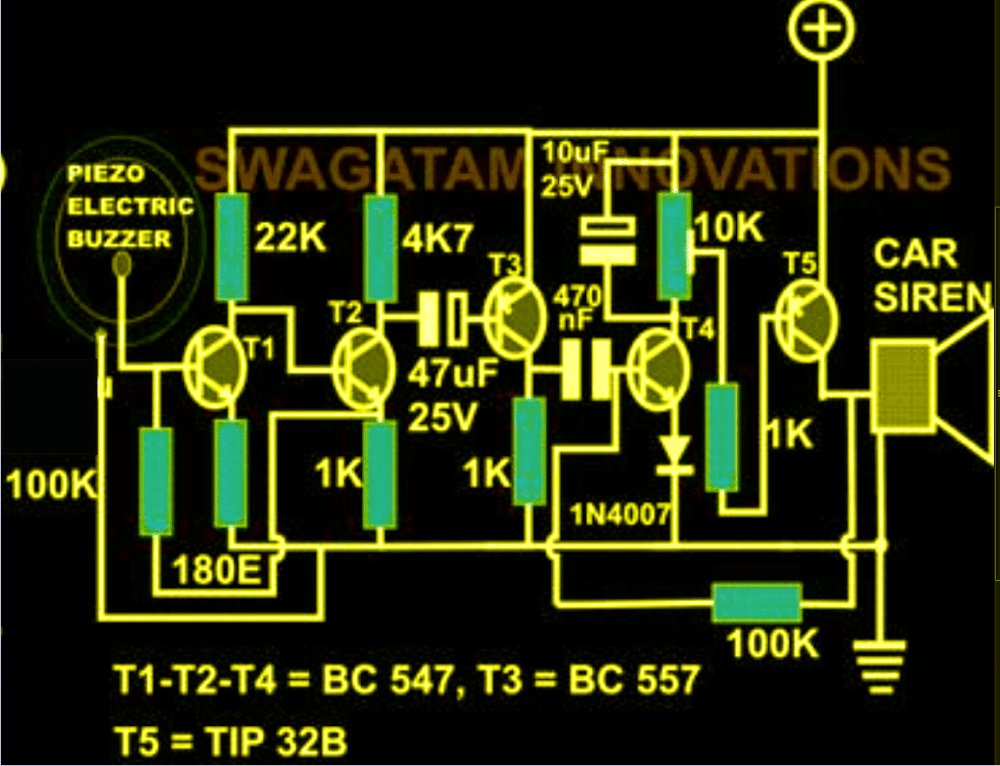
Looking at the circuit diagram we see that the circuit uses only transistors and therefore becomes very easy even for a new hobbyist to understand and make the system at home.
How it Works
Basically the whole circuit is made up of two small signal amplifiers which are connected in series for doubling the sensing power.
T1, T2 along with the associated resistors becomes the first small signal amplifier stage.
The introduction of the 100K resistor across the emitter of T2 and the base of T1 plays an important role in making the amplifier stage very stable due to the feedback loop connected from the output to the input of the stage.
The input of T2 is connected to a piezo transducer element, which is used as a sensor here.
Sound signals hitting the piezo transducer surface is effectively converted to tiny electrical pulses which are amplified by the amplifiers made from T1 and T2 to a certain higher level.
This amplified signal which becomes available at the collector of T2, is fed to the base of a high gain PNP transistor T3 via the 47uF coupling capacitor.
T3 further amplifiers the signals to yet higher levels.
However, the signals are still not strong enough and won't detect the minute sound vibrations, probably which might be emitted by human physical contacts over a particular body.
The next stage which is a replica of the first stage, consists of the transistor T4 and T5.
The amplified signals generated at the collector of T3 is further coupled to the above stage for the final processing.
T4 and T5 makes sure that the signals are amplified to the required limits as per the units expectations.
If the piezo is attached to, say for example a door, even a slight knock over the door will be easily sensed and the alarm connected to T5 will become active.
The 10uF capacitor across the 10K preset keeps the alarm activated for a few seconds of time, its value may be increased for increasing the above delay of the alarm sound.
The discussed sound activated alarm circuit will work with any supply in between 6 and 12, however if the alarm is a powerful one, the current might have to be selected accordingly.
The preset may be used for setting the sensitivity of the circuit.
Circuit Diagram
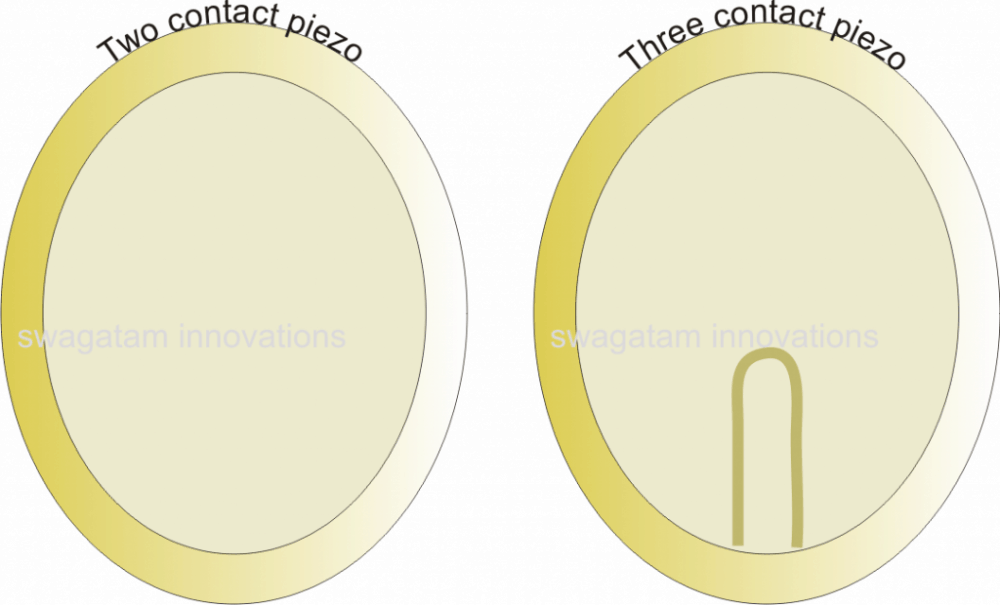
For the sensor, a 27mm piezo transducer will work the best, the following figure shows the image of this device:
Applications
The sound vibration operated switch as explained above looks suitable for creating alarm or siren alarms in response to sound vibrations and therefore could be installed under mats or fixed on doors as safety alarm units.
Whenever a intruder or thief tries to trespass the area by stepping on the mat or opening the door, the sound activates the alarm allowing the user and the neighboring people to get warned about the break-in.



Comments
I REPLACED {1) Circuit Objective } THE MICROPHONE WITH A VIBRATION CONTACT BUT IT DIDN’T WORK.
WHO WILL GIVE ME A COMPLETE PLAN?
IT SHOULD BE ACTIVATED BY VIBRATION ( SPRING CONTACT) AND REMAIN ACTIVE FOR 20 SECONDS (AN ALARM) AND SHOULD TURN OFF BY ITSELF BUT ALWAYS READY.
THANKS
The first circuit is 100% tested and will do exactly what you are intending to achieve, provided you do everything correctly.
If the circuit can detect voice vibrations then it should be easily able to detect mechanical vibrations also.
C2 can be tweaked to get 20 seconds delay OFF.
Please check the setup as given in the diagram with an electret MIC first, if it works that would confirm you have built the circuit correctly and after that you can modify it further with a spring contact….
Hello sir, please how can I extrapolate the first circuit.first when a sound is made it activates the relay, when the sound is made for the second time, it deactivates the relay.
Hello Daniel,
You can remove the relay and join the collector of the transistor T3 with the input of one of the following designs:
https://www.homemade-circuits.com/build-these-simple-flip-flop-circuits/
Alternatively you can simply try the following circuits:
https://www.homemade-circuits.com/make-simple-electronic-clap-switch/
I have an alarm siren that I would like to activate a sound activated relay so that when the siren is on it would activate a strobe light. The problem is that it has to be when the siren is on and not pickup any noise. I saw your simple activated switch video on YouTube.
I don’t think that may be feasible using the above concepts.
Because detecting the sound frequency selectively may not be possible with these circuits.
The above circuits will respond of all types of loud sounds or bangs.
Hi Swagatam,
I am trying to design a circuit that will trigger an alarm when the water faucet is inadvertently left on. My wife just left on a 4-day trip and left the bathroom water faucet running slowly. I did not discover the water running for two days. We have two bathrooms and I was using the other bathroom. The alarm should not be triggered under normal use; for say 5 minutes. After the 5 minute (adjustible) delay the alarm should be triggered. I was thinking maybe using the sound of the water running through the drain line. Do you have such a circuit or would you design a circuit to accomplish the required result?Thanks!
Hi Norman,
Depending on sound from the drain may not be too effective.
Instead the detection can be done through the water coming out from the faucet mouth.
And then integrate this water sensor output with an Delay ON timer to activate a buzzer.
Hi, Regarding the first circuit, If I want to replace the microphone with a tapped signal from a headphone, do I need to change anything else? Or just play with values of R1?
Hi, I think R1 is relevant only when an electret MIC is used, it may not be relevant if a magnetic headphone speaker is used insteadof a MIC. You can try the design as it is, without changing anything and also without R1 and check which option gives you the best results.
Thank you for the reply. But I meant I will have a audio source like a phone or laptop and I want to use the headphone out to trigge the relay. However the sound still meeds to be available on headphones.
If you are having an audio source then the above circuit may not be required, you can simply use a transistor relay driver to switch ON the relay:
https://www.homemade-circuits.com/how-to-make-relay-driver-stage-in/
Do you want the relay to be switched ON momentarily or as long as the audio source is available??
As long as the source is available. It will.be used to kill one source while the trigger source is playing then return to the original source once the trigger source stops
In that case you can use the simple transistor relay driver stage as suggested previously, just make sure to connect a 1uF capacitor between the base/emitter of the transistor.
Hi sir
I am using a 12 volt siren powered by 12 volt battery through irfn740 mosfet now the question is that does i need to put resistor between mosfet and siren….?
And if yes then which resistor should I use…?
Hi Swasti,
Which PIR circuit have you selected? Can you please comment under that particular article? I would recommend using the following concept for your application:
https://www.homemade-circuits.com/pir-burglar-alarm-circuit/
Sir thanks for your precious time
i have studied the above circuit but i think there should be a sensor or something more which detects small movement (let’s say physical displacement) of the circuit or the movement of solar panel from its position and one thing the 12 volt battery (my room ) is approximately 15 meters away from solar panels so make it like if the robber cuts the power supply from the circuit then there should be something which detect the deactivation of that circuit and activate the alarm .
Sir I will be waiting for diagram
Swasti, The alarm must be sounded before the displacement of the solar panels can happen. That means as soon somebody approaches the solar panel the alarm must be activated.
If your house is 15 meters away then I think PIR sensor is the only effective option.
Because PIR can be fixed at some distance from the solar panel and nobody can tamper with its working.
You can enclose the PIR inside a pipe like fitting so that it detects only a taller living thing such as human being, and other beings like dogs and cats can pass from below the PIR line of sight and avoid detection.
Yeah thats sounds perfect enclosing pir sensor in pipe i will try that will inform you about the results
Sir once again thanks for your kind support and precious time ?
No Problem Swasti, All the best to you.
Let me know if you have any further doubts or questions.
Hi Swagatam, I am using the first circuit in this blog. I have changed C2 to a 104 cap. I am using the circuit to flash LEDs to sounds or music. I am wondering if I had two of these circuits, each operating one of two LED circuits, if I could get them to operate on different sounds or notes. One would flash at a particular sound or note and the other one would flash at a different sound or note. If that is possible, how would I go about it? Thanks!
Hi Norman,
You may try inserting an audio filter stage at the center, as implemented in the following concept. You can see how C2 and R7 are positioned in the circuit to suppress a specific band of the audio frequency:
https://www.homemade-circuits.com/pressure-cooker-whistle-counter-circuit/
I am building a street organ (mechanical) and have seen a dancing monkey (electrical) but I would like to have the money dance while playing and then stop when the music stops
You can try the first circuit from the above article, it will do the job for you……. make sure to remove C2.
Circuit diagrams to control loud hifi noise by disconnecti mains supply temporarily
Hi
I am new electronics and trying to build a sound activated buzzer that goes into a toy. I need to turn it on from 25 to 50 feet away in order to locate the toy. Voice or other small noisemaker would work. Can this be built using a coin battery?
Where would I find someone to make a prototype or a hundred or a thousand of these?
Thanks for the info above!
Jerry
Hi, you can try the first circuit but I don’t think it can work with a coin battery. You will need a at least 5 V to operate it normally. You can replace the relay with a buzzer.
Also 40 to 50 feet looks quite a large distance which would require a significant amount of noise to activate it. You can increase its sensitivity by adjusting the value of R1.
Sorry, I have no idea from where you can get this product manufactured.
hello Mr. Swagatam
I’m 70 and a beginner in this field you have inspired me to develop new skills.
r6 is it a 4k7. I have 4.7k are they the same.
C0 C1 C2 the N after the value does it stand for non – polarizes capacitor?
C0 0.1uf larger than the rest on circuit diagram. Doesn’t seem to indicate a connection point.
The A in a circle is this an amp location.
C3C4, are they polarized. Top positive bottom negative.
2 ohm 2 ohm is that the value and what is 16 volts relate to in the circuit.
Thank you Karl, glad you found my articles inspiring.
yes, 4k7 = 4.7 k
nF stands for nano farad.
0.1uF is larger than C1 and C2, it connects between transistor base and the MIC.
Please ignore the A, it is not relevant to the circuit
Yes C3, C4 are polarized, top pin is the positive pin
2u2 = 2.2 microfarad, and 16 is its maximum tolerable voltage limit.
circuit with L 567 can pin 8 activate a relay
do i need to change value of capacitor to control latch on/off
Goal of this project would be triggering alarm on remotely and have to have a notification sent to a cell phone if an intrusion was to occur.
do you fill this is possible?
love the help have been. sharing information about you to some of my old friends at Disney.
thanks agin
is there an alarm sounding device that could replace a siren horn dc 12 v 6 tone from amazon.
Making an alarm circuit may be time consuming, so it is better to replace it with a ready made siren or horn.
thank you as always love your fast response.
It’s my pleasure!
Thanks Karl, I don’t think a relay can be used directly with the pin#8 of the IC, you will need a transistor driver for it.
This circuit cannot be latched. The capacitor value cannot be changed to latch the circuit
would the 433 MHz remote Infared wireless alarm be a better fit for the Bluetooth car ignition lock out circuit.
Yes 433 MHz remote control option is much easier to configure and use compared to a Bluetooth remote control.
Hi, I love your circuit for “the sound sensor circuit”, also “the sound activated remote transmitter “ circuit. Rather than build several sound sensor circuits to activate several different relays, I was wondering if there is a circuit that can respond to more than just one frequency. Example… frequency A will only activate relay A. Frequency B… only relay B
Hi, The second circuit in the above article is designed to respond to specific frequencies as per the adjustments.
Hello
What adaptions would be required to create a switching system to break a mains circuit when excess sound levels are encountered such as loud music in a quiet zone ?.
A relay would be sufficient to control a mains contactor and the off period would need to be variable.
I cannot find a device to operate in this way and this may be a commercially viable project for you.
Hello, you can use the first circuit from the above article for implementing the process. R1 controls the sensitivity of the circuit, and C2 value determines how long the relay might stay activated once the relay is activated.
Okey-doke. Thanks for your input.
All the best, Cody
My expertise is limited to designing small electronic circuits, so honestly I don’t think I would be able to understand the mechanical details of the system.
I can try to resend bigger images.
But do you have an idea how it might work?. Under the plastic cap, there is a little thin metal disk with a stylus, and a wire going from that cylindrical object to the polarity switch for the motor; does it work kind of like an old Edison recording device?. There is a resistor at the top you can see in one of the images.
Thank you for the images! Yes I can see the images now although they are quite small to notice the fine details. Yet still I can see the mechanism which is intriguing, but highly complex to copy or replicate at our level.
This is strange. Making it so you can’t post images is weird.
I’ll try one more time.
://postimg.cc/gallery/y8FCBRX
Even these links without https are not opening, not sure what may be the problem?
I tried to open the links, but none of them are opening. It is showing “this site cannot be reached”
I forgot to remove the
Here they are:
ibb.co/YX6yXwW
ibb.co/xjvz7wN
ibb.co/TLRVZhn
ibb.co/kJ5fYZ9
I hope you can view them. Thanks very much for your willingness to advise. I think it may work like an old Edison recorder. Note the little tin disk and stylus on top of the cylinder. I don’t know, it reminds me of that anyway.
Thanks much,
Cody
Wow, thanks for your interest and willingness to advise. When you have time to take a look, here are links to the images:
https://ibb.co/YX6yXwW
https://ibb.co/xjvz7wN
https://ibb.co/TLRVZhn
https://ibb.co/kJ5fYZ9
I hope they open. I can add more if needed. Note the little “record player” looking thing atop the cylinder with the tiny stylus. I had the theory that it worked something like a primitive Edison recorder with the thin tin disk and a small stylus that moves back and forth to record the sound from the flute, then, somehow, sends it to the motor. I don’t know. It just reminds me of that. How that would activate the motor to raise the snake is confounding and amazing.
All the best,
Cody