• Skip to main content
  • Skip to primary sidebar

Homemade Circuit Projects

Need circuit help? Post them in the comments! I've answered over 50,000!

Blog | Categories | About | Hire Me | Contact | Calculators-online
You are here: Home / Sensors and Detectors / Simple Shadow Sensor Alarm Circuit

Simple Shadow Sensor Alarm Circuit

Last Updated on January 3, 2024 by Swagatam 12 Comments

This shadow detector circuit operates using two LDRs and effectively detects the difference between the light levels and triggers a loud audible warning siren.

Table of Contents
  • Circuit Operation
    • Circuit Diagram

In circuits which uses a single LDR (photoresist), the detection may not be as sharp as with two LDRs discussed here.Operational details of the shadow detector circuit may be studied as follows:

The key elements of this circuit are the two LDRs and the active operational amplifier, which functions as a comparator.

Circuit Operation

As may be seen in the diagram, the inputs of the opamp are carefully balanced using alternately positioned LDRs across the corresponding supply rails in conjunction with the respective resistors.

The two resistors may be possibly replaced with presets for getting a fine adjustment option and for ensuring an optimum balance and a perfect zero logic at the output of the opamp.

In normal light situations that is with no shadow detected (no shade) the two LDRs are able to receive the same amount of light across the sensing input of the opamp which renders a low logic level at the output of the IC.

In an event when one of the LDRs (for instance R1) experiences a shadow or less light than the other (R4), causes the voltage at the inverting input of opamp to go lower than in the non-inverting counterpart, causing the logic at the output of IC to switch to a high logic.

The above action activates transistor Q1, which in turn activates the LED and the relay. The LED allows to acquire a visual warning while the relay activates a siren device.

Preferably you may want to place a semiconductor diode (D1) in parallel with the relay, as shown in the diagram, to protect the transistor Q1 from the relay reverse EMFs.

Circuit Diagram
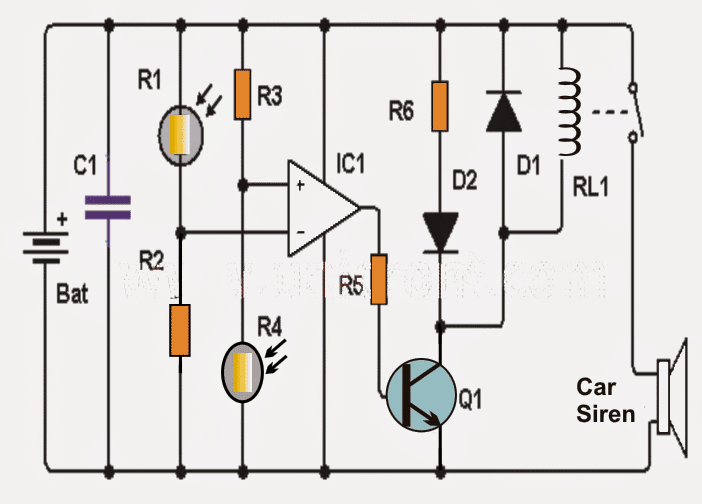
Things to be notes:
- The circuit is powered by 9 volt lead acid battery or any similar SMF battery.
- The LDRs should be placed with a separation of about 3cm. for an optimal response and to avoid incorrect triggering.

Parts list for the proposed shadow detector circuit

- 1 Operational amplifier: LM741 (IC1)
- 2 LDRs (photoresistor / LDR) (R1, R2)
- 1 NPN transistor 2N2222 or similar (Q1)
- 1 1N4007 diode (D1)
- 1 red LED diode (D2)
- 9 volt relay (RL1)
- Two 10K resistors (R3 and R4)
- 1 1K resistor (R5)
- 1 resistors 470 (R6)
- 1 100 nF capacitor (C1)

You'll also like:

  • clap2BmotorClap Operated Toy Car Circuit
  • RF detector circuit using transistors2 Simple RF Detector Circuits Explored
  • fig1Deep Soil Metal Detector Circuit – Ground Scanner
  • schematic 1Color Detector Circuit with Arduino Code

Filed Under: Sensors and Detectors Tagged With: Alarm, Sensor, Shadow, Simple

About Swagatam

I am an electronics engineer and doing practical hands-on work from more than 15 years now. Building real circuits, testing them and also making PCB layouts by myself. I really love doing all these things like inventing something new, designing electronics and also helping other people like hobby guys who want to make their own cool circuits at home.

And that is the main reason why I started this website homemade-circuits.com, to share different types of circuit ideas..

If you are having any kind of doubt or question related to circuits then just write down your question in the comment box below, I am like always checking, so I guarantee I will reply you for sure!

Previous Post: « Cyclist’s Safety Light Circuit – Nighttime Visibility for Cyclists, Walkers, Joggers
Next Post: Tuned Infrared (IR) Detector Circuit »

Reader Interactions

Questions & Answers

Total Posts: 12
Newest Oldest
li perciro everest
June 23, 2022 • 4 years ago #128417

Please I want practical videos for students.

thanks

Reply
Umer
April 27, 2021 • 5 years ago #88769

I want to ask that why the 100nF capacitor is used in this circuit? Is it a necessary component or we can ignore it to make our circuit functional?

Reply
SwagatamAdmin
April 27, 2021 • 5 years ago #88783

The C1 must be actually placed directly across the IC supply pins…it is used for cancelling the reverse voltage spikes generated due to the siren operation, and relay clicking…

Reply
Umer
April 27, 2021 • 5 years ago #88788

Thank you very much for the kind help.

Reply
SwagatamAdmin
April 27, 2021 • 5 years ago #88789

You are welcome…

Reply
Adam
August 18, 2020 • 6 years ago #81446

Please I will like a video to show me step by step in constructing Shadow Detector

Reply
adio kabiru
January 29, 2015 • 12 years ago #28514

can i use ic 555 timer in place of ic lm741,is it a must i use a relay

Reply
SwagatamAdmin
January 30, 2015 • 12 years ago #28521

for a big siren, relay will be required

Reply
SwagatamAdmin
January 30, 2015 • 12 years ago #28520

two LDRs won't be possible with a 555

Reply
yasir ulhaq
January 28, 2015 • 12 years ago #28487

hello sir,
your website is awsome. iam working on a project can you please post wifi signal detector circuit

Reply
yasir ulhaq
January 29, 2015 • 12 years ago #28513

ok

Reply
SwagatamAdmin
January 29, 2015 • 12 years ago #28493

thanks yasir, presently I do not have it, i'll post it if I happen to get it….

Reply

Need Help? Please Leave a Comment! We value your input—Kindly keep it relevant to the above topic! Cancel reply

Your email address will not be published. Required fields are marked *

Primary Sidebar

My YouTube Channel

Circuit Simulator: Draw and Simulate Schematics

circuit simulator image

Categories

  • Arduino Projects (95)
  • Audio and Amplifier Projects (134)
  • Automation Projects (18)
  • Automobile Electronics (104)
  • Battery Charger Circuits (90)
  • Datasheets and Components (109)
  • Electronics Theory (151)
  • Energy from Magnets and Earth (43)
  • Games and Sports Projects (11)
  • Grid and 3-Phase (20)
  • Health related Projects (27)
  • Home Electrical Circuits (13)
  • Indicator Circuits (16)
  • Inverter Circuits (98)
  • Lamps and Lights (161)
  • Meters and Testers (72)
  • Mini Projects (28)
  • Motor Controller (68)
  • Oscillator Circuits (30)
  • Pets and Pests (15)
  • Power Supply Circuits (91)
  • Remote Control Circuits (50)
  • Security and Alarm (65)
  • Sensors and Detectors (107)
  • SMPS and Converters (46)
  • Solar Controller Circuits (62)
  • Temperature Controllers (44)
  • Timer and Delay Relay (51)
  • Voltage Control and Protection (44)
  • Water Controller (37)
  • Wireless Circuits (31)

Subscribe to get New Circuits in your Email

Other Links

  • Privacy Policy
  • Cookie Policy
  • Disclaimer
  • Copyright
  • Videos
  • Sitemap

People also Search

555 Circuits | 741 Circuits | LM324 Circuits | LM338 Circuits | 4017 Circuits | Ultrasonic Projects | SMPS Projects | Christmas Projects | MOSFETs | Radio Circuits | Laser Circuits | PIR Projects |

Recent Comments

  • Swagatam on EGS002 Datasheet, Circuit Diagram Explained
  • Hung on EGS002 Datasheet, Circuit Diagram Explained
  • Swagatam on How to Design a Buck Converter Circuit: Formulas and Calculations
  • martin on How to Design a Buck Converter Circuit: Formulas and Calculations
  • Swagatam on Touch Dimmable LED Light Bar Circuit

Social Profiles

  • Twitter
  • YouTube
  • Instagram
  • Pinterest
  • My Facebook-Page
  • Stack Exchange
  • Linkedin

Calculators

  • ZVS Induction Heater + Tank Calculator Tool
  • Zener Diode Calculator
  • Wire Current and Thickness Calculator (Ampacity Calculator)
  • Voltage Divider Calculator
  • Transistor Base Resistor Calculator
  • Transistor Astable Multivibrator Calculator
  • TL431 Calculator
  • Solar Panel, Inverter, Battery Calculator
  • Ferrite Core Air Gap Calculator Tool
  • Parallel MOSFET Calculator Tool: How to Connect MOSFETs in Parallel Safely
  • LC Resonance Calculator for EV Battery Charger Circuits
  • LED String Series Resistor Calculator
  • PFC (Power Factor Correction) Calculator Tool: 3kW
  • Passive Power Factor Correction (PFC) Calculator
  • LM567 IC Calculator Tool
  • SMPS Flyback Boost Converter Calculator
  • Shunt Resistor Calculator for Ammeters
  • SCR and Triac Gate Resistor Calculator
  • Battery Back up Time Calculator
  • Boost Converter Calculator (Non-Isolated)
  • Bootstrap Capacitor Calculator
  • Buck Converter Calculator
  • Buck-Boost Converter Calculator
  • Capacitance Reactance Calculator
  • DCM Flyback Transformer & Wire Gauge Wire Size Calculator Tool
  • Filter Capacitor Calculator
  • IC 4047 Calculator (Frequency and PWM)
  • IC 4060 Calculator
  • IC 555 Astable Calculator
  • IC 555 Monostable Calculator
  • IC SG3525, SG3524 Calculator
  • Inductance Calculator
  • Induction Heater Inductor and Resonant Frequency Calculator
  • Induction Heater Work Coil Calculator
  • Inverter LC Filter Calculator
  • LC Resonance Calculator
  • LED Current Calculator
  • LM317, LM338, LM396 Calculator
  • NAND/NOT Gate RC Values Calculator
  • NOT, NAND Gate Frequency Calculator
  • Notch Filter Calculator Tool
  • Ohm’s Law Calculator
  • Phase Angle Phase Shift Calculator
  • Power Factor (PF) Calculator
  • RC Filter Calculator
  • Reactance Calculator
  • Sine Table Calculator for SPWM Arduino Code
  • Small Signal Transistor(BJT) and Diode Quick Datasheet
  • SMPS Calculator for Toroidal Ferrite Transformers
  • SMPS Flyback Transformer Calculator – Design by Target Duty Cycle
  • TL431 Calculator
  • Op-Amp Hysteresis Resistor Calculator

© 2026 · Swagatam Innovations