Remote controls have always been an intriguing device for all of us because of one good reason: It allows us to operate distant gadgets with a flick of a button, without having to move an inch.
Introduction
Today with the advancement of technology remote control switches have become accessible very easily from the market and we can buy such units quite cheaply and install them as per our own specific needs.
Today you can buy a remote control module from your local dealer or even more easily from an online store at very reasonable costs (for about $10).
These units will basically come with a receiver module neatly enclosed inside a small plastic box. The relays inside this receiver can be toggled using a small transmitter unit enclosed inside another tiny plastic enclosure accompanied with a key chain like attachment.
There are many versions of the above system, depending upon ones needs the particular type may be ordered.
The most basic one has a single relay which may be controlled through a single button over the given transmitter unit.
Common Technical Specifications
Other models come with 2 relays, 4 relays, 8 relays etc. which may individually controlled by pressing the relevant buttons over the associated transmitter key chain arrangement.
The transmitter is powered through a small button cell which might take to get exhausted while the receiver module needs to be powered through an external AC/DC 12V 100 mA power supply.
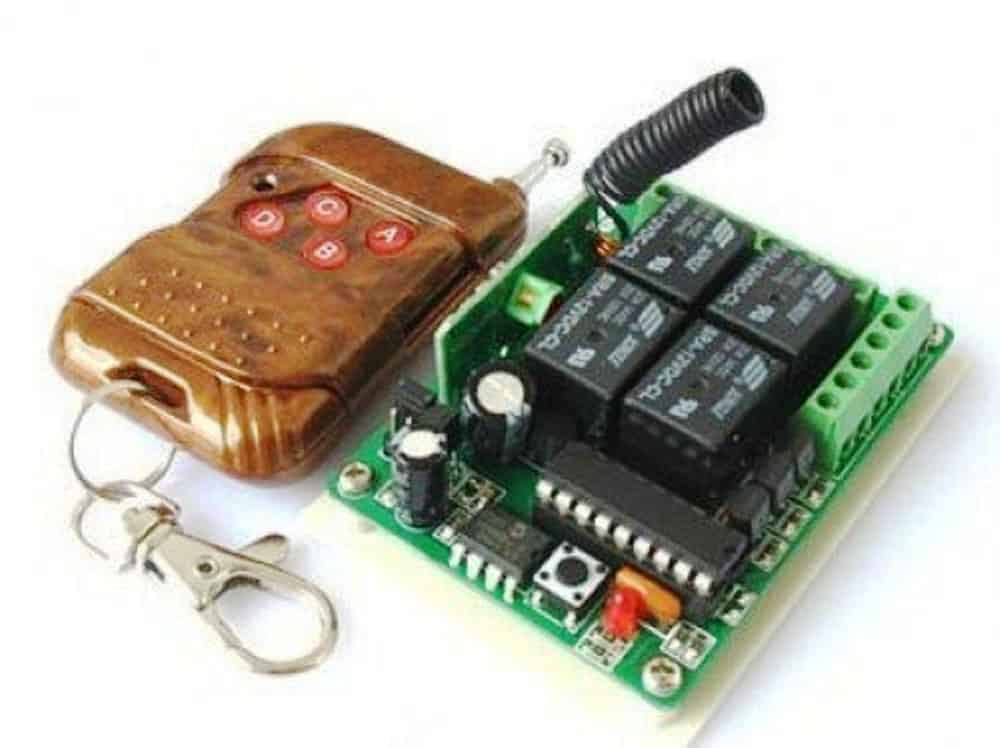
The relay outputs are very neatly terminated at the edge of the module using connectors. You just have to identify the respective pin outs and wire the electrical loads across these connectors as per your own specifications.
Where this Remote Control can be Used
The remote control can be very effectively used for remotely operating shutters, water pump motors, garage doors, apartment gates and doors, it can be also used in cars and vehicles for locking doors and ignition systems.
You may also find these gadgets useful for controlling household electrical items like lights, fans, ACs, and other similar gadgets just by a press of the respective buttons.
The Code Hopping Feature
Another cool feature with these advanced remote control systems is the code hopping feature which makes the signals generated from the transmitter absolutely fool proof.
The codes are automatically changed and made compatible with the transmitter and receiver making it impossible for the hackers and other malicious agents from copying your secret remote transmissions.
Ans whats more, in case your transmitter handset is lost, the system also incorporates a "code learning" operation, which enables you to interface any different remote with your existing receiver by pressing a single push button situated inside the receiver module....once the receiver and the new transmitter "shake hands", you can use them together very safely as these both units now become "made for each other".




Questions & Answers
Hello Swagatam.
I am using one of these 433 MHz modules for remote ignition of my pyrotechnics.
The receiver simply runs from a 9v battery, which also feeds through the CO+NO relay points to which the e-match is connected. The shorting of the e-match is so short in duration as to be negligible, and this simple arrangement works ok.
Without an external antennae the effective line-of-sight range of the transmitter/receiver pair is ~20m.
However:
For the next stage of the project I need greater distance/standoff and I want to connect the e-match via 6~10 metre wires, and the resistance of these is too great for a 9v battery to ignite the e-match.
I was wondering about using the CO+NO points of the relay to direct a high Joule through the 6~10m length, to the e-match.
Perhaps something similar to what was used in disposable cameras to fire the flash tube?
Perhaps the flash tube idea isn’t practical?
Would you be able to devise a voltage multiplier, also powered by main battery(ies) that power the receiver and relay, but with the closing of the CO+NO contacts delivering this high voltage/Joules capable of traversing through the 6~10m length of wire pairs?
The 6~10m wires would be 18AWG (regular speaker wires).
I intend to place everything inside a suitable project box.
I also intend to dispose of the 9v battery as I have a battery housing capable of holding 3 x 18650, 5500mAh, Li-io batteries.
This battery housing is of standard design, allowing for 3.7v, 7.4v, and 11.1v connections.
Hopefully I’ve been able to translate my thoughts in a reasonably succinct manner, and I look forward to hearing from you.
Hello Graeme, you can try the following simple voltage multiplier circuit and check if it works as intended or not: Let me know how it goes?
https://www.homemade-circuits.com/wp-content/uploads/2021/10/555-voltage-doubler.jpg
Dear Swagatam
I love you articles.
Please can you provide me with an RF remote control circuit that is capable of switching on/off, adjust/regulate the speed of my Fan and swing to a desire position.
Dear Chalain, I don’t have it it right now, but I will try to design it and provide it to you soon
Dear Swagatam,
What are wonderful person you are. Your instance response is amazing.
Thank you very much Sir. I am looking forward to seeing it.
I am grateful.
No Problem Chaplain, you can try one of the concepts explained in the following post:
https://www.homemade-circuits.com/simple-remote-controlled-fan-regulator/
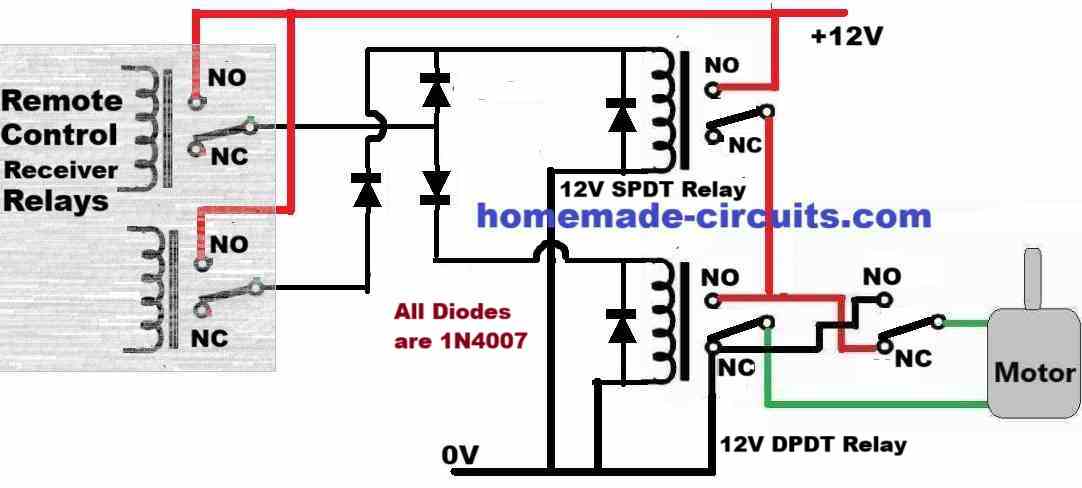
For RF control, you can probably eliminate the entire BC557 and TSOP sensor stage, and connect the pin14 of the IC 4017 with the relay contact of the RF remote receiver unit for implementing the required speed control
Dear Swagatam:
Most picrures of 433Mhz receivers show a coiled antenna. Would I get more range if I stretched out the coil to a long straight antenna form.
Also, would I get even more recption range if I replaced the 1/4 wave antenna with a Full Wave antenna.
Dear Victor, the coiled or straight structure of the antenna do not determine the range, rather it’s the length of the antenna that may vary the range. Longer wires can enhance the range to a great extent.
Hello, i want to make a drone for a class project, but i need to make the circuit by myself, do you have any drone circuit diagrams?
Thanks
Hi, you can try the following simple concept:
https://www.homemade-circuits.com/simplest-quadcopter-drone-circuit/
pls sir i did not see d circuit diagram of dis ur circuit
Hello Swagatam,
I am interested in building a remote release for my trap shooting club. I tried to use a garage door opener to release the clays but it was too slow. there was a delay between pushing the button and the release of the clay. I need a very fast signal, can you suggest anyting here?
Hello Dan, I think the selected solenoid machine is not strong enough, you must try a stronger solenoid which would be able to "shoot" at a greater speed and force
Hi Swagatam,
I hope you're still responding questions regarding this thread. I'm currently trying to work in a project with the following requirements
I need a master RF remote control with one single channel and I want to simultaneously turn on 4 LED lamps distributed through my room. This means that every lamp should be in sync with the master Tx.
I was thinking to buy 3 sets of these Tx and Rx that you describe in this article and then pick one transmitter as the master and sync up the 3 receivers with that transmitter with the "code learning" function…
Kindly provide your thoughts as to what would be the best approach for my project.
Thank you
Leo Barradas
Hi Leonel.
yes I think that's possible, you simply have to sync up the Rx with the Tx using "code learning" feature and then you can toggle each Rx with the same remote, by pressing the relevant buttons and switching the corresponding relays.
Dear Mr. Majumdar,
Is it possible to control the speed of the fan with this circuit? If, so please show the process,also show the 240 V input/out.
Regards,
Dear Mr. Ghosh, it might cost you around Rs.800/- doesn't look worthwhile to me.
but it's possible..and the procedures could be too lengthy….
Hi,this is vineeth gurudev !
I am a Btech first year student .I am very eagered and intrested in making remote based operators.my problem is that i don't know about the circuits of different types which are used in remote controlling and i don't know which circuit gives which type of out put.so can u please explain me in detail from basics as iam am a primary learner.
Hi, a remote control device involves a lot of complex electronics, so you will have to first learn the basics of electronics and then think about learning remote controls….it could take many months and years for the course to finish.