In this post I will try to explain the making of a simple 220 V, 120 V AC mains short circuit breaker using an SCR and a triac combination, (researched and designed by me).
The circuit is an electronic version of the normal main circuit breaker MCB units that we use in our homes.
Note: I did not use a relay for the cut-off, because relay contacts will simply fuse with each other due to heavy current arcing across the contacts during a short circuit condition, and therefore it is highly unreliable.
Why Short Circuit in Homes Can be Hazardous
A short circuit in a house wiring may appear to be something which happens very seldom and folks aren’t too interested to get any relevant precautionary measure installed in their houses and take the hazard very casually.
However once in a while due to some accidental fault, a short circuit in the mains wiring becomes inevitable and it the happening causes a disaster and huge lose.
At times the consequence leads to fire hazards and even lose of life and property.
WARNING - THE PROPOSED CIRCUIT IS NOT ISOLATED FROM MAINS AC, THEREFORE IS EXTREMELY DANGEROUS TO TOUCH IN UNCOVERED POSITION AND WHEN POWERED.
Though many types of short circuit breaker units are available ready made in the market, these are generally very costly.
Moreover an electronic hobbyist will always want to make such an equipment all by him and enjoy its display in the house.
Electronic MCB Circuit Using a Solid State MOSFET SSR
This promising electronic MCB circuit is designed by me, which works as series solid-state electronic circuit breaker for 220V AC mains. It is connected in line with mains, so when it cuts, load is fully disconnected.
Audio/Video Representation
Circuit Diagram
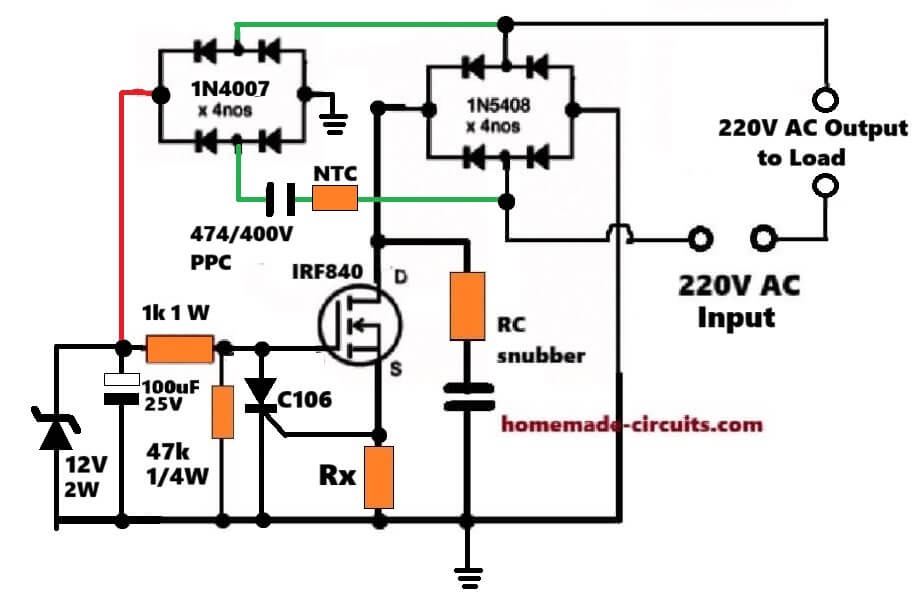
How MOSFET And Bridge Rectifier Work
MOSFET together with bridge rectifier behaves like bidirectional solid-state relay. AC input is applied in series with load, and load is connected across 220V AC output terminals. As long as MOSFET remains ON, mains power flows normally to load, nothing blocked.
DC Supply And Normal Operation
Small DC supply is taken from mains using dropper resistors and 12V zener. This DC is only for MOSFET gate bias and sensing circuitry, not for load. Under normal conditions MOSFET gate gets enough voltage, so IRF840 stays fully enhanced. MOSFET stays conductive during both half cycles of AC waveform, therefore load runs normally.
Current Sensing Using Rx
Load current flows through low-value resistor Rx at MOSFET source. During normal operation, voltage across Rx is very small and stays below SCR trigger level. So SCR remains OFF and MOSFET gate bias stays safe.
What Happens During Overload Or Short Circuit
When overload or short circuit happens, then load current rises sharply. Because of this, voltage across Rx also rises. When this voltage crosses SCR gate trigger threshold then SCR fires and latches immediately.
As soon as SCR turns ON, then it pulls MOSFET gate to ground. Gate-source voltage collapses, MOSFET goes into cutoff. Since MOSFET is in series with mains, turning it OFF instantly disconnects load from AC supply.
SCR stays latched even after overload disappears, means that MOSFET remains OFF permanently. So power must be removed briefly to reset circuit and bring it back to its original condition. This gives proper breaker-like behavior and protects mains wiring and load from overheating or damage.
Mathematical Derivation Of Rx
Trip condition depends on SCR gate trigger voltage.
For C106 SCR
Typical gate trigger voltage ≈ 0.6V to 0.8V
Design safely around 0.7V
Basic relation
Trip current = SCR trigger voltage / Rx
Rearranging gives:
Rx = SCR trigger voltage / Trip current
Example Calculations
For 5A trip current
Rx = 0.7 / 5
Rx = 0.14 ohms
For 10A trip current
Rx = 0.7 / 10
Rx = 0.07 ohms
For 15A trip current
Rx = 0.7 / 15
Rx ≈ 0.047 ohms
Power Rating Of Rx
Power dissipated in Rx
Power = I² × Rx
For 10A and 0.07 ohms
Power = 10² × 0.07
Power = 7W
That means Rx must be:
- Low-inductance
- Wire-wound or metal strip
- Rated at least 2× calculated power, so 14W recommended here
MOSFET Upgrade Tips
Here IRF840 works, but it runs close to SOA limits during overload switching. If we use better parts then it can give more reliability.
Direct Silicon MOSFET Upgrades
- IRFP460
- 500V, much higher SOA
- Lower Rds(on)
- Drop-in logic-wise
- STW11NK90Z
- 900V rating
- Excellent avalanche robustness
- Is designed for offline SMPS abuse
SiC MOSFET Options
- C3M0065090D (Wolfspeed)
- 900V SiC
- Very high dv/dt tolerance
- Almost immune to secondary breakdown
- C2M0080120D
- 1200V rating
- Very large SOA margin
- Good for inductive and harsh loads
SiC MOSFETs reduce switching losses, dv/dt false triggering and thermal stress during trip events.
Failure Mode Analysis
MOSFET Short Failure: If MOSFET fails short, then load stays permanently connected and protection is lost. Mitigation is actually simple, so always use upstream fuse or MCB.
SCR False Triggering: Noise spikes or dv/dt can cause false triggering, then nuisance trips may happen. Mitigation is small RC filter at SCR gate or tighter PCB layout.
Rx Open Circuit: If Rx goes open, then no current sensing, SCR never triggers. Mitigation is using robust shunt resistor, avoid thin wire types.
Bridge Rectifier Failure: One diode open gives half-wave operation. One diode short causes MOSFET overstress. Mitigation is using high surge diodes, so maybe 1N5408 is the minimum we should use.
Thermal Runaway: Continuous current near trip threshold heats MOSFET. Rds(on) increases, then shutdown may delay. Mitigation is good heatsinking and keeping Rx threshold margin lower.
Another Cheap yet Promising Electronic Circuit Breaker Unit
A short circuit breaker circuit I have I have explained in this article is indeed a piece cake as far making it is concerned and once installed will provide a life long protection against all short circuit like conditions that might accidentally take place.
The circuit will also safeguard you house wiring against a possible overload conditions.
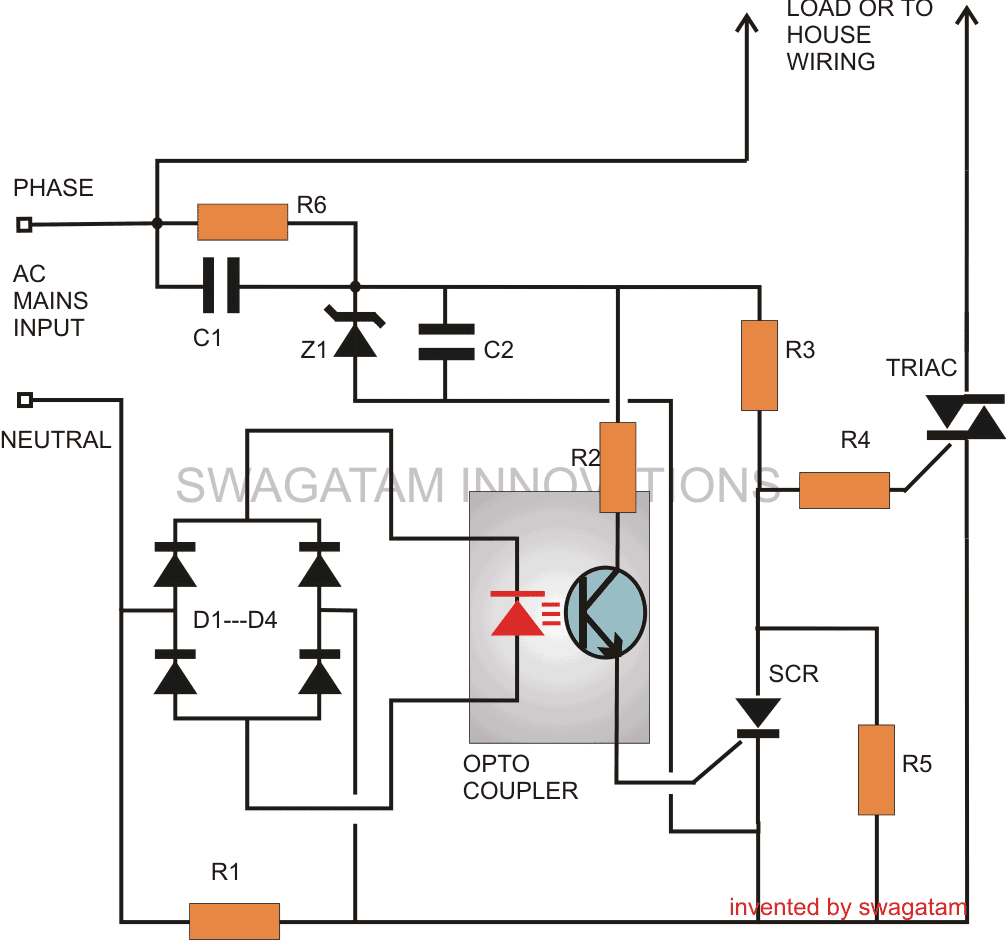
How it Works
The circuit shown in the schematic looks pretty straightforward and may be verbally simulated as follows:
The sensing stage of the circuit in fact becomes the heart of the whole system and consists of an opto-coupler OP1.
As we all know, an opto-coupler internally consists of an LED and a switching transistor arrangement, the transistor is switched ON in response to the illumination of the built-in LED.
Thus the triggering of the transistor which forms the output of the device takes place without any physical or electrical contact rather through the passage of light rays from the LED.
The LED which becomes the input of the device may be switched through some external agent or a voltage source which required to be kept aloof from the output stage of the opto-coupler.
Why an Optocoupler is Used
In our circuit, the opto coupler LED is powered through a bridge network which obtains it voltage source from the potential generated across resistor R1.
This resistor R1 is connected in such a way that the AC mains current to the house wiring passes through it and therefore any over-load or over-current is subjected over this resistor.
During an over load or short circuit conditions, the resistor instantly develops a potential across it, which is rectified and sent to the opto coupler LED.
The opto LED immediately illuminates, switching ON the corresponding transistor.
Using an SCR for triggering the main Triac Cut out Stage
Referring the circuit we see that the opto transistor’s emitter is connected to the gate of an external SCR, whose anode is further connected to a Triac's gate.
During normal conditions, the triac remains switched ON, allowing the load connected across it to remain operational.
This happens because the SCR remains switched OFF and allows the triac to acquire its gate current through R3.
However in case of an over load or a short circuit, as discussed earlier, the opto-coupler transistor conducts and triggers the SCR.
This instantly pulls the gate potential of the triac to ground, inhibiting it from conducting.
The triac immediately switches OFF, safeguarding the load and the house wiring to which it is configured.
The SCR remains latched, until the problem is rectified and the circuit is restarted.The section comprising C1, Z1, C2 is a simple transformerless power supply circuit, used for powering the SCR and Triac circuit.
Parts List
- R1 = iron coiled wire; its resistance is calculated to produce 2 volts across it at the determined critical load conditions.

- R2, R3, R4 =100 Ohms
- R5 = 1K,
- R6 = 1M,
- C1, C2 = 474/400V
- SCR = C106,
- Triac = BTA41/600B
- Opto-Coupler = MCT2E,
- ZENER = 12V 5W
- Diodes = 1N4007
Another Improved Design
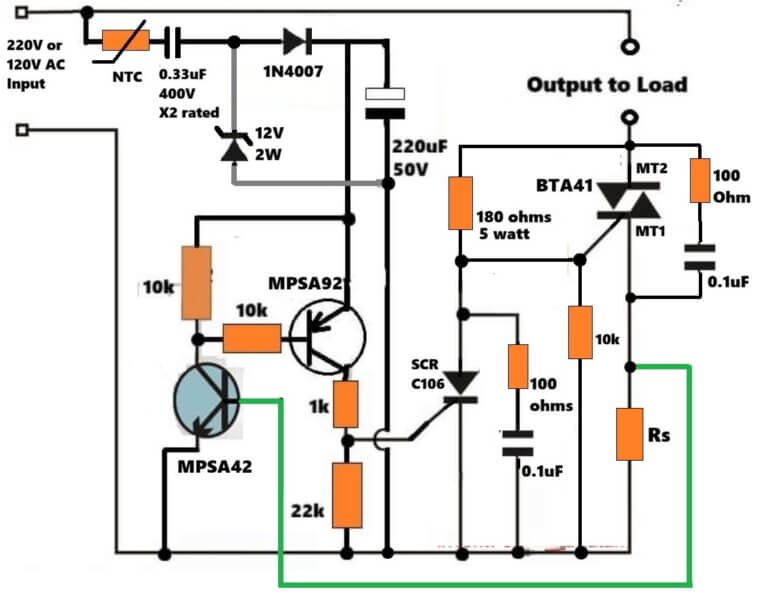
This design protects the load from sudden short circuit, heavy overload, and inrush surge. When fault happens then it reacts fast, so the load stays safe.
AC 220V or 120V enters through NTC. When power is ON then NTC limits initial surge. After that 0.33uF / 400V X2 capacitor drops current, 1N4007 rectifies, 12V 2W zener regulates, 220uF filters. So now around 12V DC is available for control section only.
Load is in series with BTA41 TRIAC. When gate gets trigger then it conducts AC. If gate drive is removed then it turns OFF at next zero crossing. The 100 ohm + 0.1uF snubber and 100 ohm 5W resistor suppress spikes. If noise appears then false triggering is prevented.
Rs is in series with load return. If load current increases then voltage across Rs increases. That voltage goes to MPSA42. Under normal load voltage is small, so MPSA42 is OFF. If overload happens then voltage rises and when it crosses base-emitter level then MPSA42 turns ON.
When MPSA42 turns ON then MPSA92 activates. This triggers C106 SCR, which then diverts gate drive from TRIAC. If gate drive is removed then TRIAC stops at next zero crossing so load disconnects.
Since SCR is latching, once it turns ON then it remains ON. To reset, mains must be switched OFF and ON again.
During short circuit, current rises sharply, then Rs voltage rises, MPSA42 turns ON, MPSA92 activates, SCR triggers, TRIAC gate drive is removed, TRIAC stops, load disconnects.
BTA41 is used because it handles high current and heavy load.
This circuit works directly on live mains. No isolation. Therefore handling must be careful.


Questions & Answers
I wasn’t certain about the value of R1, so I chose a very low resistance of 0.01 ohms (a wire strip). I suspect that it was too low a value??
Yes, because of that the circuit did not respond. R1 is the crucial element, which decides the tripping action of the circuit.
The formula is R1 = 0.6 / Trip Current.
So if let’s say the max trip current is 1amp, then R1 = 0.6 ohm
wattage will be 0.6 * trip current = 0.6 watts or 1 watt.
Hello Sir,
A very interesting circuit. How could it be modified to handle an input voltage of around 20V AC, with max operating current of around 5A?
Kindest Regards,
Leno
Thanks Leno,
Is your load a DC load or AC load? Please specify, I will try to figure it out…
Hi Swagatam,
Thank you for replying.
It would be an AC load consisting of one or more DCC (Digital Command and Control) chips, as used on a DCC Model Railway. A DCC controller supplies the source AC voltage (which also contains coded information). This AC voltage is fed to all the track circuits at once. If one track circuit gets a short across it, then all the other track circuits will short at the same time. The idea is that each ‘circuit’ gets is own protection. Hope that helps?
Thank you Leno, for the clarification,
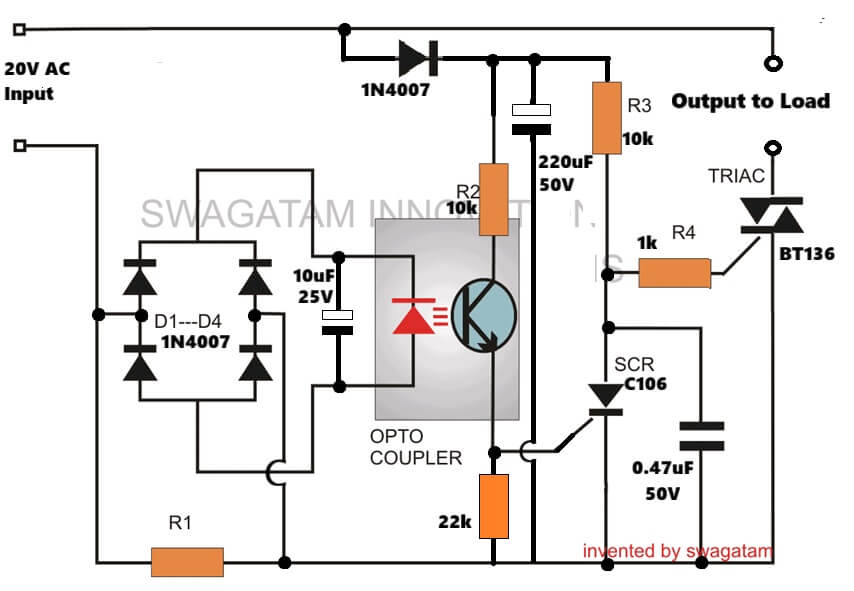
In that case, the think the following design should be able to fulfil your requirement, let me know if it works or not:
Leno, the circuit can be further simplified in the following manner:
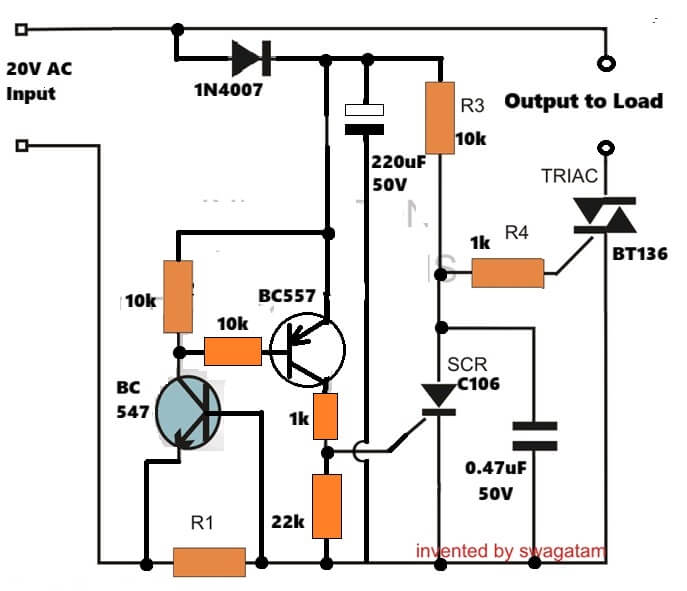
Thank You,
Please give me a bit of time to acquire the components, and put it altogether, and I will get back to you ASAP.
Sure, no problems, all the best to you…
Hi Swagatam. My apologies for the abnormally long delay in getting back to you.
Unfortunately, the (simplified one above) circuit does not work, and there are at least two reasons why, which revolve around the supply voltage from the DCC Controller:
1. It is actually a 10.8V AC supply, and not 20V – that was my mistake! I don’t have a scope, but I believe the Controller O/P is a square in nature.
2. The actual DCC Controller that produces the 10.8V already has its own built-in short circuit protection, which is kicking in before the proposed circuit can do anything!!
Would you have any ideas to overcome this, without modifying the DCC controller?
I need to have at least three of these circuits with their inputs in parallel with each other.
Thanks Leno,
If your external supply DCC is getting turned off, then it is not the fault of the SCR circuit which I proposed.
It seems your DCC controller is too sensitive and therefore it is turning off first, before our SSCR/triac circuit can respond. The SCR/triac circuit will be naturally slower because it is designed for high current triggering operations.
Actually, for a 10.8V supply the proposed SCR/triac is not suitable at all…do you want to me to design a new circuit for your 10.8V AC system, which will be faster than your DCC controller.
However, I am wondering if your DCC already has a short circuit protection, then what is the need for another external short circuit protection?
Please let me know, then we can proceed accordingly…
Thanks for your prompt reply. I agree it seems counter intuitive given that the DCC Controller has it built in, and that’s fine if all you want to do is control one Circuit ( where “Circuit” = One DCC Locomotive). The issue arises when the DCC Controller is controlling more than one Circuit simultaneously (which it can happily do up to 255 times, subject to its max load of about 5A) , so if it was controlling say 3 Circuits and one of them shorted, then the other two would also stop functioning, until the one short was removed/corrected.
I hope that clarifies the purpose of the intended circuit, of which I require at least 3 of so that I can run 3 locomotives simultaneously and if I get a short on/across one of them, not worry about the other two as they will still be active
Thanks for the detailed explanation.

In the following diagram, what value did you use for R1? R1 value is crucial and determines the sensitivity of the circuit.
hello swagatam i am wondering if it is possible to add some sort of adjustable amperage setting to this. thanks for your comment in advance nice circuit too.
Hi Michael,
It can be done by replacing R1 with multiple parallel resistors of different values corresponding to different current ranges, and then use a rotary switch to select the appropriate resistors, as per requirements…
Sir, is there wattage rating for resistor used in this circuit?
How many ampere does a diode required?
Would love to know.
Hi Warrene, all resistors are 1/4 watt 1% MFR rated…
Diodes are 1N4007.
Good morning sir, I am fascinated with this particular invention of yours. I would like to adopt this invention and embed in our system we are working on.
If i may, could you please narrate how each components work.
I would like to cite you as the inventor of this particular module.
I would love to have your positive response. If you have a complete circuit diagram of this. You can reach me out at [email protected] or at my personal email at, [email protected].
respectfully,
DWPA
Hi Denmark, the circuit works in this way:
C1 drops mains current to a lower acceptable level.
Z1 regulates the half cycles to 12V and sends it to C2.
C2 filters it to make it clean DC 12V.
R2 sends this 12V DC to opto coupler transistor, R3/R4 sends this 12V to the triac gate.
The triac now turns ON with this 12V gate voltage and operates the load.
When an overcurrent or overload happens, this high current passes through R1 and causes an proportionate amount of AC voltage to develop across R1.
This small voltage is rectified into DC by the D1—D4 diodes and applied across the LED of the optocoupler.
Due to this opto LED lights up and turns ON the internal transistor, causing the 12V from R2 to enter the gate of the SCR.
The SCR now turns ON and latches ON permanently, and this grounds the gate voltage of the triac, turning it OFF, and this also turns OFF the load, preventing the overcurrent situation and any kind of fire hazards.
Good afternoon sir, i did a simulation at multimism simulator environment and the circuit works, the problem is that the R5 must be at 3W for it to work, else if 0.25 W is used, the R5 will be toasted under normal operation.
Thanks Denmark, are you referring to the R1 current sensing resistor, because R5 does not need to be 3 watts, it can be simply a 1/4 watt resistor. R5 has R3 in series so it can never burn…
It seems off, since in the simulator the voltage running on R5 is almost 16-17V which make the resistor getting toast. I’m not quite sure if the simulator has a problem in the logic side, meaning the simulator is not that accurate. Though the logic that cuts the power when overload occurs is there, and that’s a good scenario.
Also, kindly leave your full name sir.
TIA.
Respectfully,
D.W.P.A
Thanks for your analysis, I think the simulator is correct. The high voltage may be coming through the triac gate during the negative cycles. Please try replacing the R5 with a 0.1uF/400V PPC capacitor. This R5 or the capacitor just ensures a stable gate signal for the triac.
My full name is Swagatam Harry Majumder.
no protection exist for a phase to ground fault! The ground wire may neede no protection
Hi Mr. Swagatam;
As known we use a serial bulb for safety measurement against if the circuit is short / faulty. So far I used that practice for the 220V AC circuits But now this time I need to test the 110V AC circuit and all the bulbs which I have are for the 220V AC purpose. Is it possibe to use parallel 2 bulbs for the 110V circuit test?
Hi Suat, that looks OK to me. You can use two 220V bulbs in parallel to create an 110V equivalent.
Hi Swagatam;
As the sample there is a circuit in which AC 220 and DC 5 V are together at the PCB as in the circuit AC load with BT136 triggered by DC volt. It is possible to say about that for example the DC electronic parts would be negatively affected by AC voltage(i.e. magnetic field interaction). So we should add some parts to circuits like coils for the isolation of AC and DC. Kind Regards.
Hi Suat,
for the components there will be no effect at all, but for a human it can lethal to touch any point in the circuit.
When you use a triac with a DC circuit without an optocoupler then you will have to involve one AC line as the common line in the circuit. It is a standard practice.
There’s no need to add any extra parts in the circuit.
Sir, how can i achieve this the same purpose ( short-circuit, & over current protection) using arduino ?
Godstime, My Arduino knowledge is not good, so not very sure how that can be done!
Okay.
Thank you sir.
Goodnight
In the circuit, you can replace the scr and transistor optocoupler with an scr optocoupler, such as 4n40 that already has scr internally
Thanks in advance for your attention
Yes, I think it can be worth trying an optocouper with an internal SCR, so that the external SCR can be avoided.
Goodnight
thanks for the answer
The circuit is not tripping..
What should be done now????
Is the SCR switching on when the maximum current limit is reached? You can connect an LED in series with R2 to check this….If this LED does not light up means your opto is not working or there’s some other fault.
Hey,
We practically made this practically but a problem is there The MCB is tripping before this ckt.
So what should we do now???
Hi, to verify the working of the circuit, you can increase the value of the resistor R1 to some higher value. MCB is highly sensitive and fast so it may trip quickly…increasing R1 might help to complete the preliminary tests.
Can’t we replace R1 coil with a simple resistor??
If yes then how to calculate the resistance of that resistor or which resistor to use as R1
R1 handles the full output load therefore needs to be rated high, depending on the load current. You can try a wire wound resistor, using the following formula:
R1 = 2.2 / tripping current.
Assuming tripping current is for 2000 watt / 220V load, then 2000/220 = 9 amps or 10 amps.
R1 = 2.2 / 10 = 0.22 ohms
wattage will be 2.2 x 10 = 22 watt.
so yes using a wire wound resistor is feasible for R1.
Can you please tell me which wires to use to build this ckt. And how to safely test it…
I want to do this as my Minor Project in my Diploma Course..
Sorry I did not understand what you meant by “wire”….by the way this is not a minor project, since it involves AC mains which is not isolated and there may be a possibility of a fire hazard if not done correctly.
This circuit is recommended for the experts who know how to handle mains AC circuit safely.
Ok, advice taken..
So can you please suggest me a good idea for the project.
You can go with any project which is not dangerous in terms of shock or fire hazard. There are plenty of projects already explained in this site….you can select any one of them…
Hello,
I didn’t understand how the voltage cross the diode bridge to the led of the opto coupler since the diodes are opposite to the voltage direction.
Can you explain it please?
Thank you
Hello, yes the opto LEd polarity is wrongly shown in the diagram, it should be the opposite way….LED anode towards to the bridge cathodes, and LED cathode towards the bridge anodes
The LED voltage is 6V, the AC current I want to draw is 2A, so the R will 3ohms. Sir, is this correct.
Also, how can I make the iron coil and measure it.
Please Swag, Is there any easier way.
Thanks Sir
The LED voltage looks too high, the LED voltage should not eb more than 2V. So please change the LED accordingly.
for 2V, the value of the resistor will be 2 / 2 = 1 ohm / 4 watts
please Sir, does diode in series with circuit breaker affects sensitivity, because it didn’t break as before with overload, all MOSFETs blew. And I need the diode to be there.
Seun, which schematic are you referring to?
No schematic, I just connected diode to circuit breaker to give unidirectional path. Please does that affect as requested above.
without seeing the schematic and the position of the diode it can be difficult to tell how the MOSFETs blew.
Just asking does diode affect sensitivity of breaker, because there was a short circuit from a load that affected the MOSFET and the breaker failed to trip off,which used to trip before the diode was placed.
If you connected it in series with the DC supply of the circuit then it is not supposed to affect the working of the circuit
I’m trying to simulate the circuit on Proteus I can’t find the right Optocoupler components that you used. Kindly help me out with the right value. Thanks
Hi ,sir
Can you attached the simulation of this circuit here . I’m trying to simulate it in NI multisim but there is a lot of missing details of the components .I really want this simulation please.
Hi Ahmed, sorry I cannot simulate it for you, however, if you want to know about any part specifications, I can help you in that regard.
Hi Swagatam,
The trick the user in the circuit how many time take power OFF and power ON.
sorry sabah, I did not understand your question correctly!
Please how can I make R1
wind copper wire on an iron core until its resistance value becomes equal to the value obtained by the Ohm’s law result:
R = V/I
here V is equal to the LED forward voltage rating, and I is equal to the maximum current at which the cut-off is required.
Good day Sir, please sir what is the value of LED Voltage rating to calculate R1.Thanks
Hi Seun, the LED is inside the opto-coupler, the specifications can be checked from the datasheet of the selected device….
Please Sir What is the size of the iron core . thanks
Core size is not important, only the resistance value is important and the wire gauge is important, use a 0.5mm thick wire.
I think an iron wire will work much better, and will satisfy the resistance value with minimum turns.
Three solutions to turning off quicker than a half cycle. First, use an inductor to inhibit rapid current changes to the point that your circuit can switch off. Second the old school way is forced commutation…add a reversed SCR to short out the “main” SCR and force it open. There is a reason these aren’t used anymore. Third option is use something that can both close and open like power MOSFET’s, SiC JFET’s, or IGBT’s.
Thanks for updating the information, appreciate it!
The second option looks more feasible and technically viable.
There are commercial static breakers on the market. DC breakers meet some tough FAA requirements at better pricing since DC breakers don’t get zero crossings. There is one company in Charlotte in early commercialization stages with an AC one. I think they’re current limiting such as opening an IGBT bypass around an inductor just behind dc/dt snubbing so that the IGBT filter is small and the SCR/TRIAC valve survives. They said they can soft start for free. By itself it is not cost effective but as an all in one breaker/soft start it has very realistic possibilities.
The triac will be ON until zero cross occurs even gate control is trying to turn it OFF.
Therefore, a short circuit will break the triac within 10ms (50Hz).
Please check the datasheet of the triac and check for how long the triac can withstand as high as 200 amps
I want to know sir that is possible we use scr rectifiers to get the desired dc control output. I work on it since two weeks but i cannot get the control output if you have any knoldge about it kindly share with me. It is the part of my fyp.
Thank u sir for the answers. On more question: after the short circuit occurs and the scr triggers shutting down the circuit, will the circuit automatically restarts it self? And and to which time duration? Or one need to restart the circuit manually, and how can one modify the circuit to circuit to restart within short period of time? Thanks
You are welcome Solomon,
The circuit will not restart automatically because the gate SCR will be latched.
You will have to switch OFF power and switch it ON again for restarting the circuit
remember this circuit has not been tested practically by me, so proceed with caution.
Initially use a 200 watt bulb in place of R1, and check by short circuiting the output terminals, if it works then you can replace the bulb with a resistor and proceed identically
Hello sir, im so interested with this circuit, in fact, i bought almost all the components, but i have some problems and questions about the circuit:
1. Does the triac need heat sink?
2. Opto coupler of that number is not available in my is there any alternative for that? Or there any conponent to use insted? Or can any opto coupler work?
3. Capacitor 474, 400v also is in my area, only 474, 680v and 473, 400v, which of the two can i use instead?
Hello Solomon, the replies are as follows…
heatsink will be required if the load is bigger and tends to make the triac hot during normal use.
you can try any 4 pin optocoupler, it is not critical.
474/680V is OK, can be used.
remember this project is very much dangerous so proceed only if you are sure of what you are exactly doing….
hello sir, i was opportuned to get one optocoupler 4N35, But it has 6 pins (anode, cathode, base, collector, emitter and NC), Can it serve same function?
yes it will work, check the datasheet of the opto and then you can select the relevant pinouts and ignore the other irrelevant ones..
Hello sir, can this circuit be modified by adding a piezo buzzer to make an alarm when the shortcircuit occur during operation?
Hi Solomon, a piezo buzzer can be added in series with R2 for the required alarm sound…and R2 reduced appropriate for generating a reasonably louder alarm sound.
when the triac set on , it stay on to end of the cycle and for example if occurs short circuit first of the cycle triac stay on to end of the cycle and for 60Hz it will on for 8.3 ms and it is dangerous and we should find the way to cut off triac immediately after the short circuit. So this circuit can’t protection the load for short circuit
As per the datasheet of the triac it is designed to handle upto 200 Amperes Non repetitive surge peak on-state current (full cycle, Tj initial = 25 °C) t = 20ms
http://www.mouser.com/ds/2/389/bta40-954548.pdf
Hai sir….
Pls tell R1 value and watts sir….
Instead of using TRIAC we can use relay….If u have relay circuit pls give me the link sir
Kesav, relay contacts can easily fuse and stick due to high current arcing across its contacts, whereas a triac can withstand high currents for short durations of time and operate more efficiently…..therefore triac is a better choice than a relay
however remember this circuit is recommended only for the experts in the field.
sir i want to intentionally short circuit an ac L wire with a Neutral wire taken from a wall socket.. my intention is to light a matchstick with the fusing action caused by the above case. The matchstick is followed by a cracker's fuse wire… i have tried connecting 2 MCBs of 6A rated in series to each L and N wires followed by the portion of wires to be shoted.. but what i am getting is Matchstick with the crackers wire is burned, MCBs tripped simultaneously but the main MCB of the room which is situated in the ELECTRIC DISTRIBUTION BOX nearer to the Electric Meter is also getting tripped which is actually not needed at all.. I have used a very thin copper wire to connect between L and N wires…
I dont require any batteries in place of AC.. i need this to be operated with AC only..
I dont need the main MCB to be tripped other than the externally connected MCBs..
please suggest me a better way sir
RT, shorting mains wire in any manner is never recommended, you can do it by charging a high value capacitor through a bridge rectifier and then short this capacitor for getting the required igniting spark.
You can use a 50uF/400V capacitor, charge it using a bridge rectifier made up of 4 x 1N5408, through mains AC.
I hope you are aware of the dangers of playing with AC mains experiments, be extremely cautious while doing all these…..
Good day sir! Can i ask if there would be any alternatives for the triac BTA141a? i live in philippines and this kind of components are really rare. Looking forward to your reply!
Good day Pau, you can try any 40amp 600V triac, or any very high power triac which may be available in your area.
Hi Swagatam
thanks for your quick reply,
yes as per datasheet the bta should not burn.
i guess i ll have one more try on this.
i ll update here after that try,
if that try fails i am thinking to upload the circuit i have made.
soon u hear from me.
thanks and warm regards
Prashant
Hi Prashant,
it's dangerous to put capacitor across the bridge because it may cause a delay in switching ON the opto which we don't want and the prevent the cut off action from happening instantly…..
the latching effect should be permanent and not momentary, otherwise the traic will be forced to switch ON/OFF and subjected to huge short circuit currents….
the circuit concept should be similar to what I have created in the above article, otherwise it will not work.
Dear Swagatam in my circuit tha 1000 uF cap accross the bridge output itself latches the triac in off state for some time..
the 1kohm resistor across it was used to discharge cap. later on i changed that value to a higher one so it will take more time to discharge and ultimately the opto817 will be in on state which will keep moc3021 in off state. in this way we can change the latch time by altering the resistor value across 1000uFcap.
this circuit works well in overload condition. triac gets short in actual short circuit condition
thanks Prashant, wish you all the best!
great thanks Swagatam…
actuallly i was looking for that latching factor…
ok i ll try with that SCR …
its me only 😐 .. i ll try to improve
…the BC557 is also not efficiently configured….so overall it's a badly designed circuit…who did it?
Prashant, I can't see how the trigger circuit in your diagram would latch when a short is detected?…In my circuit the SCR is selected precisely for executing the latching action as soon as a short is detected……moreover the MOC configuration is not exactly as per its datasheet diagram
i am waiting desperately for your say on the circuit…
thanks
Prashant
yes Swagatam i am sharing the circuit on google drive with the following link..
Kindly have a look at it.
https://drive.google.com/file/d/0B-FxLOzhISCQZC14dkJGTEUxa1NlcU1YZng2V0pVdDRzdHdZ/view?usp=sharing
Hi prashant, that's strange, because even if we ignore the 400amp factor still the resistor in series would absolutely prevent the triac from burning…
anyway you can upload it to any suitable picture upload site or in Google drive and post it here for an assessment.
Hi Swagatam,
i tried and triac fried… 😀
btw i m looking to upload the circuit diagram so you can find where the fault is
..
thanks
Prashant
Sure Prashant, all the best to you
Hi Swagatam,
wanted to update you, i already was working on the same purpose but with little different circuit(triac and opto is common factor), i have implemented the circuit and found that it is properly working on overload condition and not for short circuit. what i figured out is the rate of of rise of current in short circuit condition which is very fast. on the other hand triac needs max 10 ms of time to get turn off if considered that ac cycle just started on every zero cross of ac cycle. when short circuit happens the current in triac will increase in less than few microseconds as load resistance is now ZERO ohms i.e. current = voltage/0ohm. and so before getting next zero cross the bta has laready burnt…
so finally after many tries i am thinking to have a try with relay based circuit… need you suggetion
Hi PK,
If you check the datasheet of the triac BTA41/800 it shows the maximum non-repetitive current handling capacity of this triac to be 400 amps for 20ms.
20ms corresponds to one full AC cycle (50Hz), and here we need the triac to hold ON only for 10ms (the first zero crossing).
Moreover 400amps is massive, and I don't think our domestic AC is specified to deliver this much current.
So I think this triac would work fine, furthermore we have a resistance in series so it would be the resistor that would burn first in case the triac fails to fire.
A relay can be worst in such a scenario because a relay will be too sluggish and by the time its contacts are about to changeover, the current might already reach huge values causing a spark across the changeover contacts which in turn would fuse the contacts together making it impossible to move and ultimately burn the contacts
Hi Prashant, no problem, it won't be an issue, my reply under it will probably be enough to make the folks understand regarding the question.
btw i didnt know that my post will be shown as e-blogger ..
hi Swagatam,
by mistake i deleted my post while doing some other things.
should i put the same post again or u ll do something???
Thanks Prashant, yes it seems the opto LED is connected with wrong polarity by mistake…it needs to be connected the other way round.
a current limiter resistor can be included for greater safety to LED, a 50 ohm resistor will be just enough.
Thank u
I have a cdi ckt for 3 wheeler auto using this cdi ckt auto can not pickup its actual speed please help me
which CDI circuit are you referring to?
use a good quality capacitor and SCR…it will surely work….use only BT151 SCR
hi, how we can add delay of 10 seconds to the circuit before it getting starts again?
Hi, it's not designed to switch ON automatically, you'll have to switch OFF and restart the circuit for initiating the circuit and the load.
Hello. I don't know if I'm wrong, but the optocupler's LED is not connected in the wrong way? How can it light if the bridges diodes don't allow current to pass through it?
hello, that's a drawing mistake, obviously the anode needs to be connected to the bridge positive.
Hello,
Please, check Triac will be on until zero cross even gate control try to OFF.
So, Short Circuit will be broke Triac within 10ms (50hz).
Thanks, yes you are right!
immediately i am unable to find a solution for this, I'll think and try to figure some appropriate remedy
Have you found any solution yet..
It will require a small pulse transformer in series with the SCR, which will provide a negative pulse to the triac to switch it OFF instantly….but the results will need to be confirmed practically.
If you have used a 7805 IC then any external protection would not be required as the IC has built-in protections from short circuit, overload and also high voltage.