In this post I have explained a simple configuration which can be used as a automatic changeover circuit for switching AC grid mains to generator mains, during power failures or outages.
The explained circuit will effectively switch the connected appliances to the generator mains during power failure however it won't be able to switch start the generator automatically, this will need to be done manually, because most generators involve a difficult mechanical actuation procedure.
How it Works
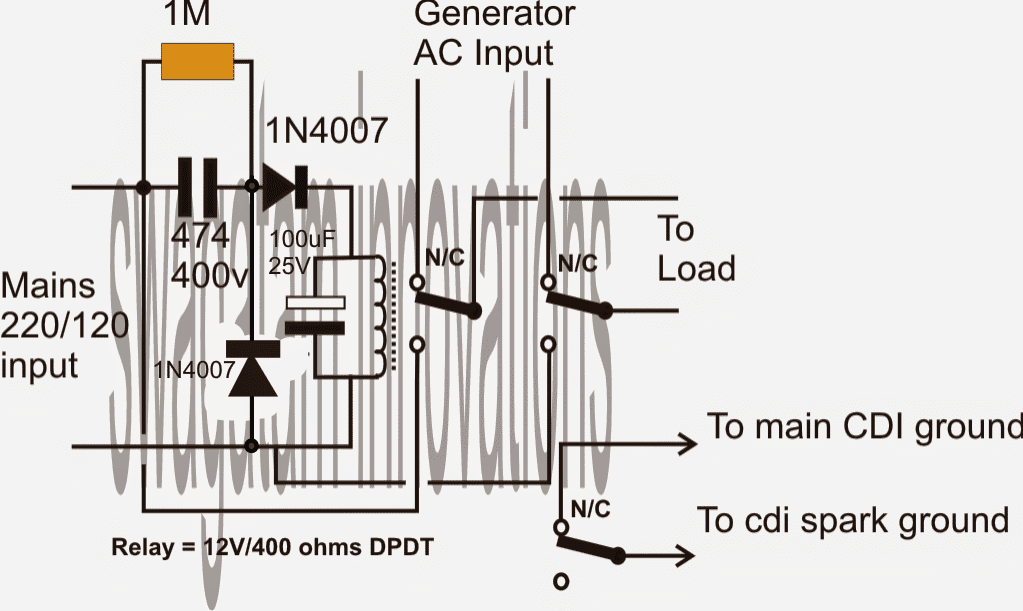
Referring to the given diagram we can see a simple circuit comprising of a TP relay (triple pole relay) as shown below, and a transformerless power supply circuit.

The input of the transformerless power supply circuit is connected to the mains 220V or 120V input.
When mains power is present, the connected relay activates with this power and switches ON the load or the appliances via its N/O contacts.
Conversely when mains power fails, the relay deactivates and connects with the N/C contacts which may be wired up with the generator mains.
Now as soon as the generator is pulled started, the mains finds its way through the connected N/O contacts of the relay to the appliances.
The third set of contacts is used for enabling and disabling of the CDI unit of the generator so that when mains is restored, the generator is automatically halted.
Simple yet effective.....
Circuit Diagram
Analyzing the Part Value Calculations
Voltage Divider Across the Relay (Using 474 Capacitor)
The 474 capacitor (0.47 µF, 400 V) acts as a current limiting element for the relay coil when connected to the AC mains (220 V or 120 V). The current through the capacitor can be calculated using the reactance of the capacitor:
Formula for Capacitive Reactance:
Xc = 1 / (2 * π * f * C)
Where:
- Xc = Capacitive reactance in ohms
- f = Frequency of AC mains (typically 50 Hz or 60 Hz)
- C = Capacitance in farads (0.47 µF = 0.47 * 10⁻⁶ F)
For 50 Hz mains: Xc = 1 / (2 * π * 50 * 0.47 * 10⁻⁶)
Xc ≈ 6,778 ohms
Current Through the Relay:
The current is determined by Ohm’s Law:
I = V / Xc
For 220 V AC mains:
I = 220 / 6,778 ≈ 0.0324 A ≈ 32.4 mA
For 120 V AC mains:
I = 120 / 6,778 ≈ 0.0177 A ≈ 17.7 mA
This current must be sufficient to activate the relay. Check the relays required current (based on its 12 V 400-ohm coil):
Relay Voltage and Power
The relay coil operates on 12 V DC. The current through the coil is:
Irelay = V / R
Where:
- V = Voltage across the relay coil (12 V)
- R = Relay coil resistance (400 ohms)
- Irelay = 12 / 400 = 0.03 A = 30 mA
This means that the capacitor-limited current (calculated above) has to be greater than or equal to the relay's required operating current of 30 mA for 220 V mains.
Diode Rectification
The diodes (1N4007) rectify the AC voltage into pulsating DC for the relay coil. The peak DC voltage after rectification is:
Formula for Peak Voltage:
Vpeak = Vrms × √2
For 220 V AC mains:
Vpeak = 220 * √2 ≈ 311 V
For 120 V AC mains:
Vpeak = 120 * √2 ≈ 170 V
However the relay sees only the voltage dropped across the capacitor and rectified output which limits the current to safe levels.
Filtering Using 100 µF Capacitor
The 100 µF capacitor smooths the rectified pulsating DC into a steady voltage for the relay.
The ripple voltage can be estimated using:
Ripple Voltage Formula:
Vripple = I / (f * C)
Where:
- I = Current through the capacitor (relay current, ≈ 30 mA)
- f = Frequency of rectified signal (100 Hz for full-wave rectification in 50 Hz mains)
- C = Capacitance in farads (100 µF = 100 * 10⁻⁶ F)
Vripple = 0.03 / (100 * 100 * 10⁻⁶)
Vripple ≈ 3 V
3 Phase Grid to Generator Changeover Circuit
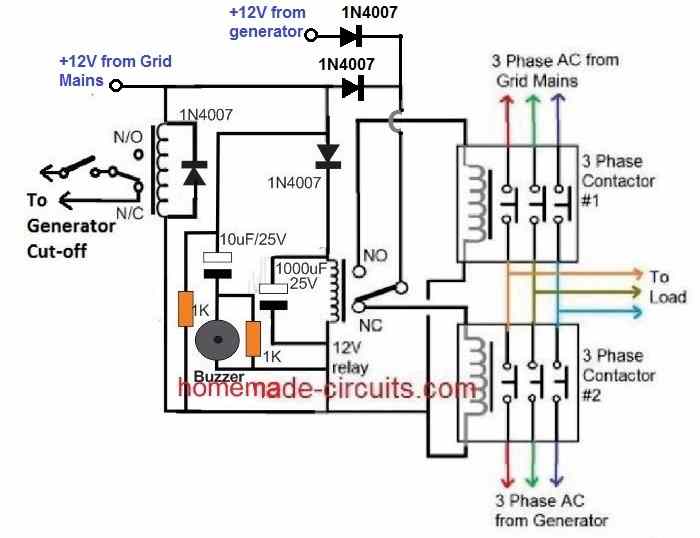
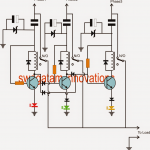
The following diagram shows how a 3 phase grid to generator changeover can be implemented using a couple of 3 phase contactors.
How the Circuit Works
Let's assume mains AC is not available, and generator is switched ON by the left side relay.
In this situation the center relay will be deactivated, and its pole will be connected with its N/C contact, so that the +12V DC from the generator passes through the N/C contact and actuates the bottom/right 3 phase generator contactor.
The top/right grid mains contactor remains switched OFF due to the absence of a +12V DC.
Therefore, the generator AC flows through this bottom/right contactor and operates the connected appliances or load.
Now, suppose the mains grid AC restores.
The left side relay activates and turns OFF the generator. Also, simultaneously the center relay switches ON through the +12V from the grid mains.
The center relay pole now shifts from N/C to N/O, so that the +12V from the mains grid AC passes through the N/O contacts and actuates the top/right contactor. The bottom/right generator contactor is simultaneously switched OFF.
With the top/right contactor switched ON, the grid AC now becomes available to the load.
Again, if the mains AC fails, the left side relay deactivates, switching ON the generator procedures, the center relay connects with its N/C contacts, turning on the generator 3 phase contactors and turning OFF the grid contactors.
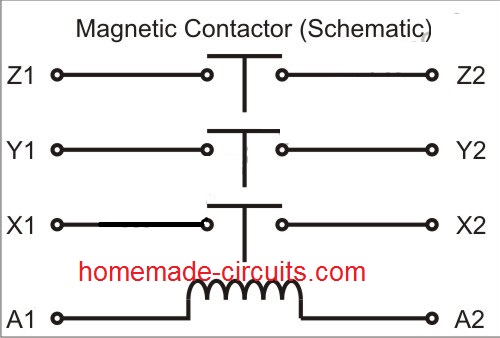
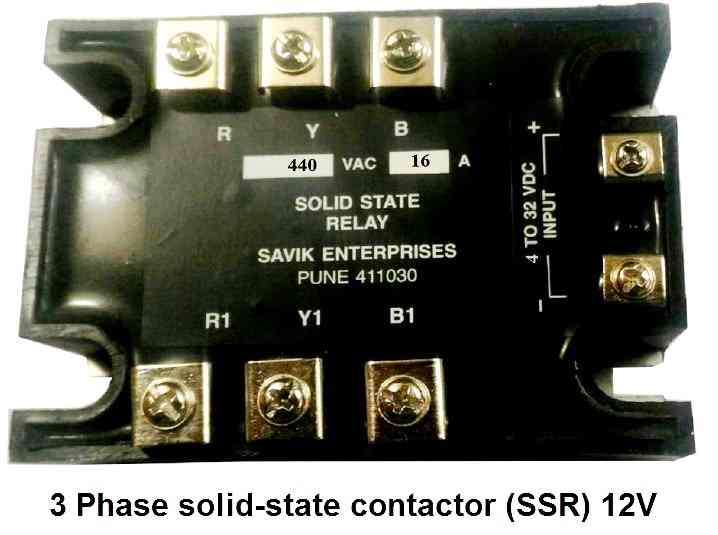
If you are unable to get the above 12V electromechanical relay/contactor, you can go for a 3 phase SSR contactor instead, as shown below.



Comments
Hi, I have four questions:
1. What are the current ratings of the two contactors?
2. What is the current rating of the relay?
3. From the above diagram, I guess it can be used for kick starter generator? And if so, why is there no stop wires/terminal to switch off generator manually the way there is start wire in the diagram?
4. How can a timer and buzzer be incorporated into the diagram?
I look forward to each of the answers, thank you.
Hi,
The contactor current rating will be as per your generator specifications
The 12V relay can be any small 12V 5 amp relay.
I have only presented a rough idea regarding the changeover stage, for specific applications you may have to add the required adjustments by your own.
The last circuit already has a timer in the form of the base 1M/100uF components for BC547, buzzer can be added in parallel to the relay coil
Hi, how are you doing? How do you connect the generator to start automatically the moment mains is absent when you are home?
2. How do you install a by pass or off switch to stop the generator from coming on automatically when you are not home?
I have already explained the start/stop connection details with the N/C, N/O points of the relay in one of the the earlier comments.
Sure, the generator has a rechargeable battery. How can I connect those relay controls? Thank you.
Ok. As you know that there are two 555 ICs (one for stop and the other for start). How will they fit in on the left relay in terms of NC and NO? Unless there will be two left relays to accommodate the start and stop? What do you think? Thank you.
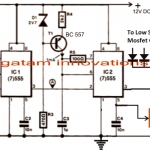
The pin2 of the IC 555 “start” circuit will connect with N/C. The pin2 of the IC 555 “stop” circuit will connect with N/O.
The pole of the relay will connect with the ground line, which must be common to the changeover circuit and the IC 555 circuit both.
The supply to the IC 555 circuit should be from the battery, and the supply to the changeover circuit should be from an AC/DC adapter
In that case, connect the circuit positive with the battery positive and negative with battery negative, and connect the N/C, and N/O contacts of the left side relay with the Ic 555 pin 2 as explained in my earlier comment
.
Yes. But I’m yet to have a full grasp of it especially the left hand relay.
1. What’s the time duration of the timer?
2. Does the generator switches off automatically when mains power come?
3. Does the buzzer sounds the moment mains power come?
4. For every application, what are those components that need to change based on specifications?
The timer delay will need to be tested and tweaked through some practical experimentation.
I have replaced the old diagram with a new one which has the stop switch and the generator cut off arrangement addressed correctly.
For momentary buzzer, you will have to add a 22uF/25V capacitor in series with the buzzer, and a 1 M resistor parallel to the capacitor.
Sorry I have no idea regarding what needs to be for every application.
How do you connect the left relay for generator start and finish operations?
Thank you
Hi, from this link,
https://www.homemade-circuits.com/remote-controlled-submersible-pump/
How can these controls have effect on generator as the relays are connected to the mains? And if mains is absent, how will the relays be actuated?
Hi, that’s correct, in that case you must have a chargeable battery installed with the generator for the initial starting up of the generator, just as we have in motor car ignition systems.
Ok. Another observation is that from the left relay you said “generator cut off” in NC position. What does that mean?
2. Does generator cut negates this information below?
https://www.homemade-circuits.com/wp-content/uploads/2020/06/borewell-automatic-ONOFF.jpg
The info on the relay was intended for deactivating the CDI system of the generator, not for the start stop contactor box operation, so it is not relevant to start stop application.
What do you mean by direct integration?
I know you said that. Just that I’m yet to understand the operation of the left relay.
The N/C contact will trigger the “start” button through the IC 555 monostable circuit when mains fails, and the N/O contact will trigger the stop button through the corresponding IC 555 monostable circuit whens mains is restored. Direct integration means connecting with wires and not through wireless modules.
I think I have explained it in the earlier comment, but it is not for remote control rather for direct integration.
Thank you. Lastly,
1. You need to incorporate a start switch to that diagram to start a generator manually.
2. If I am to connect 22uF/25V capacitor in series with the buzzer, and a 1 M resistor parallel to the capacitor, I guess they will still be connected to the relay coil?
3. What are the functions of the cap and resistor to the buzzer?
1. How will the generator switch off after the load has changed over to mains?
2. Are you saying that the left relay actuates or switches on the generator the moment mains fails?
Thanks
Yes the left relay controls the generator operations.
You can use the following recommended start stop circuit with this relay contacts:
https://www.homemade-circuits.com/wp-content/uploads/2020/06/borewell-automatic-ONOFF.jpg
You can ignore the reed switches, and connect the 0.22uF capacitor end of the start circuit with the N/C of the relay, and connect the 0.22uF end of the stop circuit with the N/O of the relay.
The pole of the relay will connect with the ground.
But make sure all the grounds of all the circuits are joined in common.,
Hello, what’s the function of the capacitor 1000uf/25V and why is it in parallel with relay coil?
To enable a delayed switch OFF of the relay when mains AC fails. The relay on the left side switches ON instantly to initiate the generator operations, but the changeover relay operates after some delay, possibly after the generator has started fully.
Correct
Thank you. I have checked the circuit and it seems ok. On simulation, mains (NO) contact takes priority over generator (NC) when relay coil has been energised. The only setback is that buzzer is not simulating at all.
You can also simulate it on Proteus CAD.
The buzzer will also work as specified. You can check it practically with a readymade DC piezo buzzer. The current will enter through the capacitor momentarily causing the buzzer to activate for a few seconds. Once the capacitor charges fully, the sound will stop. When mains fails, the capacitor will discharge through the 2 1k so that it is able to repeat the process again when main restores.
The buzzer will not sound during mains failure.
1. Hi, I have added the buzzer as suggested. I have run the circuit simulation on Proteus. The moment the relay coil is energised, the NO contact (mains) powers the load (lamp) via the pole using a single DPDT relay. The challenge is that the buzzer doesn’t stop the sound. What can I do to stop it the moment mains has come?
2. Another observation what are the functions of transistor BC557 and resistors 1k and 1k? I noticed that on the simulation, the generator (NC) contact takes priority over mains (NO) in the sense that when I run the simulation, the relay does not activate meaning that lamp connect on poles switches on. When I deleted BC557 from the circuit, relay coil was activated the mains (NO) contact connected the lamp via poles and buzzer sounded indicating that mains is present.
3. Without the capacitor network, the buzzer still sound when relay coil is energised since it is in parallel with it (coil) like I said before as BC557 has been removed from the circuit during simulations.
Please, kindly look into this three items as bulleted, thank you.
Hi, I have changed the diagram, please check it now.
Actually the transistor delay was not necessary, because once the grid fails, the complete transistor circuit fails instantly, due to lack of power so the delay effect also becomes ineffective.
Now the capacitor directly across the relay coil adds the required delay effect
I have also amended the buzzer section.
Thank you Swagatam for everything.
You are welcome Olakunle.
Correct, nice one bro
Thank you
Thanks, Glad it helped!
A generator starter or stopper works on the principle of switching on/off a generator remotely. Generator has a key starter with contacts based on the design. Some have between 3 to 5 contacts such as OFF, Battery, ON, Start and Crank respectively. When you kick start a generator, you are sending a signal from the battery to the kick starter (solenoid) till it cranks and the generator start running.
For example, I’m leaving in 19th floor of a 25 storey building. It’s very impractical for me to come down to the ground floor to kick start my generator should there be loss of mains and still go down again to switch off generator when mains is available.
I should be able to control the generator remotely from the 19th floor (expect maintenance). This operation does not nulify the automation of the circuit. But there should be room for manual operation.
Generator starter is wired to the crank/start contact of the generator (depending on generator design while generator key is on ON position) to a NO push button/switch which I will depress in my house to start generator.
Generator stopper is wired to the OFF contact of the generator (generator key is still on ON position) to a NC push button/switch which I will depress in my house to stop generator in case I want to run the generator for few hours when mains won’t be available for a longer time.
If you want a manual remote controlled start/stop operation, then you can apply the following concept:
https://www.homemade-circuits.com/remote-controlled-submersible-pump/
Sorry, I meant Generator starter not ignition system.
How does a generator starter work?
Hi, according to you, “an ON OFF switch has been already provided in series with the left side relay contacts”. From the diagram, I can only see “generator cut off” which I will assume that it’s a push button to stop generator remotely. What about the On switch in form of a push button to ignite the generator remotely?
The generator ignition system is not included in the above circuit for simplicity sake. You can refer to the following ATS articles to know more about the procedures:
https://www.homemade-circuits.com/automatic-transfer-switch-ats-circuit/
https://www.homemade-circuits.com/petrol-to-lpg-ats-using-solenoid/
What’s the principle of Capacitive Discharge Ignition and how does it work?
You can read the following article for more info:
https://www.homemade-circuits.com/how-to-make-capacitive-discharge/
Alright, thank you.
Ok. That means the two relays cannot add up to 60A isn’t it? It will be 30A for each source. I asked that question because someone said that it will add up since the NO (load) are connected together.
If you connect the N/C contacts in parallel, N/O contacts in parallel and poles in parallel, feed grid at N/O, generator on N/C, load on pole then it will support 60 amps…this is for single phase changeover
Let’s assume that you use 2nos of 12VDC/30A/220VAC relays with the following connections
Relay 1
Mains is connected to NC contact and load (output) NO contact
Relay 2
Generator is connected to NC contact and load (output) No contact
Now, both NO contacts are wired together to make a common load (output). Will the total current be 30A or 60A since both NO contacts (output) has been wired together?
If NC contacts have the mains inputs and the load is connected to NO contacts then how will the AC reach the load? The load must be connected with the pole of the relay and in that case it will be 30 amps max from either sources, 60 amp will burn the individual contacts..
Sorry, the second condition is not possible, since joining the poles together will short circuit both the ACs.
Thank you.
Hi, how are you doing?
1. Is it possible to use one TPTT relay whereby generator will be connected to NO contact, mains NC contact and load (output) to COMs contact instead of two relays?
2. Can DPDT or SPDT relays be used for single phase application?
Thank you.
1. Yes it is possible, the main reason of using contactors was to enable high power load switching, which may not be possible using relays.
2. Yes DPDT relay can be used for single phase changeover operations, here’s an example design:
https://www.homemade-circuits.com/automatic-inverter-supply-and-mains/
Hi, I made a mistake. Sorry for the error. I was referring to a DPDT relay contacts and not TPTT relays. Please, ignore my mistake.
I still didn’t get it. Like I said before, there are 2 NO contacts, 2 NC contacts and 2 COMs even though you said there are three sets of contacts exclusively the coil. We are saying the same thing. Total contacts are six. You last comment about the connection is confusing maybe you should be more explicit. For example, connect one line on NC contact, another COM etc
Ok. I’m unable to wire the connections of TPTT relays. Can you help with a schematic diagram, please?
Connect the 3 contacts of the central pole of one relay to mains 3 phase input, and the other relay’s contacts to generator 3 phase input. Next, connect the 3 N/O contacts of both the relays together and use it as the output for the load.
Ok. I have checked the relay. There are two NO contacts, two NC contacts, two Com contacts and of course the coil. If three phase lines are to be connected to the two NC contacts, where will the last line be connected?
There are 3 sets of contacts, not two, 2 is for DPDT relay (double pole double throw), here we are talking about TPTT relay (triple pole triple throw).
Thank you. Could you please help with the circuit diagram of using such a TPTT relay?
You can do it yourself by checking which contacts of the relay close when the relay coil is energized, and then wire those contacts across the 3 phase lines.
Hi, do you have this kind of circuit diagram that uses relays instead of contactors?
Hi, you can replace the contactors with two TPTT relays which is shown in the first image.
Thank you
What is CDI?
Capacitive Discharge Ignition used for operating diesel, petrol based engines.
Thank you so much. I understand the full automation of the circuit. I don’t think the manual inclusion will spoil the circuit. The essence of the manual start and stop buttons is to operate the generator remotely. The automation comes when there’s no mains power, you start the generator by pushing a start button. When mains power is available, the relay transfers power to the mains and after a preset time, the generator switches off automatically. Now, in a situation whereby mains power may not be available say 4 hours, you can manually push a start button to start the generator and when you don’t feel like running the generator (in the absence of mains power) then you also push a stop button to manually switch off the generator. The circuit is flexible enough to incorporate both manual and automatic operations.
What if in the case of emergency whereby generator contactor fails during operation, won’t there be an emergency stop button to halt the operation? Please, look into this scenario.
Thank you.
An ON OFF switch has been already provided in series with the left side relay contacts. If you want a bypass switch you can easily put one right across two arrows, which indicates the wires for the generator CDI circuit
Ok, that you. From the previous diagram, is starting the generator manually still valid?
The circuit is intended to be fully automatic, so a manual inclusion may spoil the objective of the circuit, so it is not required.
I have added the stop switch with the left relay.
The buzzer will be across the relay coil with the suggested capacitor network.
When relay is powered, the current also passes through the capacitor and sounds the buzzer, but as the capacitor charges, the current reduces and finally shuts down the buzzer. When the relay deenergizes, the 1M discharges the capacitor for the next cycle.
Ok, thank you. A quick one, the circuit doesn’t not incorporate a stop switch, why?
2. If size of contactors are 100A which, what must be the current rating of the relay? For every application (irrespective of ratings of contactors), must relay be 12V?
The relay coil voltage rating will depend on the supply voltage used for the circuit.
Thank you. Can a stop switch be incorporated into the circuit and how?
Ok, thank you for your time.
Ok. At what point in the diagram can the stop switch be placed in series with the positive supply? By convention, stop switch is connected in Normally Closed position while start button Normally Open.
You can connect the mentioned switch in series with the arrow line which connects with the positive line
The stop switch is to stop the generator manually. From the diagram, I can see “to generator ignition system” which I have assumed to be the start switch.
Yes, if this voltage is interrupted or switched OFF, the generator will stop working, you can add a series switch with this supply positive.
For what function do you want the stop switch?
Please help me out I want to design automatic changeover from two main supply Ac mains and generator. With feature that when the main supply is low I can switch to generator. The circuit diagram please. I like your circuit design
If you connect a 150 V zener in series with the relay coil, that will automatically enable the relay to switch OFF at voltages below 160 V
I understand that, thank you. Is there anything like “automatic choke” to actuate the generator during startup when the start switch is pressed remotely? Have a pleasant day!
Sorry, I do not have any idea about automatic generator chokes.
1. What I meant by automatic generator choke is that when you pull the generator to starting it, the choke is opened so that the generator can run smoothly.
2. Back to my previous comment about the 555IC being connected to the left relay by connecting the pin 2 of the IC as you have stated. I used to know that the pin 2 of the start circuit is connected to the generator solenoid while the other terminal is connected to the second wire of solenoid. The pin 2 of stop circuit is connected to off switch of generator while the other terminal is connected to the generator chassis as ground.
Thank you very much. Could you please explain the first circuit diagram and its mode of operation?
2. The suggested connections for the IC 555 are correct, it is already tested for the borewell contactor start/stop unit. The relay contacts ground the pin2 of the IC alternately which cause the relevant 555 IC outputs to switch ON for a few seconds and operate the relevant start/stop contacts.
i would want to request and upgrade to this system, to include a buzzer (using ic 555 timer set at 1minute ), two led indicator (one for main one for generator) The system will do two main function, switch from main to generator when power fails and switch back to main when power is restored . It will sound an alarm that will automatically go off after a period of time , say 1 minutes.
It will have some fail safe features, like , circuit breaker (when main is having low current and one needs to use the generator) and fuse ( for over current protection).
thanks.
looking forward to your quick response..
I already have many such upgraded circuits, you can type “ATS” in the search box and find them, you may also search by typing “generator changeover” in the search box for the same.
sorry to disturb you . none of the ”ATS”, has anything like i requested. being a newbie and yet to be fully capable of design but undergoing training, this idea came to mind and i will want to build it ..
please help.
Only the LED indicators are not included in my other similar articles, which can be simply done by adding an LED parallel with the existing relay coil. LED must include a 1K series resistor
alarm can be made using a small ready made buzzer and wiring it again in parallel with the relay coil. however one of the wires of the buzzer must have a series 100uF capacitor, and a 220K resistor in parallel with this capacitor.
hi sir what kind of relay that can be used for this particular change over or i can make use of 3phase contactor to do it
….it's not "overcharge", it should be "changeover" actions…
Gbenga, due to low current contactor cannot be used in this circuit, you must use ordinary 400 ohm type relay here….you can probably use the contacts of this relay to operate the contactor and wire the contactor contacts for the overcharge actions
Sir, great work on the circuit. But please I need a changeover circuit, this time with three different power sources; generator, AC mains and an inverter supply. So far, what I've come up with is a manual changeover using a bypass, I need one which is automatic. Thanks
Hi NNaka, I already have this design in my website, please search it in the following link
https://www.homemade-circuits.com/search/label/Relay%20Changeovers
sir, please tell me about power losses by this changeover circuit.
power consumption will be as per the rating of the relay coil, could be around 50mA, which will be consumed from the AC mains
if this circuit is used for changeover relay, then how much power losses will take place by the circuit.
great work Swagatam,have learned a lot in the past 6 months.
It's my pleasure Vincent!
If not then what I have to change in this circuit
Hi Sir can I use this above circuit for 40 amp and 63 amp single phase/3phase
yes it can be used but the upper DPDT relay will need to be selected appropriately to handle the large amp.
also for such huge relay, the activation will need to be done through a AC/DC adapter, a capacitive power supply may not be strong enough….
What is the maximum load that a 30A 250VAC can accommodate if used in the circuit above?? Can it power a house with all the basic appliances?? Thanks
yes this much power is more than enough for powering a house with basic appliances.
The relay will need to be appropriately selected for handling 30A, and also the 474 capacitor which also may need to be upgraded
use a heavy duty relay with low coil resistance, an decrease the value of the input cap to 2.2uF/400V
can you tell how it is possible to overcome changeover time.
how many pole contactor is the one used above? can i use the above changeover system for heavy amperage as in to be used for an entire flat that has up to 3 deep freezers and two ac units with other appliances? put me through please
yes you can use the above circuit for any desired high current application, you just need to change the relays as per the ampere rating of the load, and instead of a capacitive power supply you may have to use a 12V AC/DC adapter for powering the relay coils
thanx for the reply and assistance rendered so far. a have a contactor of LC1D09, it has L1 to L3, T1 to T3 and A1 and A2 two NO n NC that are in the opposite sides of the contactor. i dont know how to use it as a changeover for that your circuit. pls how do i go about it. pls i really need your expectrics. pls come to my rescure
I will be glad if you would share yours with me. I really appreciate your time and support in rendering assistance to me. Thanks alot.
Mr. EKE. I have a design of ATS using two Contactors. I'll be glad to share it with if you wish.
the shown diagram uses it's own recommended relays, it's not meant to be used with a contactor.
I a sorry I won't be able to interpret the details of your contactor.
If you are interested to build the above circuit then you may have to incorporate separate relays as per the power specs of the connected load.
please i really need your assistance to build and automatic changeover switch of 90amps 220 volts single phase and it should have the ability to switch off the generator set once there is power from the grid
you can use the circuit that's shown in the above article, it exactly matches your requirement.
What is the wattage of 1 megaohm resistance
Hi Henry, if your relay is able to trigger comfortably with this cap then it would be fine
Hi swagatam can a 373j/400v go in place of the 474/400v in the circuit
thanks
Thanks
1/4 watt
Thanks. How do you connect your CDI GND and cdi gnd with relay.
Sir, can one use three SPDT relay connected in parallel, in place of a 3P (three pole) relay? Or would series connection of the three individual coils be a better option?
Alfred, it may be done with a parallel connection, series connection would require three times the coil voltage as the input.
If I need it to connect it to an inverter for mains and when the current goes, the inverter would handle
What will be the modifications ti do?
Hi, I think that the second circuit of 3 phase should be upgraded course they will be failure to operate 3 phase motor incase one or two phases trips ( that is; only 1 or 2 phases have voltage). I think that the circuit operations will fail if there is voltage in that phase connected with relay coil and absence of voltage in either one or the other two remaining phase course will neither switch to generator nor operate 3 phase machine. I am I right?
Hi, missing phase is a different issue actually, and to prevent it we can include a single phasing preventor with the existing circuit to operate the relay coil
You will just need a single DPDT relay, the generator AC will get replaced with inverter AC and the lower CDI section will not be required.