The following circuit was taken from an old electronic book, it is indeed a very nice little two transistor radio receiver circuit which utilizes very few components yet is able to produce output over a loudspeaker and not just over headphones.
Circuit Operation
As can be seen in the given circuit diagram, the design is as simple as it can be, just a couple of general purpose transistors and a few other passive components for configuring what looks like a nice little AM radio receiver unit.
The circuit functioning is pretty basic. The antenna coil collects the MW signals present in the air.
The trimmer sets and tunes the frequency which needs to be passed across to the next stage.
The next stage which comprises T1 functions as a high frequency amplifier as well as a demodulator. T1 extracts the audio from the received signals and amplifies it to some extent so that it may be fed to the next stage.
The final stage employs the transistor T2 which operates as a simple audio amplifier, the demodulated signal is fed to the base of T2 for further amplification.
T2 effectively amplifies the signals so that it becomes audible over the connected speaker loud and clear.
T1's emitter has been configured as a feedback link to the input stage, this inclusion greatly enhances the performance of the radio making it extra efficient while identifying and amplifying the received signals.
Circuit Diagram
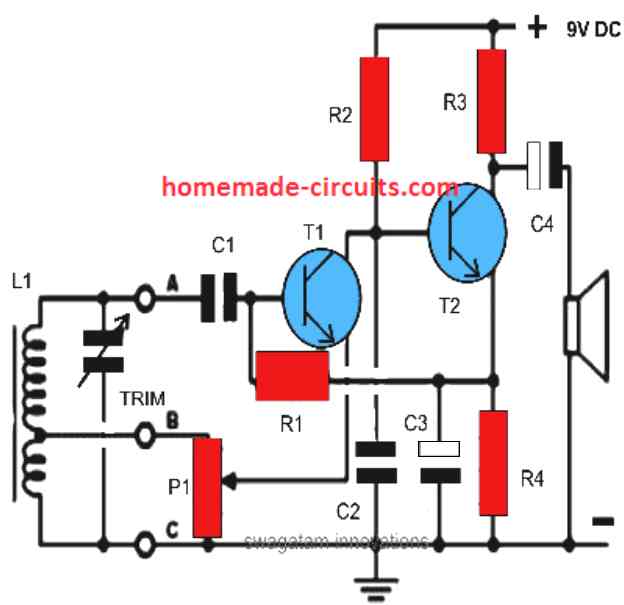
Parts List for a simple 2 transistor radio receiver with speaker
- R1 = 1M
- R2 = 22K
- R3 = 4K7
- R4 = 1K
- P1 = 4K7
- C1 = 104
- C2 = 470pF
- C3,C4 = 10uF/25V
- T1 = BC547
- T2 = 8050 or 2N2222
- L1 = ordinary MW antenna coil
- SPEAKER = small earphone 10k
- TRIM = ordinary GANG
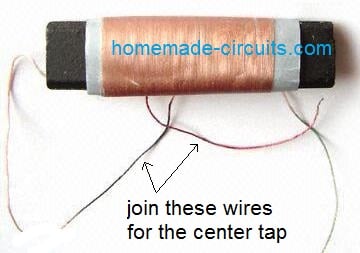
MW Antenna Coil on Ferrite Rod (L1)
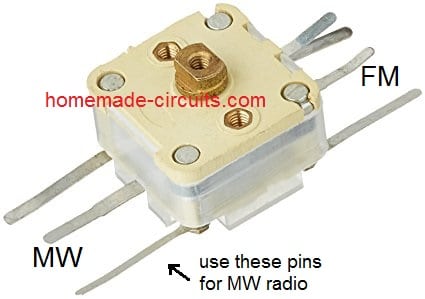
Use the Following type of GANG Condenser for the Trimmer (use the center pin and any one of the output pins from the MW side)
Simple AM radio Circuit using FET
Despite having so few parts, the following little AM broadcast band receiver circuit operates astonishingly well.
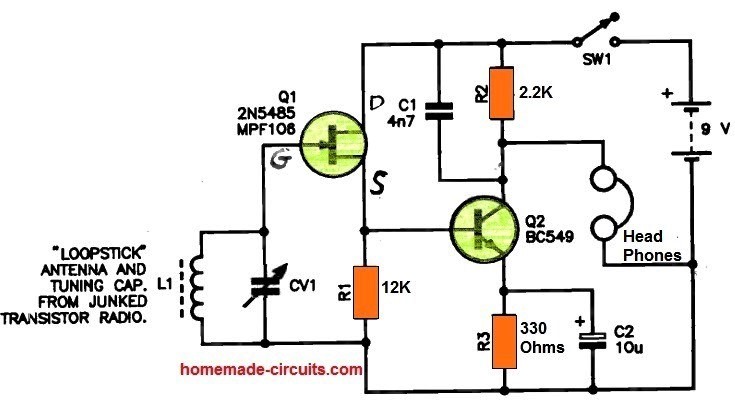
It is possible to remove the tuning coil [L1] and capacitor (CV11) from an obsolete transistor radio; L1 is the loopstick antenna.
In order to produce a sound across R2, a JFET, Q1, is utilized as a high impedance source-follower, directly connected with transistor Q2, which is employed here as an amplifier and collector-bend detector.
The transistor's collector characteristics provide the necessary rectification of the signal.
The rectified RF is bypassed by C1. C2, which is ideally of the tantalum type, bypasses the emitter bias resistor R3 of Q2 for optimal performance.
For excellent sound output levels, use high impedance headphones.
A 9 V transistor radio battery may be used to power the circuit.
Simple High Performance MW Receiver Circuit
An Improved version of the above Medium Wave radio can be studied in the following paragraphs. Once built it can be expected to work immediately without any hassles.
The MW receiver works with four transistors.
The first transistor is configured to work in the reflex mode. This helps just one transistor to do the job of two transistors which results in a much higher gain from the design.
The working efficiency may not be as good as a superhetrodyne, nevertheless is just enough for a good reception of all local stations.
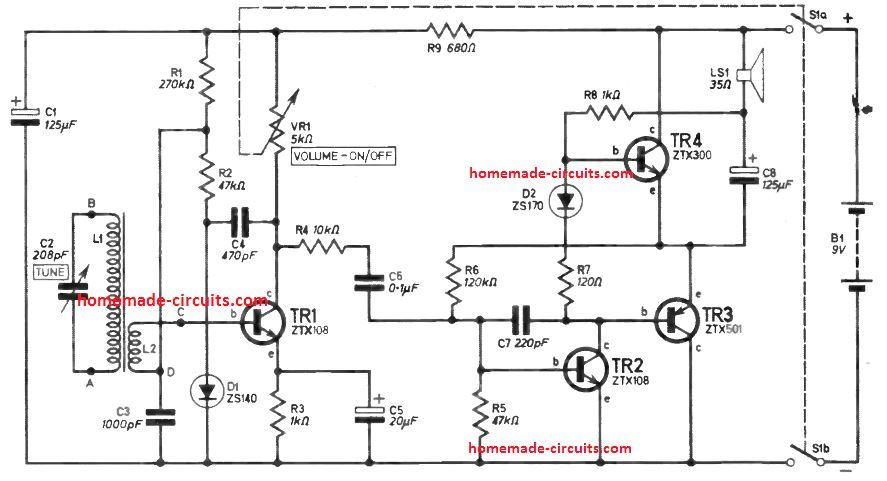
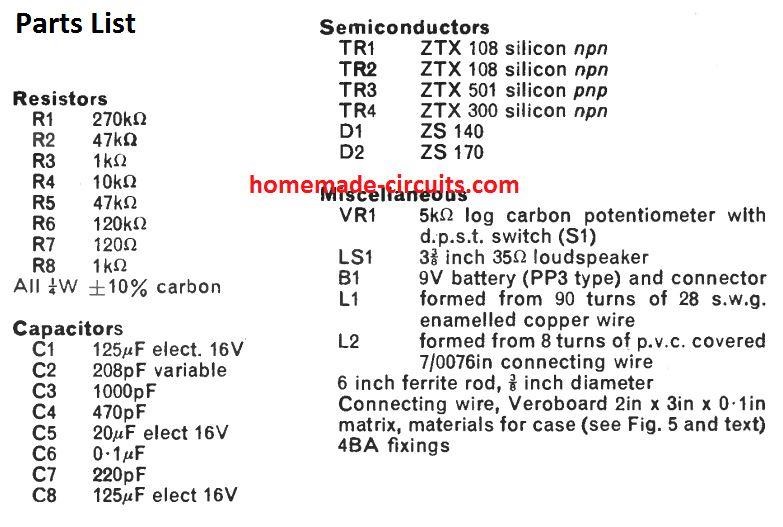
The transistors can be BC547 and BC557 for the NPN and the PNP respectively, while the diode can be 1N4148.
The Antenna Coil could be built using the following data:
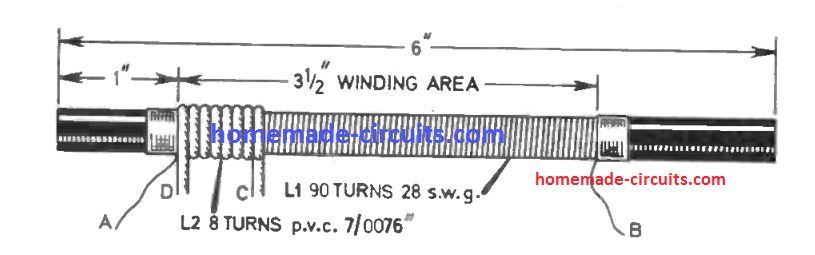
The ferrite rod antenna coil picks up the AM frequency through the tuned network of C2, L1. The tuned AM signal is fed to the first transistor TR1 via L2.
This enables a correct matching of the high impedance input from C2, L1 with the transistor input, without causing any deteorioration of the tuned signal.
The signal gets amplified by TR1 and is fed to the detector stage made using the diode DI.
Here since the 470pF capacitor C4 responds with a lower impedance to the incoming r.f. (radio frequency) than the 10 kilohm resistance R4, implies that the signal is now forced to enter through the capacitor C4.
This filters out the audio element in the signal after D1 detection, and is sent through the R2, L2 stage to the base of TR1.
C3 eliminates any form of stray RF.
Next is C4, which offers a high impedance to the signal compared to R4, which prompts the signal to move to TR2 base.
Audio Amplifier
Transistors TR2, TR3 and TR4 work like a push-pull amplifier.
TR3 and TR4 behave like a complimentary output pair while TR2 functions in the form of a driver stage.
The pure audio signal extracted from TR1 is amplified by TR2. The amplified positive cycles of the audio signal feed the TR4 through D2 while the negative cycles are sent through TR3.
The two signals are eventually combined back using C7 after the amplification process is completed. This finally produces the required output audio MW music over the loudspeaker LS1
The next MW or AM receiver is actually so easy that really tiny expenditure is necessary for its construction, and as just a few number of parts are employed it is ideally suits a mini radio receiver, that effortlessly accommodates inside a shirt pocket.
Even so it provides very good reception of nearby radio stations with no need for an external antenna or earth wire.
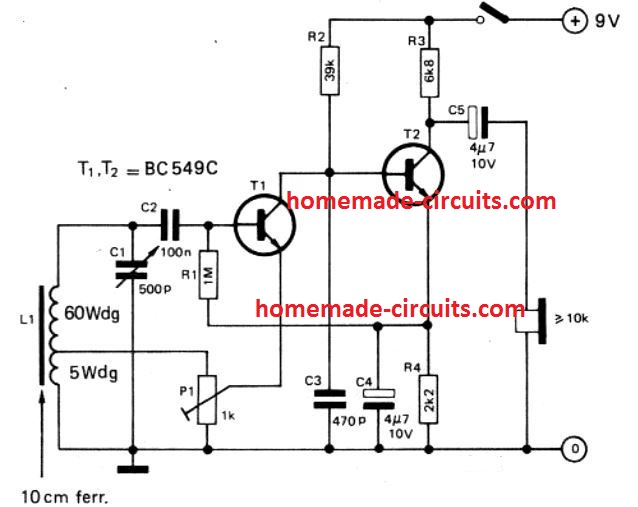
Functioning of the receiver is extremely straightforward. Transistor T1 works like an r.f. amplifier and detector with regenerative (positive) feedback. The level of feedback, and therefore the sensitivity of the MW receiver, could be manipulated by varying P1.
Even though output to the base of T1 is obtained straight from the upper section of the tuned circuit L1/C1, instead of through a coupling winding, the impedance offered by T1 is quite enough to make sure that the resonant circuit is barely suppressed.
Because the current gain of T1 decreases on the higher frequency side of the spectrum, while the input impedance rises, the gain of this stage continues to be relatively consistent on the entire spectrum, in order that it is normally not essential to fine-tune P1 often.
Signal detection happens on the collector of T1 and the output impedance of this T1 stage and C3, cleans out the r.f. portion of the rectified signal. T2 supplies further amplification of the a.f. Signal to operate the attached crystal earpiece.
PCB Layout and Construction Details
Construction An extremely stream-lined PCB layout is shown below for the proposed AM receiver. L1 must be positioned as near as is possible to the PCB surface to prevent oscillation issues.
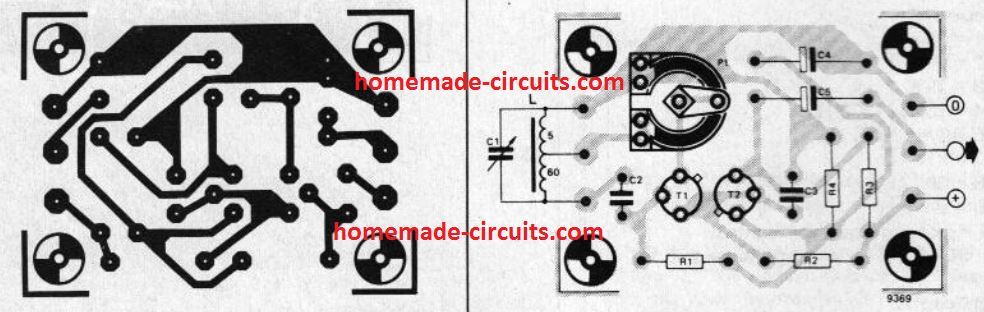
Individuals who want to miniaturize the layout even more may try things out by decreasing the measurements of the ferrite rod and adding more number of winding to obtain the very same inductance, while in case L1 is built smaller an external antenna could be required, which could be attached on the upper terminal of L1 through a 4.7 p capacitor.
The proposed dimensions for L1 will be 65 turns of 0.2 mm (36 S.W.G.) enameled copper wire over a 10 mm diameter 100 mm long ferrite rod, with the center tap coming out at 5 turns away from the `ground' end of the antenna coil.
C1 could be a small (strong dielectric) 500 pF gang condenser, or to get signals from a single fixed station only it might be substituted with a permanent capacitor of just lower than the necessary value in parallel with a 4 to 60 pF trimmer.
This may make it possible for the dimensions of the MW radio receiver to become additionally minimized.
Last but not least, the working current of the receiver is incredibly minimal that around 1 mA) in order that it will probably run for many months with a PP3 9 V battery.
Capturing Unwanted AM Radio Signals
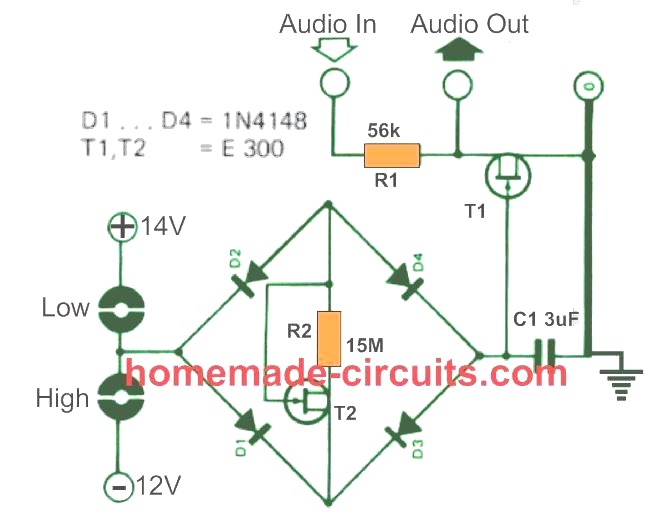
The circuit displayed below is a tunable AM signal trap circuit which can be controlled to retrieve unwanted AM signals and channel the remainder to the receiver.
Inductor L1 is used as a broadcast loopstick-antenna coil whereas capacitor C1 is set for tuning. You can easily get these components from an old radio.
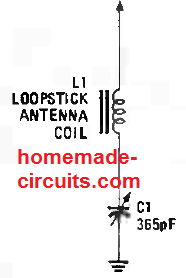
If the interfering signal comes from the lower frequency side of the broadcast band, you need to set L1’s slug around ¾ of the way into the coil and adjust C1 for a minimum signal output at the interfering frequency.
Once the interfering station’s frequency is close to the upper end of the band, regulate the slug until the end of the coil and tune C1 until you get a minimum signal.
It can happen that some unwanted transmitter signal besides a typical AM-broadcast type waves can get into the tank circuit.
When that happens, you must find out the transmitter’s frequency and choose a coil/capacitor arrangement that will resonate at that frequency. Then, connect that combination to the schematics above.
AM Signal Extractor
The following design is a frequency-selective circuit that be replaced for a LC tank discussed above.
When the expected signal can be detected but masked with noise, this circuit does the ‘unmasking’ tasks and delivers the signal to the receiver via the tank circuit.
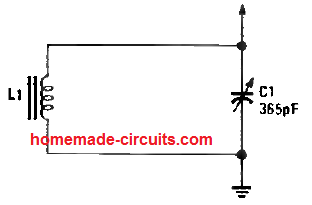
When the tuner is boosting the required level for the frequency, it is also suppressing all other signals outside its passband. You can easily use the same combination of values for the capacitor and coil as depicted above..
Other kinds of antennas and selective circuits can be evaluated through the input of this tank circuit.
A huge tuned loop will provide the circuit an option to help reduce an interfering signal arriving from diverse directions.
If there isn’t space for a big loop, you can opt for a large, tune ferrite coil as a replacement and hold its feature.
AM Booster Circuit
The above AM signal tuner circuits can be effectively attached with the signal booster circuit below for creating an enhanced antenna system for any AM radio.
You just have to connect the arrow head side of the above explained LC circuits with the gate of the FET Q1 in the below shown circuit.
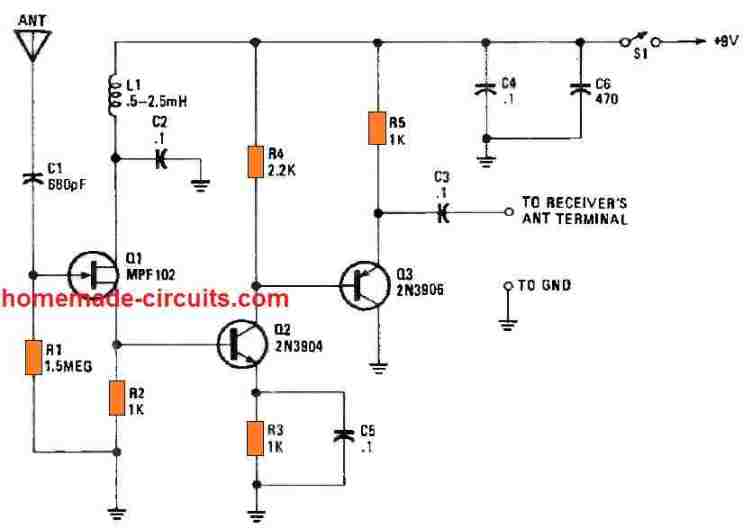
Another Simple AM Radio Antenna Booster Circuit
The following AM booster circuit can significantly enhance poor AM broadcast reception if that is a problem for you.
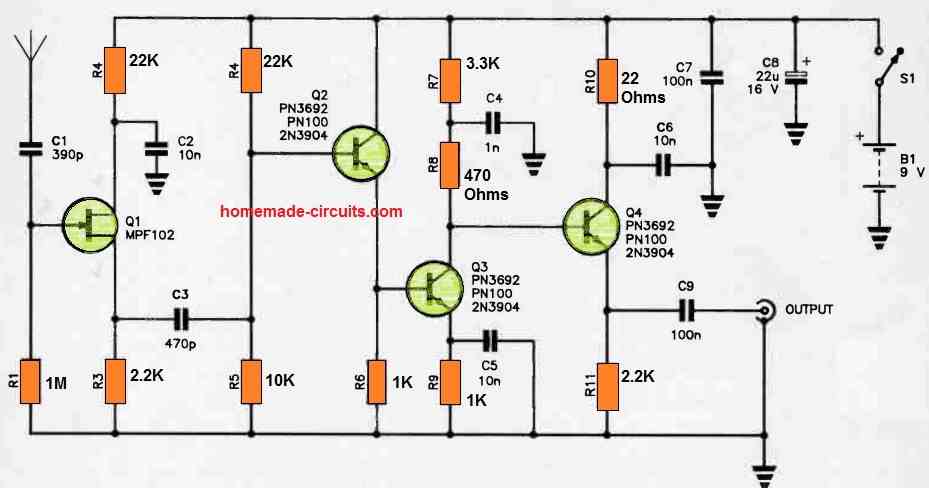
It is a four stage wideband amplifier with a high impedance input that may be used with a modestly sized vertical whip antenna.
The antenna is directly connected to the Q1 JFET in the first stage's gate.
This stage was built for a high input impedance because short whip antennas exhibit a high feedpoint impedance.
The AM radio signal at the source flows through C3 to the base of Q2, which functions like a common-collector stage.
Q1 is configured like a common-drain stage. Effective input-output isolation is provided by this configuration.
In the next stage, Q3, which functions as a common-emitter amplifier, is directly connected to Q2's emitter.
Its collector is directly linked to the common-collector emitter follower amplifier Q4's base. The signal is capacitively linked through stage C9 to deliver an impedance-low output.
Due to the splitting of load resistance and Q4's bypassing of the split load resistance, only a portion of Q2's collector load is active at RF.
Due of the circuit's minimal electricity consumption, a transistor radio battery is used to power it.
TRF MW Receiver
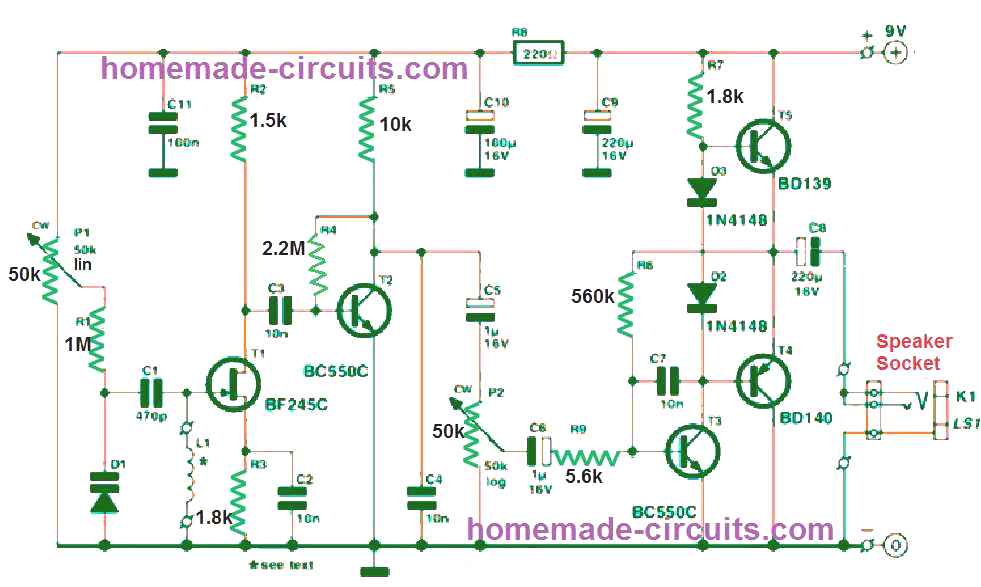
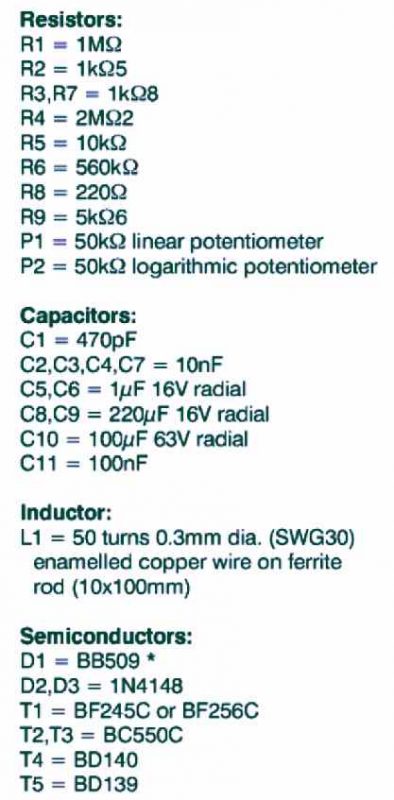
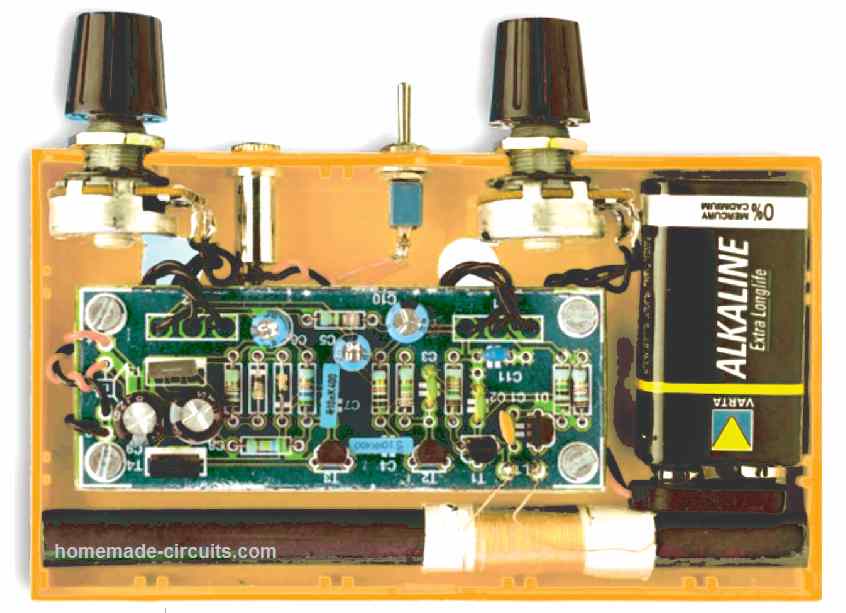
Image of the Built TRF Receiver Prototype
The antenna coil L1, the capacitor C1, and the diode D1 form the TRF MW receiver circuit or the main tuned receiver circuit stage.
C1 is a varicap diode whose capacitance varies depending on the voltage across it.
When the P1 is varied, it causes a voltage variation across C1, which in turn causes the tuning of the receiver and catching a various radio frequencies depending on the resonance formed by the C1 and L1.
Therefore varied P1 of the TRF receiver circuit allows to select the desired stations from the available incoming MW bands.
T1 and T2 along with the associated parts form the demodulator and the preamplifier stages, where T1 demodulates the resonant tuned frequency from the L1/C1 stage such that only the audio section is allowed to pass while the other unwanted voltages are blocked.
This tuned audio signal is fed to the preamplifier stage formed by T2 and the associated parts.
The pramplified radio audio is sent to the base of T3 via P2 and C6. P2 helps to set the volume of the output, and therefore works like a volume control pot.
The transistor T3 further amplifies the audio signal and forwards it to the power amplifier stage built around the transistors T4 and T5.
The T4, and T5 stage along with the other associated component form a nice little 1 watt transistorized amplifier that sufficiently amplifies the TRF audio signals, and feeds it to the attached loudspeaker.
The tuned MW radio output is thus effectively reproduced on the speaker loud and clear.
MW Radio Circuit using IC 4011
The circuit demonstrated below can be used like a simple MW receiver structured around the 4011 CMOS IC.
The four gates inside the 4011 IC package are configured as linear amplifiers by hooking up their inputs one after the other and by creating a negative feedback.
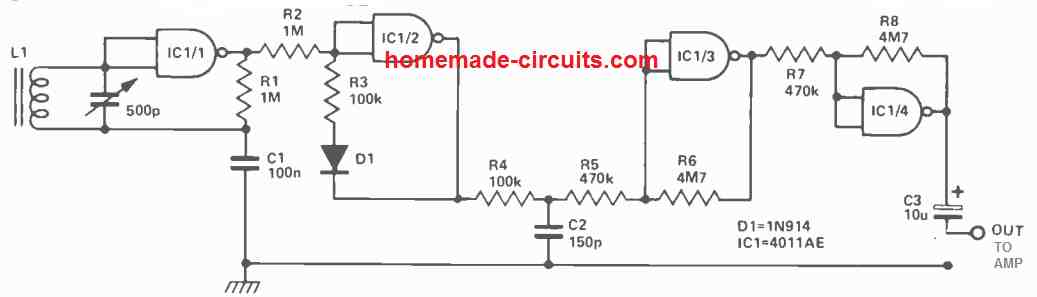
The antenna coil L1, can be built by tightly winding 80 turns of 22 SWG enameled copper wire over a 3/8" diameter ferrite rod, and this works like the pickup coil.
The L1 is tuned through the 500pF trimmer and tank circuit tus formed is referenced to earth at the radio frequency by C1.
The high input impedance, offered by IC1/1, provided to the tank circuit guarantees that the damping factor is kept to the minimum, which causes the MW receiver circuit to be highly selective.
The output from the IC1/1 geneartes an amplified RF signal which is transferred to IC1/2 for the detection function.
The unwanted RF frequency generated at the output of the detector is eliminated by the low pass filter created by resistor R4 and capacitor C2.
The output audio signal is subsequently provided to an amplifier constructed around IC1/3 and IC1/4.
The current consumption of the MW radio circuit's is around 10 mA while powered through a 9 V supply.
Remember that the IC used in this design has to be a 4011AE and not the 4011B whose input protection circuitry could prohibit it from running in the linear mode.
Super Regenerative Radio Receiver
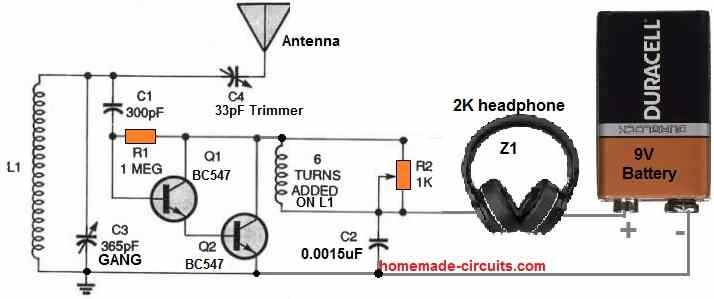
The next circuit depicts our final receiver circuit, which is a solid-state adaptation of Major E.H. Armstrong's well-known regenerative receiver.
The regenerative receiver ruled throughout its age in radio history and did so until the Major introduced his superheterodyne receiver circuit.
The majority of modern commercial radios are designed using the fundamental superheterodyne architecture.
The antenna coil L1 has 50 turns of 22 SWG super enameled copper wire over a 3 inch long former having a diameter of 2.5 inches.
The other coil with 6 turns in wound over the 50 turns of L1, with a layer of insulation tape in between.
In order to reduce the stress on the tuned circuit, the two BC547 transistors are coupled in a Darlington high input impedance circuit topology.
Tuning the desired radio stations is carried out by C3 and C4. The positive RF feedback is controlled via potentiometer R2. The regeneration control, which also controls the receiver's audio output, is more usually referred to as a potentiometer when it is used in this manner.
In case the receiver seems unresponsive and only faint signals are being received, consider swapping the 6-turn feedback coil's terminals.
That could be all that's required to make the circuit fully functional and active.



Questions & Answers
dear sir.china has developed ‘pen types pocket keeping radio with attachment through hearing wires buds can you know the interior design the electronic items for radio hearing through wires if please kindly give me schematic sketch of inside parts of that pen radio.sir.thank you.
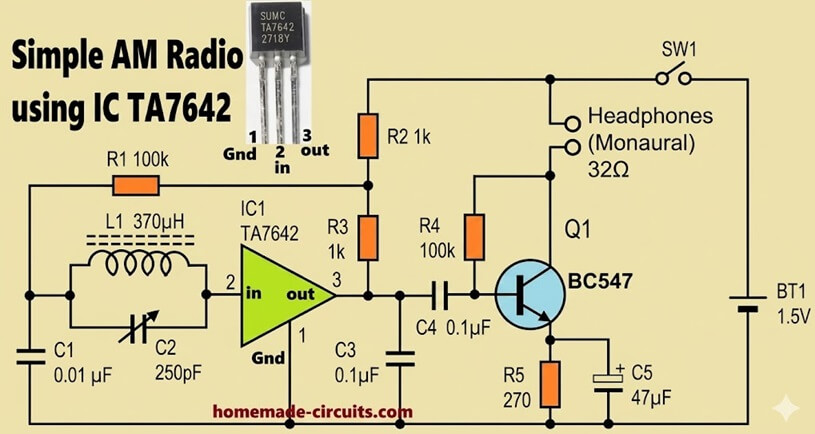
Hi Narsimhan, you can try this design:
hello, why can’t i use a bread board for the first am radio?
On breadboard the connections could be unreliable, with long connections, causing signal loss.
In the article :
Simple High Performance MW Receiver Circuit, use has been made of exotic components.eg ZS 140 and ZS170 , being each a diode.
the text goes on an says that the diode can be replaced by an 1N 4148 diode. It does not tell to replace both diodes by the same modern version. Can you confirm that both , the ZS140 and the ZS170 can be replaced by the 1N4148 diode?
You can replace both diodes with OA79 or 1N34A
But please do not use 1N4148 unless Vf is not critical…you can initially try 1N4148, if it does not work correctly then please go for the above alternatives…
My dears it is time for CRYSTAL RADIO RECEPTION starting from UHF – FM modulation to shortwave and AM broadcasting. Using the new generations of 3SK143-Q transistors and BAT85 diodes…
We can discuss about new schemes and unconventional radio reception systems and diagrams.
Sounds great, thanks for your interest in this subject. We can definitely discuss it if you have the schematics..
hi
Swag could the simple high performance mw reciever work with out ext antenna.also could i run a 8 ohm speaker instead of 35 ohm
Hi Wayne, It depends how strong the radio signal are, if hey are weak then an antenna might be required.
8 ohm speaker can be used, if the TR3, TR4 are replaced with 22N2907 and 2N2222 transistors respectively..
And if I want to keep up with the original design, where could I possibly order a loudspeaker of 35 Ohm!
35 ohms is not critical, you can try a 60 ohm also, or any other similar…
I would like to make a regen radiowhich will intercept allthe mwstation in india
You can get the circuit on this page:
https://www.homemade-circuits.com/tuned-radio-frequency-receiver-trf-circuits/
hi swag
can a oscilloscope display am signal from antenna tuned cct.all i can display is a 50 hertz signal can i get rid of it somehow?
Hi Wayne, an oscilloscope cannot be used to detect signals from antenna, because antenna signals are too weak too be detected by an oscilloscope.
thanks 👍
hi swag
simplest am radio not working,what voltages shouldi expect on Ti and T2.also what is the best way to test signal strength of tuned circuit?.all i can hear is faint scratching sound in speaker when i turn potentiometer
Hi Wayne,
The 1st circuit will be able to amplify AM signals only if the radio station is in a close vicinity and receiving signals are strong. If your radio station is far away then this circuit will not be able to catch and amplify the signals.
Initially you can try replacing the speaker with a headphone or an earphone to detect whether the circuit is capturing any radio signal or not.
I am not sure about the EBC voltage levels of the transistors in this circuit, however before assembling make sure the transistors are not faulty, you can get them verified with an good multimeter first.
hi swagatam
this circuit doesnt have a LM386.its the 2 transistor reciever bc547 and 2n2222 with speaker and ferrite rod antenna. would it drive a 8 ohm 2w speaker
Oh, sorry for the confusion, yes even that circuit will be able to work with an 8 ohm 2w speaker…however you may have to experiment with the collector resistor of the 2n2222 transistor for optimal sound volume…
hi swagatam
would the circuit, simplest AM radio circuit, drive a 8 ohm 2w speaker
Hi Wayne, yes lm386 ic can drive an 8 ohm 2w speaker
Hello! I am building the first radio design here. How important is the exact ferrite coil — what size ferrite rod are you using, what type of wire, and how many turns exactly? I think mine might be too small at the moment.
Also, what type of gang condenser / trimmer is that? I have a 25-600pF variable capacitor. Would that work? Do you possibly have a link to the correct one I could buy?
Thank you so much!
Hello,
I wouldn’t recommend building the antenna coil yourself instead you should buy it ready-made.
You can search for “buy medium wave radio ferrite rod antenna coil” it should give you some good buying options.
Your 25pF-600pF Gang capacitor will work for the mentioned application.
Or you can buy it from any online store, just search for “buy GANG variable capacitor for AM FM radio”
Hello, I am making the first radio and I have a question. I have read your replies to previous comments and still am shrouded in confusion. the variable capacitor is 500 picofarads. This is kind of big for a small radio? I have consulted an engineer who says so. I am new to making these things entirely so assume I know little to nothing, even the units of measurement.
1. The variable capacitor range is very large, and in a more specific schematic of the first radio that you provided at this link
2. For the antenna coil the schematic labels one side as 60 Wdg and the other 5 Wdg. I looked online to buy one but cannot seem to find one that has two sides with separate amounts of Wdg (which in my research I found to be the number of windings). Also, many have the unit uH which I believe to be the inductance value of the coil, but when I looked up what 60 Wdg would equate to it was 36 uH which was much lower than I saw online. Please provide a specific coil (maybe a link to something I can purchase on amazon) that would work.
3. I want to add a speaker that uses a potentiometer (amp) that can connect the radio to the potentiometer where the potentiometer will control the volume. If I use https://a.co/d/3N5YQbv would that work?
4. Why would the first radio not work on a bread board??
Thanks kindly.
Hi, I think you should try searching with the following key phrase on Google:
“Buy AM radio antenna coil”
You might many online buying options.
The variable GANG capacitor is correct and is the recommended type for all AM receiver antenna coils. It may not be compact but it is right one.
The amplifier unit you have linked will work with the first circuit above, however I would recommend the more universal type of amplifier design using LM386, such as this:
https://www.homemade-circuits.com/ic-lm-386-datasheet-explained-in-simple/
Hello thank you for the response. I have another question, what does the P1 stand for? Is this a potentiometer? Does this control the volume? Thanks again.
It can be a potentiometer or a trimpot (preset), yes it is used as a volume control or gain control in the first diagram…
OK, thank you. Other question, if we use a BC549 B transistor instead of a BC549 C transistor, what would the difference be? How about a BC550 C instead of a BC549 C? I looked it up online and for the 550 it says that the transistor collector and transmitter pins are swapped, so would we swap them?
The difference is just about the collector/emitter voltage values, however the pin connections are exactly the same for all these BJTs, you can confirm all the data under the following article:
https://www.mouser.com/datasheet/2/149/BC550-888526.pdf?srsltid=AfmBOooFeIqa646FgM9loNeKzb1b4KgzpJuneep9EbD6zRt8tfTHtE7k
Hello, for the first radio are the number of wingdings 65 total with a connection to the middle or two separated wingdings? Also, do we use paper or tape or something else to separate the rod and the wire? I am very confused on this part.
Hi, yes, the winding is a single 60 + 5 turns, using 0.2 mm (36 S.W.G.) super enameled copper wire, the centered tap being pulled between these two winding.
Hard paper will work better as the former for this coil, as it can be made to slide across the ferrite rod for better selectivity and resonance.
Hi Swag,
Suppose I would consider winding myself an antenna coil on a ferritrod, what link would describe best on how to proceed?
Best regards Michel
Hi Michel,
It is given in the above article, in the image which shows 90 turns and 8 turns, you can use that data…
Ok thanks! I was also puzzled with the usage of paper, tape etc. as some authors do but do not explain the how and the why.
Yes, the coil former must be built using thin cardboard, and the coil must be secured with tape…
if I understand well, a thin layer of cardboard needs to be fixed around the ferrite rod? This kind of howto is hard to find. Would this kind of description still be available?
It is a very basic construction and nothing’s critical in this construction. You can use a thin cardboard, or a thick cardboard rolled around the ferrite rod to make the former. You can even use a plastic tube for this.
Thanku so much for your quick response sir????
Sir, BF494 Transistors are not available in our local market… Can I use 2n2222 instead of BF series transistors to make FM receiver or plz suggest alternative of it????
Bhola, the frequency range of 2N2222 is 250 MHz, so i think it should also work, you can try it.
Good afternoon Sir,
I want to make a simple, tiny but sensitive FM Receiver using BF494 Transistors with LM386 audio amplifier IC, workable in 4 to 8 Ohms Speaker… FM stations are 150 Km far away from my House… Sir, may you plz give me the links for schematic circuit diagrams of this????
Regards????
Good afternoon Bhola,
You can try the third circuit from this article:
https://www.homemade-circuits.com/make-this-simple-fm-radio-circuit-using/
However, 150 km is too far away, I don’t think this small FM receiver would be able to catch the signal from this distance.
Hello Sir , In the uppermost AM receiver circuit diagram (In which 2 Transistors BC547 and 2n2222) are used, can we connect diy audio amplifier to make it’s voice loud?
If yes, then how can we add? Plz reply????
Hello Bhola, yes that’s possible. You just have to replace the speaker terminals with potentimeter outer leads, then use the center lead of the pot to connect with the amplifier input. The amplifier’s 0V line must be connected with the radio’s zero volt line.
Thank u so much Sir????
You are welcome!!
Do you have a step by step tutorial of how to construct this schematic on the pcb board?
I do not have a step step tutorial, which is not needed actually. There’s nothing critical in the above circuits. You can assemble it normally just as you would do for any other electronic circuit.
Good Morning Sir…
I want to make a homemade AM ferrite rod antenna coil for 1st A M Radio Receiver circuit (In which BC 547 and 2n2222 transistors are used)
Sir, what will be the number of turns between starting point of the coil and to the loop point of the coil ?
Secondly, the loop point of the coil to the end of that coil ?
Also, what should be the gap between both turns? Thanks????
Good Morning Bhola,
I won’t recommend building the antenna coil yourself. I would recommend buying the coil ready made. You can easily get this coil readymade from any electronic spare part dealer. Tell them that you want an AM antenna coil, they will give it to you.
Sir, I am already using a readymade AM antenna coil, but it doesn’t works properly (Don’t know why)?, only produces lot of
loud Vibrating and Cracking like sound!!
Sir, what to do…plz. help? Thanks for ur guidelines ????
Bhola, this circuit is very popular circuit which was published in many magazines and it should work. Check the transistor pinouts, did you connect them correctly?

And make sure you build it by soldering on a PCB….do not use breadboard, it won’t work.
Readymade antenna coil is the recommended coil, hand made coil might not work correctly.
Try moving the ferrite rod to and fro and see if you can capture any stations. An elaborate version of the first design is given in the following.
You can also try the following design with a headphone, and check if it works or not:
https://www.homemade-circuits.com/make-this-one-transistor-radio-receiver/
Good evening sir…
How can we connect (sold) the 3 pins of 33 pf trimmer capacitor in the 1st two transistors AM Radio Receiver circuit diagram (In which BC547 and 2n2222 transistors are used) ?
Plz reply????????????
Hi Bhola,
You will have to use only two pins of the trimmer, the center pin and any one of the outer pins.
Good Evening sir…
How can we connect (Sold) the 3 pins of 33 pf trimmer capacitor in the 1st two transistors AM Radio Circuit diagram (In which BC547 and 2n2222 transistors are used)
Plz. explain ????????????
Good evening Bhola,
You can use the center pin of the trimmer and the any one of the outer pins, and connect these two pins between point A and C.
Thanku so much sir????
You are welcome Bhola!
Good Evening Sir, I have a query which I want to ask… Can we use 9 volt Adaptor instead of 9 volt Battery Or it affects the performance of this Radio circuit?
Sir, I, m using 6 volt AC adaptor to power the circuit but the circuit is not performing well… Why sir?
Thanks????
Hi Bhola, you can definitely use a 9V DC adapter or even a 12V DC adapter, but this may generate a little humming sound from the radio.
6V may not be adequate for the radio since they are all designed to work with 9V, this may be the reason why it is not performing well with a 6V supply.
Hello sir, I had connected the Philips MW Antenna coil and Variable Gang Capacitor as mentioned in 1st circuit diagram correctly (As you also told me yesterday), but it’s not working… I tried so many times but didn’t get success…
But strange thing is that, when I connect homemade Antenna coil, it starts working and receives 2 or 3 stations overlapping each other (Like some Arabian, Chinese and Dhaka Radio Stations) without attaching Gang Capacitor, as still Gang Capacitor doesn’t work… Dhaka is so far away from my hometown… Sir what is wrong with this circuit?
I have been a student of science and I love science projects too much….Sir plz. help me… Lot of thanks????????????
Hello Bhola, catching the correct radio stations is just about optimizing the ferrite rod inside the coil, and the gang capacitor, so make sure you optimize them with different settings.
If your gang is not working you can replace it with a 33pF trimmer as shown in the following figure
However gang is the best and it has to work correctly.
You can also try adding a 1 meter wire as the antenna to point A in the first diagram.
Good evening sir, I bought Philips MW
Ferrite Rod Antenna coil which have 4 connection wires (2 golden of more winding and 2 red of less winding side by side)
But in the 1st circuit diagram (Using BC547 and 2n2222), there are 3 connections… Plz. explain how to loop and connect them…
Secondly, I have Variable Gang Capacitor of 7 pins (One side 3 pins and it’s opposite side 4 pins)
Sir, which pins are of MW and how to connect them in the circuit?
I, m trying but not working… Sir plz help
Thanks a lot????
Hello Bhola,
You have to connect the center red and the center golden wires together, which will become the center tap of the coil and go to the point B, as shown in the first circuit diagram
For the gang condenser you can try any two pin, one center and one outer pin
Good ????Morning sir,
I want to make AM Antenna booster for my homemade two transistors AM Radio Receiver to enhance its receiving capability, but MPF 102 (FET) is unavailable in our electronic market… Shopkeeper is unable to give it’s equivalent FET of same pinout…What should I do?
Secondly, where the both terminals of Antenna booster should be connected in our Radio receiver? Plz. help…
Hi Bhola can you send me a pic of your am antenna coil ,I have a YouTube channel , so I want to make this am Reciver and upload it on YouTube , my Instagram id is – skr_electronics_lab
Good morning Bhola,
you can use any VHF/UHF JFET such as this:
https://www.onsemi.com/pdf/datasheet/mmbfj309lt1-d.pdf
or any similar.
You can connect the C3 output to point A in the first circuit….ground line will be common for both the circuits.
Hello Sir, In above circuit diagram is 1st pin of variable resistor connected to the loop point (Middle point) of Antenna coil?
Secondly, MPF102 equivalent transistors ?
Lot of thanks????
Bhola, which diagram are you referring to?
MPF102 is an FET, you can ask the shopkeeper to provide an equivalent FET
https://www.onsemi.com/pdf/datasheet/mpf102-d.pdf
Sir, I, am talking about Two transistors (using BC547 and 2n2222) simple AM Radio receiver… Is 1st pin of variable resistor connected to loop point of the Antenna coil?
Sir, middle point of the antenna coil is loop of both the antenna coil wires…
Yes, in the first circuit, the terminal B which is one of the outer pins of the potentiometer is connected to the center loop wire of the antenna coil
Hello sir, can we add Antenna Amplifier to this receiver circuit to increase its receiving capability… If yes, then how can we add it… Thanks and Happy Deepawali sir ????
Hello Bhola, yes you can add the antenna booster explained in the above article with your AM radio to enhance its capability. Happy Diwali to you too!!!
Hello sir, plz. share me some low range Walkie-Talkie simple circuit diagrams… Thanks a lot…
Bhola, you can try the following concept. You can make two of them and use them as transmitter and receiver:
https://www.homemade-circuits.com/make-this-simple-fm-radio-circuit-using/
Sir, I had made this Radio receiver at home, but it receives only 2 or 3 radio stations without attaching variable capacitor.. Variable capacitor doesn’t work…I, am using homemade Antenna coil… Sir, what to do?
Plz. help…
Bhola, the above circuits are very basic, so they will only receive the nearest stations, and the selection will not be too precise. Try moving the antenna coil on the ferrite rod to see if that helps to catch more stations.
Hello sir,in old mw radios,with ift,transistors BF 195 C or D are used.Please tell me substitute for this transistor as it is not available. Thanks.
Hello Suresh, you can use any ordinary BC547 transistors.
Could/would you come up with a simple TRF NOT Regenerative Radio. Simple RF Amplifier driving a Crystal Detector
Also a 2 or 3 Dialer TRF Radio with separately tuned Rf Stages
I plan to do a Steampunk Antique Tuning components with modern electronics.
I suggest you do a reverse Steampunk Modern components and Antique Breadboard Style ala Atwater Kent Model 10
Salvage components from old Transistor Radios
I have a few TRF receiver circuits posted in this blog, you can check them out in the below link:
https://www.homemade-circuits.com/tuned-radio-frequency-receiver-trf-circuits/
But I am not sure if this is what you are looking for?
i am 63+ now. In my college days, i tried my hand in making small electronic projects with the-then superheroes like PNP, NPN transistors, Zener diode, Mosfet et al. i am a big fan of AM radio. The sound produced by sets available in my city Kolkata is not at all good. I wanted to make a set myself coupled with a good amplifier, but, the MW tuner is a rarity in both the shops and on the footpath, selling old goods.
But i will do it anyhow.
i chanced on your website and feel you are the right person to guide me.
Please let me know if i can get such a pcb online or in a shop.
Thank you for your question and I appreciate your interest.
However, we don’t supply kits or PCBs from this website so I am sorry I can’t help you in this regard.
Nevertheless, there are plenty of online shops like amazon, bangood, eBay from where you can easily purchase an AM radio kit with Parts and PCB.
Thanks
I want to know how the radio electronic circuits work. I found this publication interesting. Hopefully it would lead to my dream come true.
Thank you, brief explanation are already given under the relevant headings, you can get a rough idea from these explanations
I am interested to learn how radio circuit works. I found this very interesting.
Kindly reply.
Are spare parts for assembling AM/FM radio especially ICs and Transistors is readily avail in India? Whether it will be possible to compete with standard companies like Philips etc,?
Your valuable reply is highly appreciated
Kindly inquire about this in Google, you may find many relevant answers.
What is an “L1 = ordinary MW antenna coil”?
As in: “MW Antenna Coil on Ferrite Rod (L1)”
Where does one purchase the correct Ferrite Rod and how does one specify the correct Ferrite Rod? The rods used in the above circuits look different so they must have a designation so one knows which/what to buy.
L1 can be any ordinary or standard medium wave antenna coil. Please search for loopstick antenna coil, you can use any standard loopstick antenna coil, ferrite rod size does not matter, bigger size will give higher sensitivity and range, that’s all. Where to buy, I don’t know about, best place to find is inside any old discarded MW radio receiver.
OK, thanks Swagatam. I have a few ferrites I’ve removed from old AM radios, one of which is a rod, the others two are 1, a sort of rod but very short and flatter than a rod, the other is more like a rectangle.
Even the one that is mostly a rod has two flat sides rather than being perfectly round.
All of these have wire already on them.
Questions:
Do I use the wire as is or remove it and do my own windings.
I can measure the inductance of these windings so do you know what the inductances should be for each winding?
As you can see in the photo (I hope to attach) one is a rod in a tube with a winding with four wires out of it. This was for a radio that used this as the station tuner rather than using a 365pf tunable capacitor. I have one of those, 365pf tunable capacitor, as well in the photo.
Any idea how to use the wires already on the ferrites? As you can see I tried to use one of them but I used a lower hFE/ß gain (2N2222) transistor & have an order for better NPN transistors as specified in your on-line article, BC549C. This transistor has 4 to 5 times the gain of a 2N2222 according to the spec sheet.
Thanks,
Phil/KE3FL
Hi Phil, I don’t think the antenna coil which you have used has the correct specifications. Basically the coil must have two series winding, one having lower number of turns, while the other much higher number of turns. The central coinciding ends of the coils are joined together. Here’s an image that will clarify your doubts regarding the exact layout of the coil:
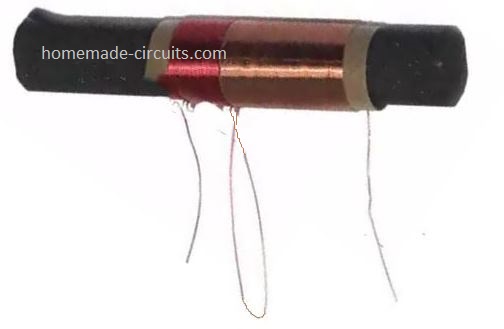
The ferrite core can be cylindrical or rectangular, that will not matter.
Thanks, I’ll give that a try with the rectangular ferrite 90 & 8 turns.
90 of 28 gauge
8 of 0.0076″ ?
Sure! The wire gauge is not critical, you can use any thin copper super enameled wire for the purpose.
Hello sir !
I am surprised that it takes 1000 turns for the MW coil, because I often see a similar requirement for small converters, for portable neon lamps (6 Volts / 220 Volts 5 watts), here, for MW (Medium waves, 100 laps should be enough!). But I recorded your diagram it is, despite what I have just said very well when you want to speed up a radio, for example in a hotel room abroad!
good luck and thank you for the vein, Janos
Hi Szara, it is not 1000 turns it is just 90 turns…
Thank you for your quick response, and you are the first person !! who answers me on a comment from me!
So, if I have design problems on phase shift oscillators I would ask the questions first!
I see that you are a man of confidence. !
best 73 Janos HB9 DRR
You are welcome. I have a phase shift oscillator circuit posted below:
https://www.homemade-circuits.com/phase-shift-oscillators-wien-bridge-buffered-quadrature-bubba/
May be this can help you.
very good site you, the article is good and neat, its contents useful once good joob at least you try together notes
thank you!
Thank you Mr. Swagatam
For your article on the phase shift oscillator it is not only complete but the various arguments put forward make your article squarely a doctoral thesis!
I myself am not an engineer because when I wanted to enter engineering school I made so many poor marks in math as much as English and French that I gave up in the 1st semester.
On the other hand I was in a private school of electronic radio for a year and I learned the simplification tables from Karnaugt and the simplification tables from mac huksley and quine.
more after having studied the elementary algebra of schons we studied the first volume of differential and integral calculus of piskounov
and of course we also studied the transistors.
Following these studies I worked at Schik Electronique in the development of site lights (in 1977). Mr. Phillippe schik m; asked if I knew how to program microprocessors at the time it was new and I did not have the experience and obviously he did not keep me!
and on the advice of mr schik i started to learn electrician late, and it was during this apprenticeship of electrician that I discovered an article by Andre Doris in the Loudspeaker where it was a question of programming the SC / MP II to make it a programmable music box. So I started mounting and it worked very well, but unfortunately I lost this box after my many divorces and moves. the last one was December 22, 2018 when I left Switzerland permanently to go to Ungheni in Romania.
And this time I almost lost everything! Thanks to friends who stayed in Switzerland, I was able to recover some books, including the study of Russian for French speakers, the algebra book and Piskunov. currently (I am retired and am 69 years old), I re-study the determinants, and also the matrix calculation and therefore wish to use the matrix calculation to solve the problem of the oscillators. (matrix calculation is in Hungarian on the internet and I study English with Marina Ozerova from Russian).
my two wishes are therefore to study the phase shift oscillator with matrix calculation and the instruction list of SC \ MPII INs 8060 in hexadecimal.
And once again thank you very much for your comprehensive study regarding the phase shift oscillators. it is very good and I intend to make it a realization with the LM3900.
best regards Janos
Thanks Szara, I truly appreciate your interest and dedication, your life journey had been tough, but so adventurous.
I wish I could help you in this regard, however my knowledge of oscillators and waveform generator is not good, since they involve many complex formulas which are difficult to remember and evaluate. I linked article was taken from a different site.
I hope you will understand and bear with me.
What is the value of the inductor?
Oui, je comprends qu’on ne puisse etre un expert en tout et surtout aux jours d’aujourd’hui ! L’electronique a tellement evolue ces 30 dernieres annees qu’une encyclopedie de 30 volumes ( telles que Encyclopedia universalis ) suffiraient a peine a contenir toutes les nouveautes sorties de terre, ces 30 dernieres annees .
Mais je pense que nous sommes bientot 20 milliards de personnes sur la terre, et que si chacune de ces personnes apportait la moindre amelioration a une quelquonque partie de l’electronique ou dans n’importe quel autre domaine de la vie ( j’ai visite 3 fois dans ma vie le salon des inventions a geneve ), En seulement dix ans, on pourrrais transformer la terre en paradis !
ma modeste contribution serait donc ( pour revenir a l’oscillateur ),
de transformer ( par des mesures appropriees ) le transistor en schema de Giacolleto la sortie du transistor etant alors transformee en generateur de courant, et donc cette resistance de sortie de ce generateur de courant serait la 1ere branche de la cellule RC et dans la troisieme branche, il faudrait tenir compte de la capacite de Miller a l’entree du transistor, ainsi que de la resistance d’entree de ce meme transistor , et transformer par thevenin la resistance parrallele en resistance serie, ainsi les parametres du transistor seraient inclus dans les parametres du filtre RC, ainsi on pourrait gagner en precision sur les caracteristiques de l’oscillateur, pour la tension de sortie, et la frequence, et la, les resultats experimentaux devraient corroborer a 1% au moins, les caracteristiques calculees.
Mais a part cela, je comprends que l’oscillateur, ne soit pas forcement votre tasse de the ! cordialement Janos !
Thank you for your knowledge and contributions, appreciate it very much!
By the way the circuit is not useless, it will work with a low output, you should think twice before commenting…
T1/T2 form a basic preamplifier stage, won’t be a good idea to disturb anything in this stage, better to add another smaller amplifier stage after C4
Hi! What is the value of the trimmer capacitor in pF? and does MW antenna coil commercially available? Thanks!
Hi Matt, yes the antnna coil is the same which are used in MW radio receivers, and the trimmer capacitor can be replaced with any standard MW radio gang condenser
also sir, how can we troubleshoot the circuit in case, for instance, if i remove the tank circuit and replace by short, should the speaker sound? how about removing inductor only? many thanks
no, that may not be possible with this design…
Good day sir, i reconnected the circuit and no sound produced still, however when i connected 9dc , there will be a 1second static then no sound anymore. i checked the capacitor and resistors and there is a voltage drop just to make sure that there is electron flow. I opened my am radio at home to make sure there is am signal reaching our home. is it that the speaker produced sound that is too small or there is something wrong with my circuit. hoping you can help me sir troubleshoot this mini project. thank you in advance sir. https://www.dropbox.com/sh/2w8f1dzn006lck6/AAA3oBds3I0QjRLXSCO3UddKa?dl=0
as you said sir the three terminals of ferrite rod must have continuity…a b and c have precise continuity in kiloohms. whereas d has continuity also but much larger compare the 3 terminal.
Charlie, the antenna coil is the heart of the above explained radio circuit, if it's not of the specified type then the circuit will not respond, there could be other faults also which you will need to find by carefully checking the stages with a meter.
by continuity I meant it should be 0 ohms….if it's in Kohms then that's not a continuity, that could be an open circuit and your meter might be showing something incorrect. because an antenna coil can never have kohm value.
a breadboard assembly might not work, you might need to assemble it on a compact veroboard by soldering.
you can initially use an earphone to test the unit instead of the speaker to get a better idea.
and yes only very strong stations will be received by this circuit, moderately weak or weak stations cannot be received.
sir, i recently dismantled an am radio kit, i obtained the ferrite rode however there are 4 connections to the rod. there is 3 seperate coils of fire on it, of different turns…which terminals will i use sir, also after connecting the circuit, there is no sound produced. thanks much sir
Charlie, you can use the two end strands of the coil and the center tap which may be close to one of the ends of the coil….but make sure all the three wires have continuity with each other.
hi sir, can i replace the speaker with a 3.5mm audio jack instead and connect an amplified speaker externally? thanks 🙂
…i have another question, why did you use a NPN transistor and not PNP?, and why MW antenna coil?…thanks a lot….
yes that's correct
the variable resistor, is the center pin connected to the emitter of T1?
NPN transistors are ideally recommended for all relevant circuit applications, PNP are just complementary and are used only when there's no other option left.
MW antenna is used because the design is for receiving AM signals not FM signals
in the diagram there's a symbol of variable capacitor but it said trimm…can you please clarify me about it, im working on this circuit…thanks
C2 is connected to ground and R2 junction.
T2 base is connected to R2 and T1 collector, P1 is connected to T1 emitter
P1 is a variable resistor, a preset
then C2 is connected to the ground only?
another thing is that is the base of T2 connected to P1? and by the way is P1 a resistor?
…hello what is P1? is it a resistor?
the cross link connections are shown with a black dots….the cross links which are not connected are shown with white gaps….so the ones which are not connected with a black dots are unconnected with each other.
R1 is Not connected to T1 emitter
…i have another question C2 is connected to the ground and is it connected to R2? also R1 is connected to the coil and is it connected to the emitter of T1?.. thanks
use the center pin and any of the outer pin in the line…there will two sections for this, don't use the FM section, use the AM section….
…what's the pin configuration of the 3 pin variable capacitor? (the square one).. thanks
thanks a lot…it really helps
Picture of trimmer :
Picture of Gang:
can you please post a picture of it, coz i think the man from the electronics shop gave me the wrong one….thanks a lot
a variable capacitor is also referred to as a trimmer…but it's a PCB mount type not the Ganged type…although a GANG cap will also work equally well.
Where can i add antina in this circuit
the antenna coil can be procured from any local electronic spare part retailer.
sir plz tell me . Ac 128 transistor is available in Indian market.
My grandmother's radio need to be repaired
Dibya, you can use BEL188 if you don't find AC128, but AC128 should be available.
Sir please publish a MW signal booster.
I had made many 6 transistor radio , 7 transistor radio and also 8 transistor , ic based 5band radio but two transistor radio is first time in my life.
sure, if possible i'll try to post it…
Sir can i use 1895 IC audio amplifier to make the sound louder.
Thank you very much sir . For your fast response
Thank you sir. My house is about 100km away from radio station .Does this work for me.
No, 100km is too far away, this radio will not work from this distance.
HELLO SIR.what is the transistor 8050.There is any symbol before it like bc,2sc.can i build it in a veroboard. also can i use a gang from very old transistor radio made of metal
Hello Dibya, the prefix can be anything, it's not important, the number 8050 is the only unique assignment and you can tell this number to the retailer while buying it.
yes a radio gang will do
umm…excuse me Sir do you have some good topic here to start for robotics?…just inquiring..Thanks…
sorry, I have not yet started anything related to robotics in this blog
Hi there sir Swagatam!! I have a few questions:
1. What is the range of the radio(in KHz)?
2. Area all resistors 1/4 watt?
3. What kind of capacitor is c1 and c2? (I think they're ceramic?..just guessing..)
4 Are c3/c4 an electrolytic capacitor?
5. Is p1 a volume control?
6. Is there a proper specs for trim capacitor, like something to tell the salesboy/girl in an electronics store?
Thanks a lot!!! (apologies for those silly questions of mine…)
Hi Eshkariel,
The range is the same as we normally have in all MW radios.
all resistors are 1/4 watt
C1/C2 can be ceramic.
C3/C4 are electrolytric
p1 is a kind of volume control
trimmer capacitor can be a normal MW GANG condenser
1) There is an earthing symbol. How to earth in a circuit board?
2) Can I use 8ohm/ 0.5watt speaker?
4k7 means 4.7k, you tell him you need a 4 point 7 kay resistor.
i mean , what i have to tell to the shopkeeper to buy? will he understand by "4K7"?
they have been calculated and placed for making the transistors conduct optimally as per the circuit specifications.
Hello sir, How can we distinguish between the FM side and AM side in a Variable Gang Capacitor? Thanks sir
Hello Bhola, it is as per the capacitor values of the respective trimmers:
i know R1 , R2 are resistances, but what signifies for R3=4K7? P1=4K7?
1) earth symbol refers to supply negative line
2)8ohm/0.5 watt will do.
how do you add a variable tuning capacitor
the component indicated as TRIM is the variable tuning cap.
yes that can be done, you can incorporate a 7809 regulator for better response.
recheck transistor polarity and antenna coil polarity, and connections.
Under normal conditions no antenna is required for this circuit.
Hello, please send some easy am radio circuits with a voltage of 1.5 volts. Thanks.
You can refer to the following page for more info:
https://www.homemade-circuits.com/?s=radio+receiver
yes the winding will have definite start and finish points, the primary from up to down, while the secondary from down to up or vice versa.
which circuit are you referring to?
Anyway, yes definitely all trafos with prim/sec stages will have specific winding arrangements.
Hi Tanmay,
Here's the formula:
XL = ωL = 2piFL
where XL is the inductive reactance, ω is the angular frequency, F is the frequency in hertz, and L is the inductance in henries.
Inductive reactance is the positive component of impedance. It is measured in ohms.
You can use 4060 IC for making a simple timer
Regarding the 810 circuit I can't say much without actually seeing it.
Thanks! Yes surely it can be done, you can the take the pickup to the amplifier from across C4 output and ground
IF trafo specs can be entirely different for different sages so it can be very difficult to set them correctly.
You can find plenty of radio repairing guides online, just type the relevant keywords and Google it.
1)Try BC557
2)You can try winding it on any small ferrite former. Wind 1000 turns of 32 to 36 SWG wire, and over that 8 turns of 27 to 32 SWG wire.
3)small RF chokes are definitely available in market.
104 = 0.1uF
T1 can be replaced with BC548, but T2 should be 1amp rated, any transistor rated at 1amp will do like 2N22222 etc.
L1 should be a readymade MW antenna coil, any other type won't produce correct results
Hi Tanmay,
The overlapping broken lines suggest that these are NOT connected. The connected lines are shown with a black dot.
P1 is a preset which has three leads, the center lead is indicated with a arrow head.
As suggested by Mr. Shane, you can replace R3 with an small audio output transformer.
The primary winding which has three wires should be connected in place of R3, while the secondary must be connected with a speaker.
can we seperate a smartphone mobile screen from its circuits making it wireless?its for a project.
no that won't be possible..