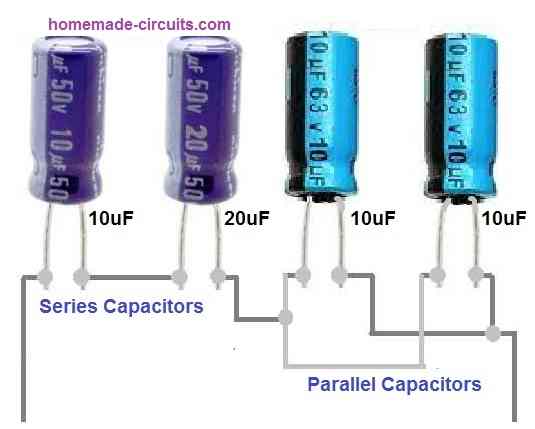
Capacitors connected in series or parallel are very common in electronic circuits. This is done in order to achieve the desired capacitance value and also to make the performance of the circuit accurate. In the following post I have explained how to connect capacitors in series and parallel: Connecting Capacitors in Series When we connect […]
Electronics Theory
How to Connect Resistors in Series and Parallel
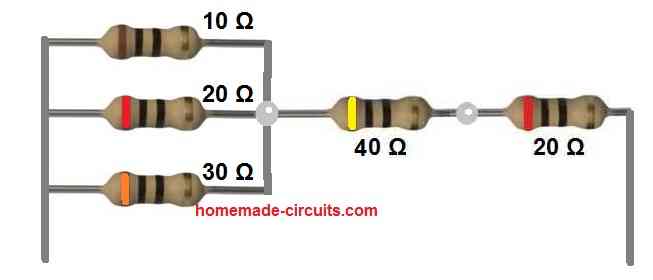
There are three ways to interconnect resistors: series, parallel and in combination of series/parallel. When resistors are joined in series, the current passing via one resistor also passes through the next. When resistors are joined in parallel, they are wired across each other, resulting in the same voltage across each resistor. When resistors are connected […]
Understanding AC Circuit and Calculating AC Waveform
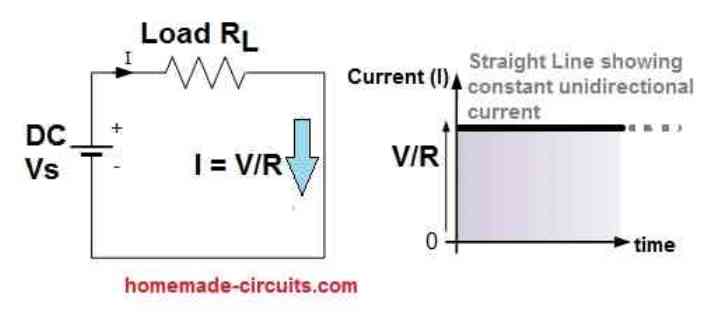
The sinusoidal waveform or sine wave is the most commonly used AC waveform in circuit theory. When a periodic AC waveform is produced by a voltage source, it creates an EMF that changes polarity at regular intervals, with the time it takes to complete one full reversal known as the waveform’s period. Direct current, also […]
How to Calculate Zener Diode Resistor
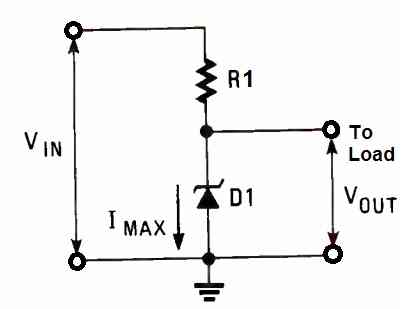
In this article I have explained how to calculate and the find the value of the zener diode resistor using simple formulas. What is a Zener Diode Zener diodes are semiconductor devices which are used for regulating an input DC voltage to any desired output voltage. The regulated output voltage value directly depends on the […]
Point Contact Diodes [History, Construction, Application Circuit]
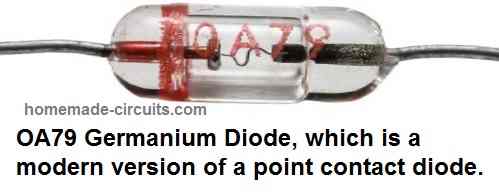
In this article I will comprehensively explain about the early point contact diodes, and their modern versions which are Germanium diodes. Here I have explained the following facts: Brief history of point contact diodes Construction of point contact diodes and modern Germanium diodes Advantages of point contact diodes or Germanium diodes Applications of Germanium Diodes […]
How to Make Logic Gates using Transistors
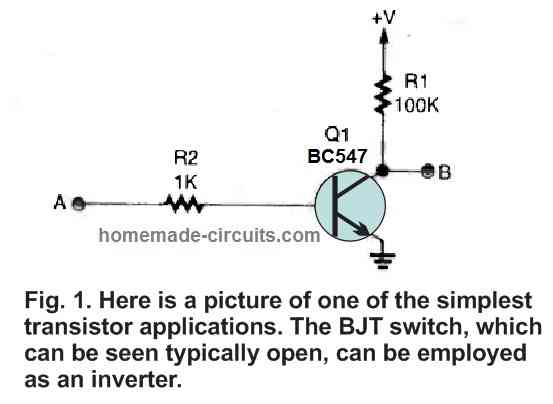
In this post I have explained how to build NOT, AND, NAND, OR, and NOR logic gates using discrete transistors. The main advantage of using transistor logic gates is that they can work even with voltages as low as 1.5 V. In some electronic applications the available voltage may be inadequate to power TTL or […]