In this article we investigate an ATS circuit for initiating an automatic changeover from mains supply to generator supply through many intermediate transfer stages which involves activating the fuel valve, choke valve and the generator starter. The circuit was requested by Mr. Hari, and another dedicated reader from this blog.
Requirement for 5kva LPG Generator
I'm Hari, from Indonesia. Thank you for your circuit ideas, i made a battery charger based on your design. Right now, i'm looking for Automatic Transfer Switch (ATS) for my portable generator.
It's 5000VA LPG powered generator with electric starter. Buy ready to use ATS is very expensive, i want to make it myself. Can you help me design the ATS? Right now, i need to shut off the LPG valve manually to turn off my generator.
I have plan to add LPG solenoid valve so i can close/open the LPG supply electrically. And add mechanic solenoid (push-pull, normally pull) to automate the choke.
The ATS system feature i need are:
- detect main supply, during normal condition (when main supply on), the ATS close the main to
load connection and open the generator to load connection - when main supply off, the ATS open the main supply to load connection, but keep the generator to load connection open.
- then, the system will activate LPG solenoid valve (normally closed) to open LPG supply to the engine and activate mechanical solenoid (normally pulled) to push the choke grip to START position
- after that, the ATS will send signal to the generator starter and start to crank the generator automatically maximum for 5 seconds. If the engine fails to start within 5 seconds, the system will stop for at least 5 second before attempting to start the engine again.
- When 3rd trial fails, the system activate an alarm (it could be flashing light or sound).
- if the starter succeeds, and the generator runs, the system will wait for 10 seconds then the system will:
- deactivate mechanical solenoid so that it pulls the choke grip back to CLOSE position.
- after this, finally the system will close the connection between generator to load.
- if the main power back, the ATS will open the generator to load connection, and keep the generator run without load for 2 minutes and turn the generator off by deactivate LPG solenoid valve.
- several seconds later, the system will open the generator to load connection, it close the connection between main to load connection
Second Request
Sir in my area, we have problem of load-shading. i want a circuit (system) to automatically turn ON a self start gas generator (6 KVAR) when Light (Grid Supply) goes OFF and load should shift to generator by itself.
And when Light (Grid Supply) is back, automatically turns OFF generator and load should be connected to gird Supply..
I know a system using automatic change over and a relay. it is only to automatically turn off generator and shift to Grid..automatic change over is used to shift from generator to Grid and relay is used only to turn off generator..
Sir, please tell me a system so that we can make our task easy to turn on and turn off generator. I think there may be a system such that when light goes off load automatically connects to generator, and we use remote or cell phone to turn on generator.
And to turn off there is already an automatic system...
Design#1: Operational Details
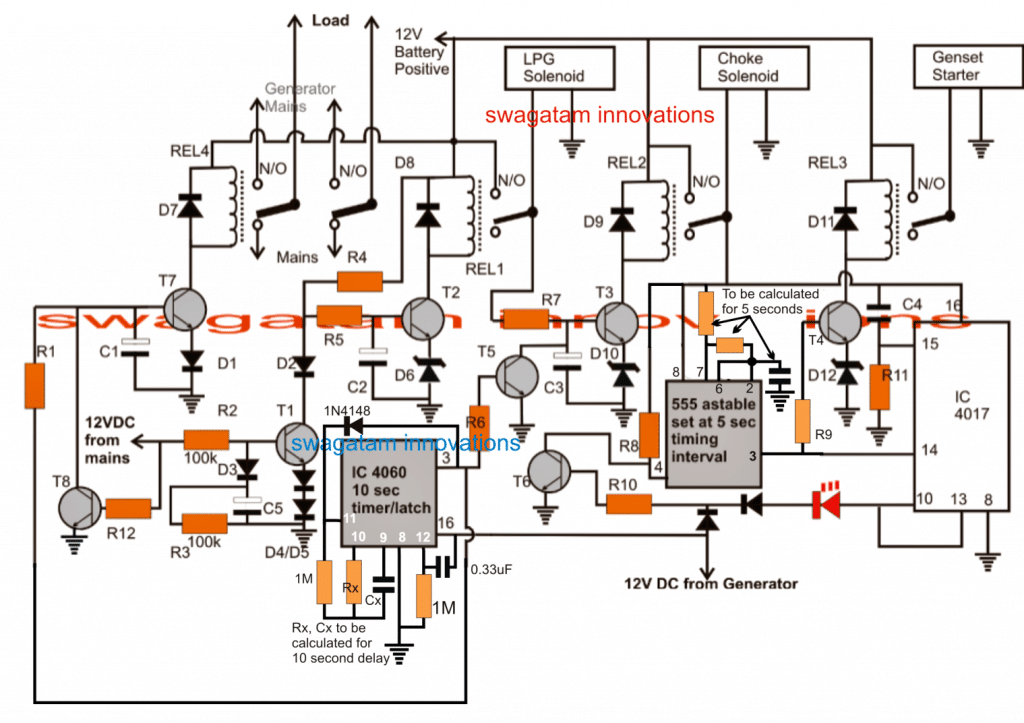
The ATS circuit or automatic relay changeover for generator/ mains circuit as shown below can be understood as follows:
For so long as home mains is present T1 base receives the rectified low voltage DC and keeps T2 base grounded.
With T2 base grounded REL1 is held switched OFF along with REL2, REL3 and REL4, the whole circuit thus stays switched OFF.
With REL4 deactivated, the DPDT holds the home mains supply with the load and the load gets powered via its N/C contacts.
Now in a situation when home mains fails, T1 is inhibited from its base drive and it instantly stops conducting.
With T1 OFF, T2 now activates, switching ON REL1, which in turn activates the LPG solenoid valve for allowing the fuel to reach generator combustion chamber.
After a few seconds delay T3/REL2 also activate pushing ON the choke solenoid into start position. The delay may be fixed by the tweaking the values of R7, C3.
REL2 activation switches ON the 555 astable which starts counting upto 5 seconds and triggers T4/REL3 so that the generator starter motor begins cranking the gen.
The astable allows this to happen for 5 seconds, if the generator starts, a 12V supply from a 12V adapter connected at the output of the generator feeds T6 base and disables the 555 astable.
The above 12V from the gen also activates the 4060 timer/latch which counts for about 10 seconds after which its pin#3 goes high.
The pin#3 high pulse latches the IC and also feeds T5 which deactivates REL2 so that the choke solenoid is pulled back to "close" position.
The 4060 output also simultaneously activates T7/REL4 making sure that the load now gets connected to the generator AC via N/O contacts of REL4.
Now suppose due to some fault, the cranking of the generator starter fails to initiate the generator, the astable makes three attempts with 5 seconds interval between each try.
Since the above pulses also reach IC4017 counter, after three pulses the IC4017 output sequence reaches its pin#10 which instantly latches itself due to a high at pin#13, and also disables the 555 astable by grounding its reset pin#4 via T6.
REL3 now stops feeding the crank mechanism.
An additional transistor driver/RELAY may be configured with pin#10 of IC 4017. The N/O contacts of this relay then could be wired with an alarm for the required warning in case the cranking attempts fails to start the generator.
When mains AC returns, T1 receievs the atached 12VDC at its base, however due to the presence of R2, D3, C5, T1 is restricted from the base voltage for a few seconds, until C5 charges.
In the meantime T7 is disabled and REL4 reverted to home mains position by T8, this happens as soon as mains returns, so that the generator gets immediately unloaded from the connected appliances.
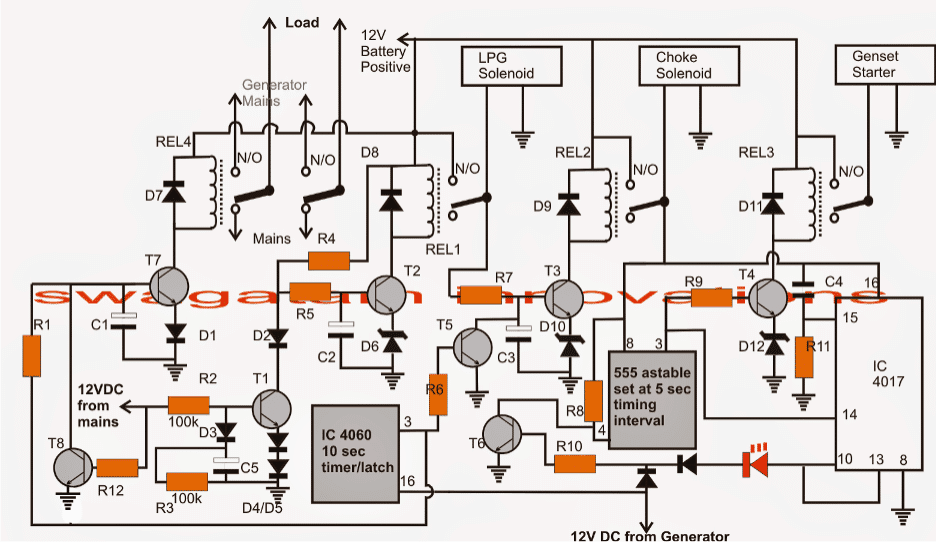
Parts list for the above automatic transfer switch or ATS circuit
R1, R4, R5, R6, R7, R8, R9, R10, R11 = 10K
R2, R3 = 100K
C4 = 0.1uF
C1----C5 = timing capacitors, can be between 10uF to 100uF
All transistors are BC547
All rectifier diodes are = 1N4007
All zener diodes (D6, D10, D12) are = 3V, 1/2 watt
REL1---REL3 = 12V/10 amps/400 ohms
REL4 = 12V/40amps or as per load specs
IC 555 Astable Configuration
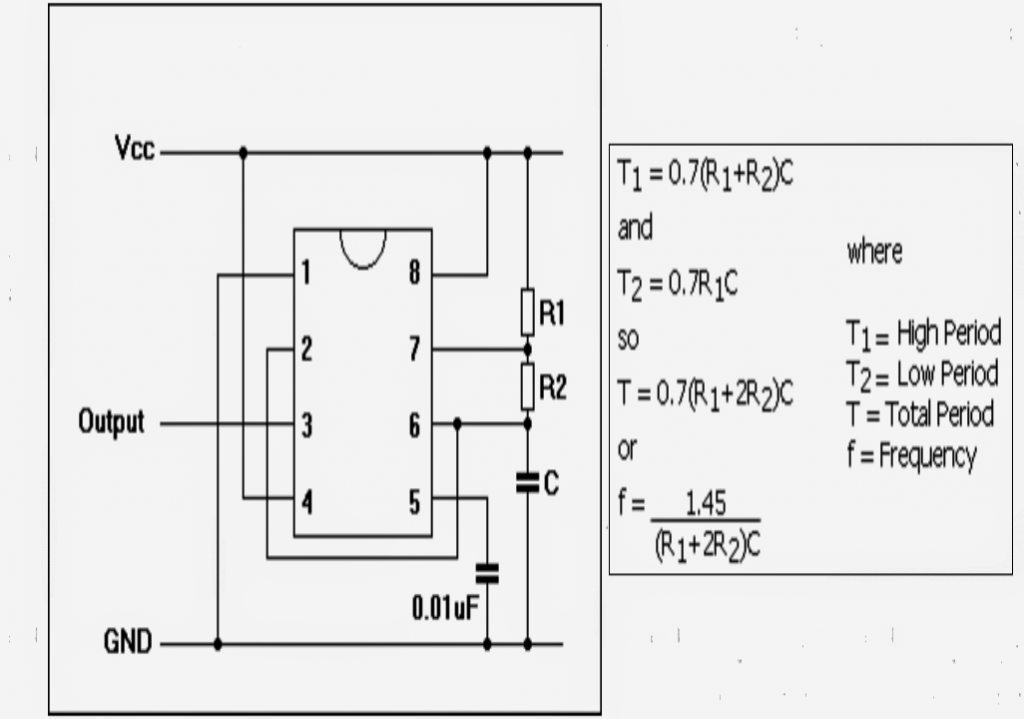
IC 555 Astable Frequency Formula
f = 1.45 / (R1 + 2R2)C
The following formula can be used for calculating the high time and low time periods or the ON/OFF time of the IC 555 astable:
On Time T1 = 0.7(R1 + R2)C
OFF Time T2 = 0.7R1C
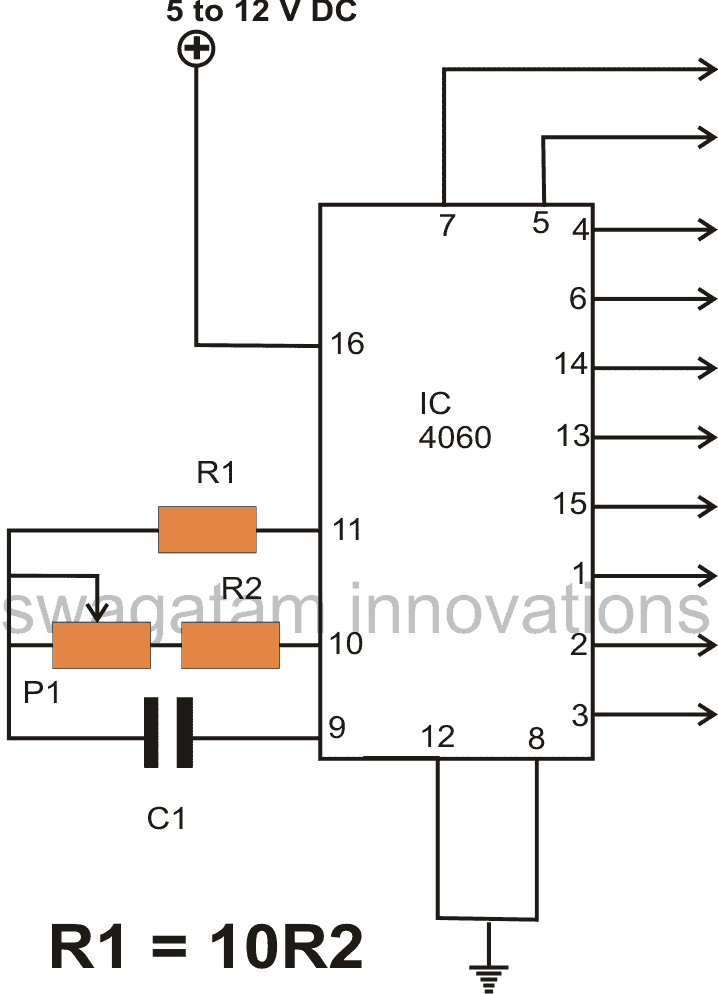
IC 4060 Timer Calculation and Formula
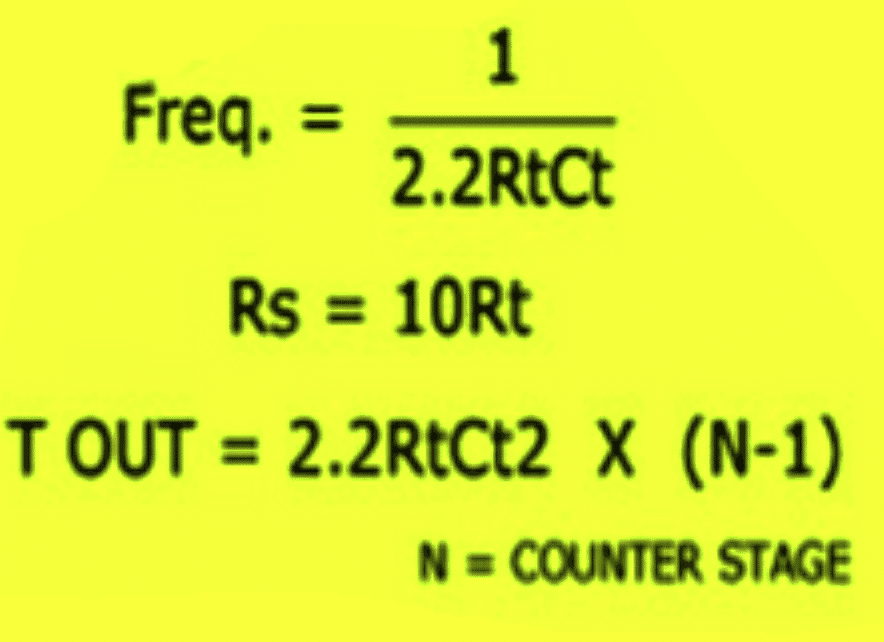
or you can also use the following formula:
f(osc) = 1 / 2.3 x Rt x Ct
2.3 is a constant term which will not need any change.
The oscillator section inside the IC will be able to give stable output only if the following criteria is maintained:
Rt << R2 and R2 x C2 << Rt x Ct.
Updated ATS Circuit Diagram with complete IC 4060 and IC 555 wiring details
Design#2
In the following post I have explained an enhanced Automatic Transfer Switch (ATS) Circuit, which includes several customized sequential changeover relay stages making the system truly smart!
Designed and written by: Abu-Hafss.
Main Features
The circuit presented here is an ATS with following features:
a) Battery Voltage Monitor - The system will not operate when the battery drops to a certain preset level.
b) In the event of power failure, the generator engine will be cranked after 5 sec. The cranking cycle will be 2 minutes in which there will be 12 cranks of 5 sec. each with an interval of 5 sec.
c) As soon as the engine is started, the cranking will be stopped.
d) Initially the generator will start on PETROL and will shift to GAS after 10 seconds.
e) When Grid Mains is restored the load will be shifted to Mains immediately but the generator will be switched off after 10 sec.
Circuit Diagram
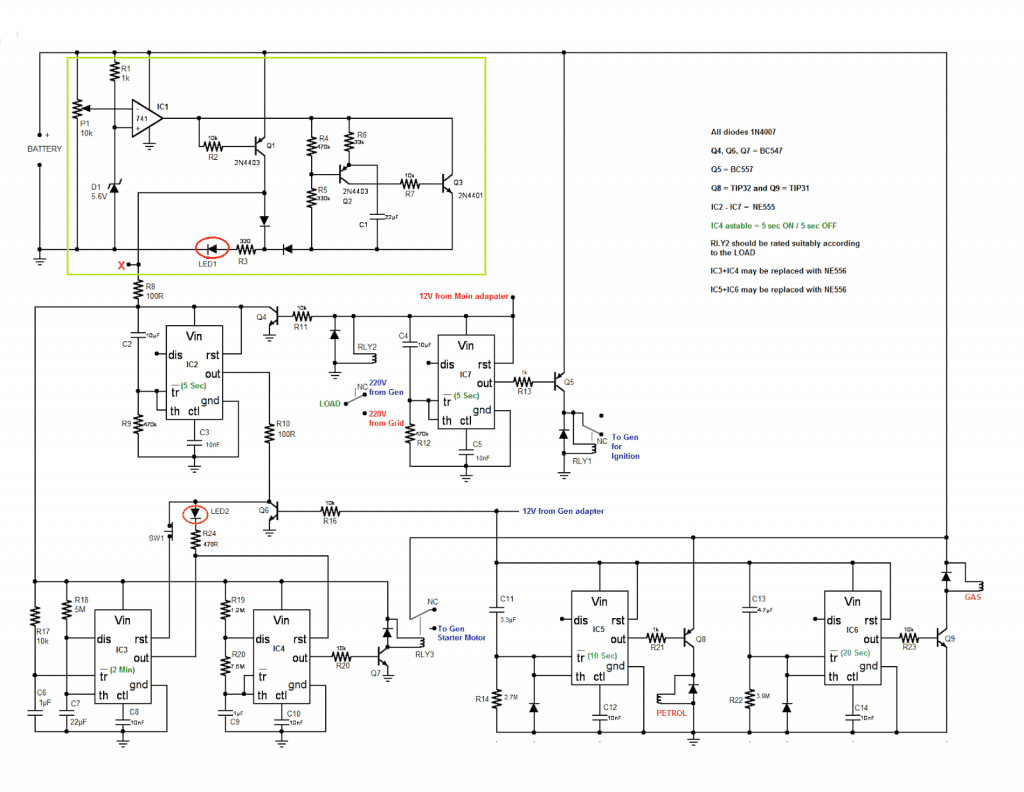
CIRCUIT DESCRIPTION:
1) The circuit enclosed in the green box makes up the battery monitor and it working may be understood here. If the generator is equipped with battery charging setup then this circuit might not be required because the battery will remain in good health. In that case, the entire circuit may be omitted and point X may be connected to the +(ve) of the battery.
2) When the Grid Mains goes off, the generator will be supplied with 12V via relay RLY1 for ignition i.e. RLY1 acts as an ignition switch and RLY2 shifts the LOAD to Generator 220V (which is not yet generated). The absence of grid Mains will switch off Q4 and as a result BATT 12V will be supplied to the rest of the circuit.
IC2, which is configured as "Power-on delay Timer" causes a delay of 5 sec and then resets IC3. IC3 is configured as self-triggering monostable having ON period of about 2 minutes. IC3 resets IC4 which is configured as an astable vibrator (about 5 sec ON and 5 sec OFF). During 2 minutes, IC4 cranks the generator (via R20/Q7/RLY3) 12 times for 5 sec with an interval of 5 sec.
If the engine does not starts within 2 minutes, LED2 will glow to indicate engine fault and the entire system will come to halt until the Grid Mains is restored. If required, the cranking procedure can be restarted by pressing the (Push-to-Off) reset button SW1.
3) Now, assuming that the engine has started during cranking, the generator will start producing electricity hence, 12V from generator adapter will be available. This will switch on Q6 hence, IC3 and IC4 will be powered off which ultimately stops the cranking cycle.
4) The 12V from generator will also power on IC5 and IC6. Both are configured as "Power-on Delay Timer" for about 10 sec and 20 sec respectively. For the initial 10 sec Q8 will conduct and the solenoid valve for PETROL will be opened to supply petrol to the generator. After 10 sec Q8 will stop conducting thereby stopping the petrol supply.
The engine will continue to run on petrol which present in the fuel lines. After about 10 sec the output of IC6 will become high and Q9 will start conducting. This will switch on the solenoid valve for GAS hence, the engine will now continue to run on gas.
5) Now, assuming the grid mains is restored, the 12V from mains adapter will switch on relay RLY2 which will switch the load immediately to the grid mains. The mains 12V will also switch on Q4 hence, IC2, IC3 and IC4 will be disconnected from the battery 12V.
The 12V mains will also power on IC7 which is configured as "Power-on Delay Timer". The output of IC7 will become high after about 5 sec which will switch off Q5 and de-energize RLY1, ultimately the 12V for generator will be switched off and the generator will be stopped.


Comments
Good day sir. there is ATS project I look forward to implement. This ATS will transit power between 2 different power sources e.g inverter and Grid without any form of delay. I mean no one will even notice power transition when operating. That way, industrial motor will not stop for a moment when Grid supply is off. To implement this, I intend using two 0 – 12v transformers provide to be powered by the two different power sources, 3 relays(12v each). one of the relays will be the output relay. My question is how to hook this up to quickly deactivate Grid relay and then switch to the Inverter relay within nanoseconds or microseconds. How will the overall switching circuit look like.
Hi Mosses,
I think the concept explained in the following article might help you to figure out the solution for your intended ATS inverter/grid application:
https://www.homemade-circuits.com/how-to-convert-inverter-to-ups/
Good day sir. I have some questions
(1) is the 4060, 555 and 4017 ic ATS circuit applicable to diesel engine generator since there is no choke for diesel engine.
(2) what is the function of 0.33uf (334) and 1M ohms at pin#16 & #12 of IC4060?
(3) from the circuit, what is the value of R12 which is at the base of transistor T8?
(4) from the formula, T out=(2.2*Rx*Cx)(N-1) , N= counter stage.
Please I want to know the meaning of “Counter stage”
Hi Emmanuel,
1) If there’s no choke then the choke control section can be perhaps eliminated.
2) Those parts are actually connected for pin#12. To reset the IC 4060 output to zero whn the ATS is initially switched ON.
3) R12 can be a 10K resistor
4) Yes the formula is correct.
Pin#3 is used as the output, which corresponds to counter number 14 according to the datasheet
Ok. Thanks for your quick response.
So should I take the value of ‘N’ as 14 in the calculation?
Yes you can take it as 14. Remember C will be in Farads and R will be in Ohms
Ok. Thank you sir
HI
I have to troubleshoot a generator transfer problem. Seems that when to power is restored the system does not transfer back to utility power. The transfer switch in mechanically held,coil has a internal bridge rectifier,
I would think the transfer voltage is momentary to make the switch. I do not know how long the pulse is.My question is how long the voltage is present to make the transfer?
Please reply
P. Popiel
Hi, sorry, without checking the circuit practically it can be difficult to diagnose the fault.
Dear Sir I am in awe for the time you put in to teach new people in this the Electronic age . I would like you to explain how the workings of the timers are acheived in the above Smart circuit and can each IC section be tested individually, not connected to each other for the timing results. I want to have IC2 as shown with the 5 sec delay, but only 40 to 50 secs IC3 and only 2 repeats of the start cycle. As this is sufficent on the Diesel engine to limit damage to the starter for obvious reasons. Is this possible ? I have used the timing formula monostable IC3 and have #3 at 48secs with #6&7at 5m/10mfd #2 10K/1Mfd/ #5 . 01nfd but upon power up 12v it shuts off #3 led . After a couple off power ups and the cap has a slight charge it starts to time correctly. I have not got to try to retime IC4 because I am unsure now of what I am doing . I am 86yrs with a small back ground in electrical and would appreciate anny help in acheiving the the change in the sequece as explained above. Many thanks in advance and would appreciate somee help
Thank you Sir, I appreciate your interest and glad you are enjoying the articles here!
Yes definitely each of the stages in the last diagram can be tested and verified separately. You can refer to the following posts to know more about these stages:
IC 555 Pinouts, Astable, Monostable, Bistable Circuits with Formulas Explored
How to Use an Op amp as a Comparator Circuit
You can also calculate the parts using the following automatic calculator software:
IC 555 Astable Calculator
IC 555 Monostable Calculator
Hope you will find these pages useful for the required calculations and verification of the individual stages….
Thankyou for the quick reply. I still have a query in that I have made up IC3 circuit but under test I find that it does not work on the first power up and shuts down test LED on #3 I do not have an oscilloscope and even if I did I would not know what to do to rectify the fault. Can you please advise how to stop the initial pre shut down on the power up from IC2. #3. I also note that R8 100R supply means that Vcc is alway on yet you say that Q6 turns on allowing V to set circuit?
Can you please explain .
You can try the following modifications for the IC3 stage and check if that solves the issue:
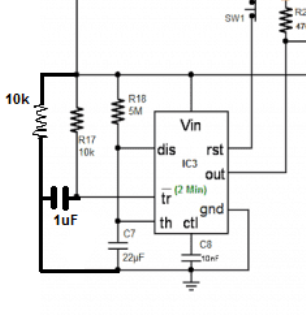
It can be difficult for me to diagnose the whole circuit since it was designed by another author, and may take sometime to simulate the circuit in mind.
Hi,this really helped me. but i don’t need the generator to switch from petrol to gas what part of the circuit should i omit. Also the time it takes for the generator to start how can i reduce it
Glad it helped!! Remove R4, R5, D8 REL1, T2, C2, D6…and connect the D2 anode with R7 end.
The bottom side diagram shows which parts need to be tweaked for adjusting the 5 sec delay.
Sorry I forgot to add that I was using the second circuit not the first. The solution you gave me is for the first circuit. Please how can I do it with the second one.
Both the circuits are one and the same. The lower circuit shows the IC connections in greater detail, that’s the only difference.
Thank you. Also I am simulating so what can I use to represent the gen ignition and the petrol sinusoid on Proteus. Two, after running the simulation, the motor keeps running when mains is on and off. Note I put a switch after my 12v mains to control it on and off.
Sorry, I cannot comment on the simulation results, I can only help with a practically built unit.
Hi,
I need help with the schematic of a Automatic Transfer Switch for a small emergency AC power generator.
Hi Swagatam, please I’m requesting for a circuit diagram of Auto starter/off for generator, with choke solenoid control and fuel solenoid control as well.Thanks, I appreciate.
Hi Tibsy, the first concept looks similar to your request, so may be you can modify it as per your needs.
I’m having problem in your site now a days
The image is not showing when ever i open your article even if i reload the page it still not showing
Please check it now, I have reverted one of the changes that I made recently in my website, thank you for notifying me, appreciate it very much.
The image is coming up now and It’s okey
Thanks for your quick response I really appreciate
That’s great Emmanuel, appreciate your feedback and the help!
Hello Sir,
I really appreciated your kind gesture in Electronics Engineering. I have a request to make based on the ATS. I hope you will have the patience to attend to it.Should I go on
Hello Sir,
thamk you for this nice ATS which I was looking for my son in the Philippines; he has several brownouts during the week, sometimes at night and sometimes the whole day; he has a new generator , which he can start with a remote control with a start-button and a stop-button.
So I only like to start the gen and stop the gen when power is back.What confuses me is the 12V from mains, is that a seperate 12v powersupply feeded by mains?? And 12 V from generator?? So I have to make 2 power supplies, one ralated to mains and one to generator?
He has an automatic transfer switch(single phase) which switches between mains and generator (manually or automatic) ; when power fails , it switches to gen and back to mains when it is back again.
What I would like is only the start-function (2 wires to a second remote control) and a stop-funtion (generator) (also 2 wires for the stop-button), but in the diagram I don’t see a stop function.
Can you help me with this problem?
Thanks in advance!
Leo Smit
Netherlands.
Hello Leo,
Referring to the ATS in the first concept, the entire procedure is supposed to be automatic and is dependent on the mains power presence or absence situations.
If you wish to control the system manually then you can control the application of a 12V DC at the base T1/T8 manually.
Nice that you responded so quick!!
At first I will try the second design with some minor changes;
for example Q5 as a BC547 npn , when mains in back IC7 , OUT is HIGH and relay is on and with the contacts that closes, I have a stop-switch for the generator with a 5 sec delay.
the wires then go to the remote control (solder them over the button-contacts) , and from relay RL Y3 comes signal to start the generator (12x 5 seconds pulses) , so those relaycontact wires go to the stop-buttoncontacts of the remote.The petrol and gas part are not necessary for my purpose.
Only have to build (2x ) 230-12v powersupplies for reference, but since the current flow is not much, that won’t be a problem.
Will make some kind of test-case here , before I send it to the Philippines and hope it will work as you described!
There was also a plan to use an Arduino as interface between mains and generator, but I am not that good in programming, so I was glad to find this project!
Thanks
No problems! please go ahead…wish you all the best!
THANKS AGAIN!!
Thanks, if it’s possible I’ll be happy to help!
cannot read the resistorvalues in desgn#2
R15: 1,2M or 12M ;
R20 : 7,5M or 1,5M ;
R14 : 2,7M ??
R22 : 3,? M
tried to enlarge the picture for better reading , but is keeps unsharp (for me that is)
the first 2 drawings are perfect!
can you give me the values?
thanks!
I am sorry, even I am having difficulty in reading them, I have another diagram which is also similar, still you can have a look at it:
https://3.bp.blogspot.com/-nPKQNcC6wds/W-_3FzgOiHI/AAAAAAAAWco/ovzNylWnRRcoqhStyHZhunXq4DD-dUofACLcBGAs/s1600/ATS-1024×792-1.png
thank you for the very quick response!
this one is really sharper..
in my opinion R19=1,2M R20=7,5M R14=2,7M and R22=3,9M
Can you show the real time project pictures
Glad it helped, yes they seem OK to me!
Good Evening Dear,
Can you please share Schematics , BOM and PCB Design of this one ?
Regards
Hardcore Fan
I am Sorry Mushahid, Presently I do not have PCB designs for this project.
Good afternoon. Your circuit works perfect. only missing pin 1 of ci 555 that goes to negative. thank you very much. from Argentina. Congratulations.
Thank you Victor, I am glad you could make it successfully.
Yes IC 555 pin#1 is mistakenly not shown, I hope readers will understand this and correct it accordingly…
thanks for the explanation I now understand better but the circuit above is wide/complex/ advance I can see it and need a lot of cares even if I start d construction this year I am not sure I ll finish it this year, why (1) I don’t know much details about generator ,hearing this LPG solenoid choke solenoid for the first time (2) moreover it’s final year student project is too tedious I will ask him to give me a new topic.
If a generator is involved then the the operations will be complex, in that case you can eliminate the generator and use only inverter (solar operated) and mainsAC for switching the two alternately, and this can be implemented without any circuit just by using a single DPDT relay
I have read the articles above on the automatic transfer switch (ATS) . its pretty good well-done sir, is like you did not understand my question/ request.
my request was :design of an automatic power supply control from four different sources mains, inverter, generator, solar to ensure no break of power to d load. I said I have seen a similar circuit in the box( circuit database ) 3 phase circuits, page4 “single phase from three phase supply” sir Is it possible to modify it and add one more supply. thanks for your patience.
The mentioned circuit cannot be used for your purpose. Inverter, and mains can be switched alternately, but adding generator can be difficult because generator requires complex process for starting, solar is a DC source which will need to associated with inverter and will require a separate changeover circuit, so all these will need to be configured separately, by combining an ATS circuit and relay changeovers published in this website together..
Hey friend, thank you so much for this post, my friend wanted to know information about ATS Circuit, and you have helped me a lot. I’ll surely forward this information to my friend. Thanks again.
You are most welcome! I am glad it helped…
You are most welcome!!
Thanks sir, so grateful for the response.