In this post I have investigated 4 simple 220V Mains Uninterruptible power supply (UPS) designs using 12V battery, which can be understood and constructed by any new enthusiast. These circuits can be used for operating an appropriately selected appliance or load, let's explore the circuits.
Design#1: Simple UPS using a Single IC
A simple idea presented here can be built at home using most ordinary components to produce reasonable outputs. It may be used to power not only the usual electrical appliances but also sophisticated gadgets like computers. Its inverter circuit utilizes a modified sine wave design.
An uninterruptible power supply with elaborate features may not be critically required for the operation of even the sophisticated gadgets. A compromised design of an UPS system presented here may well suffice the needs. It also includes a built-in universal smart battery charger.
Difference Between UPS and an Inverter
What’s the difference between an uninterruptible power supply (UPS) and an inverter? Well, broadly speaking both are intended to perform the fundamental function of converting battery voltage to AC which may be used to operate the various electrical gadgets in the absence of our domestic AC power.
However, in most cases an inverter may not be equipped with many automatic changeover functions and safety measures normally associated with an UPS.
Moreover, inverters mostly don’t carry a built in battery charger whereas all UPSs have a built in automatic battery charger with them to facilitate instant charging of the concerned battery when mains AC is present and revert the battery power in inverter mode the moment input power fails.
Also UPSs are all designed to produce an AC having a sine waveform or at least a modified square wave resembling quite like its sine wave counterpart. This perhaps becomes the most important feature with UPSs.
With so many features in hand, there’s no doubt these amazing devices ought to become expensive and therefore many of us in the middle class category are unable to lay their hands on them.
I have tried to make a UPS design though not comparable with the professional ones but once built, definitely will be able to replace mains failures quite reliably and also since the output is a modified square wave, is suitable for operating all sophisticated electronic gadgets, even computers.
All the designs here are offline type, you may also want to try this simple online UPS circuit
Understanding the circuit Design
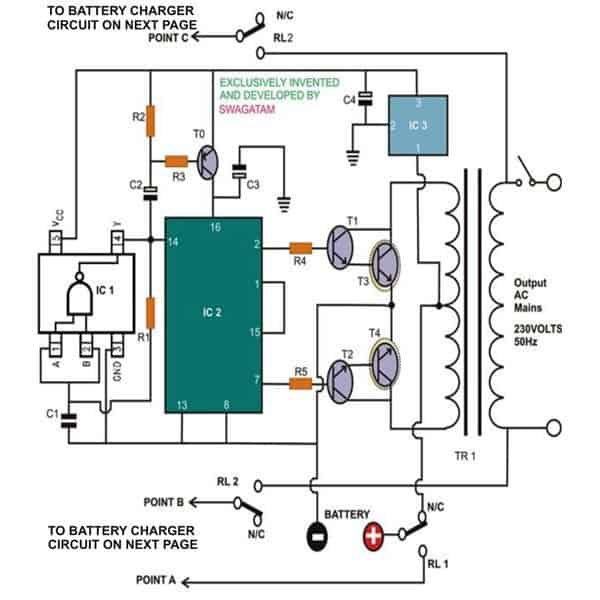
The figure alongside shows a simple modified square inverter design, which is easily understandable, yet incorporates crucial features.
The IC SN74LVC1G132 has a single NAND gate (Schmitt Trigger) encapsulated in a small package. It basically forms the heart of the oscillator stage and requires just a single capacitor and a resistor for the required oscillations. The value of these two passive components determines the frequency of the oscillator. Here it’s dimensioned to around 250 Hz.
The above frequency is applied to the next stage consisting of a single Johnson’s decade counter/divider IC 4017. The IC is configured so that its outputs produce and repeat a set of five sequential logic high outputs. Since the input Is a square wave the outputs are also generated as square waves.
Parts list for the UPS Inverter
R1=20K
R2,R3=1K
R4,R5 = 220 Ohms
C1=0.095Uf
C2,C3,C4=10UF/25V
T0 = BC557B
T1,T2=8050
T3,T4=BDY29
IC1= SN74LVC1G132 or a single gate from IC4093
IC2=4017
IC3=7805
TRANSFORMER=12-0-12V/10AMP/230V
Battery Charger Section
The base leads of two sets of Darlington paired high gain, hi-power transistors are configured to the IC such that it receives and conducts to the alternate outputs.
The transistors conduct (in tandem) in response to these switching and a corresponding high current alternating potential is pulled through the two halves of the connected transformer windings.
Since the base voltages to the transistors from the IC are skipped alternately, the resultant square impulse from the transformer carries only half the average value compared to the other ordinary inverters. This dimensioned RMS average value of the generated square waves very much resembles the average value of the mains AC that is normally available at our home power sockets and thus becomes suitable and favorable to most sophisticated electronic gadgets.
The present uninterruptible power supply design is fully automatic and will revert to the inverter mode the moment input power fails. This is done through a couple of relays RL1 and RL2; RL2 has a dual set of contacts for reversing both the output lines.
As explained above an UPS should also incorporate a built-in universal smart battery charger which also should be voltage and current controlled.
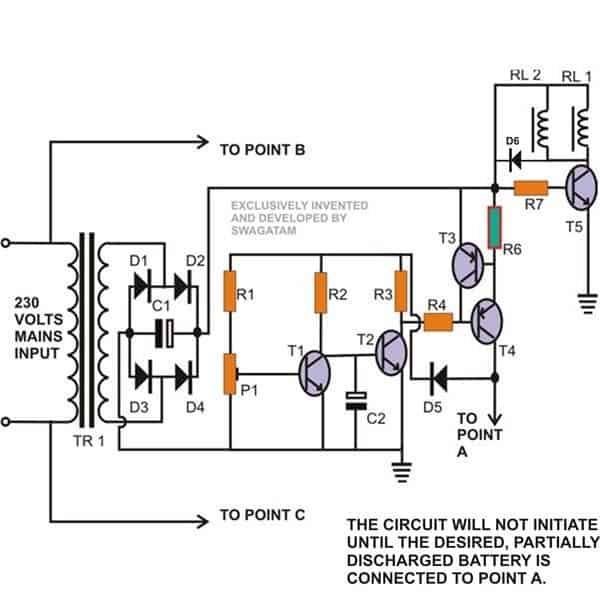
The next figure which is an integral part of the system shows a smart little automatic battery charger circuit. The circuit is not only voltage controlled but is also includes an over current protection configuration.
Transistor T1 and T2 basically form an accurate voltage sensor and never allows the charging voltage upper limit to exceed the set limit. This limit is fixed by setting the preset P1 appropriately.
Transistor T3 and T4 together keep an “eye” over the rising current intake by the battery and never allows it to reach levels which may be considered dangerous to battery life. In case the current starts drifting beyond the set level, the voltage across R6 crosses over – 0.6 volts, enough to trigger T3, which in turn chokes the base voltage of T4, thus restricting any further rise in the drawn current. The value of R6 may be found using the formula:
R = 0.6 / I, where I is the charging current rate.
Transistor T5 performs the function of a voltage monitor and switches (deactivates) the relays into action, the moment mains AC fails.
Parts list for the Charger
R1,R2,R3,R4,R7=1K
P1=4K7 PRESET, LINEAR
R6=SEE TEXT
T1,T2,=BC547
T3=8550
T4=TIP32C
T5=8050
RL1=12V/400 OHM, SPDT
RL2=12V/400 OHM, SPDT, D1—D4=1N5408
D5,D6=1N4007
TR1=0-12V, CURRENT 1/10 OF THE BATTERY AH
C1=2200UF/25V
C2 = 1uF/25V
Design#2: Single Transformer UPS for Inverter and Battery Charging
The next article details a simple transistor based UPS circuit with a built-in battery charger circuit, which can be used for getting an uninterruptible mains power output cheaply, in your homes and office, shops etc. The circuit can be upgraded to any desired higher wattage level. The idea was developed by Mr. Syed Xaidi.
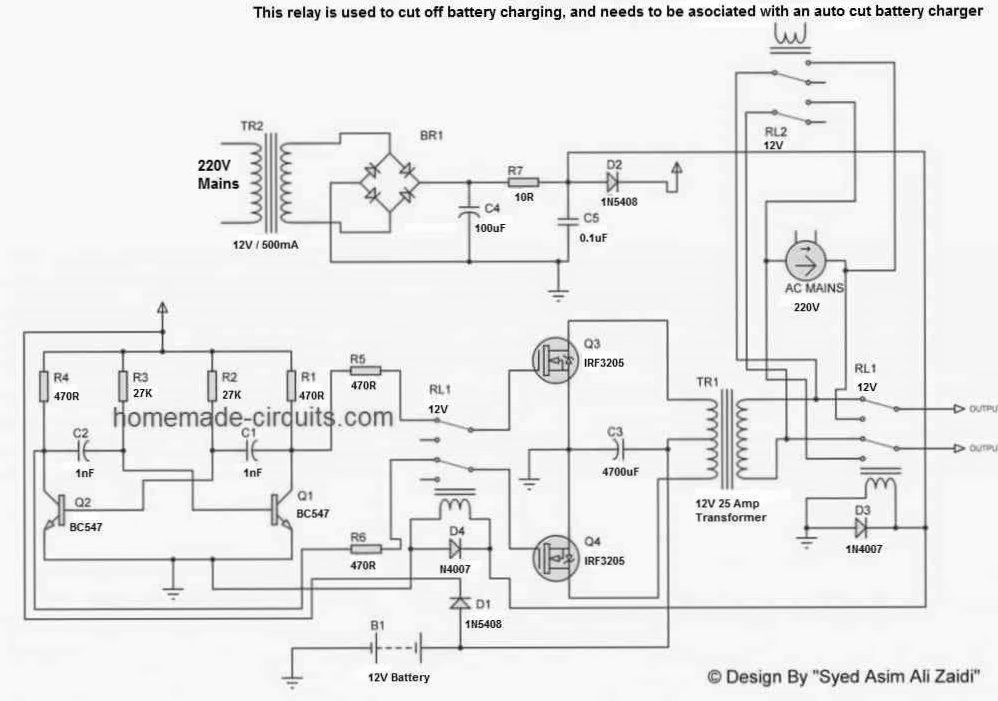
The main advantage of this circuit is that it uses a single transformer for charging the battery as well as for operating the inverter. Meaning you don't have to incorporate a separate transformer for charging the battery in this circuit
The following data was provided by Mr. Syed through email:
I saw that people are getting educated by your post. So, i think you should explain people about this schematic.
This circuit has astable mutivibrator based on transistors as you did. The capacitors c1 and c2 are the 0.47 for getting output frequency about 51.xx Hz as i measured but it is not constant in all cases.
The MOSFET has reverse high power diode that is used to charge the battery there is no need to add a special diode to the circuit. I've shown the switching principle with relays in the schematic. RL3 must be used with a cutt off circuit.
This circuit is very simple and i've tested it already. I am going to test another design of mine will share with you as soon as test is done. It controls output voltage and stabilize that using PWM. Also in that design i am using transformer 140v winding for charging and BTA16 for controlling the charging amperes. Lets hope for the Good.
You're doing best. Never Quit, Have a wonderful day.
Design#3: IC 555 Based UPS Circuit
The 3rd design I have explained below is simple UPS circuit using PWM, and therfeore becomes perfectly safe for operating sophisticated electronic equipment like computers, music system etc.
The entire unit will cost you around $3. A built in charger is also included in the design for keeping the battery always in a topped up condition and in a stand by mode. Let’s study the whole concept and the circuit.
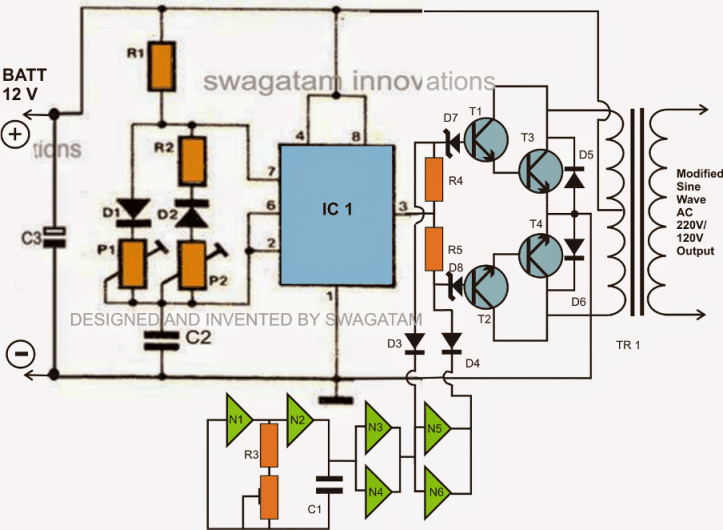
The circuit concept is quite basic, it’s all about making the output devices switch according to the applied well optimized PWM pulses, which in turn switches the transformer to generate an equivalent induced AC mains voltage having identical parameters to a standard AC Sine wave-form.
Circuit Operation:
The circuit diagram can be understood with the help of the following points:
The PWM circuit utilizes the very popular IC 555 for the required generation of the PWM pulses.
The presets P1 and P2 can be set precisely as required for feeding the output devices.
The output devices will respond exactly to the applied PWM pulses from the 555 circuit, therefore a carefull optimization of the presets should result in almost an ideal PWM ratio that can be considered quite equivalent to a standard AC waveform.
However since the above discussed pWM pulses are applied to the bases of the both the transistors positioned for switching two separate chennels would mean a total mess, as we will never want to switch both the windings of the transformer together.
Using NOT gates for Inducing the 50Hz Switching
Therefore another stage consisting a few NOT gates from the IC 4049 has been introduced, which ensures that the devices conduct or switch alternately and never all at a time.
The oscillator made from N1 and N2; execute perfect square wave pulses, which are further buffered by N3---N6. The diodes D3 and D4 also plays an important role by making the devices respond only to the negative pulses from the NOT gates.
These pulses switch OFF the devices alternately, allowing only one channel to conduct at any particular instant.
The preset associated with N1 and N2 is used to set the output AC frequency of the UPS. For 220 volts, it must be set at 50 Hz and for 120 volts, it must be set at 60 Hz.
Parts List for the UPS
R1, R2, R3 R4, R5 = 1K,
P1, P2 = as per formula,
P3 = 100K preset
D1, D2 = 1N4148,
D3, D4 = 1N4007,
D5, D6 = 1N5402,
D7, D8 = 3v zener diode
C1 = 1uF/ 25V
C2 = 10n,
C3 = 2200uF/25V
T1, T2 = TIP31C,
T3, T4 = BDY29
IC1 = 555,
N1…N6 = IC 4049, please consult the datasheet for the pin out numbers.
Transformer = 12-0-12V, 15 Amps
The Battery charger circuit:
If it’s an UPS, the inclusion of a battery charger circuit becomes imperative.
Keeping the low cost and simplicity of the design in mind, a very simple yet reasonably accurate battery charger design has been incorporated in this uninterruptible power supply circuit.
Looking at the figure we can simple witness how easy the configuration is.
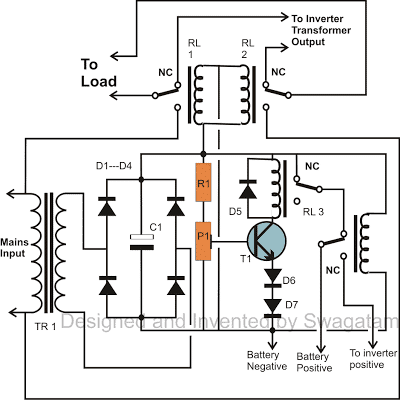
You can get the entire explanation in this battery charger circuit article The two relays RL1 and RL2 are positioned to make the circuit completely automatic.When mains power is available, the relays energize and switch the AC mains directly to the load via there N/O contacts. In the meantime, the battery also gets charged through the charger circuit.The moment AC power fails, the relays revert and disconnect the mains line and replaces it with the inverter transformer so that now the inverter takes charge of supplying the mains voltage to the load, within milliseconds.
Another relay RL4 is introduced to flip its contacts during power failure, so that the battery which was kept in the charging mode is shifted to the inverter mode for the required generation of the back up AC power.
Parts List for the Charger
R1 = 1K,
P1 = 10K
T1 = BC547B,
C1 = 100uF/25V
D1---D4 = 1N5402
D5, 6, 7 = 1N4007,
All relays = 12 volt, 400 Ohm, SPDT
Transformer = 0-12V, 3 Amps
Design#4: 1kva UPS Design
The last design but by far the most powerful discusses a 1000 watt UPS circuit powered with a +/- 220V input, using 40 nos of 12V/4 AH batteries in series. The high voltage operation renders the system relatively less complex and transformerless. The idea was requested by Aquarius.
Technical Specifications
I am your fan & have built many projects for my personal use with success & had a lot of pleasure. God bless you. Now I intend to build a 1000 watt UPS with a different concept (inverter with high voltage input dc).
I will use a battery bank of 18 to 20 sealed batteries in series each 12 volts/ 7 Ah to give a 220+ volts storage as input to a transformerless inverter.
Can you suggest a simplest possible circuit for this concept which should include a battery charger + protection and auto switching by mains failure. Later I will include a solar power input too.
The Design
The proposed 1000 watt UPS circuit can be built by using the following two circuits where the first one is the inverter section with the required automatic changeover relays. The second design provides the automatic battery charger stage.
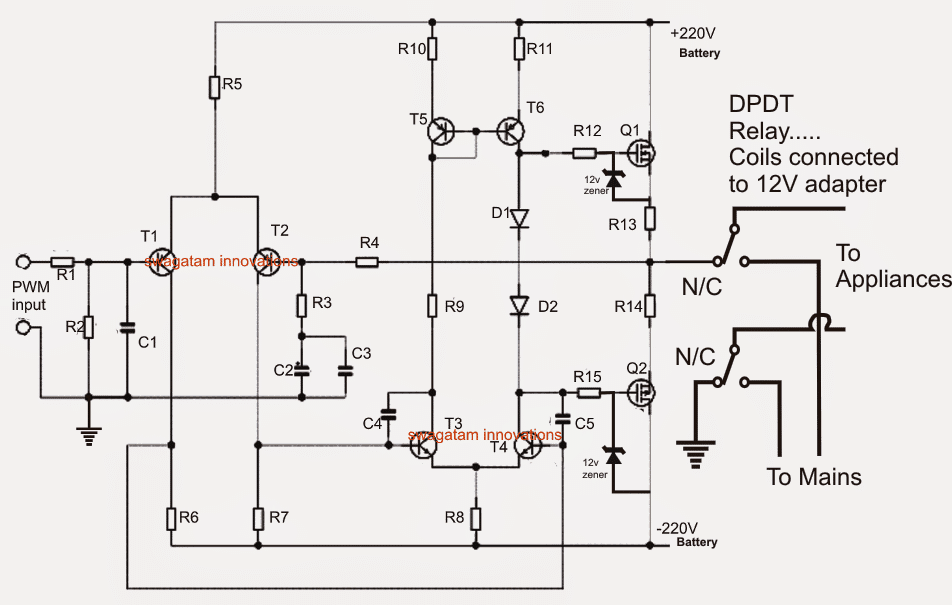
The first circuit which depicts the 1000 watt inverter consists of three basic stages.
T1, T2 along with the associated components form the input differential amplifier stage which amplifies the input PWM signals from a PWM generator which could be a sine generator.
R5 becomes the current source for providing optimal current to the differential stage and to the subsequent driver stage.
The section after the differential stage is the driver stage which effectively raises the amplified PWM from the differential stage to sufficient levels for triggering the subsequent power mosfet stage.
The mosfets are aligned in a push pull manner across the two 220V battery banks and therefore switch the voltages across their drain/source terminals to produce the required AC 220V output without incorporating a transformer.
The above output is terminated to the load via a relay changeover stage consisting of a 12V 10amp DPDT relay whose triggering input is derived from the utility mains via a 12V ac/DC adapter. This triggering voltage is applied to the coils of all the 12V relays that's used in the circuit for the intended mains to inverter changeover actions.
Parts List for the above 1000 watt UPS circuit
All resistor CFR 2 watt rated unless stated.
R1, R3,R10,R11,R8 = 4k7
R2,R4, R5= 68k
R6, R7 = 4k7
R9 = 10k
R13, R14 = 0.22 ohms 2 watt
R12,R15 = 1K, 5 watt
C1 = 470pF
C2 = 47uF/100V
C3 = 0.1uF/100V
C4, C5 = 100pF
D1, D2 = 1N4148
T1, T2 = BC556
T5, T6 = MJE350
T3, T4 = MJE340
Q1 = IRF840
Q2 = FQP3P50
relay = DPDT, 12V/10amp contacts, 400 ohm coil
Battery charger circuit for charging the 220V DC battery banks.
Although ideally the involved 12V batteries should be charged individually via a 14V supply, keeping simplicity into account a universal single 220V charger was finally found to be more desirable and easy to build.
As shown in the diagram below, since the required charging voltage is within the vicinity of 260V, the mains 220V output could be seen directly used for the purpose.
However applying the mains directly could be dangerous for the batteries due to the massive amount of current it involves, a simple solution using a 200 watt series bulb is included in the design.
The mains input is applied via a single 1N4007 diode and through a 200 watt incandescent bulb which passes through a switching relay contacts.
Initially the half wave rectified voltage is unable to reach the batteries due to the relay being in the switched OFF mode.
On pressing the PB1, the supply is momentarily allowed to reach the batteries.
This prompts a corresponding level of voltage to be generated across the 200 watt bulb and is sensed by the opto LED.
The opto instantly responds and triggers the accompanied relay which instantly activates and latches ON and sustains it even after PB1 is released.
The 200 watt bulb could be seen glowing slightly whose intensity would depend on the charged condition of the battery bank.
As the batteries begin charging, the voltage across the 200 watt bulb begins dropping until the relay is switched OFF as soon as the battery full charge level is reached. This could be adjusted by setting up the 4k7 preset.
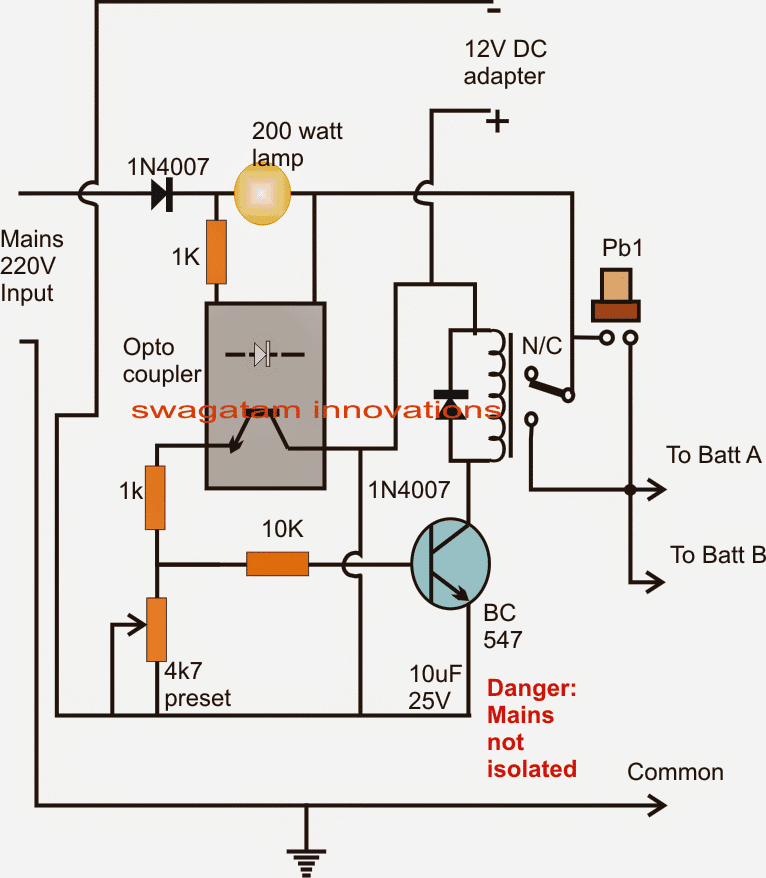
WARNING: The above circuit is not isolated from mains AC and therefore is extremely dangerous to touch in uncovered and switched ON condition. Extreme caution is advised while testing this circuit.
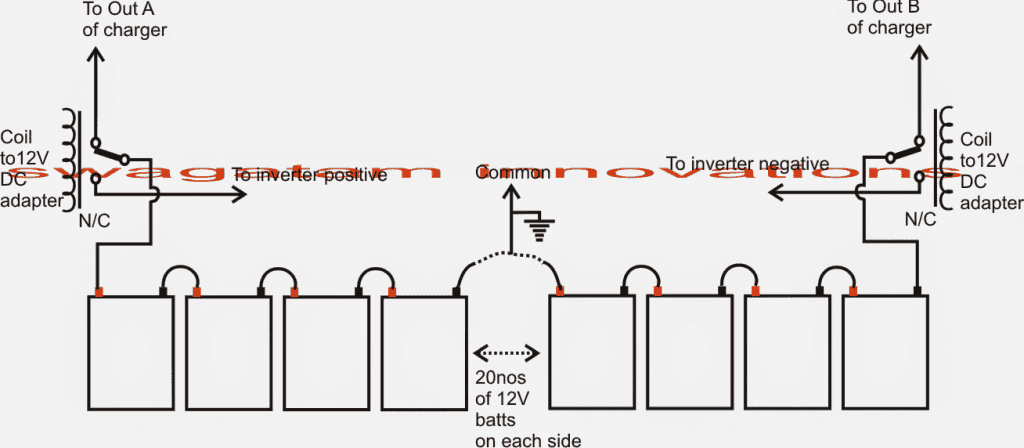
The output from the above charger is fed to the battery bank through a couple of SPDT relays as shown in the following diagram.
The relays make sure that the batteries are put into the charging mode as long as the mains input is available and is reverted to inverter mode when mains input fails.


Questions & Answers
First time I see your Designs. I will try to repair the broken Inverter. Thank you creator. Thank you.
You are welcome Le…
Dear Colleague,
In design 2 (circuit diagram), transistors Q3 and Q4 must have gate-to-source resistors of at least 10 Kohm or the static loading of the gates will cause a steering error and damage them. Greeting.
Radosh
Thanks Radosh,
You are absolutely correct, the circuit was actually contributed by an external author.
Sir, I have this V guard VG 50 model stabilizer using for 3 years and recently repaired with relay fault. found Input volt 227V AC output voltage 247V AC.
how to fix this. Thanks
Hello MK, It is difficult to trace the fault without seeing the circuit diagram of the unit.
hello,
I am a beginner in electronics and looking to fix this online ups mains 220VAC high cut – low cut PCB, from below uploaded picture. Please guide on this.
https://www.homemade-circuits.com/wp-content/uploads/2024/07/ups-board.jpg
Thank
Hello,
Without a schematic diagram it can impossible to fix the fault that you are facing in this UPS board. If possible please provide the schematic diagram.
Using the circuit if possible to operate the ups without baterry just like an extention only AC output
Sir, how to find schematics of a specific PCB ?
Sorry MK, I have no idea from where the schematic of your UPS board can be obtained. You can perhaps try inquiring with your shop dealer from whom you purchased the unit.
Thanks for your reply.
Thanks for reply, I will try search for schematics. Cheers!
Hi Swagatam, very interesting designs above. However, I’m trying to find a reliable external battery to internal battery UPS & charge controller. I can’t seem to find anything worthwhile already commercially available
Thank you Jose,
It seems you are looking for a DC to DC UPS circuit, right?
Can you provide the battery specifications (internal/external), I will try to help!
Yes, thank you! The batteries output about 14.8V … 14A. The end goal is (obviously ?) to seamlessly swap between either Int. or Ext. without power loss
OK, thanks, got it, but from where will the batteries get the charging input, is it from an 220V AC outlet through a charger controller?
So while one battery is charging the other one is powering the load and vice versa??
The input voltage for both Int. & Ext. batteries is 14.8V as the existing charge controller’s output is 14.8V. This circuit is meant for a mobile application where the internal battery only sees a load (and maintains un-interrupted output) while I swap the exhausted external battery for a fresh one & then the internal battery gets replenished by the new external battery. Thank you!
From your explanation the application resembles a power bank application.
The battery swapping is done manually. And the charging for the external battery is done at home by a 220v to 14v battery charger.
However a 14v battery cannot be used to charge another 14v battery.
Can you please specify what circuit are you looking for and what should be its role in this application?
sir , i have my 10 KVA 3/1 online UPS with ISOLATION Transformer in output. now was facing issue in heating up choke inside the UPS. please suggest the route cost for this issue.
Hi Swagatam
I am in South Africa and would like to introduce this innovation and it can be a great business for you and relief for a lot of south africans who cannot afford invertor tech.
My enquiry is to find out if you have developed these UPS’s and manufactured and ready to export?
Thank you Nkcubeko,
I appreciate your kind proposal, however currently it may not be possible for me to manufactures these units. Nevertheless if you wish to manufacture them you can definitely try it, I will be most happy to help you with the the step by step construction.
Long back I had made a prototype of this circuit and tested it, it worked fine.
Hello Ramesh, Without knowing the exact location of the choke in the circuit it can be difficult for me to understand the fault.
hi sir, it was connected in UPS output for current limiting of load. i have 36A max load of single phase connected on that choke transformer.
Hi Ramesh, you will have to make sure the choke transformer is able to handle and control 36 amps by using very thick wires, otherwise it will heat up.
Thank wonderful love your innovations very simple to follow.
Thanks alot
Plz sir, i hav 2 questions: (1)how do i set up the p1 and p2 in the inverter ckt and the p1 in the battery Charger ckt ;(2) After modifying it to a 500w inverter using irf3205 mosfets do i still need T1 and T2 stage in the inverter ckt again ? ALL THESE QUESTIONS ARE FOR THE THIRD DESIGN
Nimel, You can set P1 P2 by checking the output AC voltage and by adjusting the presets until you get the correct level of output RMS voltage.
The mosfets can be connected directly with the R4, R4 resistors, but make sure these resistor are at least 100 ohms and not more than 220 ohms.
Thanks alot i really appriciate
specifically 500w @ 12v input battery
for 500 watt you can replace the power transistors with IRf3205 mosfets, and upgrade the transformer with a 500 watt transformer, that’s all.
You may require 2 mosfets in parallel on each channel.
Good day sir,pls how can i modify the 3rd design for higher wattage
Hello Nimel, how much wattage output do you intend to have?
Have you any 12 kW/kVA UPS design circuit diagram ?
if you have any circuit please seen me by email
Wow.. Love the design of the 1Kva UPS. Having no bulky transformer, the maximum output is only limited by the size of the MOSFETS .. Can these circuits be re-configured for an output / input of 120V 60Hz instead of 220V 50Hz to be used in Canada?? What components need to be altered to accomplish this. Thanks for your valued contribution..
Mike Carlson
Glad you liked the concept…It can be adapted for 120 V AC also without any changes in the components.
Hi,
For the first circuit if i using battery 12V/25AH what is my R6 and TR1?
And can i replace 8050 transistor into TIP122 and BDY29 into TIP 35?
Many Thank
Hi, Yes you can do that!
for both transformer, what is their power rating ?
It will depend on your load power requirement.
Sorry is 12V/7AH battery
R6 = 0.6 / 1 = 0.6 ohms 1 watt
Hi,
May I know the first circuit is it workable?
If yes, can you provide the R6 , TR1 and the battery Volt and amp?
Because I just want to build this Simple UPS for my project.
hello, have you been able to design the ups?
Hi Sir,
Do you have prototype hardware for the first schematic?
Don’t you mind share the image to me
Thank
Hi Desmond, Sorry, presently I do not have it!
I need to understand the circuit of a v-guard make UPS (SESTO DX 600). there is no ac o/p as well as dc o/p to battery. pl help.thank you.
It is difficult, because all brands have their unique design and cannot be diagnosed without knowing the schematic.