The popular LM317 voltage regulator IC is designed to deliver not more than 1.5 amps, however by adding an outboard current boost transistor to the circuit it becomes possible to upgrade the regulator circuit to handle much higher currents, and upto any desired levels.
You might have already come across the 78XX fixed voltage regulator circuit which are upgraded to handle higher currents by adding an outboard power transistor to it, the IC LM317 is no exception and the same can be applied for this versatile variable voltage regulator circuit in order to upgrade its specs for handling massive amounts of current.
The Standard LM317 Circuit
The following image shows standard IC LM317 variable voltage regulator circuit, using a bare minimum of components in the form of a single fixed resistor, and a 10K pot.
This set up is supposed to offer a variable range of zero to 24V with an input supply of 30V.
However if we consider the current range, it's not more than 1.5 amps regardless of the input supply current, since the chip is internally equipped to allow only up to 1.5 amps and inhibit anything that may be demanding above this limit.
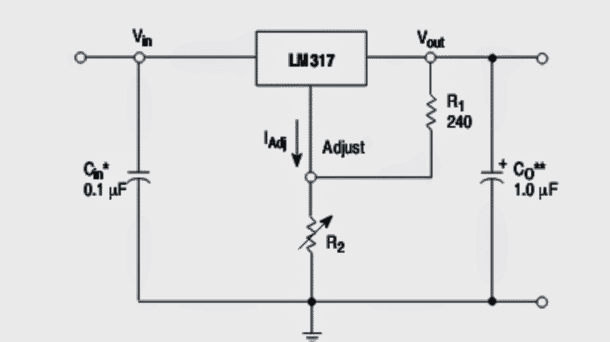
The above shown design which is limited with a 1.5 amp max current can be upgraded with an outboard PNP transistor in order to boost the current on par with the input supply current, meaning once this upgrade is implemented the above circuit will retain its variable voltage regulation feature yet will be able to offer the full supply input current to the load, bypassing the IC's internal current limiting feature.
Calculating the Output Voltage
For calculating the output voltage of a LM317 power supply circuit the following formula could be used
VO = VREF (1 + R2 / R1) + (IADJ × R2)
where is = VREF = 1.25
Current ADJ can be actually ignored since it is usually around 50 µA and therefore too negligible.
Adding an Outboard Mosfet Booster
This current boost upgrade can be implemented by adding an outboard PNP transistor which may be in the form of a power BJT or a P-channel mosfet, as shown below, here we use a mosfet keeping things compact and allow a huge current upgrade in the specs.
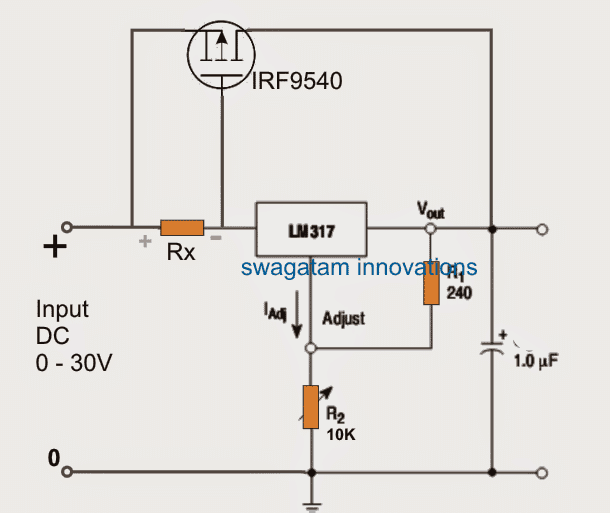
In the above design, Rx becomes responsible for providing the gate trigger for the mosfet so that it's able to conduct in tandem with the LM317 IC and reinforce the device with the extra amount of current as specified by the input supply.
Initially when power input is fed to the circuit, the connected load which could be rated at much higher than 1.5 amps tries to acquire this current through the LM317 IC, and in the process a proportionate amount of negative voltage is developed across RX, causing the mosfet to respond and switch ON.
As soon as the mosfet is triggered the entire input supply tends to flow across the load with the surplus current, but since the voltage also begins to increase beyond the LM317 pot setting, causes the LM317 to get reverse biased.
This action for the moment switches OFF the LM317 which in turn shuts off the voltage across Rx and the gate supply for the mosfet.
Therefore the mosfet too tends to switch OFF for the instant until the cycle perpetuates yet again allowing the process to sustain infinitely with the intended voltage regulation and high current specs.
Calculating MOSFET Gate Resistor
Rx may be calculated as given under:
Rx = 10/1A,
where 10 is the optimal mosfet triggering voltage, and 1 amp is the optimal current through the IC before Rx develops this voltage.
Therefore Rx could be a 10 ohm resistor, with a wattage rating of 10 x 1 = 10 watt
If a power BJT is used, the figure 10 can be replaced with 0.7V
Although the above current boost application using the mosfet looks interesting, it has a serious drawback, as the feature completely strips off the IC from its current limiting feature, which can cause the mosfet to blow-of or get burnt in case the output is short circuited.
To counter this over-current or short-circuit vulnerability, another resistor in the form of Ry may be introduced with the source terminal of the mosfet as indicated in the following diagram.
The resistor Ry is supposed to develop a counter voltage across itself whenever the output current is exceeded above a given maximum limit such that the counter voltage at the source of the mosfet inhibits the gate triggering voltage of the mosfet forcing a complete shut off for the mosfet, and thus preventing the mosfet from getting burnt.
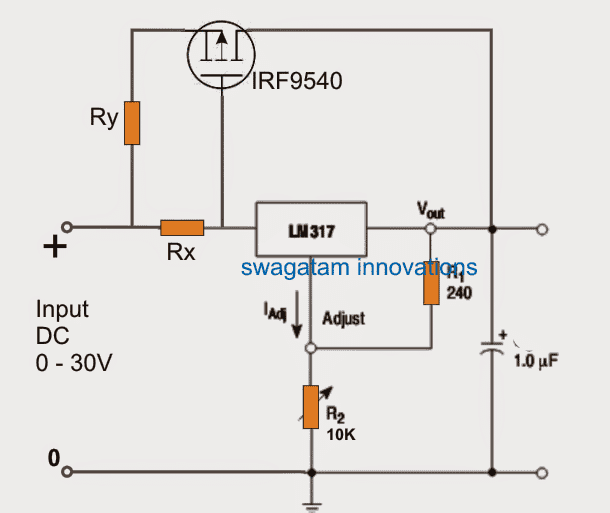
This modification looks pretty simple, however calculating Ry could be little confusing and I do not wish to investigate it deeper since I have a more decent and a reliable idea which can be also expected to execute a complete current control for the discussed LM317 outboard boost transistor application circuit.
Using a BJT for Current Control
The design for making the above design equipped with a boost current and also a short circuit and overload protection can be seen below:
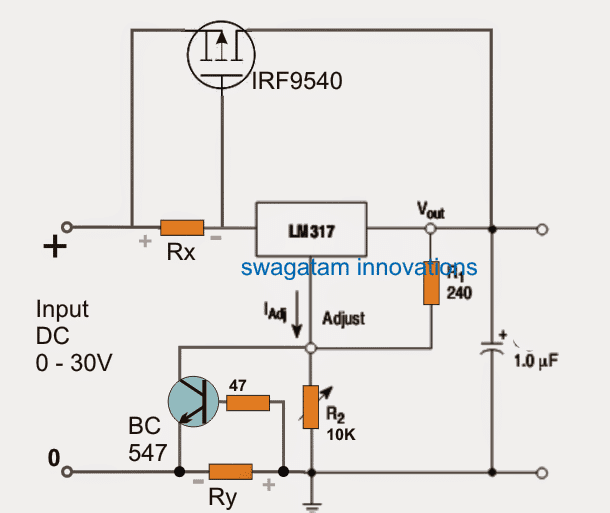
An couple of resistors, and a BC547 BJT is all that may be required for inserting the desired short circuit protection to the modified current boost circuit for the LM317 IC.
Now calculating Ry becomes extremely easy, and may be evaluated with the following formula:
Ry = 0.7/current limit.
Here, 0.7 is the triggering voltage of the BC547 and the "current limit" is the maximum valid current that may specified for a safe operation of the mosfet, let's say this limit is specified to be 10amps, then Ry can be calculated as:
Ry = 0.7/10 = 0.07 ohms.
watts = 0.7 x 10 = 7 watts.
So now whenever the current tends to cross the above limit, the BC547 conducts, grounding the ADJ pin of the IC and shutting off the Vout for the LM317
Using BJTs for the Current Boost
If you are not too keen on using mosfet, in that case you could probably apply BJTs for the required current boosting as shown in the following diagram:
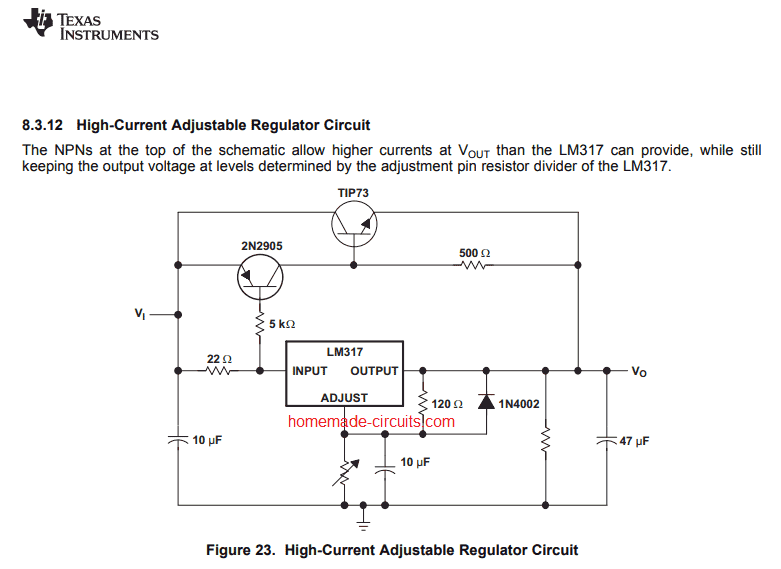
Courtesy: Texas Instruments
Adjustable Voltage/Current LM317 High Current Regulator
The following circuit shows a highly regulated LM317 based high current power supply, which will provide an output current of over 5 amps, and a variable voltage from 1.2 V to 30 V.
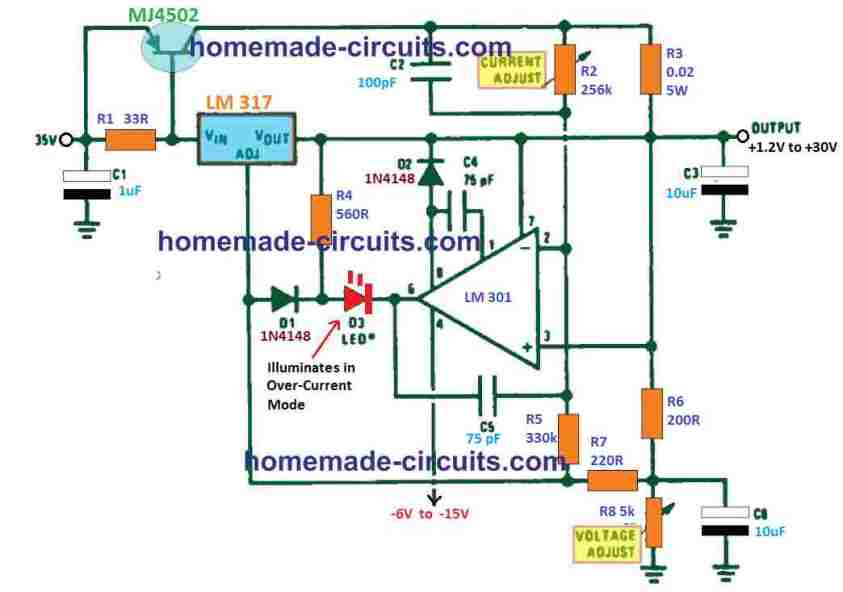
In the figure above we can see that the voltage regulation is implemented in the standard LM317 configuration through R6 pot which is connected with the ADJ pin of the LM317.
However, the op amp configuration is specifically included to feature the useful a full scale high current adjustment ranging from the minimum to the maximum 5 Amp control.
The 5 amp high current boost available from this design can be further increased to 10 amps by suitably upgrading the MJ4502 PNP outboard transistor.
The inverting input pin#2 of the op amp is used as reference input which is set by the pot R2.
The other non-inverting input is used as the current sensor. The voltage developed across R6 through the current limiter resistor R3 is compared with the R2 reference which allows the output of the op amp to become low as soon the maximum set current is exceeded.
The low output from the op amp grounds the ADJ pin of the LM317 shutting it off and also the output supply, which in turn quickly reduces the output current and restores the LM317 working.
The continuous ON/OFF operation ensures that the current is never allowed to reach above the set threshold adjusted by R2.
The maximum current level can be also modified by tweaking the value of the current limit resistor R3.
Another High Current LM317 circuit with Adjustable Current Circuit
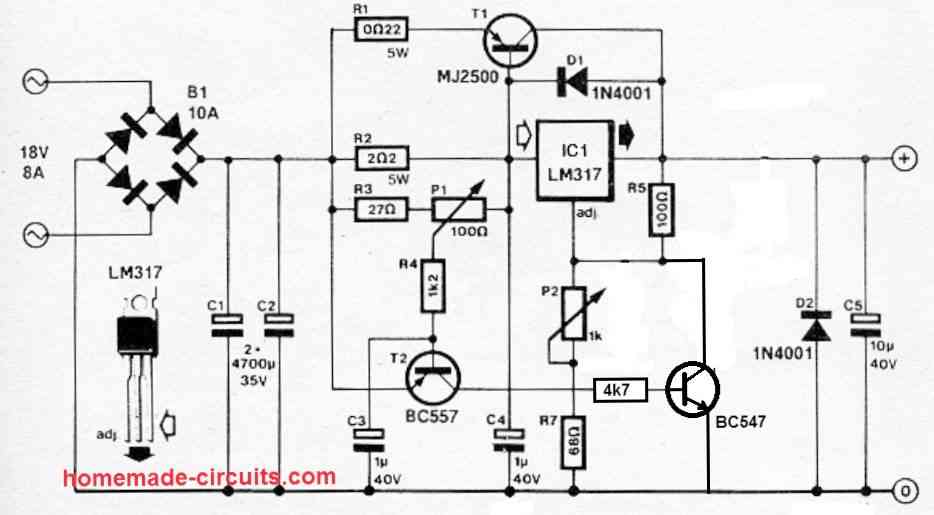
The following design also depicts an LM317 device configured with an external outboard transistor for achieving an enhanced high current output.
However, this circuit includes an improved current control feature, which is fully adjustable through a preset.
The idea is actually simple. Resistor R2 is rigged as the current sensor resistor.
When the output current exceeds the desired maximum limit, a proportionately increased potential is developed across the resistor R2.
This current is applied to the base T2, depending on the setting of the preset P1.
When this happens, T2 conducts and supplies the required base bias to the attached BC547 transistor.
The BC547 now begins conducting thereby grounding the ADJ pin of the LM317.
This causes the LM317 to shut down, and prevent the output current from exceeding any further.
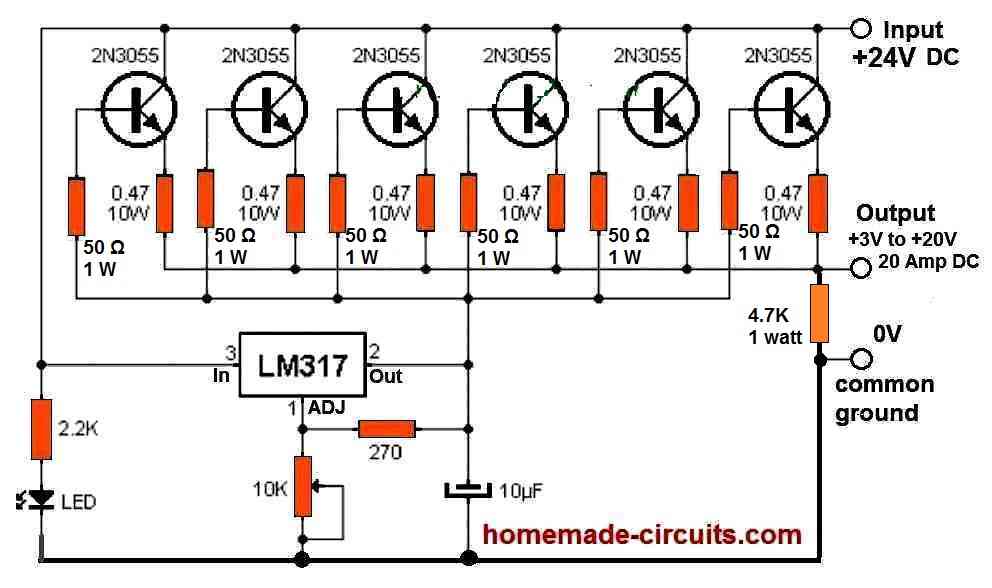
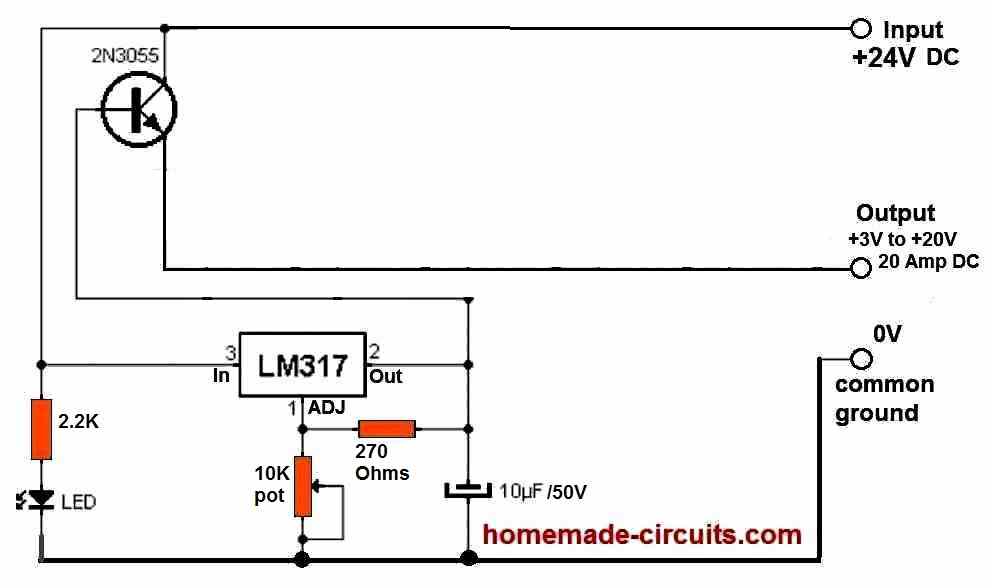
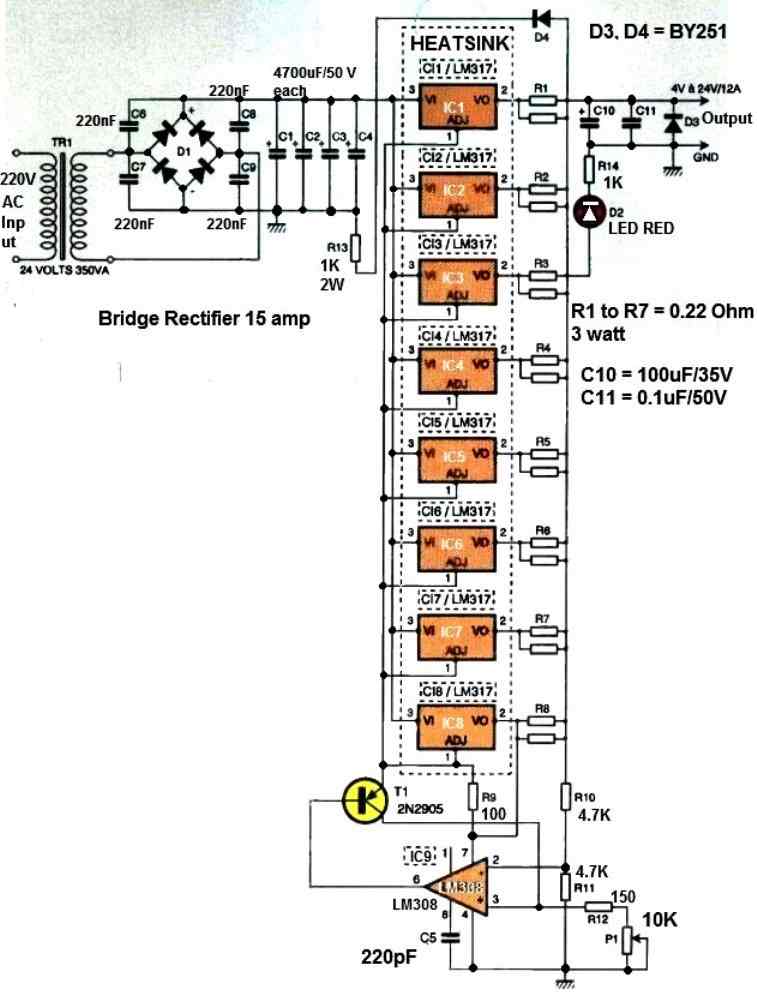
Using 6nos of 2N3055 to generate 20 amp current Output
Another very simple high current LM317 variable power supply can be built by connecting a few power transistors like 2N3055 in emitter follower configuration with the output of a standard LM317 power supply circuit as shown below.
The following design was contributed to this site by one of the avid readers of this blog, Mr. Moe through email.
Here's the details of the email as given below:
I have studied all your LM317 based power supply projects and have I have learned a lot from your wonderful posts. However; I assembled this very simple circuit below and it works very well. I would be very glad and thankful if you would please take a look at it to see if it is a perfect circuit or needs some modifications.
Using a Single 2N3055 with LM317 to Generate 5 amp output Current
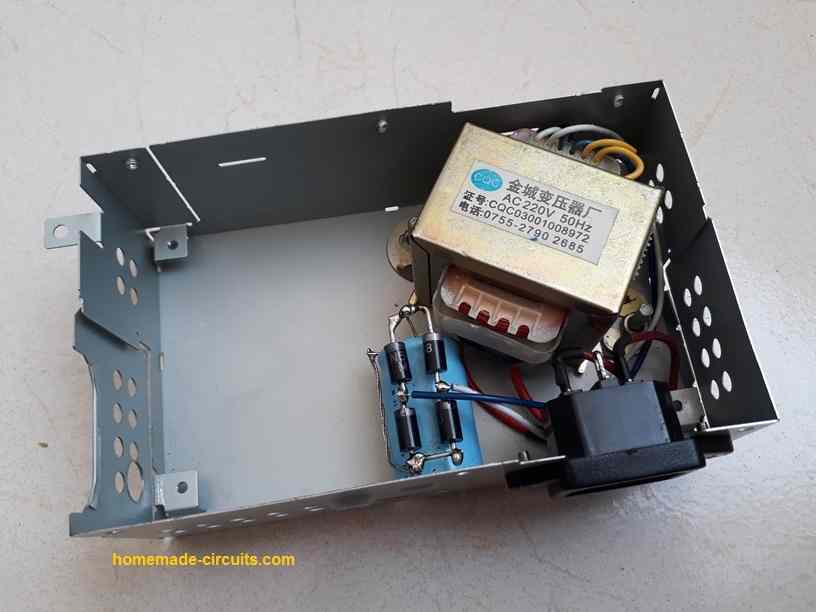
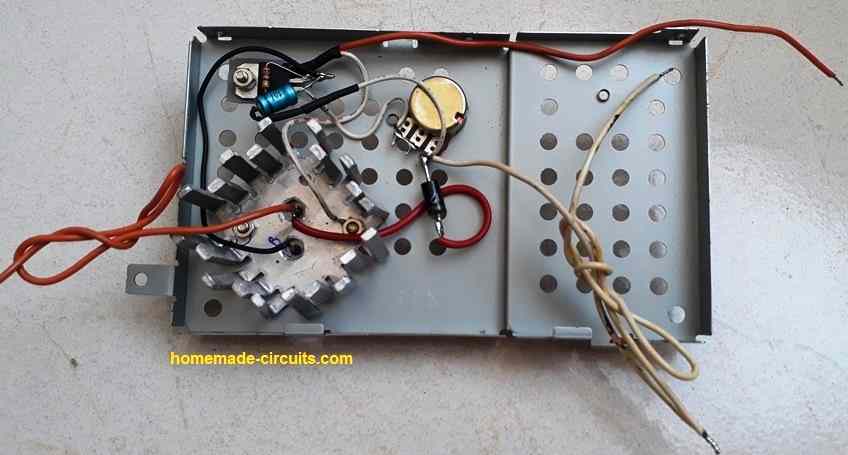
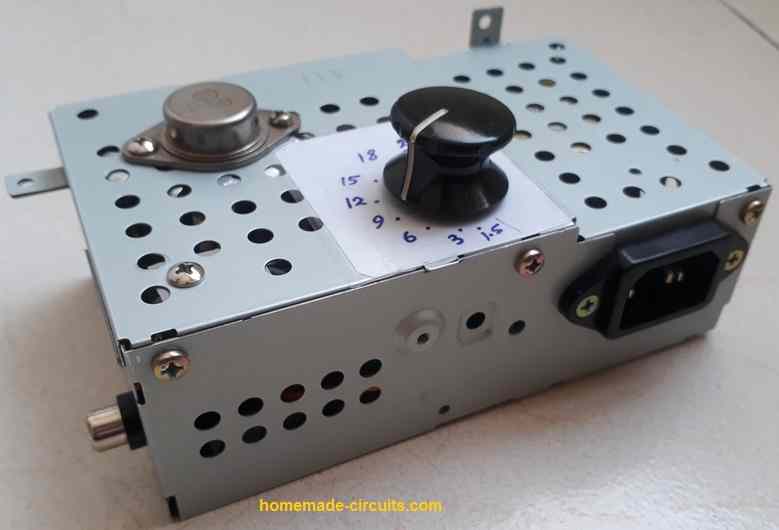
The above high current LM317 power supply using a single 2N3055 transistor was successfully built and tested by Mr. Ersa, who is a avid reader of this blog.
The following video test proof along with beautiful prototype images were contributed by Mr. Ersa:



Comments
it is the ic , because when I read the output pin and input pin both read in reverse polarity
Sure, in that case you can replace the IC with an original good quality IC, purchased from a reputable source…
hello sir , the pot still on smoking whenever I reduce the voltage
pls I has sent you the schematic diagram pls check for any error
I will your appreciate your correction
Okon, if the pot is smoking even with the basic LM317 circuit, that clearly means your IC is not original and is faulty, assuming the connections are correct and the input voltage is below 30V DC
Hello Mr Swagatam, I built one of the variable power supply circuit using lm 317 and two of tip 3055 , bd 135 and others components,but the problem am having is that
initially the voltage is not starting from zero
when I try reducing the voltage, the pot begin smoking and
the output voltage of lm317 to ground is not 1.25 is around 12 volt. pls what do you think it could be the problem because I has changed the pot it’s still smoking, I will appreciate every of device on how to solve the issues thanks
Hi Okon,
if your pot is smoking at any position of its adjustment, that means there’s something seriously wrong either with your circuit connections or the IC itself.
I would suggest you to first test the basic LM317 configuration without any external devices, and check if the problem persists or not, if it does that would indicate a faulty IC, …..assuming your connections ae correct….
https://www.homemade-circuits.com/wp-content/uploads/2015/12/317-2.png
alright thank you for your reply, I will try the basic circuit
Sure, let me know how it goes..
Hi Swagatam
In the section “Using a BJT for Current Control”, you mentioned that Ry should be 0.07 ohms 7 watts. But such low-ohm and high-watt resistors are difficult to obtain. Do you have any solutions for this problem?
Hi SAsa,
You can add many higher watt resistors in parallel to create the required equivalent resistor value.
Hello Swagatam
Currently I have set up 2 circuits with 2 LM317T, according to the datasheet schematic.
Their problem is shortage of output current, and therefore voltage drop at the outpu. For example, when I set R1 and R2 for 10.2 volts and output voltage without load is 10.2 volts, by connecting a 11.7 ohm resistor as output load the output voltage drops to 2.4 volts!! (6.77 drops to 2.4; 9.87 drops to 2.5). This is an “acute” current shortage because 10.2/11.7=0.871 Amps, much below 1.5 Amps which is the output current capability of LM317T.
The input of these LM317T circuits is from a powerful ATX power supply (its +12 line when drawing 5 Amps only drops to 11.9 volts). So input is not the culprit.
What (other than the possible low quality of my LM317T ICs themselves) is causing this acute output current shortage?
Hi SA,
The problem could be with the quality of the LM317 or maybe it is heating up too much.
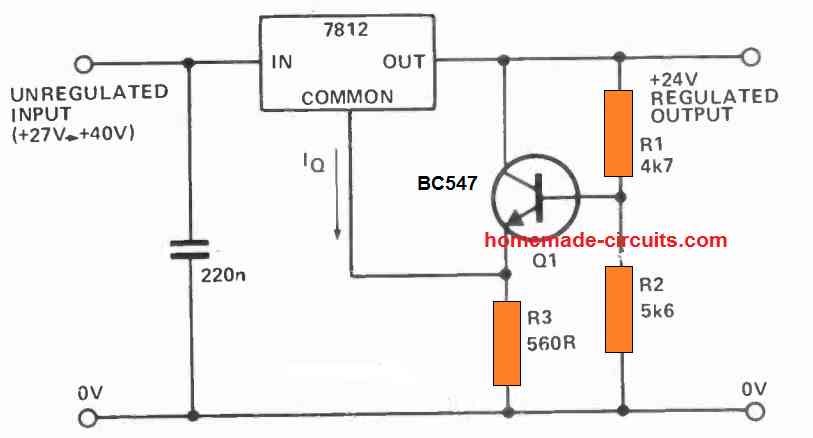
Instead of LM317, you can try the following simple configuration, which also has an overload, short circuit protection feature:
https://www.homemade-circuits.com/wp-content/uploads/2022/04/simplest-bench-power-supply.jpg
In LM317T circuit, how the potentiometer must be connected? More specifically, must the pins 2 and 3 together be connected to ground, or only the pin 2 must be connected to ground (pin 3 left unconnected? Do these two ways of connecting the potentiometer make any difference?
Only the center pin and any of the outer pins of the pot matters, the other outer pin can be ignored, it can be left open. So the center pin is the key, along with any one of the outer pins.
You can refer to the following image to understand the pot connections, here the BC547 is used to limit the output current as desired below 1.5 amps.
Sorry for asking too much questions, can I replace the Rx in the first circuit using MOSFET as current boost with another resistor because I am not seeing that type of resistor in where I live. Thanks
Do you mean, you cannot get a wire-wound resistor? Unfortunately, there’s no other replacements for a wire-wound resistor….it is the only type which is recommended for controlling high current applications…
Thanks, I will try to ask someone else.
Thanks for your reply, but I wish to increase the voltage above full charge level because when I load my inverter with it it will not draw all the load current from the battery. Thanks
Sure, in that case you can try the following design:
https://www.homemade-circuits.com/wp-content/uploads/2025/05/ideal-automatic-battery-charger-circuit-using-opamp.jpg
Hello dear Swagatam
In standard or minimum LM317 circuit, using “ordinary” non-expensive potentiometers in R2 makes a problem at least in my case. These potentiometers have no wattage specification. The problem is that heat (generated because of the flowing current through R2) gradually decreases the resistance of “ordinary” non-expensive potentiometers and as result the output voltage of LM317 too decreases gradually.
Except changing the potentiometer, can you suggest any other solution?
Hi Dear SA,
In any LM317 circuit or LM338 circuit the potentiometer should never heat up because the ADJ current passing through it is supposed to be minimal, as per the LM317 internal design of the IC. So no potentiometer regardless of how small wattage it has should not heat up at all. So in your case it is not the potentiometer but the IC that may be faulty, so the pot does not any change, rather the IC needs to be changed.
https://www.homemade-circuits.com/wp-content/uploads/2023/04/internal-schematic-of-LM317-1200×507.jpg
Thank you. You said “So in your case it is not the potentiometer but the IC that may be faulty, so the pot does not any change, rather the IC needs to be changed.”
But the problem I mentioned in my first comment occurs only when I use potentiometers or multi-turns; when I use fixed axial resistors in R2, there is no problem (decline in output voltage) at all. If my LM317 IC was faulty, there would be decline in output voltage with fixed resistor too.
As far as I have understood, you are saying that when the pot or preset is reduced to lower resistance values it starts getting warmer and dissipates heat causing a voltage drop at the output? This should never happen if the 317 IC is a good IC. Fixed resistor for R2 is not getting affected because it could be fixed at a higher resistance, please try a 10 ohm 1/4 watt, or a 5 ohm 1/4 watt resistor and check whether it gets hotter or not…
soy de cuba ing electrónico también,las explicaciones de sus diagramas están muy buenas.la pregunta que tengo es: Que onda es mejor para cargar una batería de auto, con CD o onda continua ?
Hi, a pulsed voltage is better than a continuous DC for charging a battery.
Thanks for this post, my question is that is this circuit applicable to a solar voltage regulator and charging and how can I add a relay to atop charging when the battery is full.
Yes, you can use the concepts for solar charging applications. Auto cut off will not be required if you set the output voltage to the battery slightly lower than its full charge level. For example, for a 12V battery just adjust the pot to get an output of around 14V (without battery connected), and that’s all, you are all set to charge the battery safely:
https://www.homemade-circuits.com/wp-content/uploads/2023/05/LM317-boost-current-charger-circuit.jpg
Just wonder how you can get 20A out from 2N3055 since the Continuous collector current rating of this transistor is only 15A!
Sorry, 20A is for the first circuit using 6 transistor, the second one with a single transistor can give at the most 3 amps only.
sir 2n3055 has 15amp max limit but why it can give only 2 amp as said by you in some comments.
Hello Josh,
At 2 amp you won’t need a heatsink for the 2n3055. Above 2 amp you may need to put a heatsink on the 2n3055 transistor.
As the current increases the heatsink will need to get bigger and bigger.
Beyond 10 amps the heatsink will need to be massive and might require fan cooling also.
Therefore, even though the max limit off the transistor is 15 amps, it will start getting hot after 2 or 3 amp range and the heat control will become crucial.
Hello,
I made the second last circuit with two 2n3055 transistors, but my output voltage is not stable at all.
For example if I set it to 7 volts and I draw 5 amps the output voltage drops at aprx. 5 volts.
I have an input voltage of 12 vdc at 13.5 amps.
Hi,
Please try reducing the base resistor to a lower value until the voltage drop is not too high. You may also need to do the same with the emitter resistors.
Thanks in advance, but can you help me to design a variable power supply scheme using the LM317T and ×3 TIP41C with the short protection feature (using BC547) for the following purposes:
1. Light to medium load testing (5A continuous).
2. Can be used as a 12V lead acid battery charger.
I’m interested in the LM317 schematic with the IRF9540 MOSFET you provided above. However, I don’t have IRF9540 MOSFET.
I’ve also seen the schematic of the LM317 you provided with the TIP73 transitor and also with this current limiting feature: https://www.homemade-circuits.com/wp-content/uploads/2021/07/how-to-add-current-limiter-in-LM317-power-supply-compressed.jpg. But that’s using TIP73, while I only have ×3 TIP41C and also I’m stumped on how to parallelize it. Also, I want to ask about what is the function of the 1K ohm potentiometer in the schematic? can use 1 fixed resistor with a certain value?
Thank You.
Edit: The input volatge is 25VDC and current ±8A.
Hi, you can try the second last circuit, which shows how to use 2N3055 in parallel for getting high current outputs. You can replace the 2N3055 with your TIP41 transistor.
In the linked diagram, the 1K pot is for adjusting the output current limit.
Hello sir! Can we use an N channel Mosfet such as IRFz44n or IRF9540N instead of BJT in the last diagram where 2N3055 is used? Such that source is connected to input supply, gate at output of LM317 and get high Amp output from Drain?
Hello Saad, A BJT will drop only 1 V at its emitter, whereas a MOSFET might drop upto 5 V at its source, that may be an issue.
hello swagatham, how to add remote sensing to LM317 with 1m long load wires? can we connect the R1 ,R2 feed back resistors near to load instead of at regulator? Thank you
Hello KV Ramana,
R1 and R2 must be near the IC, they cannot be added at a distance from the IC near the load. If your load is 1 meter away from the IC in that case you must use a filter capacitor across the load for proper regulation and elimination of noise. The capacitor can be a 470uF capacitor.
https://www.homemade-circuits.com/wp-content/uploads/2023/03/LM317-outboard-transistor-current-booster.jpg
hi dear Swagatam
how to determine the amount of R1 in the above circuit ?
can we add a base resistor to the tip127 ?
Hi Khorshid,
The two transistors will require around 1.2 + 1.2 = 2.4 V to switch ON.
The current passing through R1 must generate 2.4V across R1. So this is the amount of current required to pass through LM317 so that a 2.4 is developed across R1. If you consider 1 amp to be allowed through R1, then:
R1 = 2.4 / 1 = 2.4 ohms
I think the calculation is already explained in the above article.
You can add a base resistor although it is not strictly required.
hi sir how can I boost a 0.08A 3v into 1
A 3v?
Hi Muktar, that is not possible.
If you increase the current then the voltage has to go down and vice versa.
Hello sir,
can we get a very low ripple of 1mv p to p with LM317 with current booster? The ripple rejection is given as 77 dB with 10uf across ADJ pin to GND? How to get ultra low ripple say less than 1mv p to p? Thanks sir!!!
Hello k.v.ramana rao, I am also not sure how to precisely generate the ripple voltage and what could be adjusted to fix lower than 1 mV peak to peak ripple. I guess capacitors connected across the input and output leads of the IC could be adjusted to achieve this. This might require some practical trial and error.
Good day sir, I have 4 power supplies for a 4 channel LM3886 amp. Unfortunately I purchased the wrong transformers, and was too late to return. I have 4 +42/-42DC @4.15 Amps supplies. I need +35/-35DC @4.15Amps for my project. Your LM317HV/LM338HV adjustable regulator would work with additional transistor for additional current. The Lm317/ LM338 regulator with transistor current boost, could I just substitute the HV version for the regular version? Or would additional circuitry be necessary? I need a symmetrical supply on 1 board so as to use 4 board’s, space being a big consideration, and cost, both not planned for in initial design. PLEASE HELP, I’m stuck at the moment with this. I’d like to have board’s made for this, so a gerber file would be so appreciated if possible. Thankyou for your time and for all I’ve learned on your site, your quite the engineer, and teacher. Andrew Cassel.
Hi Andrew,
Replacing the LM317 with the HV version and outboard transistor may be possible, but I am not sure about the negative IC LM337 replacement options or whether we have an HV version for this IC or not?
Instead, I think you can try a transistorized version which might give the same results without any fear of burning. You can perhaps try the following concept and see if it works for you or not:
https://www.homemade-circuits.com/0-to-50v-0-to10amp-variable-dual-power/
But this might consume a little more space.
Yes there is a negative HV version LM337HV. If I swap out the standard for HV with current boost there needn’t be any additional circuitry? What do you think of a buck converter with its higher efficiency? Can a buck converter be used in a symmetrical supply? Only seen single rail supply used with them. Again thanks for your time.
Sure, if you have a HV version for the negative supply IC then you can swap it with the standard version.
You can use a TIP2955 pnp transistor for boosting the negative current, as shown in the following diagram:
https://www.homemade-circuits.com/wp-content/uploads/2022/10/LM317-boost-symmetrical-power-supply.jpg
I have also never seen a buck converter with symmetrical supplies, however I guess it should be possible to configure one.
Hi, how much voltage do you get across the output/ground of the LM317 IC. The IC LM317 output minimum voltage should be 1.25 V, which will turn into approximately 0.25 V at the emitter of the 2N3055 transistor. Please check these results across the two devices.
The LED/resistor has nothing to do with the output voltages of the circuits, so you can ignore it.
Let me know how it goes?