• Skip to main content
  • Skip to primary sidebar

Homemade Circuit Projects

Need circuit help? Post them in the comments! I've answered over 50,000!

Blog | Categories | About | Hire Me | Contact | Calculators-online
You are here: Home / Motor Controller / Bluetooth Motor Controller Circuit

Bluetooth Motor Controller Circuit

Last Updated on June 30, 2026 by Swagatam 10 Comments

In this post I have explained how to use Bluetooth technology for transmitting PWM wirelessly, the circuit application could be used for controlling various appliances such as motors, lights, RC gadgets etc using your Android phone.

Table of Contents
  • The Bluetooth PWM Transmitter
    • How to Obtain the PWM Transmission for the Bluetooth Headset

The Bluetooth PWM Transmitter

In one of my earlier posts I explained how to hack and modify a Bluetooth headset for making a Bluetooth Home-theater system, the same concept can be employed here for controlling a preferred appliance such as a motor using Bluetooth PWM.

There are actually two options to transmit Bluetooth PWM, one is by using a specialized Bluetooth transmitter module and a function generator circuit, or a much simpler modified Bluetooth headset gadget.

In this article I have explained how the second option could be used for implementing the proposed Bluetooth PWM motor controller circuit.

The idea is actually as simple as integrating the Bluetooth headset speaker wires with a mosfet or BJT motor driver stage, that's all.

The details can be seen in the following figure.
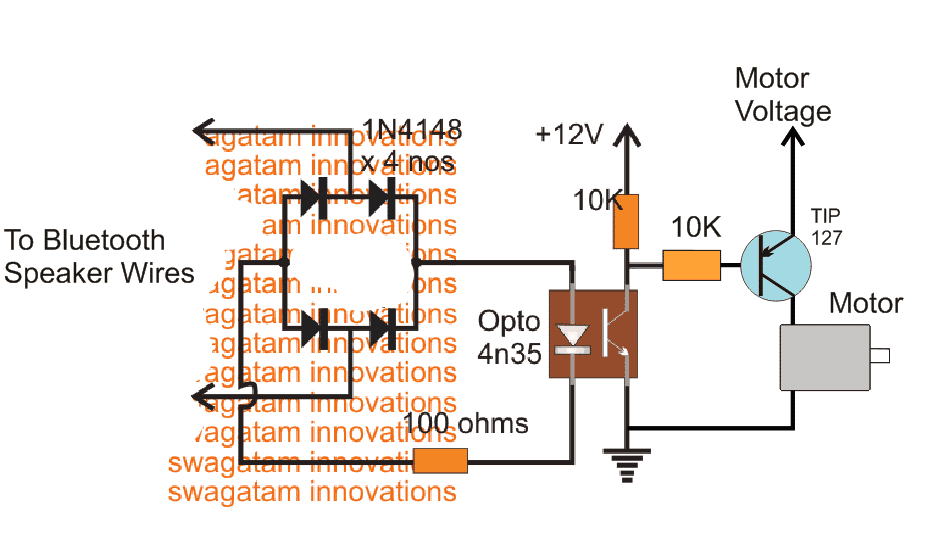
Bluetooth PWM Motor Controller Circuit

The above set up shows an external PWM motor driver simply configured using some diodes, an opto-coupler and a BJT stage.

The PWM from the Bluetooth Headset is passed through a bridge diode network and then applied at the input of an opto coupler.

The output from the opto coupler is finally fed to a motor driver stage.

Now as the PWM from Bluetooth headset is changed, the motor responds to the PWM and correspondingly changes its speed.

How to Obtain the PWM Transmission for the Bluetooth Headset
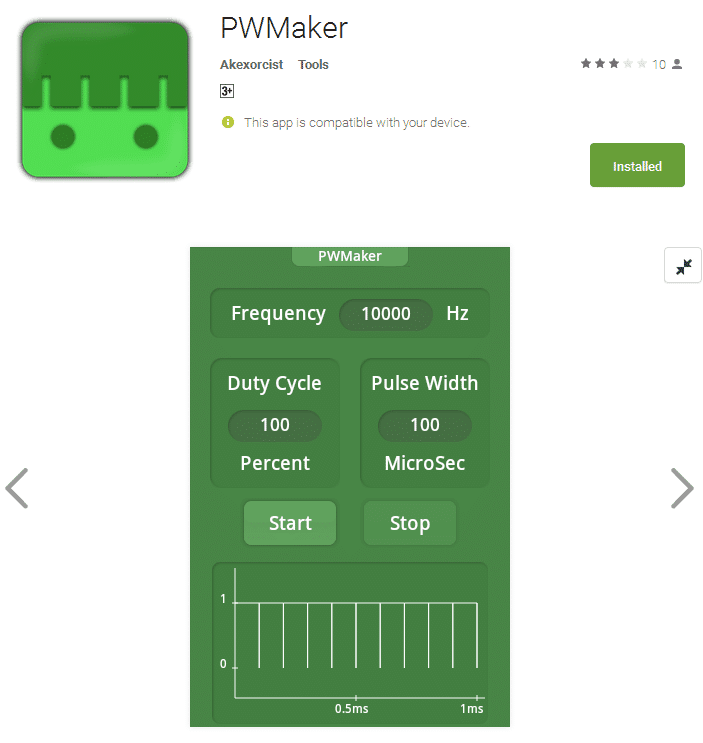
The PWM transmission for the Bluetooth headset can be obtained from your Android phone.

For this you may have to install any standard PWM generator application and then "pair" it up with your Bluetooth headset.

Next, you would be prompted to adjust the duty cycle, PWM, frequency etc within the application, which you can fix as per your preferences.

Once all these initial set ups are completed, the PWM transmission for the Buetooth headset could be initiated for executing the motor control operations.

The PWM or the frequency could be changed as per your wish and will, from your android phone application whenever the speed of the motor is required to be altered.

This concludes our tutorial on Bluetooth PWM motor controller circuit, which looks extremely simple and useful, thanks to the all latest technology like android applications and Bluetooth features.

You'll also like:

  • gate2Bopen2Bclose2BcircuitSimple Gate Open/Close Controller Circuit
  • pircontrolledfanandlightcircuitPIR Ceiling Fan Controller Circuit
  • 1Stepper Motor Driver Circuit using IC 555
  • Servo Motor Working Explained

Filed Under: Motor Controller Tagged With: Bluetooth, Controller, Motor

About Swagatam

I am an electronics engineer and doing practical hands-on work from more than 15 years now. Building real circuits, testing them and also making PCB layouts by myself. I really love doing all these things like inventing something new, designing electronics and also helping other people like hobby guys who want to make their own cool circuits at home.

And that is the main reason why I started this website homemade-circuits.com, to share different types of circuit ideas..

If you are having any kind of doubt or question related to circuits then just write down your question in the comment box below, I am like always checking, so I guarantee I will reply you for sure!


Previous Post: « Password Security Lock Circuit Using 4×4 Keypad and Arduino
Next Post: How to Send and Receive SMS Using GSM Modem »

Reader Interactions

Questions & Answers

Total Posts: 10
Newest Oldest
Anushanga
August 3, 2026 • 3 weeks ago #211244

can you plz tell me can I reduce motor voltage to 3.7 V and use this circuit to drive motor ?

Reply
SwagatamAdmin
August 4, 2026 • 3 weeks ago #211282

Yes, you can do it…

Reply
Tomas Fritsvold
November 26, 2017 • 9 years ago #56114

I hope this forum could help me with a little drone project… I have a PWM signal that I need to transfer to a device attached to a moving gimbal. This makes the use of wires impossible.

Would it be possible to send this PWM signal wirelessly, then back to PWM?

Alternatively, my gimbal has S. BUS and CAN-BUS, so I am wondering if I can convert PWM to BUS and back again.

Thanks in advance for *any* input

Cheers

Reply
SwagatamAdmin
November 26, 2017 • 9 years ago #56116

Hi, I am not sure how S.BUS or CAN-BUS can be used for the pwm communication, however PWM can be sent wirelessly through 433MHz RF modules, if integrating these modules is possible, then I can perhaps help…

Reply
Manas Mallick
September 9, 2016 • 10 years ago #44367

Ok I got it,I will try and inform you.
Thanks.

Reply
Manas Mallick
September 8, 2016 • 10 years ago #44364

Many thanks for quick reply.Your advise
Very helpfull to me but I have tried to search on google your suggested link " fly-back regulator" but failed.

Reply
Davis Kakumba
September 8, 2016 • 10 years ago #44358

hi SWAGATAM thanks for all your work and this massive technology , now what if i want to add more motors like three of them how can i modify this

Reply
SwagatamAdmin
September 9, 2016 • 10 years ago #44375

Thanks Davis, you can add all the 3 motors in parallel….

Reply
Manas Mallick
September 8, 2016 • 10 years ago #44340

Sir if kindly answer my question I will be thankfull to you. I have a battery charger build with Ic 3843
8 pin ossilator. How to increase amp and voltage with simple change of Ic biasing.

Reply
SwagatamAdmin
September 8, 2016 • 10 years ago #44354

Manas, please refer to the datasheet of the IC, and check out the diagram titled "27 Watt Off−Line Flyback Regulator", you will e able to see a 0.5 ohm resistor connected with the source of the mosfet…this resistor determines the current limit of the circuit, so you can change this resistor for the current adj….and the voltage will need a feedback loop using an opto coupler connected with a the Ct pin of the IC…that will be a little complex…

http://www.onsemi.com/pub_link/Collateral/UC3842A-D.PDF

Reply

Need Help? Please Leave a Comment! We value your input—Kindly keep it relevant to the above topic! Cancel reply

Your email address will not be published. Required fields are marked *

Primary Sidebar


Categories

  • Arduino Projects (95)
  • Audio and Amplifier Projects (134)
  • Automation Projects (18)
  • Automobile Electronics (104)
  • Battery Charger Circuits (90)
  • Datasheets and Components (109)
  • Electronics Theory (150)
  • Energy from Magnets and Earth (41)
  • Games and Sports Projects (11)
  • Grid and 3-Phase (20)
  • Health related Projects (27)
  • Home Electrical Circuits (13)
  • Indicator Circuits (16)
  • Inverter Circuits (98)
  • Lamps and Lights (161)
  • Meters and Testers (72)
  • Mini Projects (28)
  • Motor Controller (68)
  • Oscillator Circuits (30)
  • Pets and Pests (15)
  • Power Supply Circuits (91)
  • Remote Control Circuits (50)
  • Security and Alarm (65)
  • Sensors and Detectors (107)
  • SMPS and Converters (46)
  • Solar Controller Circuits (62)
  • Temperature Controllers (44)
  • Timer and Delay Relay (50)
  • Voltage Control and Protection (44)
  • Water Controller (37)
  • Wireless Circuits (31)


Circuit Simulator

circuit simulator image


Subscribe to get New Circuits in your Email


Other Links

  • Privacy Policy
  • Cookie Policy
  • Disclaimer
  • Copyright
  • Videos
  • Sitemap

People also Search

555 Circuits | 741 Circuits | LM324 Circuits | LM338 Circuits | 4017 Circuits | Ultrasonic Projects | SMPS Projects | Christmas Projects | MOSFETs | Radio Circuits | Laser Circuits | PIR Projects |


Recent Comments

  • Swagatam on Simple Delay Timer Circuits Explained
  • Maddy on Simple Delay Timer Circuits Explained
  • Swagatam on HX710B Air Pressure Sensor Datasheet, How to Connect
  • Swagatam on Simplest One Transistor Regulated Power Supply Circuit
  • Luciano Orozco on HX710B Air Pressure Sensor Datasheet, How to Connect

Social Profiles

  • Twitter
  • YouTube
  • Instagram
  • Pinterest
  • My Facebook-Page
  • Stack Exchange
  • Linkedin

Calculators

  • ZVS Induction Heater + Tank Calculator Tool
  • Zener Diode Calculator
  • Wire Current and Thickness Calculator (Ampacity Calculator)
  • Voltage Divider Calculator
  • Transistor Base Resistor Calculator
  • Transistor Astable Multivibrator Calculator
  • TL431 Calculator
  • Solar Panel, Inverter, Battery Calculator
  • Ferrite Core Air Gap Calculator Tool
  • Parallel MOSFET Calculator Tool: How to Connect MOSFETs in Parallel Safely
  • LC Resonance Calculator for EV Battery Charger Circuits
  • LED String Series Resistor Calculator
  • Calculator to Design a High Power 3kW PFC (Power Factor Correction) Circuit
  • Passive Power Factor Correction (PFC) Calculator
  • LM567 IC Calculator Tool
  • SMPS Flyback Boost Converter Calculator
  • Shunt Resistor Calculator for Ammeters
  • SCR and Triac Gate Resistor Calculator
  • Battery Back up Time Calculator
  • Boost Converter Calculator (Non-Isolated)
  • Bootstrap Capacitor Calculator
  • Buck Converter Calculator
  • Buck-Boost Converter Calculator
  • Capacitance Reactance Calculator
  • DCM Flyback Transformer & Wire Gauge Wire Size Calculator Tool
  • Filter Capacitor Calculator
  • IC 4047 Calculator (Frequency and PWM)
  • IC 4060 Calculator
  • IC 555 Astable Calculator
  • IC 555 Monostable Calculator
  • IC SG3525, SG3524 Calculator
  • Inductance Calculator
  • Induction Heater Inductor and Resonant Frequency Calculator
  • Induction Heater Work Coil Calculator
  • Inverter LC Filter Calculator
  • LC Resonance Calculator
  • LED Current Calculator
  • LM317, LM338, LM396 Calculator
  • NAND/NOT Gate RC Values Calculator
  • NOT, NAND Gate Frequency Calculator
  • Notch Filter Calculator Tool
  • Ohm’s Law Calculator
  • Phase Angle Phase Shift Calculator
  • Power Factor (PF) Calculator
  • RC Filter Calculator
  • Reactance Calculator
  • Sine Table Calculator for SPWM Arduino Code
  • Small Signal Transistor(BJT) and Diode Quick Datasheet
  • SMPS Calculator for Toroidal Ferrite Transformers
  • SMPS Flyback Transformer Calculator – Design by Target Duty Cycle
  • TL431 Calculator

© 2026 · Swagatam Innovations