A vey basic yet reasonably efficient 1500W PWM based sinewwave inverter circuit can be studied under this post. The design utilizes very ordinary parts to accomplish a powerful SPWM type inverter circuit.
Main Specifications
Power Output: Adjustable from 500 watts to 1500 watts
Output Voltage: 120V or 220V as per the transformer specs
Output Frequency: 50Hz or 60Hz as per requirement.
Operating Power: 24V to 48V
Current: Depending on the Mosfet and transformer Ratings
Output Waveform: SPWM (can be filtered to achieve a pure sinewave)
The Design
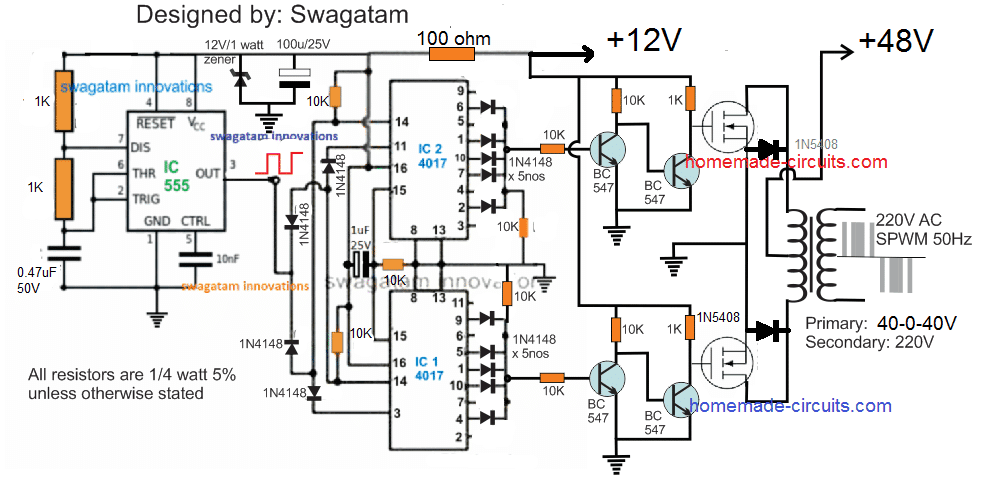
The proposed 1500 watt PWM sinewave inverter is designed using extremely basic concept through a couple of IC 4017 and a s single IC 555.
In this concept the sequencing logic from the output of the IC 4017 are configured by selecting and skipping subsequent pinouts such that the resultant sequencing produces a decent SPWM like switching on the connected mosfets and the transformer.
The complete schematic could be visualized in the following diagram:
The working of the Inverter can be understood from the following explanation:
Circuit Operation
As can be seen, two IC 4017 are cascaded to form an 18 pin sequencing logic circuit, wherein the each negative pulse or frequency from the IC 555 produces a shifting output sequence across each of the indicated outputs of the two 4017 ICs, starting from pin#9 of the upper IC upto pin#2 of the lower IC, when the sequence is reset to initiate the cycle afresh.
We can see that the output of the IC 4017 are intelligently tapped by skipping and combining sets of output pinouts such that the switching to the mosfets achieves the following kind of waveform:
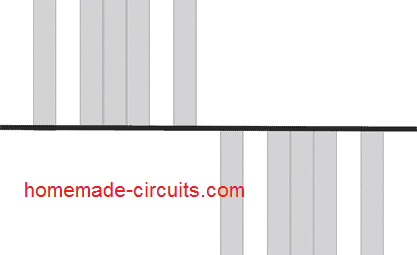
Acording to the waveform, the start and the end sequences can be seen being skipped by eliminating the relevant pinouts of the IC, similarly, the second and the 6th pinouts are also skipped, while the second, 4rth, 5th, 6th pinouts are joined for accomplishing a decent SPWM like pulse form across the outputs of the two 4017 ICs.
Video Proof (100 watt example)
The Objective behind this Logic Configuration
The above shown waveform is selected so that it is able to replicate the actual sinusoidal or sine waveform as closely as may be possible.
Here we can see the initial blocks are eliminated so that the SPWM waveform can match the actual sinewave's initial lowest RMS value, the next two alternate blocks imitate the average rising RMS within a sinewave, while the center 3 blocks tries to replicate the maximum RMS of an exponentially rising sinewave.
When the above PWM format is applied to the gates of the mosfets, the mosfets alternately execute the switching of the transformer primary with the very same switching format in a push pull manner.
This forces the secondary synchronously to follow the induction pattern with an identical waveform which ultimately results in the creation of the required AC 220V, having the above SPWM waveform pattern.
An appropriately dimensioned LC filter across the output winding of the transformer may finally allow the secondary side to achieve a perfectly carved sinusoidal waveform.
Therefore when the resultant output of this SPWM is filtered should hopefully result in the replication of a sinewave output which could be suitable for operating most electrical appliances.
The Oscillator Stage
An ordinary IC 555 astable is implemented here for creating the required clock pulses for feeding the cascaded 4017 ICs and for enabling the sequencing logic across their output pinouts.
The R1, R2,and C1 associated with the IC 555 must be accurately calculated so that pin#3 is able to generate around a 900Hz frequency at around 50% duty cycle.
A 900 Hz output becomes necessary so that the sequencing across the total 18 pinouts of the 4017 ICs causes the BJTs to trigger at a 50 Hz across the two channels, and at around 150 Hz for chopping the individual 50 Hz blocks.
About the Mosfets and the Transformer
The mosfets and the transformer of the above explained 1500 watt SPWM inverter circuit are the two elements which determine the total power output.
For getting a 1500 watt output make sure the battery supply is not less than 48V, at 500 Ah, while the transformer could be anywhere around 40-0-40V/ 40 amps.
The mosfets can be IRFS4620TRLPBF each if 48V battery is used, a pair of these mosfets would be required in parallel on each channel for ensuring proper delivery of the full 1500 watts at the output
If you have any doubts or personalized queries, please feel free to add them in the comments below for getting quick pertinent replies.



Comments
Dear sir,
Is it necessary to have a center tap transformer for final Trs or mosfets in the inverter circuits.?
I found an inverter using IRF 3205 in which primary winding connected to the drains of mosfets.
No center tap, but 24 volts given to one end. Out put 230 volts taken by the secondary .
Regards.
can we add “pwm and output voltage correction circuit” to inverter? If so,why and if not so,why?
Yes we can but it is not required, since it is constant pwm oscillator which makes sure the output voltage is constant.
Hi Dear Swagatam, can the 555 oscillator circuit be replaced with “EGS002 psw inverter module” ?
if can, please update the circuit diagram.
Best Regards
Novax
Hi Novax, the IC 555 circuit here functions like a simple oscillator or pulse generator. It can be replaced with any other simple astable oscillator, but not with a complex circuit like the EGS002
Hi Sir, l appreciate your good works. Please l cant see the components from the circuit diagram of 1,500W inverter and it doesn’t zoom . Can you resolve that please, so that the components will be visible.
Hi Okafor, It is quite visible to me, you can refer to the following image: It zooms when pressed cntrl+
https://www.homemade-circuits.com/wp-content/uploads/2018/03/1500-watt-inverter.png
pin 14 and 16 are used for what purpose?
Pin 14 is for the clock input, and pin16 is for the DC supply to the IC.
sir
can the 555 oscillator circuit be replaced with a 50Hz xtal oscillator, to get a pure sine wave?
No, that’s not feasible.
Thanks sir, for cheering us the concept,may God almighty bless you.amen
You are welcome Eniola….
Hi sir, the above cascade ic’s inverter circuit diagram, the 555 output is blocked with the diode in the reverse biased, or was it a mistake? secondly, one of your article I read on the ic4017,is that pin 14 has to be sychronize, but not that was as it is in the diagram,or is that also correct? looking forward to your nippy response.
Hi Eniola, the reverse biased diodes are correct, the 4017 responds to the negative pulse from the IC 555. Please provide the link of the article so that I can understand the explanation and provide the clarification.
Good morning Swagatam,
Thank for the diagram, in your mail you replied that if I want to up from 1500watt or higher i must go higher on the mosfets and the caps I need to connect in what way (diagram would help a lot) with their values.
The batteries I currently have is 2 x 12VDC 18aH.
What must the transformer spec be?
Thank you for your valued input!
Best regards,
Marius
Hi Marius,
2 x 12V 18 Ah can provide a maximum of 200 to 250 watts. For this 24V battery specifications (2 in series) you can try a 18-0-18V/20 amp transformer or something near to this.
For 1500 watt you will need a lot more than this, along with more number of mosfets
Thank,s for the design of your sine wave inverter.Can i add 4 or 6 mosfet to have bigger wattage…?
You are welcome, yes you can do that!!
hi,
dear Swagatam ,i’ve a switching power supply that it’s switching ic has been exploded.if i send you the photo of circuit ,can you help me to find the IC number?
best regards
mohsen sadighian
00989125417914
Zanjan -Iran
Hi Mohsen, I am sorry that can be very difficult, because there are many different ICs that are used in SMPS circuits, and identifying the specific one can be very difficult unless we have the complete circuit diagram.
Pls sir can u explain (two ic’s has been cascaded) i dont really understand
Cascaded means connected in series, one after the other, so that the output sequence follows from one IC to the other, continuously.
I like it
Полезная хорошая статья, большое спасибо!
Glad you liked it!
Sir please i have an experiment to make but i wanted your advice, can i rectify a transformer, attached a DC battery to it for better DC filtering and connect it to an inverter so to get AC delivered for use?
Please i wait to read from you.
Nkwenti.
Nkwenti, from where the transformer will derive the input supply from? do you mean using the inverter output to charge the battery in a cyclic manner?
Hi, I am looking at High efficient 1500W to 2000W Solar Power for my home with 5 hours of power backup…Request you to publish a PIC based ckt with pure sinewave AC output. Also Primarily Battery should charge from Solar panel and if no proper sunlight then battery should charge from the Grid..
Initially I thought to purchase it but I had checked with a vendor, he had qoute me 1.20L for 2000W, Thought let me build it myself..
Hi, sorry I do not have a PIC based design with me at this moment with me.
what is the component name of E-MOSFET in proteus
Sorry no ideas….
Good Morning,
Very nice website… I am interested to have a complete circuit design to connect a solar panel 300w into a circuit to produce 120 AC/60 Hz/ 20 Amp. (willing to pay for the design).
Solar Panel Specs: (to install 2 solar panels in parallel).
Open Circuit Voltage: 38.80V
Opitmum Operating Voltage: 32.20V
Optimum Operating Current: 9.32A
Thank you, and glad you liked it!
You can probably build the circuit explained in the above article for your specific need, and hook it up straight with your 38 V panel.
The only criteria being, the transformer and the 100 ohm resistor which will need to be replaced with a 24-0-24V transformer, and a 2k2 10 watt resistor respectively.
Additionally you can add a couple of more MOSFETs in parallel with the indicated ones, for ensuring a much higher efficiency in terms of power optimization.
Hi,
I am working on developing a power box powered using lithium batteries and requirement is 1 kva power pure sinwave without transformer. Battery we can have multiple packs..Individual cells come at 2.7 v appx and packs can be arranged to have specific voltage and power.
Can you help with good circuit to weigh less and have simplest but robust technology.
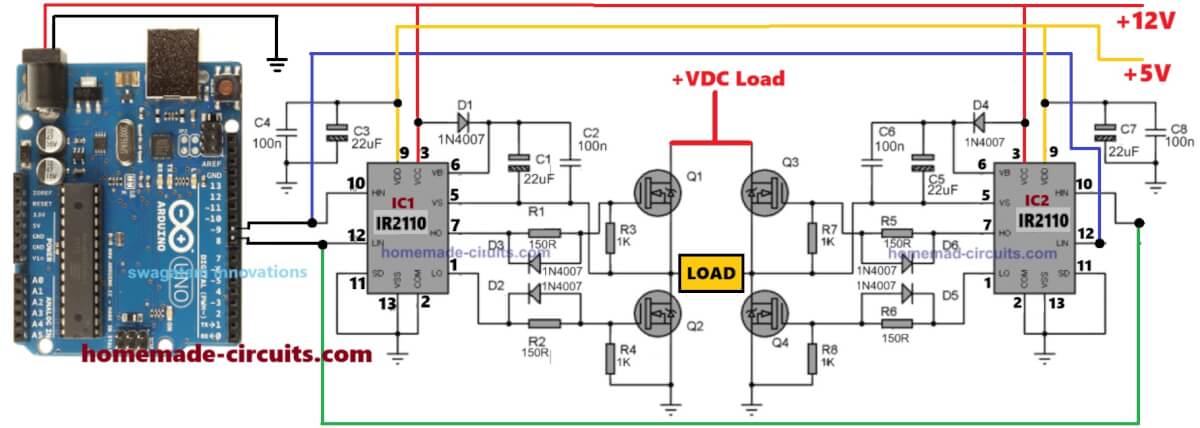
Hi, you can try modifying the above explained concept in the following shown manner:
This will be a 250 watt model, if it works you can increase the current capacity by prortionately increasing the number of parallel MOSFETs and the battery mAh rating
What would the efficiency of this inverter be?
around 80% with iron transformer
Hi Mr Swagatam;
To understand the matter I made an simple circuit with 555 and IRF44 and by using 12 V DC 2 Amper input and I gained 220 V AC and 15W bulb was ON. However I am not able to measure output AC voltage since I measure live voltage at both side of output. Whenever I try to gauge AC output voltage then my multimeter shows error and short contact occurs again on the rotary switch terminals by excluding the fuse error. Thanks in advance
Suat, either your meter is faulty, or may be the frequency is too high. Make sure the frequency is 50 Hz, also test the meter in your 220 V home AC socket for verifying its condition.
Dear Mr.Swagatam
I want to ask and comment on the inverter with the 48V battery that you designed. I have tried to make it and the results are good, my question is, if we are going to increase the power output capacity to 6 kW, our power mosfets are parallel 5 mosfets each. What transistor drivers need to be replaced with BC141 for example so that the driving power is large enough, another thing is that each gate needs to be installed with a resistor of about 5 ohms so that the signal is evenly distributed to the gate. ask for an opinion and explanation and thank you for your attention
Best regards,
Widiatmono
Hello Hersan, I am glad you could make it successfully.
Nothing needs to be changed in the circuit, no matter what output power is selected, except the transformer, MOSFETs and the Battery.
Gates will not need any resistor for all the parallel MOSFETs in this circuit….you just need to connect their G,S,D pins together in parallel.
Hi Dear Swagatam; this is an amendment to my latest report. Please consider the following measurement is correct one.
My pen meter shows the home AC measurement as:
live side: 12 36 55 110 220 (AC 220 is active)
notr side : shows only the value 12
the meter also shows the inverter outout as:
at the both side 12 36 55 110 (as I said before the value at one side is pale) The point is being interesting that although there is no output voltage on the meter the bulb 15 watt is ON.
Hi Suat, please use a standard digital multi-meter with red/black probes, for verifying the results correctly, any other form of meter is not recommended for electronic circuit testing and troubleshooting.
Lots of thanks Swagatam for he reply, however when I remove the short contact residue on my meter no problem on meausuring the home 220 AC voltage but after measuring the my circuit output then I am about to face the same problem. And also I have got 2 pencil types of meter one shows light if there is AC and other also shows the AC value. After receiving your reply, I have decreased frequency in the degree of that I can watch (as if blinking mode) I tested and again see the 110 AC at both side by measuring pen type meter. One side seems clear 110 V and other side seems inactive / pale written on the display / screen of the pen type meter. (it seems 110 AC since my input is 5 V DC there is no problem I am sure if I would increase the input DC voltage the output will be higher)
Hi Sir,
For the timer 555 pin 3 will it get square wave form? because I using Simulation only give me constant voltage.
Hi Desmond, it will be in the square wave form!
ok got it my mistake enter wrong value. then for 4017 which out measurement should i take?
the output frequency measurement should be taken at the MOSFET gate, or transformer output
ok thank. just one last thing . do u have the BOM list for this circuit? if yes can u list it down?
I will try to update it in the article, if possible…
Dear Swagatam,
Thank you for your response. May you please clarify me about the voltage and current used to calculate the power of the resistor(10k) in transistor BC547. According to the formula you used in that 1500W inverter circuit: R =(1/4)x(W)x(5%).
Dear Mabana, for high impedance (resistance) loads like mOSFeTs the calculation is not critical. For example instead of 10k you can use 22k or 47k or even 100k.
for other loads you can use the formula which is explained in the following article:
Transistor Relay Driver Circuit with Formula and Calculations
Dear Swagatam,
I am about to implement the 1500W inverter circuit design. May you please guide me to determine the resistors values of the transistor BC547: 10K and 1K.
Also I would like to know how to determine the number of Mosfet to be used in that circuit.
Thanking you in advance for your assistance.
regards,
Mabana Kabuna
Hello Mabana, if you are referring to the wattage of the resistors, they are all 1/4 watt 5%
the number of MOSFETs can be 5 on each side.
Hi Sir, One question for the 48 V and 12 V is it connected together or i just choose one ?
Sorry this is my first time doing this project.
Hi Desmond, they are supposed to be from different sources, however the 12 V can be derived from the 48 V also, by replacing the 100 ohm resistor with a 1 K 5 watt resistor
Dear Swagatam,
Thank you very much for your response.
May you please provide me a list of Technical specification of the components used in your design “1500 watt PWM Sinewave Inverter Circuit”. I am thinking to update it to 2000W if possible and combine it with Raspberry-Pi.
Kind regards,
Augustin Kabuna
Dear Mabana, everything is standard in the diagram. You can copy the parts from the diagram, and procure them.
For 2kv you may have to add a couple of more MOSFETs in parallel, and upgrade the transformer accordingly.
Dear Swagatam,
Thanks for sharing your ideas in this field of electronic.
I would like to build solar inverter using Raspberry-Pi. May you please provide me the details specification for your design: 1500 watt PWM Sinewave Inverter Circuit.
Please if you have some suggestions for that project of mine, you are welcome for discussion.
Kind regards,
Augustin Kabuna
Dear Mabana, I am sorry, Raspberry is not within my field of expertise so it can be difficult foe me to suggest you on this subject.
Swag you are an excellent professional and a true passionate about electronics, I am an electrician but I am still passionate about electronics, I appreciate that you share your knowledge and your projects. I am from Venezuela today the electrical system is very deteriorated and I want to put together simple projects that can contribute to improving quality of life.
I will build this wonderful project greetings
Thank you Francisco, I appreciate your kind feedback, and wish you all the best with this project!
Hello what frequency out will I have if I have 4khz input to 4017s
Hi, Divide it with 18
Hello sir,
Thank you so much for the answer you provided to my earlier question.Please i would like to build the 1500kva sine inverter with a transistorised astable multivibrator with two square wave outputs.How can i do away with the 555 timer on your circuit and incorperate my sq wave circuit and still retaining the two 4017 ic.How many and the values of capacitors to be added at the output to improve the wave form and i would like to know why it has no feedback to avoid output voltage drop at addition of loads.
Thank you in advance,i am looking forward to your reply.
Hello Patrick, you just have to remove the IC 555 stage and replace it with transistor astable. Use one of the collectors of the astable transistor and connect it to the point where pin#3 of the IC 555 is connected.
You an add 5uF/400V for the output capacitors. Feedback is avoided for simplicity. voltage will not drop by much as long as the load wattage is within the battery capacity.
Hi
Thanks for such informative information really enjoy it. Just want to know if you have a 1500w, 240vac inverter circuit with the charging circuit.
Regards
Hi thanks, I have many charger circuits explained in this website, you can select an appropriate one and use it in conjunction with this design
Hello sir: if i use 2n3055 transistor will it work as mosfet do?
sir please i want to build 1000 watt inverter how can i calculate ,
1. the size of transformer to use
2.how to calculate the number of mosfets to use
3.how can i know that both transformer and mosfets will give me 1000 watt
Haruna, you can read the following article for the required details
https://www.homemade-circuits.com/how-to-calculate-and-match-inverter/
You will have to use it Darlington form, but still it won’t produce more than 200 watts.
Hellow Sir can i use irf 540n mosfet?
Yes you can, but add a few in parallel for better efficiency
Great design. Is it possible to increase the output power by adding additional output output stages (drivers, FETs and transformers) in parallel? I think they do something like that with the commercially available devices for the grid tied systems. How complicated is this to acheive? Thanks.
Thank you, the power can be increased to any limit by modifying the battery, MOSFETs and the transformer, but Grid integration will require accurate synchronization of the frequency and RMS
Hellow Sir is fan necessary in this circuit for cooling? if it is how can i connect it?
It will depend on the load, if it’s fully loaded then a fan may be needed….you may apply the last circuit from this post
https://www.homemade-circuits.com/lm35-circuit/
Hello sir: what if i will use 1n5406 diode instead?
The difference is only in the maximum tolerable voltage levels, please compare the two through their datasheets and you will be able to understand the difference.
Dear Swag
Thank you so much for the wonderful elect. Engineering package from you to the world for free. I am sure many would not like to do it and keep it to themselves.
I have been regularly visiting your cite for various elect,circuits but the pwm sinwave inverter has taken my whole attention.I was taught on sq wave inverter by friend in polytecnic school and it worked fine ,but i want to build a pure sine wave circuit.
Please among your two or three spwm circuit descriptions,which one is the best if i want to build like 1500va.
I would also like to know why you leave some finishing touches on some circuit to the intended hobysts and builders ,like tank circuit you talked at the output .How can one know he achieved a bether result in absence of an oscilloscope to check output wave?
I did my I.T in Indian acquired firm in Nigeria.I photocopied an inverter booklet from a friend from an indian.One circuit talked about using a tank circuit where inductor and capacitor reactance are equal and connected to the transformer input to achieve a pure sinwave and not at the output.What do you say on this?
Thank you,
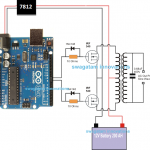
Thank you Patrick, the above circuit is best sine wave inverter you can have in terms of simplicity and accuracy. If you can compromise with light lower sinewave quality, then you can try the following design which is ee simpler than the above:
As you can see adding a filter at the output side is much easier and can be implemented with some trial and error and with minimum losses. Moreover you can achieve pure sine results even without an inductor, because the secondary winding itself acts like an inductor, therefore this looks a simpler and more effective option.
Sir I have 2n3055 transistors can i place them instead of TIP 35?
you can after adding a TIP122 in Darlington with the TIP35
Sir I want 500watt only can i use 12-0-12 transformer and 12v 100ah battery?
Bios, use a 300 watt transformer for getting 300 watt power
Hello Sir: would this inverter power small appliances like televisions, and phone charger
Hi Bios, yes it can be used for powering all types of electronic equipment
Regards. 400 W at 60 Hz is enough for me and I only have a 12 V / 60 W solar panel as a source. Can I implement it? What should i change? You help me?
60 w panel will not produce 400 W
Cordial Greeting, I congratulate you on your excellent page.
I have proposed to design the inverter that is very interesting but a question arises, adding another power transistor in parallel I can place it completely in parallel or I must place a resistance, and of what value, to the Gate of the transistor, thank you very much for your attention and collaboration.
Thank you jorge,
You can place the mosfets directly in parallel, no need of any resistor or transistor
ok swag thank you for you respect full replay, i will see you next days if you can.
You are welcome Hassen!
Dear swag, Thanks so much for your useful information and guiding for different persons who are interesting to study and work on this course. , if you have please bring me a document which basically explains the design calculation of “designing inverter using SPWM technique”
Thanks Hassen, I have not yet investigated the calculations of SPWM, but I may surely look into it and present a new article on it, possibly soon!
Please can I use a battery charger to run an inverter. Pros and cons
If its current is high enough then you can use it for testing the inverting
Can’t it be used to run small loads
Please explain the purpose so that i can understand the reason behind using a power supply to run an inverter.
I have 24v battery bank and 400w panel connected to 2kva inverter. I also have 48v /20amps battery charger. I want to build 48v/2kva inverter to connect with the charger for better efficiency with my loads, because I can’t buy more batteries for now. Please educate me . thanks sir
So you want to charge the battery bank with the solar panel, and then use the charged battery in parallel with a 48V mains converted DC for operating the inverter?? No problem, You can do that!
sir,
I have a luminous sine wave inverter…….
recently it is
1.Not giving output with battery(gives output when mains connected).
2.On connecting battery……all led display lights glow for 2 sec then gets off.
3.Outer Fuse
What could be the problem…….which components on the PCB should i check ?
Hi Nishant, connect a load and then connect the battery. Check if the load is also activating for 2 seconds or not.
If yes in that case the relay changeover circuit could be malfunctioning, the relay may not be holding to keep the battery connected with the inverter.
If the load does not activate then the problem could be more complicated, in that case you may have to manually bypass the battery line connecting the inverter and do the further checks depending on the results.
thankyou sir for the reply
O QUE TENHO QUE FAZER PARA MUDAR PARA 110V NO SECUNDÁRIO? OBRIGADO.
Use um enrolamento secundário de 110V para o transformador, isso é tudo. Nenhuma outra mudança necessária no circuito
sir gud day…I tested the circuit frequency and waveform at the collectors of two bc547 using my DIY soundcard Oscilloscope, the output frequency 52.9 hz and the wave was like this:
https://www.4shared.com/photo/XSIBuOsKee/1500_watt_PSW_inverter.html
is that ok sir?I’m a bit confuse becoz ist very distorted square wave…pls help me how to enhance this sir.
Good day Sinoda, yes that’s OK, you can adjust the upper and the lower waveform uniformly to make it look perfect…it will be distorted slightly, because there will be always some spike and transients and harmonics, but those can be countered by adding a small value capacitor at the secondary side of the trafo.
then can i replace the mosfets with IRF540?
yes you can
Sir can you explain a little about the transformer, you said primary 40-40 , where you trying to say secondary? then what about i replace the 1N5408 with 4007?
then if i use 4 pair of mosfet transistors, will it deliver more power? what is the maximum secondary amperes of the transformer, then sir please do you have a 50AMP battery charge controler schematic for the solar?
thanks and i will be looking forward to hearing from you.
NKwenti, The input winding is always referred to as the primary, so here since the 40V side is the input it is the primary.
The requirement for the mosfet is to have a specification higher than the maximum load wattage, you can satisfy this using 2 or 4 mosfets depending on the the selection…the same goes for the transformer secondary:
https://www.homemade-circuits.com/how-to-calculate-and-match-inverter/
there are plenty of battery charger circuits in this website, please use the search box and then you can select the one which suits you the best…
Hi. Please what are the filter components to use at the output of the iron core transformer?
Hi, the secondary transformer winding will itself act like an inductive filter, still you can add a 0.22uF or a 0.47uF/400V capacitor across the coil and check the response….check with a load connected.
can the mosfets be replaced with IRF540?
yes, if your requirement is within the mosfet’s rating specs
Dear Swagatam:
Thanks a lot for your useful info on electronics and guiding us to this course.
would you please explain more about how to parallel transistors??
and how to connect them in series ???
thanx a lot
Your Sincerely Saeed
Thanks Saeed, I already have one related article posted in this website which explains the right ways to connect transistors in parallel, you can read it here:
https://www.homemade-circuits.com/transistor-facts/
Connecting transistors in series is normally not practiced in electronic circuits and it may not be recommended also.
7808ic is a voltage regulator. So how can it work as AND gate?
sorry, it is 7408 and not 7808
Thanks sir.I have Google it but I didn’t understand how to use it.pls give me any one with the pins out that you know according to my description of that diagram.
you can use 7808 IC which has AND gates inside it, just check which pins connect with the those oval shaped designs inside the IC, and replace those pinout with your AND gates shown in your inverter circuit
Sir swag,pls i dont know how to configure this (AND gate) with this microcontroller. Pls give me any circuit relating to AND gate.check the schematic here. 4.bp.blogspot.com/-Llu4f6lzODA/UR-Gya40gGI/AAAAAAAAAbM/nuos2eLOTSs/s1600/pic+config.png
Please Google for “AND gate IC” and integrate the selected IC pinouts accordingly
Good day Mr. Swag, can the above concept be implemented with 3kva and above? If yes, what specs of transformer and MOSFETs will you recommend.? And how do I go about the filter part. Thank you, awaiting your reply.
Hi King, that is possible. Divide 3000 with battery voltage this will roughly give you the transformer primary current.
For the mosfet make sure its continuous current and voltage ratings are much higher than transformer rating.
Battery Ah should be 5 to 10 times higher than the calculated value of transformers current rating
https://www.homemade-circuits.com/how-to-calculate-and-match-inverter/
Thanks so much swag.Its a final year project and my certificate depend on it.I will try it again.
wish you all the best jojo, if you have any further doubts don’t hesitate to ask them.
Swag,most engineer does not have oscilloscope but I think you will have a design that has lc filter,so pls help me with the one that has giving you good result. Thanks
Jojo, while dealing with a sinewave inverter circuit, an oscilloscope is mandatory, otherwise it won’t make sense.
Anyway, you can select one of the following designs as per your preference, but all these will again require an oscilloscope for confirmation of waveform and will require an LC filter at the output, I do not have the calculations for the LC filter it will need to be done through manual experimentation.
https://www.homemade-circuits.com/?s=SPWM
here’s another good choice
https://www.homemade-circuits.com/pure-sine-wave-inverter-circuit-using/
I tested it with load like refrigerator and air condition but it did not work fine.pls help me with a better version that is pure sine wave
sorry that’s not the way to test and fine tune an inverter output, you must do it through an oscilloscope by analyzing the waveform and then tweak it through a LC filter circuit at the output to achieve the required output. If you do not have an oscilloscope then please do not attempt any of the sinewave inverter circuits.
Pls swag,I av tried this circuit but its not pure sinewave.pls I need your best PURE SINEWAVE CIRCUIT for 5kva/36v battery.
JoJo, how did you check the output waveform?…you will need to check it with an oscilloscope and with a load connected with the transformer. For further improving the results you may try connecting a 105/400V capacitor across the secondary winding output.
By the way it will not give a best sineave, but much closer to a sinewave
Pls sir I need a 48v/5kva pure sine wave inverter circuit that has an automatic battery shut down and no load sencing.
Jojo, you can try the above explained concept, the battery shut-off circuit can be easily included later on one the inverter is finalized
Hi Swag,
What is the amp rating on your 40-0-40 transformer
Hi Giel, just divide the required output wattage with 40, this will roughly give you the required amp capacity of the transformer
Sir
Witch transformer should i use for 1000w with 12v 200AH battery
Thank you
Fardin, with a 12V battery the transformer will need to be around 1000/12 = 83 amps, 7-0-7V
Sir
Do i have to change the mosfets?
Yes, you can try the following specs:
https://www.homemade-circuits.com/55v-110a-n-channel-mosfet-irf3205/
Sir
From ic1 i’m getting around 6.6vac gate voltage
And ic2 i’m getting around 5.1vac from gate
Why this is happening?
And my ic2 is getting warm
My suppy voltage was 12vdc
Fardin, slight voltage difference at the gates may not be critical, but if your IC is getting warm then that could be an issue. I hope you have connected the reverse diodes across the mosfets, if not please do it and check again.
Also make sure the IC Vcc is not over 12V.
In the working of this circuit you have 40-0-40v transformer to be used with 48v battery supply, shouldn’t that only be used for a square wave inverter?
with a spwm inverter shouldn’t the transformer be 24-0-24 for a 48v battery supply?
It will depend on the average value of the SPWM voltage with respect to the battery voltage. The resultant value can be used for determining the transformer secondary voltage value.
You can the related information below:
https://www.homemade-circuits.com/inverter-voltage-drop-issue-how-to-solve/
so as an example If I was to use a 12v battery supply transformer would be 6-0-6v, is that correct?
you will have to identify the average ON time % of the SPWM, multiply this % with the battery voltage to get the transformer primary value
Good Day,
Have you tested this design or the arduino spwm design?
yes those are tested designs
hello sir do you have any idea about self running generator thanks
sorry I do not have any idea regarding this concept
Sir can i run the above inverter circuit with 12v battery by changing 48-0-48 transform er with 12-012 transformer
bashir, it is possible, but the transformer will need to be rated at 9-0-9V
..and the mosfets could be replaced with IRF540
Olá sou do Brasil e acompanho as suas publicações continui com esse bom trabalho tem ajudado muita gente eu fiquei interessado no projeto do inversor senoidal se possivel poderia me enviar o projeto completo por gentileza obrigado
sorry youupdated already the diagram but one more questions sir the mosfets where is the gate drain and source canyou please put it on each channel thanks..nd more power sir
Fred, the pins which are connected with the transformer are the drains, the pins which are connected with the BC547 are the gates, and the ones which are connected to the negative or ground line are the sources of the mosfets.
sir swatagam do you have the complete diagram and omponetguide and pcb design for this 1500watts inverter can u please send it o my email thank you it much appreciated…
Fred, I have updated the diagram with more details, please copy the parts list from the diagram, everything has been included according to me….if you have any further doubts, please let me know.
PCB design is at the moment not there with me, if possible I’ll try to update it soon…
Thanks a lot mr swag,for the reply ,there are some design i have put-up to that effect using DPDT relays and low battery cut-off protection circuit ,i will send an attachment to you when i conclude.well done!
You are most welcome saviour! please keep up the good work
dear swagatam i really thank you for great work in helping people like us who are born engineers but could`nt afford to study in a Tertiary institution, to navigate our way around in electronic circuit design.
I conceive an idea, pls check if such idea is design-able.
i called it P.P.S.S that is permanent power supply system,this is it.You create two inverter system that works in flip flop manna to power a connected load,one will be working while the other is charging,when its battery reaches a certain discharge level the system flips and the other takes over duty without any interruption to the connected load.to reduce cost one transformer may be use for the two of them.
secondly how can we partner in Nigeria to enter into production of affordable power supply system for the poor people who are paying with their blood just to light candle.
Dear Savior, I am glad you liked my website.
However the idea you have conceived may not work, because the power output from any inverter will be always less than the input battery power consumption, so ultimately the power exchanges between the two inverters will keep reducing until the both the batteries are unable to get charged any longer from the inverter outputs.
I am really sorry, partnering may not be possible due to the work pressure that I have to handle in the present moment, although I appreciate your offer very much and wish we could partner for this noble cause.