A vey basic yet reasonably efficient 1500W PWM based sinewwave inverter circuit can be studied under this post. The design utilizes very ordinary parts to accomplish a powerful SPWM type inverter circuit.
Main Specifications
Power Output: Adjustable from 500 watts to 1500 watts
Output Voltage: 120V or 220V as per the transformer specs
Output Frequency: 50Hz or 60Hz as per requirement.
Operating Power: 24V to 48V
Current: Depending on the Mosfet and transformer Ratings
Output Waveform: SPWM (can be filtered to achieve a pure sinewave)
The Design
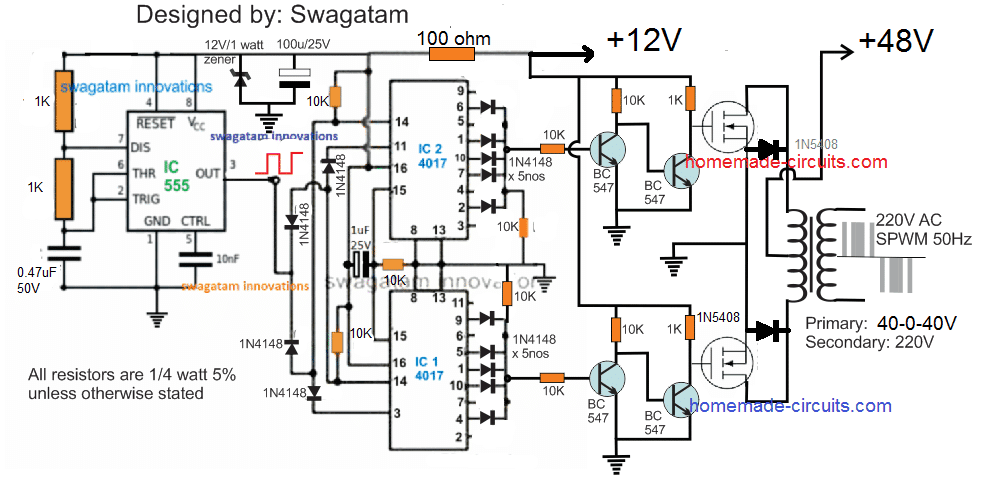
The proposed 1500 watt PWM sinewave inverter is designed using extremely basic concept through a couple of IC 4017 and a s single IC 555.
In this concept the sequencing logic from the output of the IC 4017 are configured by selecting and skipping subsequent pinouts such that the resultant sequencing produces a decent SPWM like switching on the connected mosfets and the transformer.
The complete schematic could be visualized in the following diagram:
The working of the Inverter can be understood from the following explanation:
Circuit Operation
As can be seen, two IC 4017 are cascaded to form an 18 pin sequencing logic circuit, wherein the each negative pulse or frequency from the IC 555 produces a shifting output sequence across each of the indicated outputs of the two 4017 ICs, starting from pin#9 of the upper IC upto pin#2 of the lower IC, when the sequence is reset to initiate the cycle afresh.
We can see that the output of the IC 4017 are intelligently tapped by skipping and combining sets of output pinouts such that the switching to the mosfets achieves the following kind of waveform:
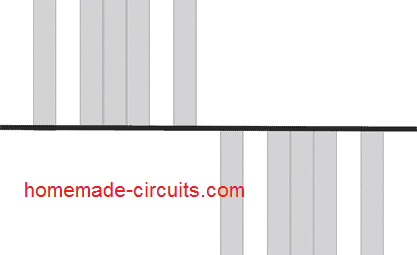
Acording to the waveform, the start and the end sequences can be seen being skipped by eliminating the relevant pinouts of the IC, similarly, the second and the 6th pinouts are also skipped, while the second, 4rth, 5th, 6th pinouts are joined for accomplishing a decent SPWM like pulse form across the outputs of the two 4017 ICs.
Video Proof (100 watt example)
The Objective behind this Logic Configuration
The above shown waveform is selected so that it is able to replicate the actual sinusoidal or sine waveform as closely as may be possible.
Here we can see the initial blocks are eliminated so that the SPWM waveform can match the actual sinewave's initial lowest RMS value, the next two alternate blocks imitate the average rising RMS within a sinewave, while the center 3 blocks tries to replicate the maximum RMS of an exponentially rising sinewave.
When the above PWM format is applied to the gates of the mosfets, the mosfets alternately execute the switching of the transformer primary with the very same switching format in a push pull manner.
This forces the secondary synchronously to follow the induction pattern with an identical waveform which ultimately results in the creation of the required AC 220V, having the above SPWM waveform pattern.
An appropriately dimensioned LC filter across the output winding of the transformer may finally allow the secondary side to achieve a perfectly carved sinusoidal waveform.
Therefore when the resultant output of this SPWM is filtered should hopefully result in the replication of a sinewave output which could be suitable for operating most electrical appliances.
The Oscillator Stage
An ordinary IC 555 astable is implemented here for creating the required clock pulses for feeding the cascaded 4017 ICs and for enabling the sequencing logic across their output pinouts.
The R1, R2,and C1 associated with the IC 555 must be accurately calculated so that pin#3 is able to generate around a 900Hz frequency at around 50% duty cycle.
A 900 Hz output becomes necessary so that the sequencing across the total 18 pinouts of the 4017 ICs causes the BJTs to trigger at a 50 Hz across the two channels, and at around 150 Hz for chopping the individual 50 Hz blocks.
About the Mosfets and the Transformer
The mosfets and the transformer of the above explained 1500 watt SPWM inverter circuit are the two elements which determine the total power output.
For getting a 1500 watt output make sure the battery supply is not less than 48V, at 500 Ah, while the transformer could be anywhere around 40-0-40V/ 40 amps.
The mosfets can be IRFS4620TRLPBF each if 48V battery is used, a pair of these mosfets would be required in parallel on each channel for ensuring proper delivery of the full 1500 watts at the output
If you have any doubts or personalized queries, please feel free to add them in the comments below for getting quick pertinent replies.




Comments
Don’t you have a circuit diagram for simple or pure sine wave inverter that produce 1500 watts that MOSFET irf 1010e or irf3205 and sg 3524/4017?
in my those are common I marketplace.
Hi, Sorry, I do not have a 3524/4017 based sine wave inverter circuit at the moment.
I really impressed with your knowledge
am trying to be your follower but I fail what should I do?
Dear Swagatam,
I need a DC to DC inverter, to minimize space, the transformer uses a large Fair Rite transformer for SMPS. Do you have a schematic diagram and a glance at the calculations for the transformer, especially? 600volts output for am transmitter power supply. thank you
Hi Hersan,
I think you can try the following design:
https://www.homemade-circuits.com/wp-content/uploads/2024/06/DC-to-DC-converter-600V.jpg
The output winding of the ferrite transformer can be increased proportionately to increase the output voltage to 600V.
The transformer can be wound on any standard ferrite E core transformer.
Dear Swagatam, if the supply voltage is 48 Volts, do we just need to multiply the number of primary coils by 4, or does it need to be recalculated. The second question is to make the mosfet power dissipation stronger. Can I use the FGH60N60 mosfet or equivalent. so it’s safer and doesn’t get too hot. or igbt STGW39NC60. Coincidentally there is stock. Thank you, your opinion is very helpful and appreciated
Hi Hersan,
https://www.homemade-circuits.com/wp-content/uploads/2024/06/DC-to-DC-converter-600V.jpg
I think that should work, for 48V you can multiply the 13 turns into 4 for each of the primary winding.
Also, you can eliminate all that parts which are just above the 220 ohm resistor, and then replace the 220 ohm with a 10k 2 watt resistor, and also make sure to connect a 15V zener diode across the supply pins of the IC and ground.
Yes, both of those OGBTs can be tried.
I would advise you to try the circuit with 12V firstas exactly shown in the diagram….if it works only then go for the upgrade.
hi. great job! how i put to 60hz? increase hz on outout of 555?
Hi, yes you will have to slightly increase the frequency of the IC 555 output, and confirm the results using an oscilloscope.
Hi Swag! Very good job that you are doing esp regarding Inv and pwr supplies. I’m not sure and I may be mistaken but in the above circuit diagram using 555 to drive 2 of 4017,s, here I’ve noticed that santhosh the circuit appears logically ok, I’ve discovered that the pin numbers of the 4017 ic,s which should have been identical are not the same in both the Ic,s. Is this deliberate and ok or is it a printing error? And also BTW Pz include the winding details of the Opt Trx optimised for 12+12v/150A each or more simply 24/150 Thanks.
Regards,
Thank you Prashanth, Glad you liked the design.
Yes the pinout configuration of the two 4017 ICs are not identical and that’s as per the requirement of the circuit so that the two ICs can work in cascaded manner.
You can use a 12-0-12V transform or a 24-0-24V transformer, rated at any desired current with this circuit, just make sure the battery voltage matches the transformer voltage spec.
The transformer will need to be order made from a professional transformer manufacturer.
Sir, there’s+12V and +48v. I’m confused. Does it mean we need two sources of DC supply to the circuit?
Ochima, you can derive the 12V from the 48V source using a transistor regulator circuit or a buck converter.
Please sir i don’t have 48v battery to power this circuit can i use 12v instead and please explain for me how to use BJT transistor
You can use a 12V battery also, but to get 1500 watts the Ah value of the battery may need to be around 1000 Ah
Dear Swagatam
2 questions,
1) inorder to fine-tune the output voltage, can I connect a feedback loop from the output of the transformer to pin 5 of the 555ic ?
2) can the outputs of the 4017 be connected to ir2110 to get a full bridge drive as I only have a 3kva 220input, 0 -12v output transformer at my disposal
Hi Richard,
Adding a feedback with pin#5 of 555 will not work. Instead you can configure the feedback with the bases of the left side BC547 transistors, so that these transistors are switched off if an over voltage is detected.
The outputs of the 4017 are specifically designed to work with a center tap transformer so a full bridge configuration may not be possible here.
Hi Swagatam,
How would you approach a low cost PI controller that can control a 1500W 120V input to a resistive heat element. I need temperature feedback and digital readout and temperature setpoint controls.
Thanks Chuck.
Hi Chuck, this can be perhaps designed using simple circuit stages, but the above article is about a sine wave inverter so we cannot discuss it here. We can discuss it under the following post:
http://www.homemade-circuits.com/how-to-make-25-amp-1500-watts-heater/
Hello Swagatam, I’m Paulo from BRAZIL… Congratulations With praise, for the excellent work you do, in favor of science, contributing enormously, with your spiritual greatness, to serve and at the same time humbly, listen to the other sides, suggesting them ideas and reflections to your projects.
I come here, to request your knowledge, for some doubts I have, regarding the OFF GRID INVERTER…
I am an Electronics Technician, and in calculations, projects, I have no competence…
I would like to hear from you the following:
I can use 11 BATTERIES in series of 12Vdc, 30 Amps each, making a total of 132Vdc and 330 Amps, and convert straight to 120 Vac, 60 Hz, providing an output, a load of 3,000W, in a PURE SINUSIDE INVERTER ( ~ ).
Another question, is it possible to extract, obtain from the 120 Vac POWER GRID, the 60HZ, instead of going through the square wave OSCILLATORS and then transforming it into SINUS.
If possible, I would like to see a project of yours like this, posted here.
Thanks.
Olá Swagatam, sou Paulo do BRAZIL…
Parabéns Com louvores, pelo excelente trabalho que faz, em prol da ciência, contribuindo enormemente, com sua grandeza espiritual, a servir e ao mesmo tempo humildemente, ouvir os outros lados, sugerindo-lhes idéias e reflexões aos seus projetos.
Venho aqui, solicitar seus conhecimentos, para algumas dúvidas que tenho, no que se diz respeito a INVERSOR OFF GRID…
Sou Técnico de Eletrônica, e em cálculos, projetos, não tenho competência…
Gostaria de saber de você o seguinte:
Posso usar 11 BATERIAS em série de 12Vcc, 30 Amperes cada uma, perfazendo um total de 132Vcc e 330 Amperes, e converter direto para 120 Vca, 60 Hz, fornecendo uma saída, uma carga de 3.000W, em um INVERSOR SENOIDAL PURO ( ~ ).
Outra pergunta, é possível, extrair, obter da REDE de ENERGIA de 120 Vca, os 60HZ, ao invés de passar pelos OSCILADORES de onda quadrada e depois, transformá-la em SENOIDAL.
Obrigado.
Thank you Paulo,
You can connect the specified 11 batteries in series but the output current will be 30 Ah, it won’t be 330 Ah since the batteries are in series.
Yes the 60 Hz wil be required for replicating a synchronized version of the grid AC, but the circuit will be complex. I already have one article on this, as shown in the following link:
Designing a Grid-Tie Inverter Circuit
Dear sir.
If use FET z44
Hi Sankhaja, IRFZ44 can be used in the above explained design
Dear Sir,
An inverter driven by 24 DC volts (12 volts/7AH X 02 batteries) , producing approximately AC 200 volts.
Guess 600VA and performing ok.
In order to increase the sustain period of the device in the absence of mains, I suggest 01 number 24volts high capacity battery Or high capacity 12 volts 02 batteries, providing external charger for the same.(let’s say 40AH)
Sir, since the the device was originally designed for a specified time for in the absence of I/P AC. Can the device stand for proposed extended period ?
Regards et have a nice weekend.
Dear Roy,
Dividing 600 with 24 gives 25 amps.. But 25 amps is too high, it cannot be obtained from a 7 Ah battery.
Yes you can connect more batteries in parallel to increase the backup time, but make sure not to increase the load beyond the rated capacity of the inverter.
Dear Sir,
I doubt, if I submitted my question above correctly to understand anyone.
There are already inbuilt 12volts/7AH 02 batteries in series in the device.(ie inverter driven by 24 volts DC and producing out put 200 volts AC.)
I want to replace those batteries with a 24 volts 40AH battery or 12 volts,40 AH 02 batteries in series in order to increase the back up time. (Suggest an external battery charger if necessary )
01. Is it advisable ?
02. can the device stand for such proposed extended period. ?
Regards.
Yes it is fine to increase the Ah rating of the battery for extending the back up time….but you cannot increase the output load wattage beyond the specified rating of the inverter otherwise the internal mosfets and transformer may burn.
Thank you sir,
Answer was very clear and you simply put me in the picture.
Best Regards.
You are welcome Roy!
Thank you sir, learned a lot from the given file.
I just want to know any publications of yours,(for international community)
Best Regards.
You are welcome Roy. I only have this website online and I do not have it published in any other form.
Hi Sir,
In fact, how do we differentiate between an Inverter and a Ups? The functions of both devices look same.
If you had answered to this question before , Please tell me where it was I can find.
My next question is sir, if we don’t know the specifications of a given inverter how we can find the VA of the same ? ( I guess, a known load will be connected to the o/p and wait till batteries totally drained with respect to the time. Is that correct?.),also, the current taken by the inverter circuit is also taken into account.
Regards.
Hi Roy,
The difference is very basic. An inverter will normally not have an automatic changeover from battery mode to grid mode AC output, whereas an UPS, as the name suggest, will have an uninterruptible output since it features a built-in automatic changeover that will changeover from mains AC to battery mode and vice versa depending on the presence or absence or the grid mains AC.
Yes the only approximate way to find out the VA rating of an unknown inverter is by draining the battery through a known load, which may be moderately rated.
The current consumption method can be also tried, but in this method it can be difficult to figure out how much maximum load can be tried without burning the mosfets.
Thank you Sir,
Seeking for further clarification. If it is an off line UPS then it is similar to an inverter as you explained above. Am I correct Sir? ( And all I am referring to small scale, not industrial ones.)
One last question Sir, (awfully sorry if I’m disrupting you)
Considering two individual devices such as an Inverter and a UPS having almost similar specs such as
DC volts, OP power, Q factor, average magnitude value of AC o/p,… so on then connected to identical loads.
Under no AC i/p condition,
The sustaining period of each equipment approximately same?
Regards.
You are welcome Roy, yes I was referring to an off line UPS. You can learn more about them in the following article:
Different Types of UPS systems – Explained
Basically an UPS is also an inverter, so if its specifications are exactly similar to another inverter, then the performance of the two systems will be also exactly similar.
Hi Sir,
I have been repairing an inverter almost similar to ur 04 Mosfet one (but here IRF 3205’s and 12volts x02))
Rectified the fault, replaced said 04 Mosfets, But a complex issue has arisen. Now the op is nearly 380 volts AC. The OP is loaded , no hum, no over heating. Performing ok apart from the excessive over voltage.
Sir, what factors determine the magnitude of the op?
Is it PWM (KA3843 being used),
Defect of a feed back path,
Or the transformer.
Best Regards.
Hi Roy,
Yes the output voltage can be reduced by reducing the PWM. The transformer can be also responsible, if its winding voltage is less than the average DC value of the PWM.
Noted with thanks sir.
Hi Sir,
I found an u/s inverter almost similar to your 04 Mosfets,(IRF3205), body diodes charging 24volts.(12×02 batteries).
Sir, when powered the unit only 150volts ac o/p appeared, beeps at regular intervals (10seconds) and battery alarm LED blinking simultaneously.
No o/p load connected, Removed AC i/p. The two batteries are fully charged,. As in your circuit relay controlled.
Seeking your guidance to rectify the fault.
Regards.
Hi Roy, Without actually seeing the circuit it can be very difficult to judge the fault. The function may be similar to my circuit but physically there may be a lot of difference, so it can be very difficult to troubleshoot without a practical check.
Noted with thanks.
Dear sir,
Why SCR s being used for full wave wave rectifications in inverters instead of diodes/bridges?
Any specified reason?
Regards.
Dear Roy, SCRs also work exactly like rectifier diodes, the only difference being they can be switched ON/OFF with an external signal. So in inverters there might be a need of a rectifier which can be switched ON/OFF for some specific purpose in the circuit, therefore SCRs may be preferred instead of diodes.
Hi Swag,
Hope you doing well.
I am from Sydney, and I am trying to design a grid-tie micro-inverter circuit. Will it be possible to get some help from you, please? It will be appreciable if you contact me. TIA.
Hi Kai, I wish I could help you, however I am not an expert with micro GTI circuits, so it will difficult for me to help you with this subject.
All good mate. Thanks for your early response though. Cheers.
I want to add an update here, very sorry for the incorrect diagram, the above H-bridge circuit will not work with 310V, it will work only with a 12V DC.
It’s my pleasure Roy. Thanks for your encouraging words, appreciate it.
Thank you sir, I have gone through most of your articles, innovations, teachings, tutorials so on.
In fact, Sir you are an asset to India.
Best Regards and best luck for all your future endeavors.
Dear Roy, For the above circuit a center tap transformer will be required. If you use a single mosfet then a two wire transformer can be used, but then the output will not produce a full AC cycle rather a half wave cycle only.