• Skip to main content
  • Skip to primary sidebar

Homemade Circuit Projects

Need circuit help? Post them in the comments! I've answered over 50,000!

Blog | Categories | About | Hire Me | Contact | Calculators-online
You are here: Home / Remote Control Circuits / Whistle Activated Switch Circuit


Whistle Activated Switch Circuit

Last Updated on January 2, 2024 by Swagatam 2 Comments

In this post I have explained how to build a simple whistle sound operated relay circuit, which can be used for switching ON/OFF a 220 V load through whistle sounds.

Table of Contents
  • Circuit Description
    • Parts List
    • Advantages
    • Disadvantages

You can consider this circuit to be a whistle operated remote control circuit which will operate a connected load remotely through the sound of whistling.

Circuit Description

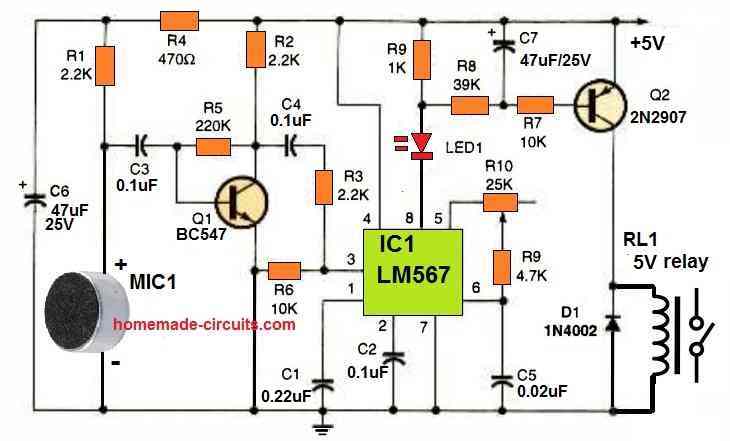
The whistle frequency is captured by electret-type microphone MIC1 and sent to transistor Q1 for amplification. The signal is amplified by transistor Q1 and is fed to the input of IC1, which is an LM567 PLL (phase-locked-loop) tone-decoding integrated circuit.
whistle activated switch circuit

Upon identification of the whistle sound, IC1 changes its output at pin 8 to low (0V). This switches ON the LED1 and lowers the resistor R8 to almost ground potential.

A simple time-delay built around the timing components C7 and R8 prevents the relay from chattering because of voices and background noises that occur within the IC1 LM567's wavelength.

By adjusting the value of capacitor C7, the delay may be changed. A higher value means more delay, while a lower value means less delay.

For RL1, just about any 5 V SPDT relay will work as long as the coil resistance is between 200 and 500 ohms.

Consider the required load switching operation while choosing the relay's contact ratings. The part values provided should allow the circuit to detect whistle frequencies between 1 kHz and 15 kHz.

To adjust the frequency detecting tuning range of IC1, simply modify the value of capacitor C5.

For a lower frequency range, make C5 value bigger; and for a higher frequency range, make C5 value smaller.

You can use a toy whistle if you are unable to whistle or produce the same pitch repeatedly.

Parts List

  • SEMICONDUCTORS
  • D1- 1N4002, 1 amp, 100 PIV, general purpose rectifier diode
  • IC1 - LM567 PLL tone decoder IC
  • LED1 - LED, any color
  • Q1 - BC547 NPN or any other NPN equivalent
  • Q2 - 2N2907 PNP or any other PNP equivalent
  • RESISTORS
  • (All fixed resistors are 1/4 watt, 5% rated)
  • R1, R2, R3 - 2.2 K
  • R4 - 470 ohm
  • R5 - 220 K
  • R6, R7 - 10 K
  • R8 - 39 K
  • R9 - 4.7 K
  • R10 - 25 K potentiometer
  • CAPACITORS
  • C1 - 0.22 uF ceramic-disc capacitor
  • C2, C3, C4 - 0.1 uF, ceramic disc capacitor
  • C5 - 0.02 µF, mylar, or similar capacitor
  • C6, C7 - 47 uF, 25V , electrolytic capacitor
  • ADDITIONAL PARTS AND MATERIALS
  • MIC1- Electret-type microphone
  • RL1 - 5 V relay, Whistle, cabinet, power source, etc.

Advantages

The main advantages of this whistle controlled switch circuit are as I have explained below:

  • The circuit is cheap to build and use
  • It can be used like a remote control for activating a load with whistle sound
  • No complex transmitter handset is required.
  • Requires ordinary electronic components to assemble the unit.
  • The frequency of the circuit can be customized for activating with any other desired frequency.

Disadvantages

The couple disadvantages of this whistle activated switch circuit can be summarized as given below:

  • Whistling may create disturbance and annoyance to the other people around.
  • Anybody can activate the load using a whistling sound.

You'll also like:

  • farmerpumpcontrolCheap Cellphone Controlled Water Pump for Farmers
  • dtmf FM transmitter circuitDTMF based FM Remote Control Circuit
  • ats 2Remote Controlled ATS Circuit – Wireless Grid/Generator Changeover
  • Simplest Quadcopter Drone Circuit

Filed Under: Remote Control Circuits Tagged With: Activated, Switch, Whistle

About Swagatam

I am an electronics engineer and doing practical hands-on work from more than 15 years now. Building real circuits, testing them and also making PCB layouts by myself. I really love doing all these things like inventing something new, designing electronics and also helping other people like hobby guys who want to make their own cool circuits at home.

And that is the main reason why I started this website homemade-circuits.com, to share different types of circuit ideas..

If you are having any kind of doubt or question related to circuits then just write down your question in the comment box below, I am like always checking, so I guarantee I will reply you for sure!


Previous Post: « AC Ammeter Circuit for Measuring Current across 220 V Appliances
Next Post: Blinking LED Circuit using LDR and Resistors »

Reader Interactions

Questions & Answers

Total Posts: 2
Newest Oldest
Kimberly Shields
August 14, 2026 • 1 month ago #211941

Hi, I am working on trying to repair a vintage whistle activated doll. When batteries were first put in she did do her actions. The problem is she is not supposed to do her actions until the whistle blows and she should start and stop by the whistle command. I have already put in a new transistor, capacitor and microphone. She still did the same exact thing after all those new parts were installed. There are about 8 more parts on the circuit board that could possibly be the problem. My next guess is maybe it is the resistor connected to the on switch. The colors on the resistor are tan, brown, redish pink and silver. I don’t have a multimeter yet to test all the components. Do you have a guess on what is the most likely culprit in this case to cause the malfunction? Thanks, Kimberly

Reply
SwagatamAdmin
August 14, 2026 • 1 month ago #211958

Hi, I think, most likely the problem is not the resistor near ON switch. Since doll starts action immediately when battery is connected, some transistor or trigger section may be staying ON. Could be another resistor/transistor or maybe a leakage in capacitor. However, without a multimeter it may be difficult to say which is that exact part, so it would be better to first get a cheap multimeter and check voltages and resistances. It wouldn’t be a good idea to replace parts just by guessing the color codes.

Reply

Need Help? Please Leave a Comment! We value your input—Kindly keep it relevant to the above topic! Cancel reply

Your email address will not be published. Required fields are marked *

Primary Sidebar

My YouTube Channel

Circuit Simulator: Draw and Simulate Schematics

circuit simulator image


Categories

  • Arduino Projects (95)
  • Audio and Amplifier Projects (134)
  • Automation Projects (18)
  • Automobile Electronics (104)
  • Battery Charger Circuits (90)
  • Datasheets and Components (109)
  • Electronics Theory (151)
  • Energy from Magnets and Earth (43)
  • Games and Sports Projects (11)
  • Grid and 3-Phase (20)
  • Health related Projects (27)
  • Home Electrical Circuits (13)
  • Indicator Circuits (16)
  • Inverter Circuits (98)
  • Lamps and Lights (161)
  • Meters and Testers (72)
  • Mini Projects (28)
  • Motor Controller (68)
  • Oscillator Circuits (30)
  • Pets and Pests (15)
  • Power Supply Circuits (91)
  • Remote Control Circuits (50)
  • Security and Alarm (65)
  • Sensors and Detectors (107)
  • SMPS and Converters (46)
  • Solar Controller Circuits (62)
  • Temperature Controllers (44)
  • Timer and Delay Relay (51)
  • Voltage Control and Protection (44)
  • Water Controller (37)
  • Wireless Circuits (31)


Subscribe to get New Circuits in your Email


Other Links

  • Privacy Policy
  • Cookie Policy
  • Disclaimer
  • Copyright
  • Videos
  • Sitemap

People also Search

555 Circuits | 741 Circuits | LM324 Circuits | LM338 Circuits | 4017 Circuits | Ultrasonic Projects | SMPS Projects | Christmas Projects | MOSFETs | Radio Circuits | Laser Circuits | PIR Projects |


Recent Comments

  • Swagatam on Adjustable Voltage Regulator Circuit using LM324 IC with Over Current Protection
  • Swagatam on Inverter Circuit with Feedback Control
  • Swagatam on Inverter Circuit with Feedback Control
  • Swagatam on Proximity Detector IC CS209A Pinouts – Datasheet Explained
  • PRAFUL WANDHARE on Proximity Detector IC CS209A Pinouts – Datasheet Explained

Social Profiles

  • Twitter
  • YouTube
  • Instagram
  • Pinterest
  • My Facebook-Page
  • Stack Exchange
  • Linkedin

Calculators

  • ZVS Induction Heater + Tank Calculator Tool
  • Zener Diode Calculator
  • Wire Current and Thickness Calculator (Ampacity Calculator)
  • Voltage Divider Calculator
  • Transistor Base Resistor Calculator
  • Transistor Astable Multivibrator Calculator
  • TL431 Calculator
  • Solar Panel, Inverter, Battery Calculator
  • Ferrite Core Air Gap Calculator Tool
  • Parallel MOSFET Calculator Tool: How to Connect MOSFETs in Parallel Safely
  • LC Resonance Calculator for EV Battery Charger Circuits
  • LED String Series Resistor Calculator
  • PFC (Power Factor Correction) Calculator Tool: 3kW
  • Passive Power Factor Correction (PFC) Calculator
  • LM567 IC Calculator Tool
  • SMPS Flyback Boost Converter Calculator
  • Shunt Resistor Calculator for Ammeters
  • SCR and Triac Gate Resistor Calculator
  • Battery Back up Time Calculator
  • Boost Converter Calculator (Non-Isolated)
  • Bootstrap Capacitor Calculator
  • Buck Converter Calculator
  • Buck-Boost Converter Calculator
  • Capacitance Reactance Calculator
  • DCM Flyback Transformer & Wire Gauge Wire Size Calculator Tool
  • Filter Capacitor Calculator
  • IC 4047 Calculator (Frequency and PWM)
  • IC 4060 Calculator
  • IC 555 Astable Calculator
  • IC 555 Monostable Calculator
  • IC SG3525, SG3524 Calculator
  • Inductance Calculator
  • Induction Heater Inductor and Resonant Frequency Calculator
  • Induction Heater Work Coil Calculator
  • Inverter LC Filter Calculator
  • LC Resonance Calculator
  • LED Current Calculator
  • LM317, LM338, LM396 Calculator
  • NAND/NOT Gate RC Values Calculator
  • NOT, NAND Gate Frequency Calculator
  • Notch Filter Calculator Tool
  • Ohm’s Law Calculator
  • Phase Angle Phase Shift Calculator
  • Power Factor (PF) Calculator
  • RC Filter Calculator
  • Reactance Calculator
  • Sine Table Calculator for SPWM Arduino Code
  • Small Signal Transistor(BJT) and Diode Quick Datasheet
  • SMPS Calculator for Toroidal Ferrite Transformers
  • SMPS Flyback Transformer Calculator – Design by Target Duty Cycle
  • TL431 Calculator
  • Op-Amp Hysteresis Resistor Calculator

© 2026 · Swagatam Innovations