This simple refrigerator protector circuit is actually a delay ON timer circuit which makes sure that whenever a power failure occurs or in case abrupt power fluctuations take place, the refrigerator is never allowed to switch ON instantly, rather after a delay of a few moments.
Conventional Protection Features
Today most modern refrigerators are equipped with a protection feature which prevents the fridge from suddenly switching ON or OFF due to sudden power fluctuations or a sudden power restoration.
However, for those fridges which are not equipped with this feature, the following simple delay ON timer circuit can be applied to enable the refrigerator to switch ON after a certain delay, and only when the mains power has become stable.
Until this happens the circuit keeps the fridge switched OFF and monitors until the power has returned to a perfectly normal status.
NOTE: Please use a 50 ohm 1 watt resistor in series with mains input line, otherwise the zener diode may burn during power switch ON.
Circuit Operation
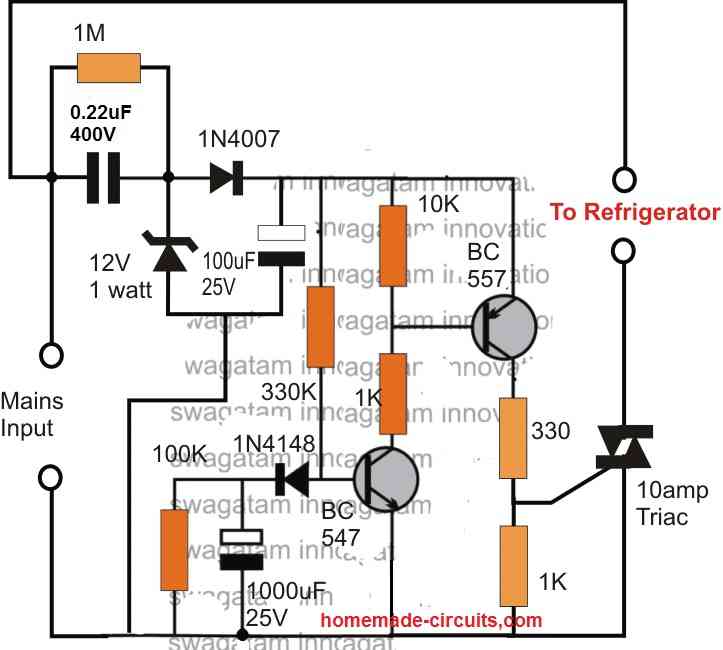
Referring to the above shown refrigerator protection circuit, we are able to witness a two transistor circuit which forms a very basic yet effective delay ON timer circuit, meaning this circuit switches ON its output after some delay, after power is applied to it.
The power supply to the circuit is derived from the mains via a transformerless power supply circuit
which is appropriately stabilized at 12V and fed to the delay circuit.
Whenever power is switched ON, may it be during the first initialization, or during a power failure situation, the associated 1000uF capacitor prevents the BC547 from switching ON at the onset, which in turn keeps the BC557 and the triac switched OFF. The load is therefore unable to receive power and stays switched OFF too.
However, the 1000uF now gradually begins charging via the 330K resistor and when the potential difference across it reaches the approximate total of transistor's biasing limit plus the emitter zener value (0.6 + 3 = 3.6V), the transistor begins switching ON which prompts the BC557 also to switch ON.
The triac now begins acquiring the required gate voltage and within moments switches ON the fridge.
The 1000uF capacitor stays charged as long as power is available to the circuit, and during power failures the capacitor discharges through the parallel 100k resistor so that it can get into the standby mode for the next delay ON cycle operation.
The time delay period can be accomplished by appropriately selecting the values of the 330K resistor, the 1000uF capacitor and the 3V zener diode, as per the user's preference.
This concludes the explanation for the proposed simple refrigerator protection circuit, for any related query please feel free to use the comment box.
Using Relay
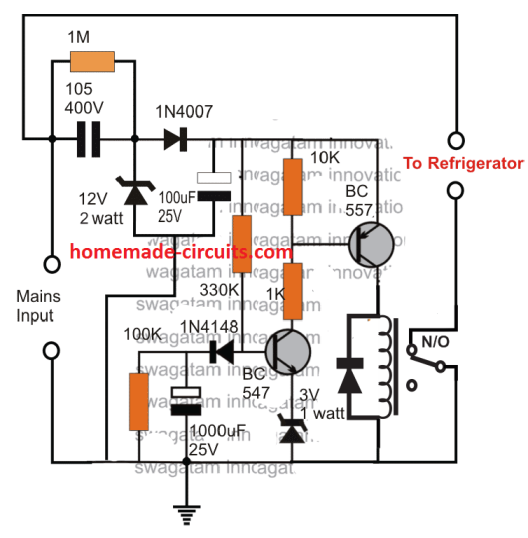
The above design can be used with a relay also as demonstrated below:
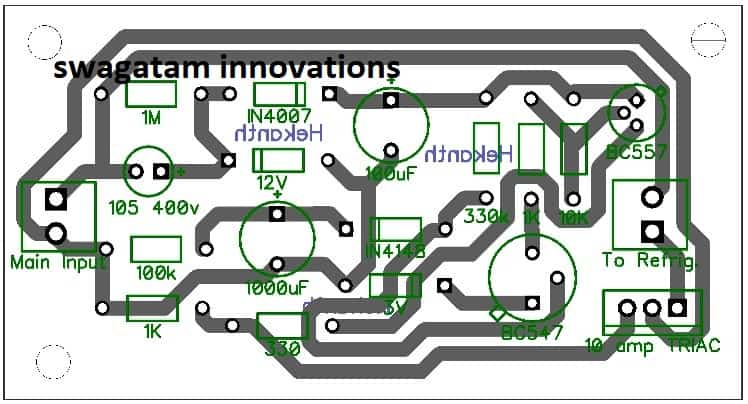
PCB Design (Triac)
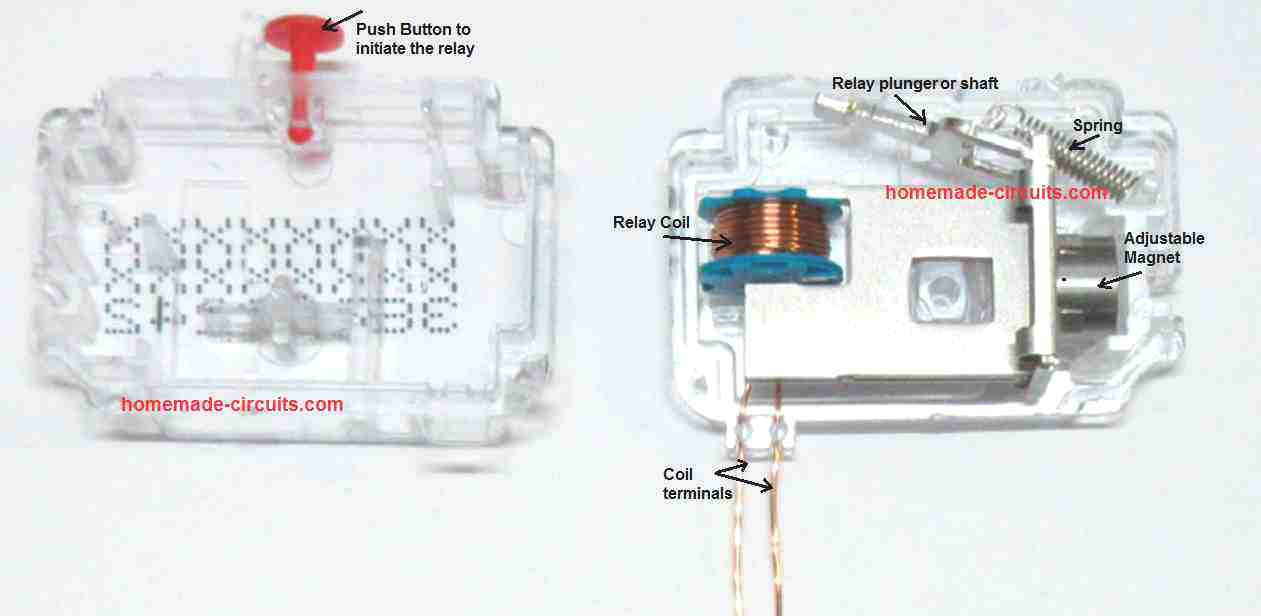
WARNING: CIRCUIT IS NOT ISOLATED FROM MAINS... STRICT PRECAUTIONS MUST BE OBSERVED WHILE HANDLING THE DEVICE, WHILE IT'S IN AN UNENCLOSED CONDITION.



Questions & Answers
Hi sir
For second circuit, if we need to use relay 24V, what will be changed in the circuit for Zener 12V, Zener 3V and the resistors 10K and 1K.
What is the resistor for the 24V coil that will be used with her?
Thank you
Hi Ahmad,
If you want to use a 24V relay, then you just need to change the 12V zener with a 24V zener diode, that’s all, nothing else needs to be changed. Also, you can can connect a 5 ohm 1 watt resistor in series with one of the input AC terminals, just for limiting the initial inrush current.
Thank you very much, sir What about 24V coil resistor? how much value must be used
Ahmad, no coil resistor is used for the relay, only a 1N4007 diode is used parallel to the coil…
sorry sir, I mean the XL of coil how much to be used
Do you mean the coil resistance? Select a relay which has a coil resistance as high as possible, with a contact current rating that can handle the fridge load comfortably.
yes I mean that
thank you
Ok, so you can check the datasheets of the various 24V relays and select the one whose contact rating is sufficient to handle your fridge load, and also the coil has maximum resistance. You have to compare the relays from different companies to find the one which offers higher coil resistance and yet a reasonable contact current rating.
Dear Sir Swagatam
I hope you are doing well
I would like to request your instruction in this regard: upon removing the following components (R: 1 MR, C: 105/400V, D: 1N4007, Z: 12Volt 2W, C: 100uf/25V) from your relay-based circuit and applying a 220/12V adapter to the circuit, would the circuit effectively disconnect the output of 220V if the mains supply drops to low voltages, such as 180V? Additionally, I am interested in knowing whether the circuit would remain operational in the event of a surge in voltage, such as 250V or higher. I would greatly appreciate your response.
Truly yours
Ali
Dear Ali,
No, the above circuit will not cut off at high or low voltage situations. It is just a delay on timer circuit which will delay the switch ON of the load whenever AC power fails and restores back.
You can refer to the following article instead, for the high and low voltage cut off with delay ON feature
https://www.homemade-circuits.com/mains-ac-home-protector-circuit/
Would you kindly recommend the SMD components for this PCB?
You can ask the spare part retailer to provide you the SMD versions of the components indicated in the diagram.
Noted. Thank you
Would this work as a delay on for a refrigerator compressor? Connected before the compressor relay? What combination of parts would equal a 1 to 3 minute delay for a 120 v, 15 LRA compressor?
Yes, it will work, if the wiring is done correctly. The delay time may need to be adjusted with some practical experimentation. Either the 330K resistor or the 1000uF capacitor can be tweaked individually, or together to get the desired delay ON timing.
sir i have been given a task to design and manufacture a low cost simple fridge surge device . would you please help me on few steps i need to take to design this..?..thanks in advance sir
Hi Reagan, You can try one of the circuits explained above, they are one of the best forms of fridge surge suppressor with timer.
Thanks sir… I will be here for more queries sir ????
hello Swagg, my name is Vladimir. Can you help me to make a circuit that will use (50amps) ssd relay to connect battery to sine way inverter with delay while capacitors inside inverter being charged by resistor to avoid big spark on input terminals and damage inverter if connect it straight to battery. Thanks.
Hello Vladimir,
You can try implementing the following diagram:
https://www.homemade-circuits.com/wp-content/uploads/2022/11/slow-start-inverter-protector.jpg
Hi Swagatam
What should the voltage of the relay coil be?
Thank you
Redge
Hi Redge,
Since a 12V zener diode is used in the power supply, so the relay coil will be also 12V rated.
Hi
I am an electronics dummy, but I like playing around with it. Could you please tell me the exact specs of the 50 ohm 1watt resistor in series with mains and also the relay – I will use it for a 240V fridge that draws about 140watt running and 900watt starting.
How long will this capacitor take to discharge?
Thank you for your website and for this circuit!
Regards
Redge
Hi,
The 50 ohm resistor should be a wire-wound type resistor. It could rated at 1 watt or 2 watts. I would prefer using 2 watts. For more safety for the zener diode, you can use a 2 watt zener diode so that it remains unaffected by the initial input current surge through the 105/400V capacitor.
Remember this circuit is not isolated from mains AC and is therefore very dangerous to touch in an open and powered condition.
Hi i am looking at the Refrigerator protector circuit .
Do you have the circuit board for this pls advise.
Regards
George Foster.
Hi no problem thank you.
Sorry, No, I do not have a ready PCB for this project.
Hi, would you design me one circuit (with a Triac or relay) ? I want to purchase it from you sir.
Hi Reagan, sorry making it practically may not be possible for me. I can guide you with the construction and testing of the unit if you want to build it.
May I use triac 400 V 12 A instead 10 A? Please clarify my doubt sir.
You can use it!
Thank you very much sir.
You are welcome A Jegannathan!
Hi I SALEEM FAEQ from Iraq-Baghdad I like this field thanks for all at this website>
You are welcome!
I have tried you “Simple fridge on delay circuit”, it is working fine but one big drawback is there, when circuit is on and fridge working, suddenly power goes off and within second restored, that time this circuit cut off the power but switching on the fridge without any delay (as capacitor hasn’t discharged yet). How to overcome this issue as this is very dangerous for fridge?
You can try adding a PNP transistor across the 1000uF capacitor as shown in the following diagram. I have also added a 4k7 bleeder resistor across the supply terminals so that 100uF filter capacitor can discharge quickly and switch ON the PNP transistor whenever mains AC fails. I have also reduced the input 0.22uf/400V to protect the zener diode from surge currents.
Hello Sir,
Hope you r donig fine.
Sir I want to know about Solar Hydro Panels working. How it generates drinking water frome air and can we construct it with an ordenery solar panel of 12V, 150 W ?
Please if you can help.
Thanks in advance
Hello Rashid,
Solar hydropanel consists of solar cells, along with areas that can absorb water vapor from atmosphere. The solar cell voltage is used for driving many small motors which act like exhaust fans, and help to suck air into the water absorbing surface, which absorb the water content from the atmosphere and channelize them into water storage tanks.
You can definitely use your 12 V panel to build a solar hydropanel, as described in my above explanation.
Thanks for your answer
excellent page contains important things needed by hobbyist and professional in electronics .
outstanding effort .i like this page and i will visit it several times .thanks
Thank you, and glad you found the page informative…
I am an retired electrical diploma eng.(electrical).now I have enough time.i want to get training on different electrical./electronic circuit diagram of domestic equip.how u can help me.If u help me then I will be very grateful to u.After getting knowledge I want to give the services to the people.
Thank u
No problem, you can ask specific questions, I will try my best to help you with the answers.
Dear Swagatam,
I have build this circuit on veroboard but there is problem with this circuit. Output of the power supply portion is about 11.5v while output at relay terminals remain clamped at 6.2v no matter what resister and capacitor I use for delays. I have wait for 10 to 12 minutes with 150k & 1000uF capacitor but the voltage remains at 6v and 12v relay is not operating.
Dear Swagatam,
I have checked first basic design with LED as you told and the LED light up. When I checked the voltage, found it is around 6v. I need minimum 9v to operate 12v relay. Anyway I am going to check my circuit again thoroughly. Thanks for your help.
Regards
Nisar
Hi Nisar, I hope you have connected a 1k series with the LED. Please try a bridge rectifier instead of a single diode rectifier at the input side of the power supply, and the check the voltage again…The voltage may be dropping due to lack of current.
The best alternative way is to use a 12V AC to DC adapter for supplying the DC input to the circuit, which will work without any hassles.
Dear Nisar, the problem is not in the circuit, it may be in your relay coil. Make sure it is not less than 400 ohm. You must always begin by checking the basic design, and then proceed with the final design. Please remove the relay and connect a LED with 1k series resistor across the collector/ground of the PNP. The LED should light up after the set delay, which will prove the correct working of your circuit….if it doesn’t your circuit may be having problems, which you will have to troubleshoot yourself….the circuit is thoroughly tested OK.
but yes there’s one thing missing in the circuit….the C1 must have a 50 ohm 2 watt resistor in series otherwise the zener may burn, alternatively you may have to increase the zener wattage to 2 watt or 5 watt.