In this post I have explained how to make a couple of simple washing machines using a bidirectional single motor with timer and a simple version using cam shaft mechanism, cheaply.
In the first design we use a bidirectional, alternately rotating clockwise and counter clockwise with a pause in the middle:
Audio/Video Representation
Circuit Working
The IC 555 here is working like the clock generator and its timing can be adjusted through the 100k preset and the 22uF capacitor. So by adjusting this preset the motor forward/reverse timing can be increased or decreased.
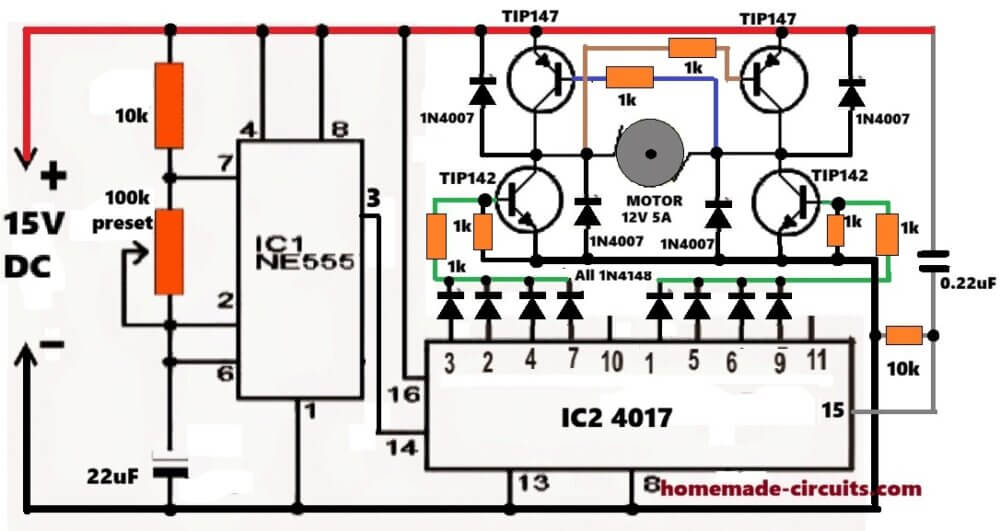
The clock pulses from pin#3 of the 555 goes to pin#14 of the IC 4017, and the 4017 then shifts its outputs one by one.
Here the IC 4017 pin 3, 2, 4, 7 outputs are combined through the diodes to switch one diagonal side of the H-bridge, so the motor rotates in one direction for four counts.
After this, pin 10 is not connected anywhere intentionally, so during this count all the transistors remain OFF and the motor gets a small pause before reversing. This helps to reduce sudden reverse current stress.
Next pin 1, 5, 6, 9 outputs of the 4017 become high, and these are combined to drive the opposite diagonal pair of the H-bridge transistors, causing the motor to rotate in the opposite direction.
Again pin 11 is left unused, so another small pause is created before the cycle repeats.
The ground connection of pin#15 via the 10k resistor resets the IC 4017 so the sequence starts again from pin#3.
So the sequence becomes:
Forward Rotation then Pause, Reverse Rotation then Pause, then again repeat, this goes on continuously.
The TIP142/TIP147 transistors are forming the H-bridge motor driver stage. The 1N4007 diodes are for absorbing the motor back EMF spikes during switching.
Overall the idea looks OK for a small DIY washing machine agitator type application. Proper heatsinks on the TIP142/TIP147 will be important if the motor current is high.
Using Only Motor and Cam Shaft Mechanism (No Circuit)
Washing machines are costly devices which may not be affordable for a section of the population and also to villagers who even might not have an easy access to these equipment. A homemade version for the same may be learned in this article.
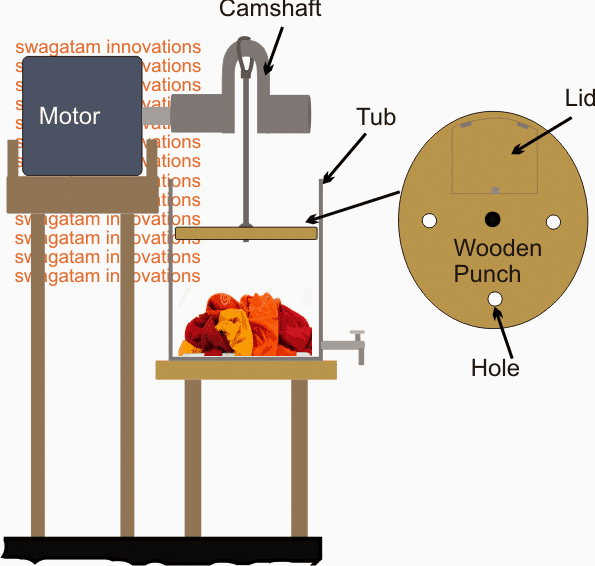
A Simple Washing Machine Mechanism
A rather straightforward approach may be witnessed in the above shown homemade washing machine mechanism, where a motor/camshaft mechanism is used for implementing a slow punching or hammering action over the clothes which needs to be cleaned and washed.
The motor spindle can be seen attached with a camshaft and a vertical rod with a wooden punch.
The wooden punch is supposed to be fixed inside a plastic tub such that the punch diameter is just smaller than the tub inner diameter. This allows the punch to execute the hammering action smoothly within the specified range.
In order to facilitate an easy introduction of the clothes, the wooden punch has a lid cut-out over its surface, which operates with a hinge and lock.
The clothes are pushed at the bottom of the tub by opening this lid upwards and then inserting the clothes through the opening towards the bottom of the tub.
Next, the required amount of water and detergent is poured through this lid over the clothes.
Once this is done, the lid is closed and locked.
Finally, the motor is switched ON so that the slow punching action is initiated over the clothes.
The wooden punch can be seen having a bunch of holes drilled across it, this allows water to squeeze in and out while the hammering action is being carried out. The action ensures a better cleansing due to an active exchange and churning of water/detergent over the clothes.
Note: The motor should be integrated with a built-in gear box in order to carry out a relatively slow and gentle rotation (hammering) action over the clothes.
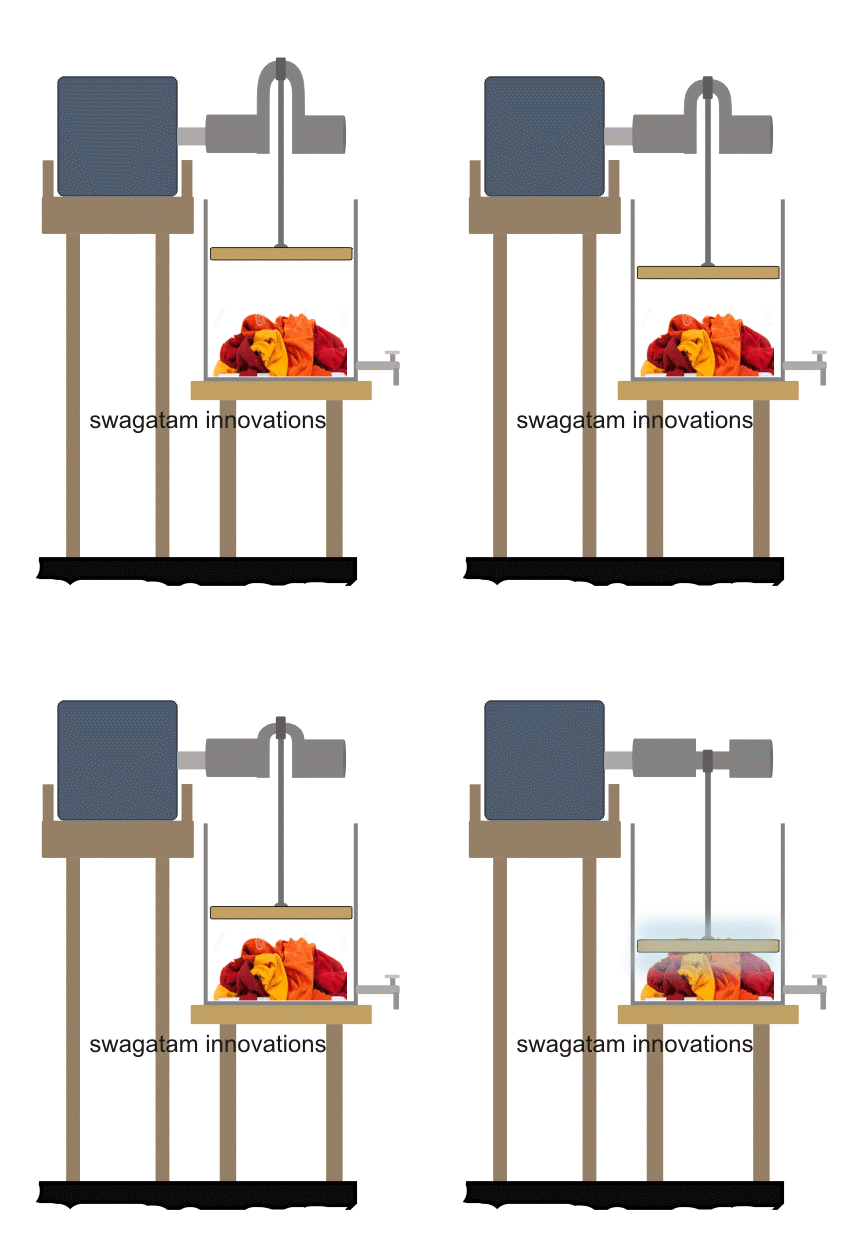
Simulating the Washing Machine Operation
A Rough Simulation to understand how to make a simple washing machine and its mechanism.



Questions & Answers
Hello sir,
I recently changed the dryer motor of my samsung washing machine. But what i noticed is after i wired the motor exactly as the wiring color code, the motor spins in the opposite direction to what is was earlier.
Can you please help me as how can i reverse the direction of the motor?
The motor is a single phase, 3 wire motor. Has a 6 Mfd capacitor.
Thanks
Hello Anirudh, sorry I have no idea about it since the problem could be specifically due to an incorrect wiring, you can consult your local washing machine technician or the customer care
sir, as this washing mechin mentioned simple. can this mechin rotate with help of bicycle . instead of electric motor . this would be more simple and much usefull to villegers.
thank you
Manjunath, yes the motor can be replaced with a bicycle mechanism…however the motor option looks more convenient and effective, because a bicycle will need a manual effort which might add to the troubles the villagers…electricity is now available even in the villages or a solar energy option could be tried
Dear Swagatam
Although you have already mentioned SIMPLE, it would be more effective if you introduce some technique to tumble the clothes when the punch is lifted up.
Dear Abu-Hafss,
adding any kind of improvement could make it complex….so let's keep it as given, and may be let the user decide what else he may want and be able to add in the design…
Sir swagatam good day. Can you give me a circuit how to reduce the current bill in my home? Please I badly needed
Hi Mark, That’s illegal, so I can’t help in this regard.
Ok mr swagatam. Thank you ????