• Skip to main content
  • Skip to primary sidebar

Homemade Circuit Projects

Need circuit help? Post them in the comments! I've answered over 50,000!

Blog | Categories | About | Hire Me | Contact | Calculators-online
You are here: Home / Energy from Magnets and Earth / How to Generate Electricity from Piezo

How to Generate Electricity from Piezo

Last Updated on June 30, 2026 by Swagatam 8 Comments

Generating electricity from piezo could be as easy as making a flick with your finger..... curious to know how? I have explained more about this amazing device called piezo, which can be used for generating music as well as electricity.

Table of Contents
  • How Piezo Responds to Force and Electricity
  • How to Generate Electricity from Piezo
    • Illuminated Carom Board Using piezo Lit LEDs
    • Using piezo electricity in Children Shoes.

How Piezo Responds to Force and Electricity

Piezo material is a crystalline substance which has the property of generating electricity when its crystalline structure is subjected to a certain mechanical stress level.

Conversely when the same crystalline structure is subjected to an electric current it exhibits an equivalent level of deformation which in turn causes a sound to be generated.

That's exactly why piezo elements are used in buzzers for generating sound by applying an pulsating voltage across it.

Therefore we can conclude that the discussed property of piezo material is flexible and reversible, meaning it allows both, generation of electricity when deformed, and generation of sound when electrified.

Having said this, care must be observed not to over limit the stress level on a piezo while attempting to generate electricity from it since the deformation limit of a  piezo element is
extremely small, exceeding which could result in breakage or permanent
damage of the element.

How to Generate Electricity from Piezo

For experimenting the generation of electricity from a piezo, the easiest way to access a piezo material is to procure the standard 27mm piezo element which are normally used in piezo buzzer circuits.

The picture below depicts a couple 27mm piezo elements which may be readily available in most electronic spare part stores.

The right side pic shows a 2-pin piezo element, while the other one represents a 3-wire, any of these will work for the experiment.
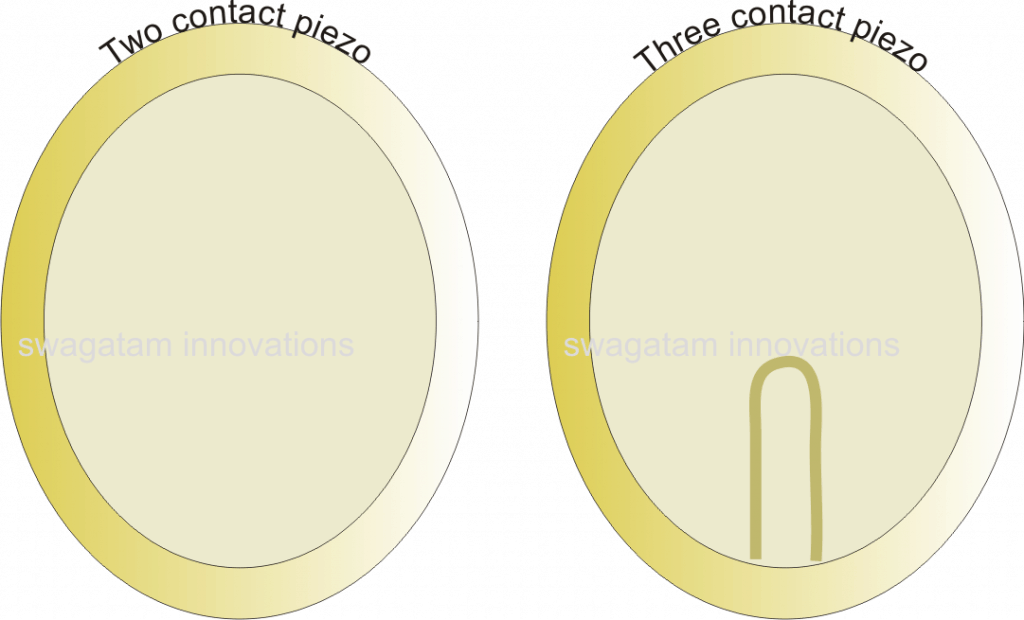
piezo

Once the piezo is procured, solder a couple of wires to it, connect a 20mA white LED across the other end of the piezo.

As soon as the above assembly is built, you can make the LED illuminate brightly momentarily by flicking the edge of the piezo with your finger.

Each time you strike the piezo with your finger, you can find the LED illuminating brightly during that instant.

Generate Electricity from Piezo Transducer

And somehow if the striking is sustained through some external means, would enable the LED to illuminate rapidly, or even continuously if a capacitor is connected across its leads.

If the output across the piezo wires is measured, you would be surprised to see the voltage to be as high as upto 3V depending on how hard the striking was.

While conducting the above experiment make sure the piezo is pinched tightly from opposite edge with your other hand fingers, do not clamp through any mechanical tool as that could crack the piezo causing permanent damage to the element

Applications Hints:


Please also see how to charge battery with a piezo mat circuit


Illuminated Carom Board Using piezo Lit LEDs

The above explained concept of generating electricity from piezo transducer and illuminating an LED could be implemented in carom boards, for producing attractive LED illumination within the coins and also around the inner surfaces of the board rim.

SMD LEDs could be used for flush embedding them within the carom coins surface such that they do not affect the sliding effect of the coins.

The inner edges of the board could be also embedded with piezo/LED assemblies for generating the proposed piezo electric LED illumination.

Once this is done, each time the coins are struck or when coins hit the board edges the associated LEDs could be expected to light up brightly for that second producing interesting LED light show.

Using piezo electricity in Children Shoes.

The effect of piezo electricity could also be effectively used in children shoes, by suitably fixing the piezo, LED assembly beneath the heels of the shoes. This would enable the LeDs to light up brightly each time a step is taken by the child wearing these enhanced shoes.

Many more such innovative ideas could be implemented by using the proposed concept of generating electricity from a piezo buzzer element, if you think you have even more interesting ideas do let us know about it through your comments.

You'll also like:

  • The Bubble Current Machine: A way to harvest energy from gravity
  • THE HIGGINS ENGINE: Generating Electricity from Gravity
  • 8X Overunity from Joule Thief – Proven Design
  • electricity2Bfrom2BflywheelHow to Generate Electricity Using a Flywheel

Filed Under: Energy from Magnets and Earth Tagged With: Electricity, Generate, Piezo

About Swagatam

I am an electronics engineer and doing practical hands-on work from more than 15 years now. Building real circuits, testing them and also making PCB layouts by myself. I really love doing all these things like inventing something new, designing electronics and also helping other people like hobby guys who want to make their own cool circuits at home.

And that is the main reason why I started this website homemade-circuits.com, to share different types of circuit ideas..

If you are having any kind of doubt or question related to circuits then just write down your question in the comment box below, I am like always checking, so I guarantee I will reply you for sure!

Previous Post: « How to Make a Simple Math Calculator using Arduino
Next Post: How to Interface 4×4 Keypad with Arduino »

Reader Interactions

Questions & Answers

Total Posts: 8
Newest Oldest
Cecilia
February 10, 2025 • 2 years ago #168368

Hello,

I am a meducal researcher, I want an enthustic engineer to join a project to protect harm from ultrasonic and emf.

The attached reading was found on Feb 2, 2025.

This is dangerous level. I repeatedly asked help but no one help.

I need to help myself to find out and remove it immediately.

The Canafian and many guidelines tell it is dangerous level. My ears are painful.

Guideline

canada.ca/en/health-canada/services/environmental-workplace-health/reports-publications/radiation/guidelines-safe-use-ultrasound-part-industrial-commercial-applications-safety-code-24.html#a4.2.1

Then a medical research to reassess the harmful sources in the environment or intentionally place it recklessly.

No one can place such source no matter what reason.

Can you reply the easiest way to communicate?

Thank you very much.

Cecilia

Reply
SwagatamAdmin
February 11, 2025 • 2 years ago #168375

Hi, thanks for your interest in the subject, this commenting platform is the easiest way to communicate with me.

Reply
Jameer Shaikh
July 13, 2017 • 9 years ago #51673

how and where can this peizo electricity generated can be saved

Reply
SwagatamAdmin
July 13, 2017 • 9 years ago #51678

inside 2 or 3 capacitors, then these capacitors could be connected in series to raise the output and this boosted charge could be transferred into a Li-ion battery.

Reply
Antonio Toquero
June 9, 2017 • 9 years ago #51004

Good day!
Sir Swagatam,
Please help me to build a regulated power supply input 60 VAC, 60hz
output 50 VDC 2kw, low ripple none parasitic regulated output. this proposed power supply
is to be use as a back up power supply of my existing off grid 3kw solar installation.so that my battery will will not drain during daytime and save for the night time. the proposed regulated power supply 50volts will parallel to the Battery output with blocking diodes so that if during cloudy the harvest goes down then instead battery will help the regulated power supply will handle load soon the the output of battery lower down to 50volts.

Reply
SwagatamAdmin
June 10, 2017 • 9 years ago #51021

Hi Antonio, 50V 2kV looks huge, presently I do not have any power supply circuit even close to this massive value…so I am sorry won't be able to help with this design

Reply
Syed Ameer Hamza Askari
September 11, 2016 • 10 years ago #44424

Sir meri ap se request ye hay k ap 1 led cube banana sikha dain please

Reply
SwagatamAdmin
September 12, 2016 • 10 years ago #44462

LED tube or cube?? With how many LEDs, please specify this?

Reply

Need Help? Please Leave a Comment! We value your input—Kindly keep it relevant to the above topic! Cancel reply

Your email address will not be published. Required fields are marked *

Primary Sidebar

My YouTube Channel

Circuit Simulator: Draw and Simulate Schematics

circuit simulator image

Categories

  • Arduino Projects (95)
  • Audio and Amplifier Projects (134)
  • Automation Projects (18)
  • Automobile Electronics (104)
  • Battery Charger Circuits (90)
  • Datasheets and Components (109)
  • Electronics Theory (151)
  • Energy from Magnets and Earth (43)
  • Games and Sports Projects (11)
  • Grid and 3-Phase (20)
  • Health related Projects (27)
  • Home Electrical Circuits (13)
  • Indicator Circuits (16)
  • Inverter Circuits (98)
  • Lamps and Lights (161)
  • Meters and Testers (72)
  • Mini Projects (28)
  • Motor Controller (68)
  • Oscillator Circuits (30)
  • Pets and Pests (15)
  • Power Supply Circuits (91)
  • Remote Control Circuits (50)
  • Security and Alarm (65)
  • Sensors and Detectors (107)
  • SMPS and Converters (46)
  • Solar Controller Circuits (62)
  • Temperature Controllers (44)
  • Timer and Delay Relay (51)
  • Voltage Control and Protection (44)
  • Water Controller (37)
  • Wireless Circuits (31)

Subscribe to get New Circuits in your Email

Other Links

  • Privacy Policy
  • Cookie Policy
  • Disclaimer
  • Copyright
  • Videos
  • Sitemap

People also Search

555 Circuits | 741 Circuits | LM324 Circuits | LM338 Circuits | 4017 Circuits | Ultrasonic Projects | SMPS Projects | Christmas Projects | MOSFETs | Radio Circuits | Laser Circuits | PIR Projects |

Recent Comments

  • Swagatam on Electronic Circuit Projects, Tutorials, and Practical Engineering Solutions
  • Swagatam on Simplest Full Bridge Inverter Circuit
  • Amal on Simplest Full Bridge Inverter Circuit
  • Michael on Electronic Circuit Projects, Tutorials, and Practical Engineering Solutions
  • Swagatam on Electronic Circuit Projects, Tutorials, and Practical Engineering Solutions

Social Profiles

  • Twitter
  • YouTube
  • Instagram
  • Pinterest
  • My Facebook-Page
  • Stack Exchange
  • Linkedin

Calculators

  • ZVS Induction Heater + Tank Calculator Tool
  • Zener Diode Calculator
  • Wire Current and Thickness Calculator (Ampacity Calculator)
  • Voltage Divider Calculator
  • Transistor Base Resistor Calculator
  • Transistor Astable Multivibrator Calculator
  • TL431 Calculator
  • Solar Panel, Inverter, Battery Calculator
  • Ferrite Core Air Gap Calculator Tool
  • Parallel MOSFET Calculator Tool: How to Connect MOSFETs in Parallel Safely
  • LC Resonance Calculator for EV Battery Charger Circuits
  • LED String Series Resistor Calculator
  • PFC (Power Factor Correction) Calculator Tool: 3kW
  • Passive Power Factor Correction (PFC) Calculator
  • LM567 IC Calculator Tool
  • SMPS Flyback Boost Converter Calculator
  • Shunt Resistor Calculator for Ammeters
  • SCR and Triac Gate Resistor Calculator
  • Battery Back up Time Calculator
  • Boost Converter Calculator (Non-Isolated)
  • Bootstrap Capacitor Calculator
  • Buck Converter Calculator
  • Buck-Boost Converter Calculator
  • Capacitance Reactance Calculator
  • DCM Flyback Transformer & Wire Gauge Wire Size Calculator Tool
  • Filter Capacitor Calculator
  • IC 4047 Calculator (Frequency and PWM)
  • IC 4060 Calculator
  • IC 555 Astable Calculator
  • IC 555 Monostable Calculator
  • IC SG3525, SG3524 Calculator
  • Inductance Calculator
  • Induction Heater Inductor and Resonant Frequency Calculator
  • Induction Heater Work Coil Calculator
  • Inverter LC Filter Calculator
  • LC Resonance Calculator
  • LED Current Calculator
  • LM317, LM338, LM396 Calculator
  • NAND/NOT Gate RC Values Calculator
  • NOT, NAND Gate Frequency Calculator
  • Notch Filter Calculator Tool
  • Ohm’s Law Calculator
  • Phase Angle Phase Shift Calculator
  • Power Factor (PF) Calculator
  • RC Filter Calculator
  • Reactance Calculator
  • Sine Table Calculator for SPWM Arduino Code
  • Small Signal Transistor(BJT) and Diode Quick Datasheet
  • SMPS Calculator for Toroidal Ferrite Transformers
  • SMPS Flyback Transformer Calculator – Design by Target Duty Cycle
  • TL431 Calculator
  • Op-Amp Hysteresis Resistor Calculator

© 2026 · Swagatam Innovations