In this article we investigate the flywheel concept and learn how it may be used for charging batteries and also enhance to work at the overunity level.
What is a Flywheel
According to Wikipedia, A flywheel is a spinning mechanized machine utilized to stock and release rotational power.
Flywheels are seen to possess an inertia, termed the "moment of inertia" which therefore resists alterations in rotational to their speeds, much like the mass (inertia) of an automotive system prevents its acceleration.
The level of power trapped in a flywheel is proportional to the square of its rotational movement.
Energy is delivered to a flywheel by the utilization of a torsional power to it, consequently raising its rotational velocity, and as a result its accumulated power. On the other hand, a flywheel produces collected energy by making use of torsional power to a physical load, consequently lowering the flywheel's rotational rate.
Typical applications of a flywheel incorporate:
Offering nonstop energy where the source of energy is discontinuous. As an illustration, flywheels are utilized in reciprocating motors since the power source, torque from these motors, are irregular.
Dispensing energy at rates beyond the capability of a persisting source of energy.
This is often accomplished by gathering energy in the flywheel progressively then simply discharging the energy swiftly, at rates that surpass the capabilities of the source of energy.
Managing the alignment of a mechanised equipment. In this kind of usages, the angular speed of a flywheel is specifically routed as a torsional power to the connecting mechanized system while energy is moved to or from the flywheel, consequently provoking the connecting equipment to move into certain expected position.
Flywheels are ideally made from steel and move over special high grade bearings; these are typically confined to a revolution value of several thousand RPM.
A number of contemporary flywheels are constructed of carbon fiber components and implement magnetic bearings, making it possible for these to rotate at rates up to 60,000 RPM.
The above discussion clearly states that flywheels have the potentials to generate an output power that may much higher than the input once it has been rotated to some specified high speed.
From the above discussion we can conclude that using a flywheel an overunity electricity generator can be achieved without much complications and skepticism.
Considering Flywheel as an Effective Free Electricity Generator
In a one of my earlier posts I have discussed a similar concept using a pendulum and have tried to convey the method of using it for achieving overunity limits.
In this article we'll see how a flywheel can be used for executing an overunity result, and derive over 300% more output than the applied input.
In the diagram below we can see a simple flywheel with a motor set up:
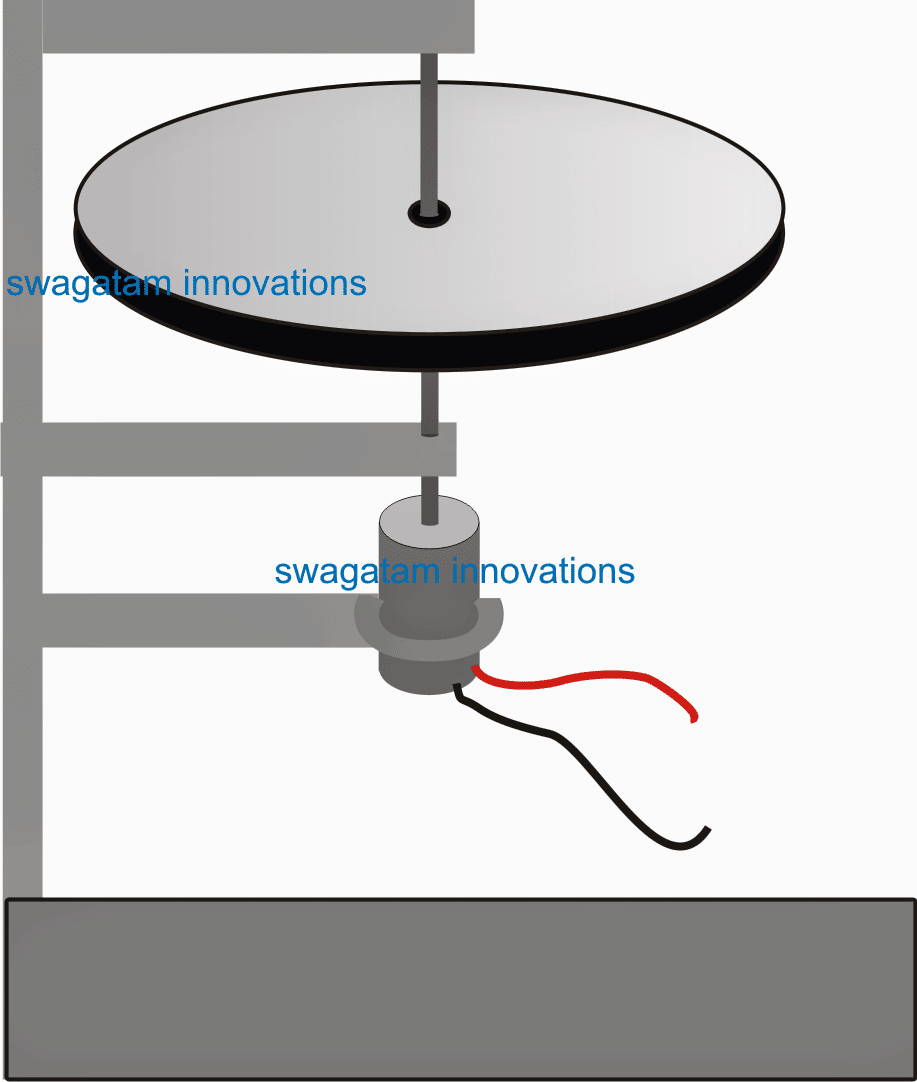
This can be seen as a manual electricity generator using a flywheel wherein the flywheel needs to be pushed occasionally for sustaining a consistent rotation over the attached motor.
The motor wires can be appropriately terminated with a battery for acquiring the proposed free electricity from the set up.
The advantage of this set up is that once the flywheel is rotated with the specified maximum torque, the rotational can be sustained by pushing the flywheel with significantly less amount of energy.
Although efficient, the above set up may not look too impressive due to the requirement of an individual all the time near the system.
Using Flywheel for Generating Free Electricity
In the above sections I have explained regarding how a flywheel can be used for generating excess electricity from its stored potential energy when it's given a swift spin using an external torsional force. In the following discussions we'll learn how the system can be made into a perpetual motion without the need of any external intervention.
In our last discussion we understood the naturally attributed overunity feature of a flywheel, and learned how it can be used like an efficient machine for generating free electricity with the help of a frequently applied external minimal sustaining force to it.
However, in order to transform the flywheel into a free electricity generator andalmost perpetual, and automatic without the requirement of any manual intervention, the following shown smart idea can be incorporated.
The Flywheel Circuit Setup
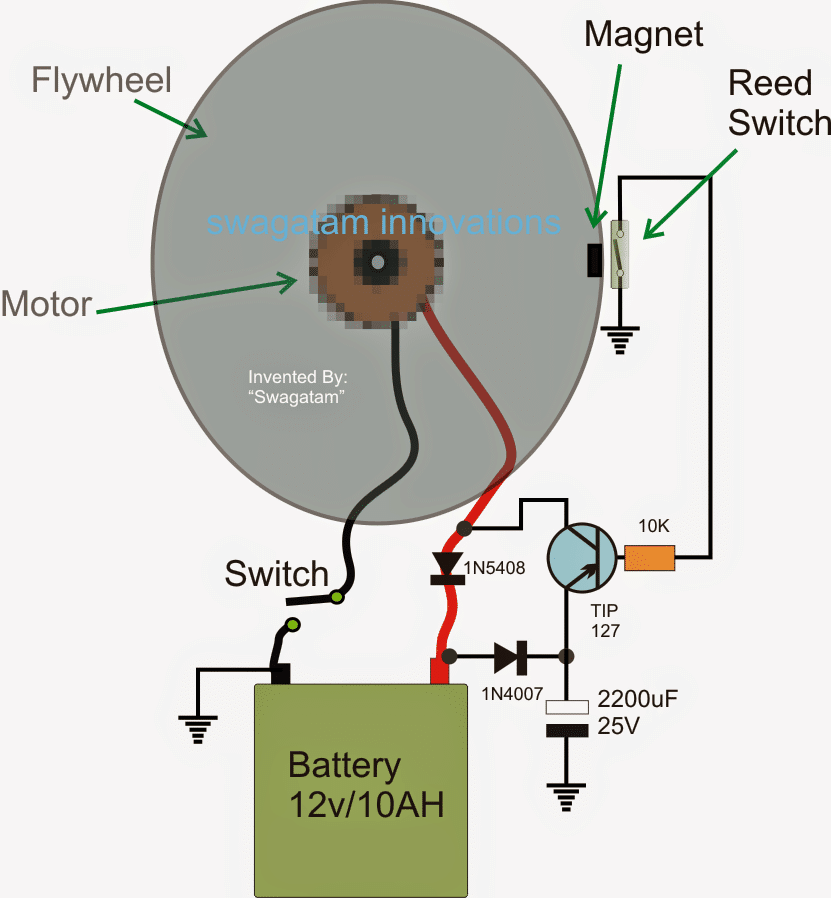
If the explanation provided in Wikipedia is believed to be correct, then the above design should work as per the proposed overunity concept here.
In the design above we can see an appropriately calculated flywheel, motor, and a battery circuit set up.
How it Works (Overunity)
The figure shows the top view of the flywheel, the attached motor being right under the flywheel, shown in a pixelated form.
The motor wires are connected to a battery which needs to be charged, via a blocking rectifier diode (1N5408). This diode makes sure that the voltage from the battery remains blocked while the energy from the motor is allowed to reach the battery.
A PNP transistor network can also be witnessed, whose base is configured with a reed switch.
The reed switch is supposed to be activated through an embedded magnet sealed at the edge of the flywheel.
Initially the switch connected in series with the negative wire is kept toggled off, and the flywheel is given is tight rotational spin (torque) manually or with any desired external means.
A soon as this is executed, the switch is immediately toggled ON.
Here the flywheel dimension is assumed to be significantly large such that the "switch ON" action (battery connected) inflicts only a minor resistance to the torque of the flywheel.
Once the above action is initiated, the motor instantly begins generating and supplying electricity to the battery.
Also in the course of its rotational cycle, the magnet attached with the flywheel edge begins switching the corresponding reed switch intermittently.
The reed switch in turn switches the PNP transistor at the same rate creating momentary short across the 1N5408 diode so that during these instants the battery power is reverted to the motor for applying back the required sustaining torque to it.
The 2200 uF capacitor further aids to this and reduces the load on the battery each time the transistor switches ON.
Now since the reed switch is toggled only for a fraction of time of each complete rotation from the flywheel, except for these periods, the rest of the rotational length of period is used for generating free extra electricity for the battery.
It implies that while the flywheel is rotating only a fractional energy from the battery is used for sustaining its optimal torque, while a significantly large amount of its energy is transferred to the motor for generating an equivalent amount of charging current for the battery.
The above explained scenario ensures a perfect self-sustaining flywheel system which becomes capable of generating free electricity in excess tow hat is being used as its sustaining input.
The shown 2200 uF capacitor may be increased to some higher value and if possible super capacitors can be tried for further enhancing the efficiency of the system.
Feedback from Mr. Mark Baiamonte
Can you use a 3 phase washing machine motor and how would it be wired? I have been fooling atound with a windmill and got it to work but not enough wind. You plans are excellent and i would love to try it. Here is my motor.
Solving the Query
A 3 phase motor could be difficult and confusing to wire with the shown flywheel circuit, because the motor would need a 3 phase to single phase DC conversion and a DC to 3 phase reception from the transistor...
Finalized Flywheel Design By Mark
I built the flywheel and it works! I only had a 2200uf 16volt. I used a motor from a treadmill.
What the biggest size capacitor i could use? Thank you very much. This is the first thing i made like this. I enjoyed it very much.
Only sorry i didn't start fooling around with this kind of stuff at a younger age. Thank you again for your design and your time.
Mark Baiamonte Ashley,
Pa USA
primoswilkesbarre@gmail.com
My Response
That's great Mark, thanks for updating the info.
The capacitor value is not critical, however bigger values might help to increase the efficiency of the system, so you could try adding a a couple of more 2200uF in parallel.
Best Regards
Swag
A Few Optimization Tips from Mr. Thamal Indika
I saw a big difference by attaching a 4700uf capacitor to the motor terminals and the speed of the fly wheel increased significantly. At the same time i checked the out put of the motor and it is about 6.5 V . I am going to rotate another motor by that output current and using that separate motor i can create a good generator by moving magnets on a fixed coil.
I hope to use super magnets like N38 (Diameter 2CM, Width 1CM) and use guage 20 coils . I can make an assembly for that and i will attach another fly wheel to the shaft attached to that separate motor so that the speed will be increased. . Then it will generate more that 12 V current and about 2 A. Also i can change the amount of ampere by attaching more coils . Then i can give that out put current to the 7.4 V 1A Dialog Router battery and it will charge well.
I think this is a good modification to your circuit design and instead of giving the output current of the battery through a rectifier , i am going to rotate another separate motor by that current and thus running a generator and supply the output of the generator to the battery. please note at present i use a 7.4V 2A Dialog Router with a 6V cassette motor for your design and the speed of the fly wheel increased significantly by attaching a 4700uf capacitor to the terminals of the 6V cassette motor .
It brought some successful results. I just checked the charger of this battery and it is 12V 1A charger . I hope i will be able to create a generator that would provide 12V 1A.


Comments
I am very interested in electric generator.
Please tell me the phone number and what state it is in or country.
Altonetor RPM 1500, 3PHASE, 18.75KW. Motor 2800 RPM single phase.
I need help on size of pulley in motor, flywel and altonetor also flyweel kg.
Hey Sudi, Here’s the calculations for you:
Motor RPM × Motor Pulley Diameter = Alternator RPM × Alternator Pulley Diameter
Given:
Motor RPM = 2800
Alternator RPM = 1500
Let us assume motor pulley = 100 mm, then:
2800 × 100 = 1500 × Alternator pulley
Alternator pulley = (2800 × 100) / 1500 = 186.66 mm
So Ideal Pulley Sizes:
Motor pulley: 100 mm
Alternator pulley: 190 mm approx…(you can also use 90 mm and 170 mm, or any set that keeps ratio 1.86:1)
Flywheel Size and Weight (Rough Idea):
For a 18.75 kW alternator at 1500 RPM, we can keep:
Flywheel diameter: around 500 mm to 700 mm
Weight: around 60 kg to 100 kg
Material: Cast iron or steel
Too heavy flywheel may overload motor at startup. So better to try with 60–70 kg first, if motor can handle, then try more.
Since 16 years, I have been dealing with angular energy electricity generation systems (R&D). My positive designs about angular continue. In this regard, my own financial means are insufficient, I had meetings with many businessmen, they accepted the financing of the project, but they gave up when it came to signing a protocol, that is, when it came to formalisation. If there is an entrepreneur who will take firm steps with me on this path, who is idealistic, has financial means and wants to make an official protocol, I would like to meet. 98% of the published videos are wrong and do not work. I know the mistake they all make.
How can I bring the electricity generated out?
how fast will the battery recharge itself?
im guessing you can use this to top up a low battery too? basically a dead battery charger?
It will depend on the flywheel size.
Yes it can be used for keeping a battery topped up, but might not be suitable for dead batteries.
Can I use this to operate two 1.5hp borehole pumps on the farm. Thanks
Sir, can you extract power from this device to power another device when this particular device is running
I don;t think that’s possible.
what if i integrate a car alternator to constantly charge the battery, in place of a diode rectifier, connected through a belt and pulley attachment to the flywheel shaft, would that be fine ?
Hello,
Does it matter if the flywheel is vertical or horizontal placed for the operation to be optimal ?
Best Regards,
Kim Jensen
Hello, I don’t think it really matters whether the flywheel is held vertically or horizontally.
Dear Sir Swagatam
Hello. You have probably seen many fake videos about free electricity production on the Internet. I will send you a video in this case to your Email address that a friend has sent me and I hope this one is real . Those fake videos remind me of the story of a man sitting by the sea with a bowl of yogurt and pouring spoonfuls of yogurt into the water and stirring it with the spoon. A passerby asked him: “what are you doing”? The man replied: “I am producing yogurt”. The passerby said: “but you cannot turn the sea water into yogurt with a bowl of yogurt”, and he answered:” I know, but imagine how much yogurt I will own/have if the sea water turns into yogurt”.
Waiting for your hopeful answer, I remain
with best wishes
Ali
Thank you Dear Ali,
I saw the video which you sent me. Unfortunately it is also one of those fake videos from youtube, and the results are impossible to achieve through the shown setup.
Dear Sir Swagatam
Hello. Thank you so very much for answering me. Please apologize for taking your precious time.
He who never forgets your kindness
Affectionately yours
Ali
No problem Ali, You are most welcome!
Good day sir. I read the explanation and you said that the motor will produce Power to the battery. I quote “Once the above action is initiated, the motor instantly begins generating and supplying electricity to the battery”. How is it possible that a DC motor will generate dc voltage or is it a special motor that will act as DC gen and dc motor? From your diagram, the transistor and reed switch function is to enable the motor to get supply from battery to motor. Please sir explain
Hi Emmanuel,
When a DC motor shaft is rotated by an external force the motor starts generating electricity, that’s a standard working principle of all DC motors.
Yes that’s right the transistor and reed switch function is to enable the motor to get supply from battery to motor.
I have started building my own flywheel to generate electricity to be stored for use.im waiting on the mail to bring me the rest of what I need,wish me luck!
Sounds great! I wish you all the best with the project!
Sir engineer Swagatam
Hello. A friend of mine has recently sent a video regarding generating electricity using magnetic field. I sent it to your Email to please check out and tell me weather it is real and if so, would you do a favor and introduce it as a project in your site along with technical features of it such as type of magnet, size and diameter of screw and so on?
Thank you in advance
Wish you all the best
Mehrdad
Hello Mehrdad,
that is a 100% fake video and will never work. There are many such videos on youtube created to fool the audience, so please do not build them.
Sir engineer Swagatam
Hello. I thank you very much for your reply.
Wish you all the best
Mehrdad
You are welcome Mehrdad!
I wish you guys would stop wasting your time, you are NEVER going to get more energy out of a system than you can put in, the law of conservation of energy has stood the test of time for centuries for good reason.
Consider this, you start with a flat battery and spin it up by hand, the battery will never charge and the flywheel will lose momentum and stop.
All this system does is maintain the speed of the flywheel while slowly depleting a charged battery.
Your comment about Flywheel energy . Yes its true about Law of Conservation however what about Pulsed motors and Flywheel Generators producing 1 amp of pulse into the battery.
In light of super capacitors coming online. What I”m saying is … can you not produce energy slightly
faster than your dispersing it. That is to save on specific amperage or milliamperage loads say for example
a household air conditioner. It eats like 16 amps to operate but if you could differ most of that lost energy
you energy bill would sure come down.
thank you
“Your comment about Flywheel energy . Yes its true about Law of Conservation however what about”…..
No.
Hello sir.i would need to try this concept with high power motor and generator,around 1500w-2500w.its looks practical I mean.i have a certain suggestion since I deal with car alternator works.any generator spins at certain speed to produce power.according to me ,this rotation is essential for the stator coils to experience changing flux.hop it’s clear.i want to design a generator which does not require spinning power but I will use an oscillator driver to control the magnet polarity inside the stator coil,, through the field excitation coil like car alternators do. about 50hz to 100hz frequency.though stationary,the stator coils will still experience changing flux as of moving generator.think of a inverter transformer….is that practical sir..please reply sir
Yusuf…. Seems you are correct. What’s the status right now?
Sorry Yusuf, I have no idea about the details and the questions that you have asked, since my expertise is with the electronic circuits only.
Can anything from the Earth’s Rotation affect the energy stored in a Flywheel? If this is in the text already, I am sorry and I might have just passed that part. I really need this for my project.
The Earth is not spinning. It is stationary and closed with firmament. Under the firmament rotate the Sun and the Moon.
Sorry, I have no idea about it!
Hi Sebastiano, You may be correct, I have not investigated the topic yet, thanks for your interesting feedback.
Hi Swag, I am quite sure that one of the layout that consist in two motors in series could be overunity or at least very efficent. I am speaking about the Tesla asymetric motor.
“Ufopolitic” eplained very well on youtube how this coilings work. Big motors begin to run with very low potential.
Thanks your reply, yes it is, but I have no idea with whole Concept if you can enlighten me the basics I appreciate
Thanks, If it is a permanent magnet type motor, then maybe it can be tried
Thanks for your Contribution to Flywheel energy, my question is can a treadmill motor be helpful in this Flywheel energy?
No issues bro, I appreciate your dedication, keep up the good work…you can add a Hall sensor instead
hello Bro,
more and more iam investigate about this prjoect,
i found that,
its need more calculations ,i found a relations between RPM-reed switching-Charging period- magnetic field afected by the RPM too,
,Mean,with high RPM ,which is need to make the motor generate strong enough electricity to charge the battery,,,the high RPM causes in ‘need some calculations to control the time/period of reed switching,
seems,..i need add another method to replace the reedswitch,to ensure the charge period keep.bigger no matter how high RPM its rotate,
based on trial i have done,
which is in small size,
use only 3×1.2volt battery,
small flywheel ,65mm diameter,
,i assume that,its will work better with larger scale,
,12volt 3ampere DC motor,
,12 volt 5Ah battery,
,and absolutly,bigger and heavier flywheel,
,multiplying that 65mm,so its good to use about 650mm flywheel,
the flywheel sure,its the key ,the heart of this system,
and based on my trial, the shape of the flywheel are the most critical factor instead of the weight
mean,
with the same weight but bigger diameter,and less thick,and consentratting its mass weight pn its radian, ,mean, the flywheel has a less weight near its center
Thanks alek, I hope you will succeed with the project! Sorry, i discuss through comments only in this website, wattaspp is not possible.
good nite bro,..
its 00.30 am in my country,haha,
,i wish i can send you a video of my experiment,
would like to give me your Whatsaap maybe?
now iam running this device bro
i have made a simple reed switch,to replace the damaged one,,,
its about…,3hours ,and rpm are stabil,
hope its will keep run till tomorow
,
one more ..
aftet that 8hours,,
it was stoped because the reed swicth was damaged,i dont know why,,i let it running while i was sleep ,
maybe because i use the most cheap one so its weak,,
but,,,over that,,,my 3battery are remind have a power,
mean,if the reed switch was not damaged,the sytem still running,
thank you Brother,
I keep going on to do this project,
first ,build the small scale with 100% work,,,
,pocket size,,so people can use this to charge their gadget,cellphone,laptop,etc even when no comercial electricity avaiable
,i think its good enough if the battery as power source can keep running for few months,,,4-5-6 or,
1 year, ,with 3-4hours daily use ,,4times/ day maybe,,,
,,
You can replace the reed relay with a Hall effect device which will never get damaged due to high speed or frequency
No problem bro, I wish you all the best!
Thank you for your valuable research, hope this info will help the other readers to optimize the system better!
That’s great bro, appreciate your efforts!