In this post I have explained 6 simple, cheap class A power amplifier circuits which can be used for any small scale audio amplifier application.
By: Dhrubajyoti Biswas
1) Zero Negative Feedback Amplifier
This following data will detail how to build an amplifier having zero negative feedback which implies building a zero component amplifier. The amplifier will be single-ended and Class A.
To begin with, let us first lay down the circuit design of the proposed amplifier, as given under:
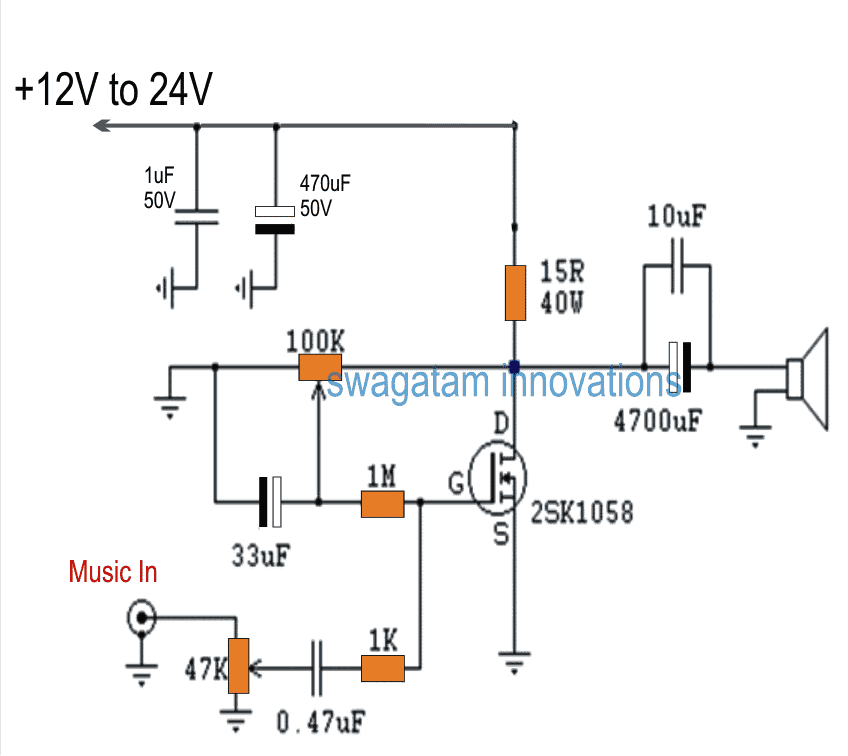
How to Build the Circuit
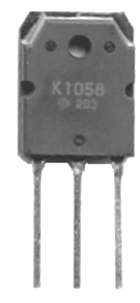
To build the circuit we need: A MOSFET, some capacitors and resistors and a sturdy power supply which has to be properly filtered using large filter capacitors. The amplifier we are building is built by incorporating the device 2SK1058 N-Channel MOSFET from Hitachi. The pin diagram is shown below:
The capacitors that we used in this experiment is that of Sprague. This is used to couple the input and on the output a large electrolytic along with polyester bypass capacitor of 10µF. To manage the load, we used four non-inductive wire wound resistors of 10W.
However, to achieve total resistance of 15 ohms, the resistors are wired on a series of two, which makes 30 ohms and furthermore setting up the sets in parallel. Please note, the device would be hot and susceptible to burning during idle mode, hence caution is utmost important.
Class-A can never be an ideal option for a high efficiency amplifier design, but as we are applying the idea in this setup, we had to use more than 20 Watts power to generate a modest 4.8 Watts audio. The heat-sink used for the mosfet was of 0.784 °C/W.
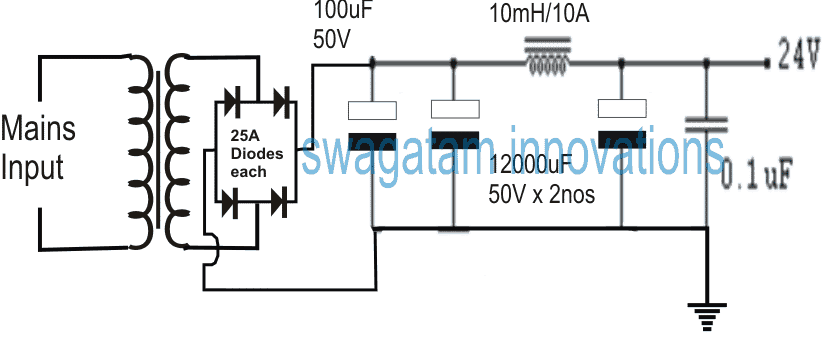
Power Supply
The power supply used for this single MOSFET class A power amplifier circuit is 18VAC and 160VA EI transformer attached to a bridge rectifier of 25 amp to generate DC power of 24 Volts.
To filter and smooth the power we used 10000µF capacitors and Hammond make 10mH choke of 5 amp over pi filter setting [Cap - Choke - Cap]. The bias was via a pot of 100K along with resistor of 1M.
Care should be taken to adjust the pot only for so long as half of the DC gets over the load resistors and MOSFET.
2) Easiest Class A Amplifier
The IRF511 (Q1) is wired like a most simple class-A audio-amplifier circuit, as shown in the figure below. Having zero gate bias employed, Q1 acts similar to a switch which is in the switched off state. In this condition no current moves from the load resistor, R2. Essentially, the voltage across Q1 and the load resistor have to be the same for the working of class-A amplifiers.
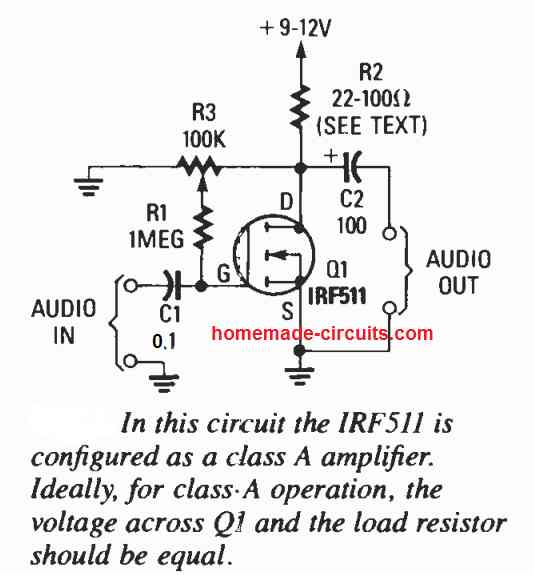
A 100K potentiometer (R3) along with a 1M fixed (R1) constitute a straightforward adjustable gate-bias circuit. If we put a a voltmeter across the Q1 drain and the ground of the circuit, and we fine-tune R3 to get a meter reading of half the power supply voltage.
Practically any resistor could be utilized in place of R2 provided that the maximum current and power ratings of the FET aren't surpassed. A resistor value of between 22 and 100 ohms can be a decent selection for testing. If high current supply is used, make sure to use an appropriate heat sink for the FET.
3) Class A Amplifier using BJTs
In the above paragraphs I have explained how to build a class A amplifier using MOSFET, now let me explain how a simple class A amplifier circuit could be built using only bipolar transistors or BJTs.
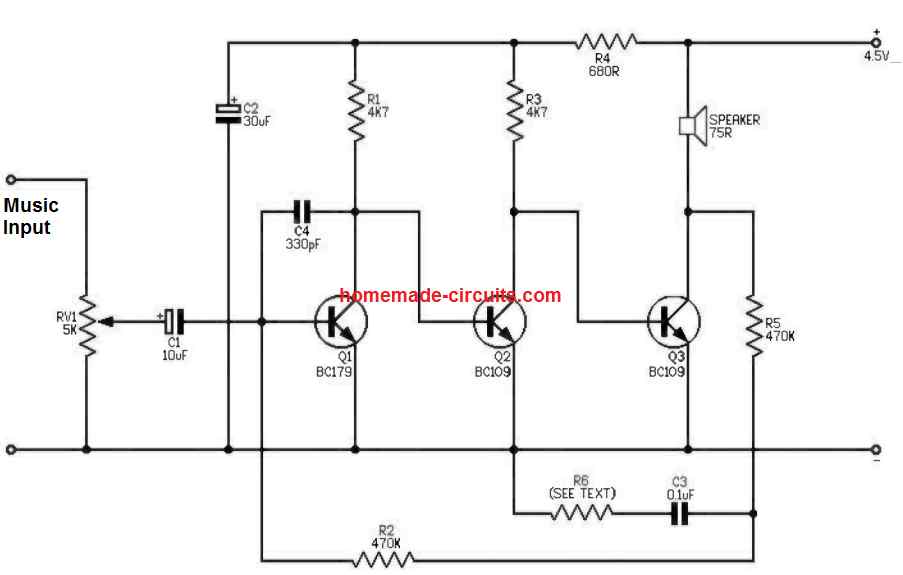
When power output, harmonic, distortion, frequency response are not considered critical for an amplifier, for example in small radios receivers, applying a class 'A' amplifier becomes a favorable choice. The circuit shown below makes use of just 3 transistors, is able to amplify with an output transformer, and provides an output power between 100 -200mW. It operates using a battery supply as low as 4.5V.
RV1 works like a volume control and hooks up with the amplifier stage by means of C1. The below discussed three stages are directly connected. The base bias of Q1 is implemented by resistors R2 and R5. Resistor R1 and transistor Q1 behave like a bias potential divider for Q2 base and likewise resistor R3 and transistor Q2 perform the bias base for the transistor Q3.
Resistor R2 and resistor R5 additionally work like a section of an overall negative feedback loop enhancing the frequency response of this BJT class A amplifier circuit, and also minimizing its distortion. A bargain between gain and quality is determined through appropriate selection of R6 and C3 values.
C3 is configured like a decoupling capacitor and R6 value can be found through some experimentation. (The lowest possible value of R6 should not be below 22k).
4) Class A Power Amplifier Circuit
The key benefit of a class A amplifiers is that is works without any crossover distortion. Alongside this significant advantage we find a big disadvantage of forever hot heatsinks and large wattage power supplies.
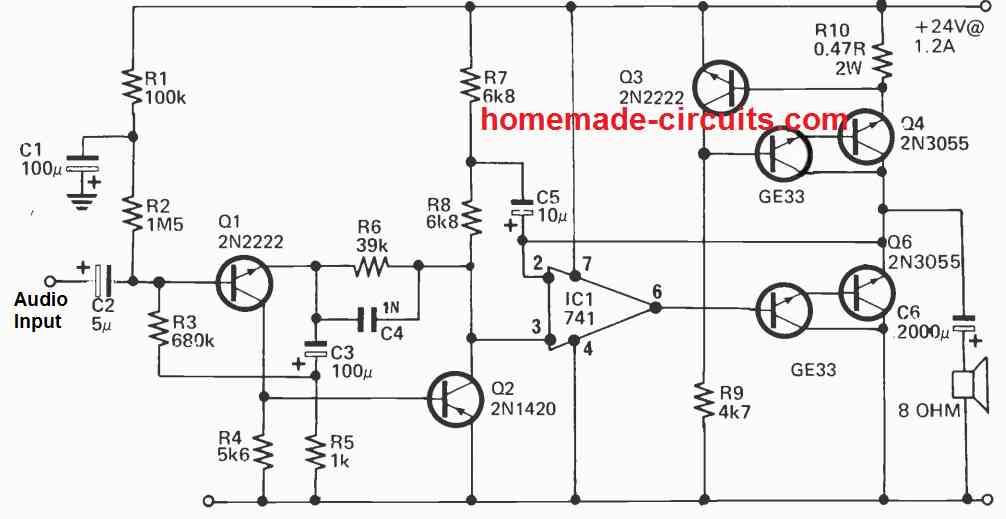
The circuit displayed above consists of a number of good features and is capable of providing a 5W of genuine class A audio into an 8 Ohm load. Q1 and Q2, in conjunction with the connected parts, work like a top-notch voltage amplifier with all round ac and dc feedback fed from the Q2 collector by means of R6 to the Q1 emitter.
The output stage genuinely includes Q6 and Q7 configured like an emitter follower Darlington pair. These transistors are driven by IC1, which is a 741 op amp. These BJTs can be also seen incorporated in the 741's feedback loop. These three elements together constitute a almost ideal output stage having an input impedance of many megohms along with a bandwidth ranging from a DC to higher than 100KHz.
Quiescent current is provided by The constant current source formed by the transistors Q3, Q4, Q5, R9 and R10 determine the quiscent current of the circuit. The utilization of a constant current source in this class A amplifier design appropriately isolates the output stage from supply line fluctuations and ripple.
Using the indicated part values, the circuit gets a a bandwidth between 10Hz - 30KHz -3db, with a distortion much lower than 0.1% just before clipping. The circuit also offers an input impedance of 1.5M and a sensitivity of 180mV for the complete output power.
Transistors Q4 to Q7 should be attached to an appropriate heatsink, which may have a dimension of 5" by 4" and should be finned type. These heatsinks should be installed vertically and positioned in such a way that it gets exposed to adequate air flow.
5) Another Good Class Amplifier Circuit
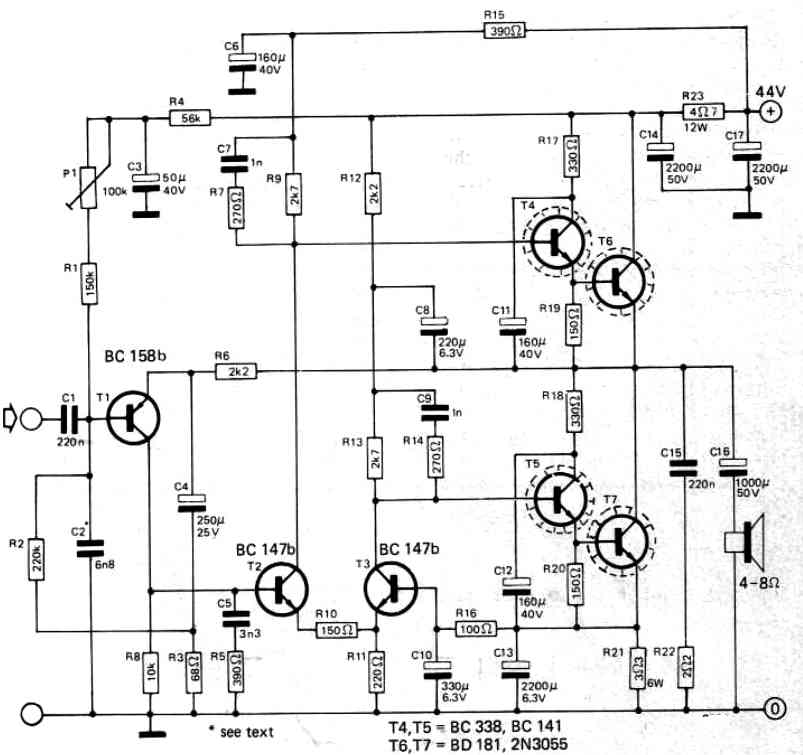
The problem with class A amplifier circuits is their reduced efficiency in comparison to class B stages. With this particular layout, and applying a 44 V power supply the quiescent current is going to be around 960 mA.
An output power of around 15 W is going to be supplied directly into an 8 Ohm loudspeaker. Harmonic distortion can be expected to be lower than 0.1%.
The input sensitivity of ths design can be around 360 mV for with respect to power output, this can be around 15 W into 8 Ohm speaker. The input impedance will be roughly 150 k.
For preamplifiers having a 1 k source impedance, capacitor C2 is going to be 6n8, for 2 k source impedance it will probably be 3n3. This class A amplifier provides a great feature of being short circuit proof; if you find a short it is going to consume roughly 1.6 A.
The potentiometer P10 is employed for implementing the offset control to the the no-signal output voltage at the intersection of the parts R18/R19 (around 21 V).
Every single output transistor (T6 and T7) must be mounted over a large heat sink, the thermal resistance must not be lower than 3.3°C/W; driver transistors T4 and T5 will necessitate a clip type heatsink.
6) 5 Watt Class A Amplifier Circuit
This class A amplifier circuit produces 5 watts rms into an 8 ohm load, however it needs a supply of 22 to 24 volts at 1 amp. This results in a maximum efficiency of around 19%, which is lower than 1/3 of the efficiency of typical Class B configurations.
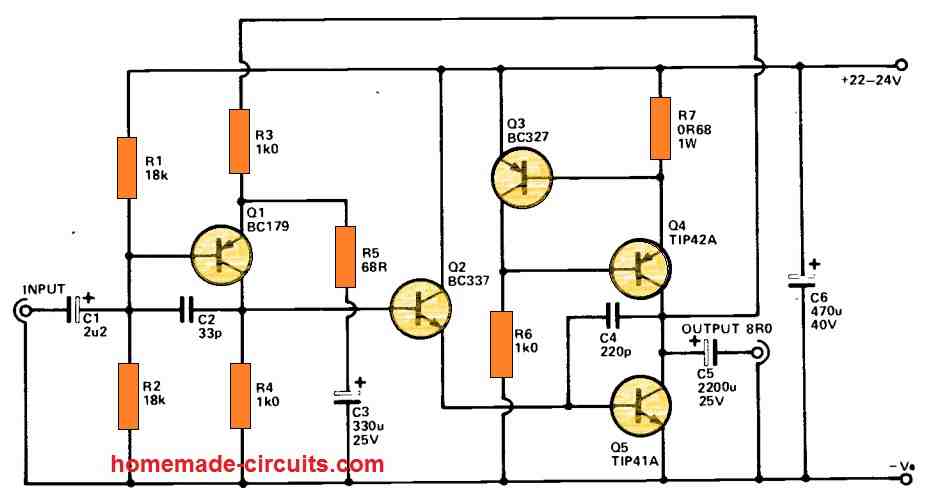
Q1 is utilized in the common emitter input stage and is linked directly to the output stage through the emitter follower buffer transistor, Q2. The latter is essential due to the output stage's rather large driving current. The output transistor, Q5, is used in common emitter mode. Its collector load is produced by Q3, Q4, and R7, and it is a constant current source. The latter fixes the circuit's output current to slightly below 1 amp.
The constant current generator load has a higher efficiency and linearity compared to an ordinary load resistor. At DC, R3 provides nearly 100 percent negative feedback to the amplifier, resulting in unity voltage gain. R1 and R2 bias the input to 1⁄2 the supply voltage, which likewise biases the output to the desired level of 1⁄2 the supply voltage.
At audio frequencies, R5 and C3 eliminates some of the feedback, allowing the circuit a maximum output sensitivity of around 380 mV rms. C1 and C5 enable DC blocking at the input and output, correspondingly, while C2 and C4 help with stability. Q4 and Q5 need to be placed atop a large heatsink.
Smallest Two Transistor Design
This simple two transistor class A amplifier circuit works by using Tr1 as a common emitter driver stage configured to directly operate Tr2; the common source output stage. R1 to R3 are positioned to bias the circuit to ensure that we have a quiescent current of approximately 25mA by means of LS1 and Tr2. The input signal modifies this current both side of the quiescent value, allowing the required operation of the loudspeaker LSI.
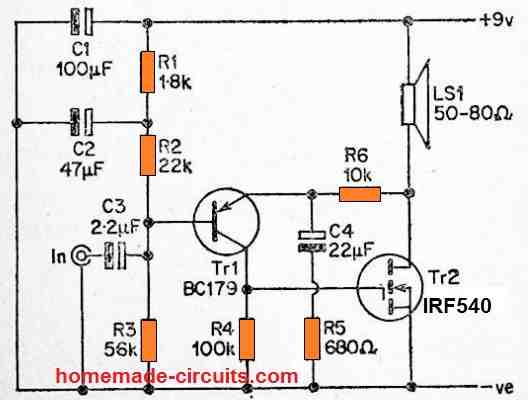
The output current swings through 0 to around 50mA at the peak output, and the typical current consumption as a result stays consistent at 25mA, and does not increase at higher output levels such as the case of a class B amplifier. The output power from this circuit is barely around 23mW RMS, nevertheless it is sufficient for several applications (tiny radios, intercoms, etc.).
The circuit provides fairly decent audio quality; the major constraint on the audio quality being the distortion levels, and restricted frequency response from the tiny high impedance loudspeaker employed. An input signal of merely around 80mV RMS is necessary to be able to generate a optimum output, however this value could be modified, to some extent, by adjusting the value of R5.
Alterations in the value of R5 leads to an inversely proportional variation in the input sensitivity of the circuit. A low impedance loudspeaker is not recommended in this circuit, since that might cause a high current to move via Tr2 and the loudspeaker, most likely leading to the break down of one of these or both.
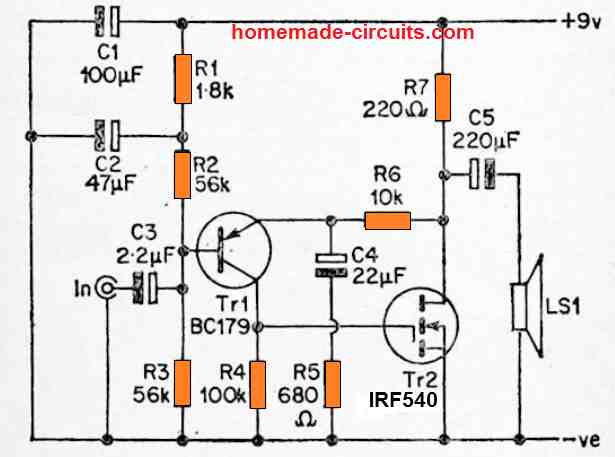
Improving the above Design
The above circuit has a minor flaw due to the presence of a lingering current in the loudspeaker, causing the cone to never move back and forth around its usual resting position, but to constantly be offset one way or the other. The loudspeaker's performance may suffer as a result of this.
the following improved design eliminates the above issue.


Comments
hi
i have assembled the last circuit(class-A with BC179 and IRF540). I used bd136/pnp instead of bc179. apart from that all other components are same. but i getting distortion when I raise the volume.following voltage readings are got when I measured
supply volt-8.42v
base of bd136-4.04v
collector-2.32v and emitter-4.6v
IRF540-gate-2.32v and drain-4.85v
will you give some idea to solve these problem.. thanks in advance
Hi, can you please replace the BD136 with BC557 and check again…also please make sure the pinouts are connected correctly for all the transistors. Let me know how it goes…
hi
as suggested, i replaced bd136 with bc557. but no significant effect noticed. also checked pin legs.it was correct. later I decreased the value of 10K resistor to 5k6 and also increased 1k8 to 8k2. now some what good..measured reading are..base 3.78volt, collector 4.32volt, emitter 2.3volt and drain 4.4volt…(only small variation from previous readings but sound quite clear than earlier)…and one more thing i changed input electrolytic capacitor to disc cap….any way it was good project..thanks and expect more circuits..
Prefect! You did everything correctly. The distortion happened because the MOSFET gate was biased too low earlier. IRF540 needs around 4 to 5 volts on the gate to work in its linear region. After you changed 10K to 5K6 and 1K8 to 8K2, then DC operating point shifted and the MOSFET gate reached around 4.3V which is perfect for a Class-A midpoint. That is why the distortion disappeared. BC557 works fine as a replacement for BC179 but it does not give the same bias point so the resistors must be adjusted. Your final readings show that the bias is now exactly right, which is why the sound became clearer. Good work!
thank you.
In the circuit with the operational amplifier, are the final power transitory PNP or NPN as one needs to revise this with respect to the supply.
Hello sir!
I have a project where I need to make an audio amplifier using BJT. However I have to use 12V power so regarding the class A BJT design how do I modify it?
Hello Andrei,
You can find a couple of BJT amplifier projects in the following article, which can be operated with 12V DC:
https://www.homemade-circuits.com/simple-hobby-circuits/
Thank you for the answer, I just checked but I can’t seem to find one with pure bjt transistors used. Unfortunately we are limited to BJT only, no ICs and so on. If there is none, It’s fine thank you for the help!
Here are the two amplifier concepts which can be found in the previously suggested article, and can be used with 12V:
https://www.homemade-circuits.com/wp-content/uploads/2022/05/100-watt-amplifier.jpg
https://www.homemade-circuits.com/wp-content/uploads/2020/04/10-watt-amplifier.jpg
hi dear Swagatam,
please desighn a class A…. jlh1969 or Jean hiraga ….with easly available transistors.incude pcb layout too..
Thank you.
Hi Dr.Sison,
Sorry, I have no idea about jlh1969 or Jean hiraga specifications, if you can provide the technical specifications, then perhaps I can try figuring it out…
Buenos dias, quisiera saber si el circuito que usa el transistor TRF540 se puede alimentar con 12V y que otro se puede usar por el TRF540 y por el BC179…..
Hi, 12V can be used for that design
Hi, Swagatam!
About “Smallest Two Transistor Design”.
Could you tell me how to adjust the volume of sound in this circuit?
Hi Jorge, you can do it by connecting a 1K pot at the input of the circuit. One outer pin of the pot go to the signal input, the other outer pin will go to the ground line, and the center pin will go to the C3 capacitor.
Please what are the characteristics of the mosfet used here
Please check the datasheet of the IC, you will find all the characteristics of the device in its datasheet.
Hello Mr Swagatam !
Why do we need 160W transformer for 20W power consuption?
Why does Negative Feedback through 33uF improves the sound?
I am not electronics engineer.
Thank you!
Mr Genadij, sorry,The above circuit was contributed by another so I have not yet read it, so unable to provide you the required information
se pueden poner 2 mosfet en paralelo?
yes you can put two MOSFETs in parallel
Hi sir. How much is the output power of this ckt?
It is around 5 watts, but consumption will be 20 watts
Hello Sir
I have a Hybrid audio amplifier B2200 which got burnt one channel,the cause of the problem I don’t know but I found the mains fuse bridged probably by the user.I tested the components on the pcb and found several transistors ,fuses and resistors burnt. I replaced all I thought were bad and powered the amp. There is sound coming out but it’s low power and very distorted .I did tested the output for dc offset- negative probe to the negative terminal and positive to positive I got -0.151vdc. Now am stuck don’t know where to start.
I know it’s very difficult for you to troubleshoot without schematic but I just thought you may have raw idea where the problem might be lying so I can just concentrate on that area.
Please you may find some photos of it here
https://ibb.co/album/cEqsaa
Hi Francis, sorry, it will be impossible to find the fault since the design looks too sophisticated and have many complex stages…so troubleshooting might require a thorough practical investigation
i need your help,
i want to make circuit to drive bike horn 12v 3A. (musical like mocc horn).
a portable mp3 player with 3 watt output is used for input .
any transistor mosfet circuit can be use ful please
use a 12V 7AH battery, and switch the horn though a 3 amp ON/OFf switch
I need a power amplifier circuit which works upto 500KHz square wave. Will you suggest any circuit for that.
Please Google search the following:
"BTL power amplifier circuit"
you will be able to find many good options
hi sir.I'm trying this project.I did not understand the input method.please help me.
Hi Ajith,
the input will be your music input which needs to be amplified, for example from a mobile phone's headphone socket, DVD player's earphone socket or from an ipod etc….
can i modify this circuit to use j162 mosfet? schematic will be a great help..
it may be possible by reversing the polarities of all the relevant parameters…but I don't recommend using a p-channel fet for the config
I have much more piece frome. This taip transistors
Can I have more power?
hi SWAGATAM i have my subwoofer with two speaker but the inner base went off how can troubleshoot that and make my inner base play again
sorry, I don't know much about speaker construction details, so can't help with this…