• Skip to main content
  • Skip to primary sidebar

Homemade Circuit Projects

Need circuit help? Post them in the comments! I've answered over 50,000!

Blog | Categories | About | Hire Me | Contact | Calculators-online
You are here: Home / Battery Charger Circuits / How to Select the Right Charger for Li-Ion Battery

How to Select the Right Charger for Li-Ion Battery

Last Updated on May 17, 2026 by Swagatam 3 Comments

Table of Contents
  • Li-Ion Charger Related Question
    • Specifications of the Li-ion Battery charger
      • Solving the Circuit Problem

In this discussion we try to learn the right procedure for selecting a charger for a Li-ion battery. The question was raised by Mr. Akshay.

Li-Ion Charger Related Question

I have a 5000mAh Li-ion battery. Can i select a charger for my Li-ion battery having the following specifications, the product is available on ebay? I will be thankful if you can help me with a better option or alternate options over this. Thanks & Regards,Akshay G. Anarse
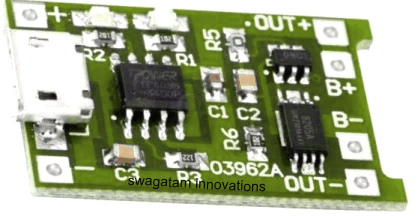
 

5000mAh Li-ion battery

Specifications of the Li-ion Battery charger

Lithium Ion Battery/Cell Charging Module with CC-CV operating mode, high performance output.

Just because you can Charge your Li-ion battery optimally, a Li-Ion charger would need 5V mini from a PC USB source, in order to ensure a direct charging of the battery from the PC.

RED led illumination indicates charging mode, while the BLUE Led glows as soon as the battery is Full.

Module Specifications: non-isolated module with Li-ion/Li-Po protection chip.

  1. Size: 25x19mm
  2. Color: As shown in the ebay picture
  3. Maximum current charging Temperature: 30 c
  4. Input voltage: 5V via Micro usb or from any external 4.5V -5.5V DC power supply.
  5. Output voltage for charging the battery to full level : 4.2V
  6. Output current: 1A, and self-adjusting as per the battery mAH specs
  7. Charging Method: CCCV (Constant Current-Constant Voltage)
  8. Protection Chip included: S 8205A
  9. Operating Temperature for this module is as per the Industrial grade (-10 to +85 )

Solving the Circuit Problem

Hi Akshay,

Your Li-ion Battery is rated at 5000mAH, so charging it at a 1 amp rate could cause a slow charging of the battery, and could take many hours, therefore selecting the charger for your Li-ion battery is OK, but will have this drawback.

In order to charge your battery at a faster rate, a preferable rate would be 3 amp, higher charging rates up to 5 amps could be tried but that would cause some heating of the battery and therefore might demand a temperature controlled circuit.

A fan cooling could be used for keeping the heat of the battery under control so that the battery is able to charge quickly at a 1C rate.

Here "C" refers to the AH rating of the battery, therefore 1C signifies charging of the Li-ion at its full 5 amp rate.

Instead of going through the hassles of selecting a charger for a Li-ion battery from the market the unit could be built and used at home by following the instructions as explained in this Li-ion battery charger circuit with auto cut off
You'll also like:

  • Inductive charging 1Wireless Li-Ion Battery Charger Circuit
  • cellphonechargerfromlaotpbatt 1Charging a Cellphone battery with a Laptop Battery
  • battery1battery2changeovercircuitDual Battery Charger Circuit with Isolator
  • li ionfaultindicatorBattery Charging Fault Indicator Circuit

Filed Under: Battery Charger Circuits Tagged With: Battery, Charger, Right, Select

About Swagatam

I am an electronics engineer and doing practical hands-on work from more than 15 years now. Building real circuits, testing them and also making PCB layouts by myself. I really love doing all these things like inventing something new, designing electronics and also helping other people like hobby guys who want to make their own cool circuits at home.

And that is the main reason why I started this website homemade-circuits.com, to share different types of circuit ideas..

If you are having any kind of doubt or question related to circuits then just write down your question in the comment box below, I am like always checking, so I guarantee I will reply you for sure!

Previous Post: « Automatic Voltage Regulator (AVR) Circuit
Next Post: Power Factor Correction (PFC) Circuit – Tutorial »

Reader Interactions

Questions & Answers

Total Posts: 3
Newest Oldest
Sherwin Baptista
February 15, 2017 • 10 years ago #48974

Dear,
I've had a small palm sized i-pod given by a friend which was not charged, so when i kept it to charge after some time the i-pod started getting warm. After unplugging the i-pod it didn't accept any charge.
When upon opening I've figured out a small li-ion battery which is just 100mAH.
My queries-
What does it indicate if the battery is getting warm during charging?
What happens to the internal resistance of the battery?
Does li-ion battery have any liquid inside that dries up over time?

Fortunately, the i-pod circuit is working fine when connected to another good cell.

Reply
SwagatamAdmin
February 16, 2017 • 10 years ago #48993

not sure whether the chemical can dry up overtime or not

Reply
SwagatamAdmin
February 16, 2017 • 10 years ago #48992

Hi,
slight warming while charging is not bad and is normal especially with Li-ion cells, but heating above around 45 degrees must be avoided
internal resistance will increase on heating and will cause an increased inefficiency.
Internally it has the chemical LiCoO2 in electrolyte form sandwiched between its +/- electrode plates

Reply

Need Help? Please Leave a Comment! We value your input—Kindly keep it relevant to the above topic! Cancel reply

Your email address will not be published. Required fields are marked *

Primary Sidebar

My YouTube Channel

Circuit Simulator: Draw and Simulate Schematics

circuit simulator image

Categories

  • Arduino Projects (95)
  • Audio and Amplifier Projects (134)
  • Automation Projects (18)
  • Automobile Electronics (104)
  • Battery Charger Circuits (90)
  • Datasheets and Components (109)
  • Electronics Theory (151)
  • Energy from Magnets and Earth (43)
  • Games and Sports Projects (11)
  • Grid and 3-Phase (20)
  • Health related Projects (27)
  • Home Electrical Circuits (13)
  • Indicator Circuits (16)
  • Inverter Circuits (98)
  • Lamps and Lights (161)
  • Meters and Testers (72)
  • Mini Projects (28)
  • Motor Controller (68)
  • Oscillator Circuits (30)
  • Pets and Pests (15)
  • Power Supply Circuits (91)
  • Remote Control Circuits (50)
  • Security and Alarm (65)
  • Sensors and Detectors (107)
  • SMPS and Converters (46)
  • Solar Controller Circuits (62)
  • Temperature Controllers (44)
  • Timer and Delay Relay (51)
  • Voltage Control and Protection (44)
  • Water Controller (37)
  • Wireless Circuits (31)

Subscribe to get New Circuits in your Email

Other Links

  • Privacy Policy
  • Cookie Policy
  • Disclaimer
  • Copyright
  • Videos
  • Sitemap

People also Search

555 Circuits | 741 Circuits | LM324 Circuits | LM338 Circuits | 4017 Circuits | Ultrasonic Projects | SMPS Projects | Christmas Projects | MOSFETs | Radio Circuits | Laser Circuits | PIR Projects |

Recent Comments

  • Nicodemus Onate on How to Design Your Own Inverter Transformer
  • Swagatam on Making a Self-Powered Generator
  • Swagatam on Electronic Circuit Projects, Tutorials, and Practical Engineering Solutions
  • Ranjith Gurusinghe on Making a Self-Powered Generator
  • Mazlom on Electronic Circuit Projects, Tutorials, and Practical Engineering Solutions

Social Profiles

  • Twitter
  • YouTube
  • Instagram
  • Pinterest
  • My Facebook-Page
  • Stack Exchange
  • Linkedin

Calculators

  • ZVS Induction Heater + Tank Calculator Tool
  • Zener Diode Calculator
  • Wire Current and Thickness Calculator (Ampacity Calculator)
  • Voltage Divider Calculator
  • Transistor Base Resistor Calculator
  • Transistor Astable Multivibrator Calculator
  • TL431 Calculator
  • Solar Panel, Inverter, Battery Calculator
  • Ferrite Core Air Gap Calculator Tool
  • Parallel MOSFET Calculator Tool: How to Connect MOSFETs in Parallel Safely
  • LC Resonance Calculator for EV Battery Charger Circuits
  • LED String Series Resistor Calculator
  • PFC (Power Factor Correction) Calculator Tool: 3kW
  • Passive Power Factor Correction (PFC) Calculator
  • LM567 IC Calculator Tool
  • SMPS Flyback Boost Converter Calculator
  • Shunt Resistor Calculator for Ammeters
  • SCR and Triac Gate Resistor Calculator
  • Battery Back up Time Calculator
  • Boost Converter Calculator (Non-Isolated)
  • Bootstrap Capacitor Calculator
  • Buck Converter Calculator
  • Buck-Boost Converter Calculator
  • Capacitance Reactance Calculator
  • DCM Flyback Transformer & Wire Gauge Wire Size Calculator Tool
  • Filter Capacitor Calculator
  • IC 4047 Calculator (Frequency and PWM)
  • IC 4060 Calculator
  • IC 555 Astable Calculator
  • IC 555 Monostable Calculator
  • IC SG3525, SG3524 Calculator
  • Inductance Calculator
  • Induction Heater Inductor and Resonant Frequency Calculator
  • Induction Heater Work Coil Calculator
  • Inverter LC Filter Calculator
  • LC Resonance Calculator
  • LED Current Calculator
  • LM317, LM338, LM396 Calculator
  • NAND/NOT Gate RC Values Calculator
  • NOT, NAND Gate Frequency Calculator
  • Notch Filter Calculator Tool
  • Ohm’s Law Calculator
  • Phase Angle Phase Shift Calculator
  • Power Factor (PF) Calculator
  • RC Filter Calculator
  • Reactance Calculator
  • Sine Table Calculator for SPWM Arduino Code
  • Small Signal Transistor(BJT) and Diode Quick Datasheet
  • SMPS Calculator for Toroidal Ferrite Transformers
  • SMPS Flyback Transformer Calculator – Design by Target Duty Cycle
  • TL431 Calculator
  • Op-Amp Hysteresis Resistor Calculator

© 2026 · Swagatam Innovations