I am presenting a circuit design here in response to a request sent by one of the avid readers of this blog. The proposed circuit is of a sequential LED light driver, especially designed to suit the application of a multipurpose car tail light indicator.
Circuit Connections
The circuit is integrated to the brake switch and works as a brake light, it’s also connected to the turn signal switches for indicating the turning of the vehicle with chasing light patterns, and the circuit can also be used just as an ordinary tail light warning indicator.
In order to successfully make the proposed car LED chasing tail light, brake light circuit, it will be important to first understand the circuit functioning in details with the following points:
How it Works
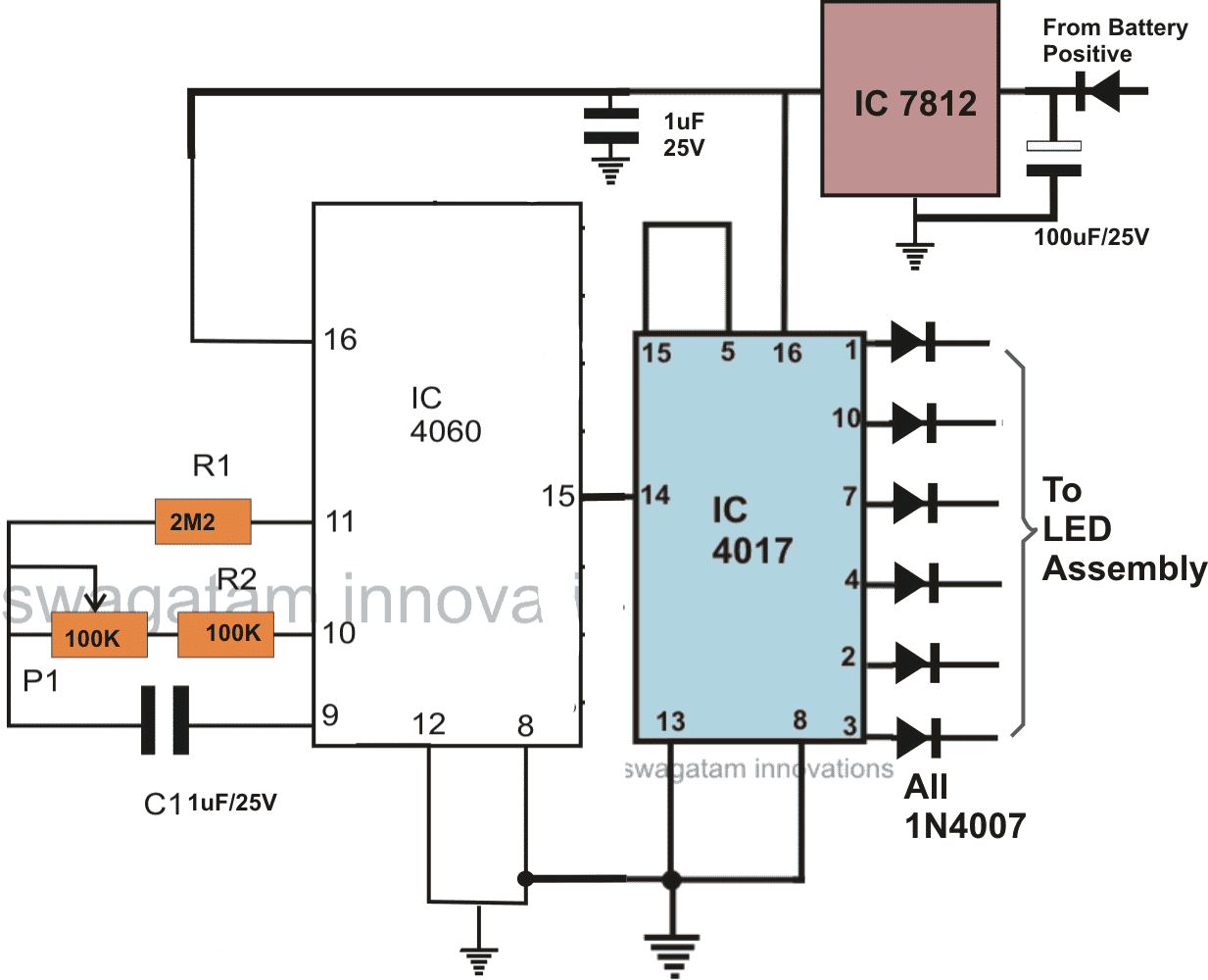
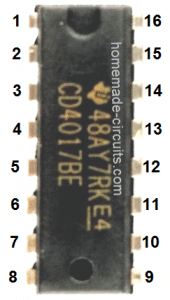
The CIRCUIT DIAGRAM can be divided into two sections, the first consists of the LED driver stage, where the IC 4017 forms the main LED sequencer and is configured in its usual counter/divider mode.
Only six channels of the IC 4017 have been used to avoid lengthy sequencing patterns and crowding of the LEDs.
Two arrays of LED are taken from the above outputs such that they “run” in opposite directions when switched ON, however both the channels are never run together since they are used for the LEFT, RIGHT turn indicator purpose and therefore only the relevant side is switched ON depending upon the vehicles turning side.
The IC 4060 is configured in its standard mode, as an oscillator and is used for driving the IC 4017 with its clock signals.
With every rising peak of the clocks, the outputs of the IC 4017 shift from one pin out to the next in the shown order, making the connected LED illuminate sequentially.
The pot associated with the IC 4060 may be used for adjusting the sequencing speed as desired.
Left Right LED Sequence Layout
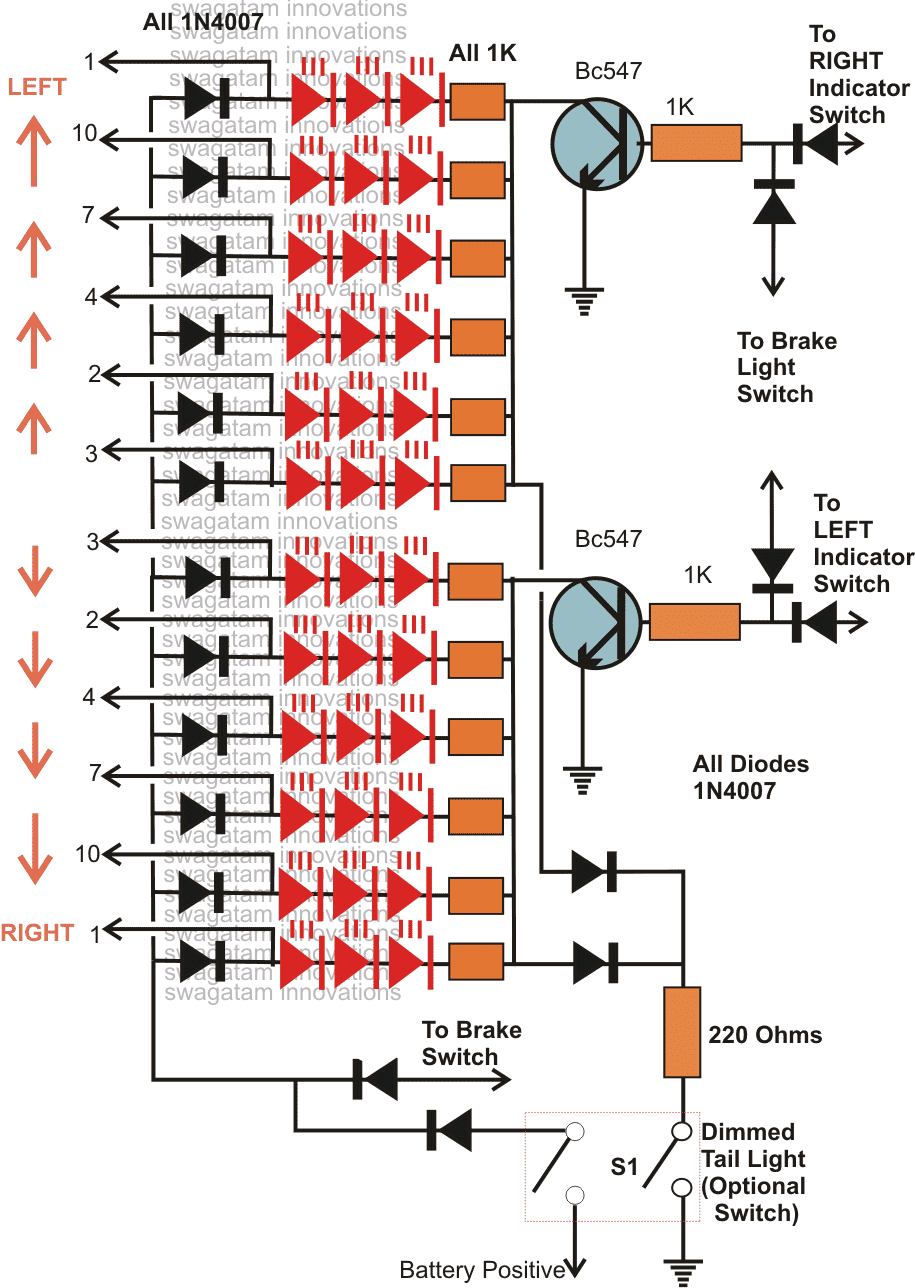
The LED stage consists of the LEDs arranged in a definite sequencing pattern as discussed in above explanation.
The LEDs are connected to the IC 4017 outputs so that they are able to perform the intended sequencing or chasing function.
The LEDs are also discretely wired up to the different vehicle controls like the brake switch, the turn signal switches and an optional DIM tail light switch.
When the brake switch is applied, the LEDs light up all together brightly, indicating the application of the brakes.
When one of the turn signal switches is switched ON, say for example the LEFT turn signal is applied, the LED array positioned on the LEFT portion starts sequencing from center, toward LEFT, indicating the intended moving direction of the vehicle.
The above function is repeated toward the RIGHT side by the right portion LED array when the right signaling is made with the relevant switch.
A couple of optional switches (S1) may also be included and wired up with the LEDs as shown in the diagram.
This provides a feature of operating the LEDs as a dim tail light indicator which stays switched all the time with a relatively lower brightness, however when the brakes are applied the LEDs light up brightly.
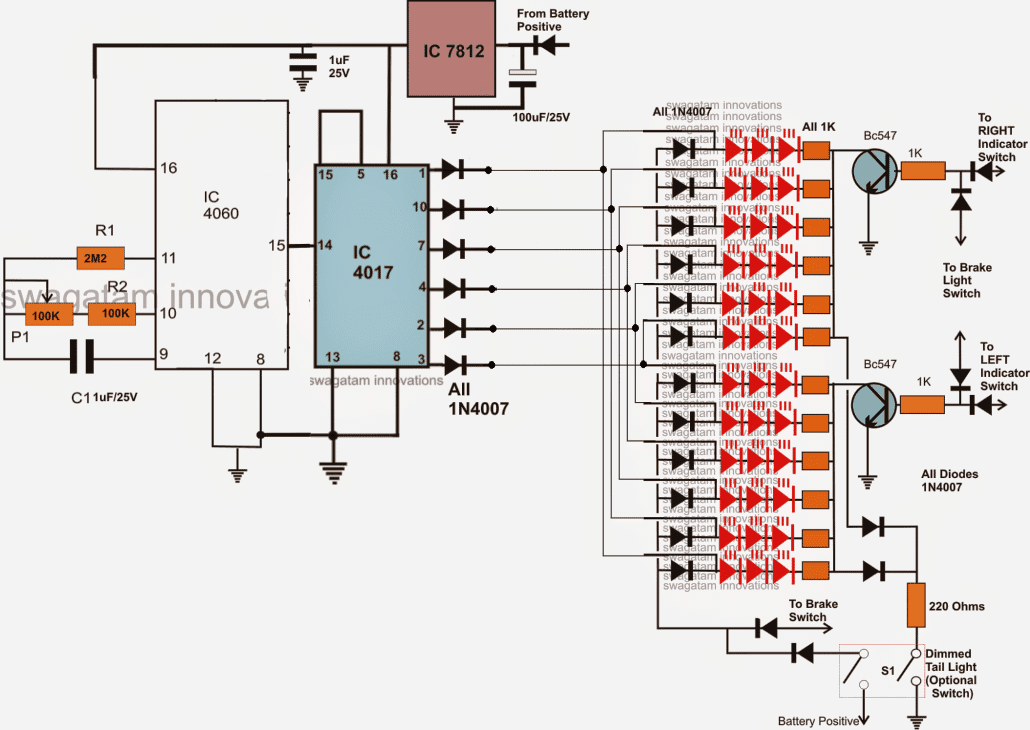
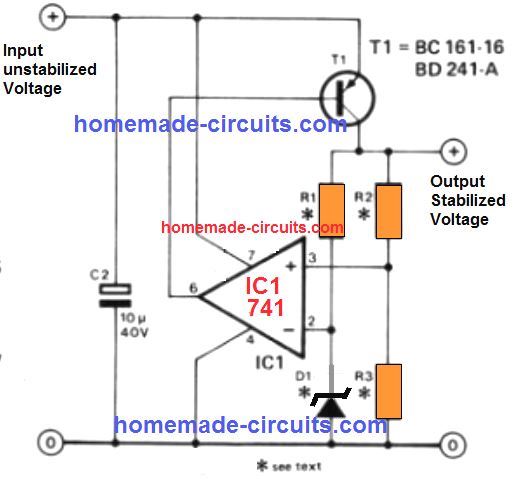
The driver circuit is powered through the IC 7812 which is a voltage regulator and provides safe operating stabilized voltage to the circuit, irrespective of the input fluctuations.
In the above position, the turn signals will also work, but is not recommended as the DIM light at the background may affect the signaling.
The following image shows the complete combined circuit design of the above discussed two stages:
Complete Schematic Diagram
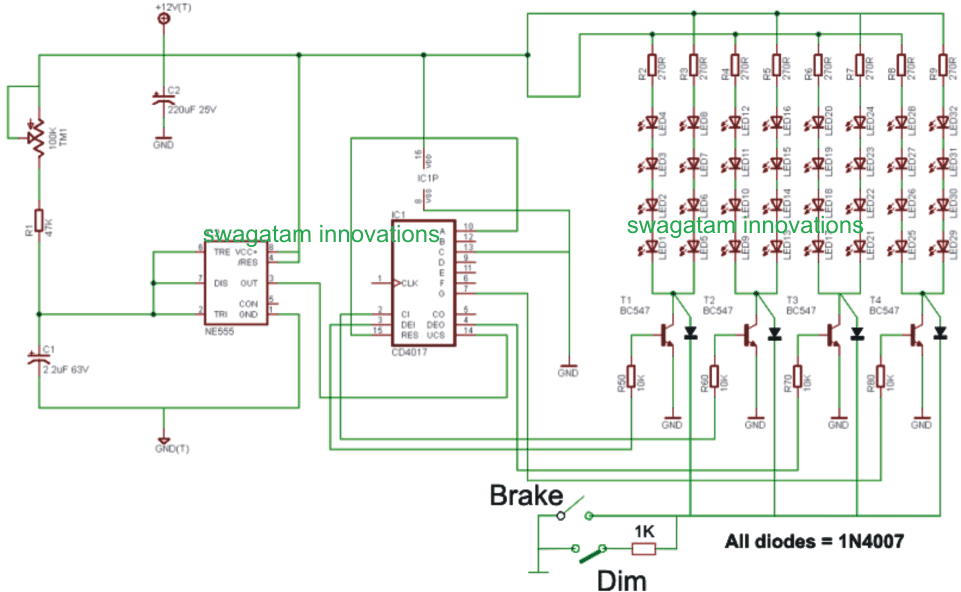
A simplified and scaled down version of the above explained car chasing light circuit with brake light and park light can be witnessed below:
The post illustrates an elaborate circuit design that can be used as an enhanced "chasing" LED tail light for cars and other vehicles, the design also includes the modification details for the associated turn signal and the park light systems. The idea was designed and presented by Mr. Jason.
The entire discussion may be referred to in the comment section of this post:
Sequential Turn Signal Indicator
Modified car chasing light circuit
The circuit description below explains the proposed modified car chasing light circuit, as presented by Mr. Jason:
Okay, I had a chance to work on it, but have not tested it on the breadboard yet. If this works, one 4017 and 555 timer chip can be used for both left and right turn signal.
The schematic
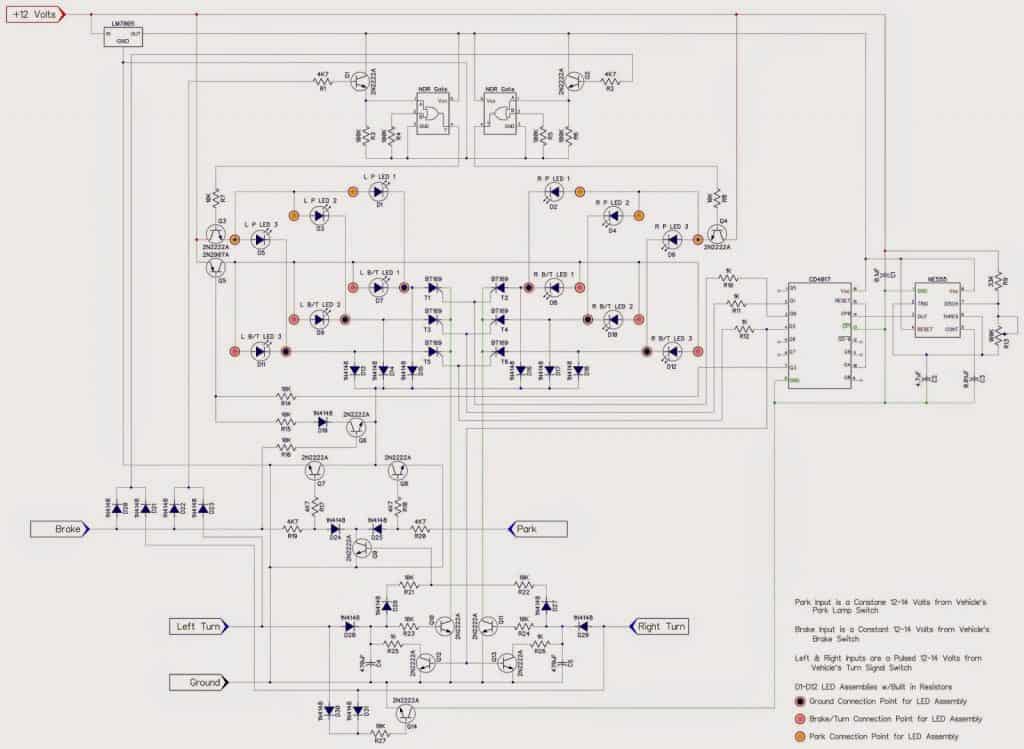
How the Circuit Functions
I hope you can understand what it is doing. The LED's I will be using have 3 wires out. One is ground, one is Brake/Turn, and one is Park. When just 12 volts is hooked up to the assemblies,
It seems that there are different resistors to control the brightness (a fixed amount) for the brake/turn, and for the Park. Which is a nice factory option from the LED assemblies themselves.
If I just use one wire (the brake/turn), and a potentiometer to adjust the brightness for the Park, I am thinking I would need a 19W potentiometer, and those are expensive.
Each LED assembly draws 246mA at 12.8 volts. If all 6 lights were on, that's 246mA * 12.8 volts = 18.89W of power. So, wiring them separately and using a common ground to switch them on and off, would eliminate the need for a potentiometer, since the resistors are built into the lights themselves.
I am using a NOR gate to turn off the Park LED's when the brake or turn signals are applied.
I am not sure on the resistor values. I've changed the Vcc for the 4017 and 555 to run off of the LM7805 voltage regulator.
By doing that, I have also run the other inputs/outputs of those chips off of the LM7805 as well? I am not sure of the Capacitor and Resistor values needed then.
I'd like to switch all power to 5volts for less power consumption. Except for the LED supply voltage of course. that needs to stay the 12-14 volts coming straight from the wiring of the Truck.
I took your suggestion and added the transistor and the resistor to rapid discharge the 470uF capacitors so the LED's do not continue to sequence for 15 seconds AFTER the turn signals have been turned off.
As per your request, I have connected them to the last sequencing output of the 4017. It makes sense, and as you said, should work for turning off the LED's from sequencing.
If I can get this to work, I plan on building a circuit to allow up to the 8 sequencing LED's (available outputs for the 4017 since two are used to reset the 4017 and the SCR's).
I will do it using either dip switches or more simply, solder bridges.
I will also make it so that solder bridges will be before and after a resistor of each LED, if a resistor is needed for standard LED's to be wired up.
I need to do this for my car, and my new lights will have 5 rows of LED's I will need to sequence instead of the 3 that my nephews truck has.
So I'll need to design the circuit to work for both. Fun Stuff!
Using High Watt LEDs
Now let's discusses how to construct a chasing car tail light circuit using high watt amber LEDs. The idea was requested by Mr. Brian Walton.
Technical Specifications
I've been giving the project some further thought. I am wondering what changes might be needed to use single, higher power leds instead of the advised 5mm ganged in threes? So there would be 6 LED's rather than 6*3 5mm
The reason is that I have combined LED DRL & indicators on the front of my car, so I would like to retain the OEM look & feel at the rear - where I propose to use your excellent circuit design.
I'm thinking along the lines of the LEDS in the link below.
They are Osram Opto Diamond DRAGON Series GW Amber LED. They are designed for automotive use in DRL's and indicators.
They are 2.9v forward voltage and appear to take about 1.4A at typical lumens.
The LEDs above are not definitive but a suggestion in terms of output and style for my construction needs.
So my question is can the circuit take or how do I need to modify the circuit to take the extra power these LED's may take.
For info; from a practicalities point of view, I intend to have a separate driver circuit for each side of the vehicle - it makes installation simpler given i'm going to attach the pulse form the existing indicator
relay as discussed previously with you.
I hope you can advise me (again!) and many thanks for your devotion to the electronics hobbyist on the web.
Best wishes
Brian
Solving the Circuit Query
Thanks Brian!
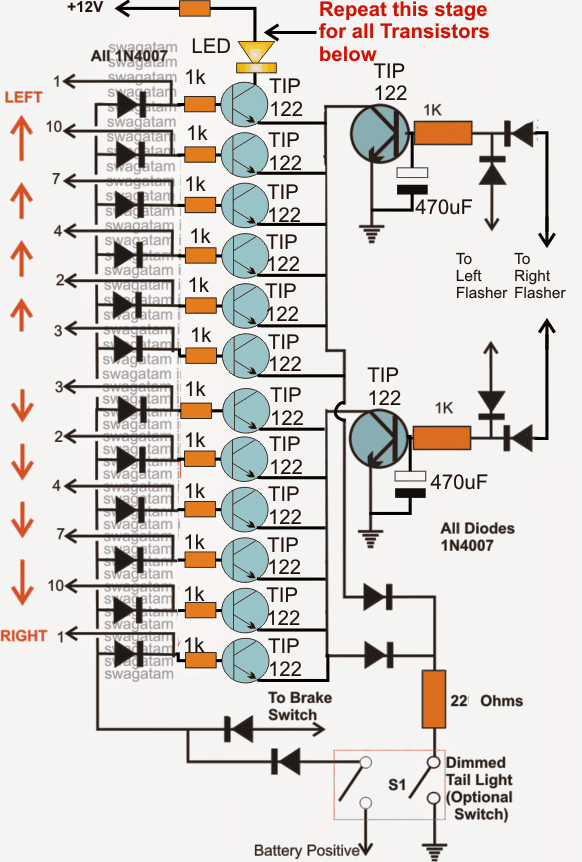
Incorporating higher wattage LEDs will need individual transistor buffers across the 6 outputs from the IC, it's actually very easy to implement.
I'll try to explain the connections verbally, although I am also thinking of updating a suitable diagram for this particular application, I may do it within a couple of days....in the meantime you could try doing the following mods in the above circuit:
Use TIP122 for the buffer transistors.
Connect the bases of the 6 transistors to the respective outputs of the IC 4017 via the indicated diodes. Make sure the base have individual series 1k resistors
The LEDs will need to be attached across the transistor collectors and the positive, the LEDs too must have their own series limiting resistor
The LED resistors could be calculated using the following formula:
R = (Us - LEDfwd)/I
where Us is the supply voltage,
LEDfwd is the optimum glow voltage of the LED or the forward voltage drop spec.
I is the optimum current for the LED as specified in its datasheet.
That's all..... now your circuit is ready and would be capable of handling any type of high watt LEd in the range....
Circuit Diagram



Comments
Hi SIr,
What if i wanted to have 9 sets of 3 LED’s to chase each other? Whould that require to replace the IC 4070 with a different one? my taillight housing is 3.5″high and about 10″ long. 6 sets of 3 lights might be not enough to make a nice “full run” or would it?
Regards,
Wilmer
Hi Wilmer,
You can use the same setup explained above simply by connecting the pin#15 of the 4017 IC with its pin#11.
Then you can use its output pins in the following order for connecting the 9 strings of LEDs with 3 series LED on each string:
pin sequence: 3, 2, 4, 7, 10, 1, 5, 6, 9.
Let me know if you have any further doubts.
Hi Swagatam,
i want to make two timing circuit one in each taillight unit, to eliminate the issue of routing allot of wires from left to right. Could the two systems be linked together so when the emergency flasher is switched on both taillichts “run” together?
what if i made a “Master” taillight and a slave, One has the 4060 in it. Then make a connecting wire from pin 15 to the Slave unit’s 4017 pin 14 would that work? would the two 4017 sync up?
Also, The capasitors are all ELCO’s? including the “meteor shower” capasitors?
Kind Regards,
Wilmer
Hi Wilmer,
Yes, your Master and Slave idea should work nicely to sync up the two 4017 sequencing. You can even try the IC 555 for the oscillator circuit instead of the IC 4060.
ELCO capacitors should work without any issues.
How does you circuit differentiates between the brakes being pressed and the turn signal in a four wire system? The brake and turn are the same connection. Your circuit shows them as separate connections.
Regards,
Randy
Mr. Swagatan, I do have several questions on my taillight build. I am using 5mm brite red leds behind red translucent plastic panels lenses. My led panels are 3″ wide X16″ long each. The LED holes are 3/16″ and they press fit snug into the 1/8th ABS panels.
Questions: I plan on laying out groupings of 5 red leds. I think the math shows 66 rows of 5 leds each. So how best to wire these for the sequential turn signals, parking lights and stop lights? Should I only use the Red Leds ,I have the amber ones as well but all behind the Red Lenses. Suggestions most helpful. I have these modules already. 4 modules and parts:
1x illumaesthetic 12V regulation/parking module dimming (PAIR)
2x 5mm LED’s Illumaesthetic-Spec – Multiple Colors 200-leds
1x Resistor Pack (For DIY LED kits)
1x 5mm LED’s Illumaesthetic-Spec – Multiple Colors 100-leds
1x CorsoMotion – Sequential Module V3.5 (Pair) ground control 14 channel
Your suggestions would be wee received and thanks Ron
Hello Ron,
5 LEDs in series will not illuminate with a 12V battery supply. Ideally you can have 3 LEDs in series on each string with a limiting resistor. You can have 4 LEDs also but with 4 LEDs in series the illumination might look dim if the battery voltage drops below 12V.
The red LEDs are extremely bright so I would recommend them for the stop lights. For the turn signals and parking lights you can use amber LEDs.
Mr. Swagatan,
If you are still administering your project blog…
I realize this is a very antiquated thread on your website, but never-the-less, this sequential brake light project is PERFECT for implementation on my motorcycle to maintain a minimalist appearance of the bike which is a cruiser. I am particularly interested in the “Modified car chasing light circuit” submitted by Mr. Brian, and originally submitted by a Mr. Jason would be thankful and grateful for either a higher resolution pictograph of the schematic for legibility or a detailed parts list for it.
I also invite all readers of this forum to contribute to my conundrum if they have any clarification to offer!
Direct Email is: danielgraham1961@att.net
Thnx, Danny
Hello Danny, glad you found the project useful, I understand few of the diagrams have obscured component numbers and I am sorry about that….however it can be difficult for me to recreate the drawings with clear component numbers as that would require writing so many part numbers carefully for those drawings. Nevertheless, I greatly appreciate your involvement with this project.
Great article. I have an issue maybe you can help. Custom chopper motorcycle.
How to eliminate brake light function when turn signals are activated. Turn lights are sequential. At the end of the sequence the momentary pause allows the brake activation to interfere with the sequence creating a pulsing effect. This only happens when the brakes are applied. Hope you can help
Pulsing effect happens on which light, brake light or the sequential lights?…..by the way when brakes are applied the brake light must always override the turn signal light….or both must light up together…
Hi, thanks!!
40 pattern LED driver circuit is available in Indian markets, however to make one at home might require some intense Arduino coding, and it can be a lot of fun…
I hope you can help me, I'm working on a project for a gentleman that has a 67 firebird.
He wants the LEDs to sequence until all on and the repeat for left and right signals. Then if the running light are on(low brightness)then the brakes(high brightness). If you press the brakes pedal the LEDs will get bright. Then if you turn on the turn signal, he wants the sequencing to start at the high brightness level, until the brakes are released then the lights go back to the running light level. He sent me two separate schemantic to use and wanted them combined to one circuit. I was able to get the brake light circuit working on a bread board, but the turn signal circuit I'm having issues getting to work. So, in my research I came across this circuit which sounds like it may be what we are looking for. The turn signal needs to be 1 to 8 and repeat. So 1 on, 2 on, 3 on, 4 on, ect…. Then when all are on repeat.
You can try the following concept
https://www.homemade-circuits.com/2013/03/sequential-bar-graph-turn-light.html
it contains six channels which can easily extended to 8 by changing the pinout connections of the 4017 accordingly.
for the brake light effect, you can connect the positive line directly with the brake switch and through a dropping resistor to the turn switch..the value of the resistor could be anywhere from 50 ohm to 330 ohm, will need to be experimented
hi I was wondering that in your schematic design is it possible to keep the brake lights override to the lower half while keeping the turn signals running on the upper half so that there would be a solid bar across the bottom with a running light bar on top! say like at red light while waiting to make a left hand turn
Hi swagatam,
I’m a big fan of you and regular follower of your blog. Really very thankful to you for helping everyone.
Sir,
By seeing the above circuit, I hope you can design the similar circuit which works only for the brake light without turn signal and dim lighting. Taking an example of a car named tata tigor or a Benz led spoiler brake light bar.
Here all I need a help is,
Imagining if once we applied brake,
Taking from the center of the led light bar,
(for suppose 1 to 10 towards left and towards right.)
leds should glow in a sequence as shown in the above schematic. As long we pressed brake, all LEDs should stay glowing. And when ever released the brake,
reverse sequentially (10 – 1) LEDs getting off.
Again when we pressed, LEDs lights up sequentially. And when released, lights off sequential.
If the led connection is designed as shown the above circuit like 4 LEDs per channel. 5 channels to left and 5 to right. Is enough to fit full length of my car spoiler.
And need a provision of led sequence speed as per required.
It’s one of my dream to make this type in my car. I searched in all car decor stores and even online. But no use. Can you please design it for me.
I’m very poor in English. In advance sorry for the inconvenience. Hope you understand my need. Awaiting for the valuable help.
Thanks in advance, God bless you 🙂
Thanks Vamsi,
Modifying the above circuit as per your requirement can be a bit complex, instead you can try one of the designs presented in this article, which is exactly as per your mentioned specifications:
https://www.homemade-circuits.com/knight-rider-led-chaser-circuit-mains/
Please check the circuit under the following title in the above link
“Knight Rider LED Scanner Circuit Mustang Type”
With little modification you will e able to achieve the required working of the design in your car.
Hi, yes that can be implemented quite easily, as you can the brake light switch is linked to all the LED strings via individual diodes, we just need to remove 50% of these links from the selected strings, so that those strings do not get affected by the braking, and continue with the chasing pattern regardless of the braking.
The BC547's have a max continuous collector current of 100mA, does this mean that it can only be used with LEDs drawing less than 100mA each? Thanks!
yes, in fact less than 50mA, because at 100mA the transistor would be at the verge of getting burnt.
The above circuit.. instead of bc 547 i am using 2n2222.. piranha led current is 80ma and ic 4017 output current is 5ma. Ic output is connected to base of 2n2222.
resistor is recommended, you can use 1K resistor, or any other nearby value will also do…
hi swagatam , can i use npn 2n2222 without a base resistor directly to pin outputs of cd4017 for getting collector correct ?
Hi Anupam, to which circuit are you referring to??
Thanks.
i am able to do the sequencing using 555 instead of 4060 . i have used all 10 channels with piranha led 4 nos in each series with Bipolar transistor as power. applying 12 volt to the board shows a smooth sequencing . how to connect this to TURN signal ? i dnt want any brake or optional light , just i need that whenever i turn right or left the led should show sequence irrespective of any other switches like brake or parking as i have separated them with individual led array(also two boards for each left and right indicator). The turn signal gives 12 volt with a relay in central power system of car . if i put this signal as supply to the led board , the sequence is incomplete as it cuts the 12 volt synchronized to relay tik tik.? Should i bypass this relay system?? Or putting the board in constant 12 volt supply and using the turn signal to make it active only whenever the turn switch is on??
will the led shows the sequencing uninterruptedly if i use TIP122 at led array and powering this tip122(at base) with turn signal? i mean to say as the turn signal contains voltage with on and off pattern will this signal at TIP122 base shows the same effect as if the board is powered directly and without the TIP122 signaling section
you can connect the board directly with the 12V from the turn signal switch, the turn signal flasher can be removed it won't be required here. So whenever any of the turn signal switches are switched ON the relevant LEDs will start sequencing and continue doing so as long as the switch is ON.
IC is CD, i have tested with two more same CD4060 , same result at pin 3 constant led and also in pin 15 constant led and no response to P1 , capacitor at 1 uF, why touching the pin 11 starts led to blink ? IC555 circuit can i get sequential
Pin#11 is the oscillator input of the IC, may be this in not properly connected with the 2m2 resistor in your PCB, you can check it.
Any blinking or oscillating input at pin#14 of the IC 4017 will always produce a sequencing logic across its output pins, it does not matter whether it's from 4060 or from 555 IC or from any other source.
Normally a good IC may be identified with a visible and hard etched print on it.
the supply voltage should be a good DC at above 5V
thanks for support. whats the wrong with this circuit ?? please check image
webnxt-india.com/c.jpg
pin 9 10 11 of 4060 contains the exact resistors and capacitor (as 1uf didnt work i have tried 0.1 and .01 ) pin 8 and 12 ground and pin 16 Vcc .. so that PIN 15 should get blink signal.
i could not make it to work even after trying 3 ICs with all different components , i am 100% sure all components are working and wiring as per as your circuit . as this IC is very reliable what can be the cause ?? the 4017 part is working.
A 1uF capacitor will definitely work, in fact any capacitor will work.
0.1uF or 0.01uF will make the oscillations so fast at pin#15 that the connected LEd will appear glowing constantly.
did you check the oscillations at pin#3, 2, 1 etc using an LED if all these pinouts are not responding to P1 adjustments, then there may be certainly something not right in your design, make sure the IC is from a reputed brand, having a prefix such as CD, ST, TI etc. before the number 4060
If you are having problems with 4060 IC you can simply replace it with a IC555 circuit.
as per as diagram one end of 100k resistor connected to pin 10 of ic4060 should be connected to one outer end of pot and the other outer end of pot should be connected to the another end of 2.2M resistor connected to pin 11 where the middle point of potentio meter also gets connected . Is it correct ? or one outer end of potentio-meter can be eliminated and only the middle point should be connected to another end of 2.2M resistor along with other pin of capacitor connected to PIN 9?
please refer to this image webnxt-india.com/swagatam.jpg
and correct me whichever should work,image 1 with RED circle and image 2 with green circle.
The middle is the most important pin of the pot, it must shorted with any of the outer pins, that will do the job.
to be precise only the middle and any one of the outer leads needs to be used, the other outer can be left unused….just as indicated in your no.2 diagram.
both the diagrams are correct.
as commented by Wade McBeth the leds becomes solid without sequencing and there is no blinking signal at pin 15 of IC 4060 , only in pin 7 the led blinks and rest pins show steady led, the touching of PIN 11 of IC 4060 signifies something as pin 7 outputs blinking led when touching pin 11. please clarify the point
the blinking rate or the osculations across the output pins will be different and will change as P1 is adjusted. Pin#3 will have the slowest blinking rate and pin#7 will have the highest blinking speed…this will be relative to the P1 adjustment.
For more info, you can go through the following link
https://www.homemade-circuits.com/2011/12/how-to-understand-ic-4060-pin-outs.html
Sir I have tested this circuit on a bread board, the BC547 blow up, I tested 3 times…what do you think could be the cause? I have check every wiring. The 7812 Vin and Vout, Vin is from the diode to +12V correct?
yes 7812 left pin will go to the input (+) source
Reeko, the BC547 transistors can blow up due to any of the following four reasons:
base 1K not included.
collector shorted to the positive line
pins wrongly connected
duplicate quality B547 used
Sir, can you explain a bit on S1 switch, Battery Positive & Dim Tail Light. where do you install this switch inside the car. Is it necessary to have this switch. Thank you for reply.
Reeko, S1 is optional and may be included only if you want the dimmed LED feature.
S1 switches are GANGED together, that is both are joined and are switched ON in a combined way.
Please click on the diagram to enlarge and just wire the parameters exactly as shown.
Thankyou so so much! Very helpful to see the updated circuit, cleared up what I was getting confused about. Time to order the parts and test it out.
obviously you will need a 12V power supply to test the circuit on your work bench.
connect the 12v supply to the circuit, then make all the indicated "brake switch" wire ends common (join them together) and manually connect the joint to the positive line…this will simulate the brake application and hopefully illuminate all the LEDs (if you have done everything correctly.)
Do the same with the L/R wire ends…connect these individually to the positive line for implementing the relevant L/R chasing LED effect.
LED are in series on each channel
So I recieved all my parts and built this circuit on a breadboard…before finalizing this circuit on pcb board, how do I test this circuit without hooking this up to my cars positive+ground and brake switch? I don't want to go splicing wires in my car unless I know this is a fully functional circuit. I'm assuming I would have to hook this up to a power supply(12v)….but what could I use to imitate a brake switch signal and both left & right signal? Also to help others and myself, understand your diagram better; are those LED'S in series or parallel?
you are most welcome:)
Alright, I'm most definitely determined to make this and apply it to my car, BUT im having trouble with the schematics. Can you please, for me and everyone else wanting to make this, make a new schematic that incorporates them both together. In the first schematic where can you apply a POT? im assuming PIN 11 of the IC4060. Also are the diodes(1n4007) running from 4017 in the first schematic the same ones appearing in the 2nd schematic that connect to the LED's? If the 1st schematic is the only driving circuit how is there a left and right side of LED's in your 2nd schematic?
I would really appreciate if you could make another digram/circuit/schematic all in one with just a tad more detail, PLEASE you would be a hero.
I have the updated the design as per your request.
P1 is speed timing pot.
The left and the right turn signal switches decide which set LEDs need to "run" as per the user preference.
1. You can use output across pin 3, 2, 4, and remove all the connections across pins 7, 10, 1, Make sure to disconnect pin15 from pin5, and connect pin15 with pin7.
2. You can sustain and hold the illumination on each pin for sometime by adding a large capacitor between the cathode pins of each 1N4007 diodes and the ground line. The capacitor value can be anywhere between 100uF to 470uF.
3. You can modify the design as explained above for the said purpose.
I have a couple questions.
1. Can I use only 3 of the outputs?
2. Can this be modified so that each one stays ON until reset and sequence begins again (like mustang sequentials)?
3. This will be used on a motorcycle which has only running (at a lower brightness) and turn signal. How would I modify the circuit for that use?
Do you mean the LEDs should not respond to the brakes while the turn signals are ON? That can be suicidal!
Also interested in this. For this to be a practical circuit The turn signal must override the brake light!
that's quiet strange and should not happen, because both the ICs are very reliable with their functioning and will start working immediately, if wired correctly.
the pot should be as shown in the following image:
https://www.futurlec.com/Pictures/D_Shaft_Potentiometer.jpg
any of the outer terminal can be eliminated, while the remaining two employed across the indicated points of the circuit.