• Skip to main content
  • Skip to primary sidebar

Homemade Circuit Projects

Need circuit help? Post them in the comments! I've answered over 50,000!

Blog | Categories | About | Contact | Calculators-online
You are here: Home / Lamps and Lights / 3 Watt, 5 Watt LED DC to DC Constant Current Driver Circuit

DIY Circuits | Learn Basics | Arduino Coding


3 Watt, 5 Watt LED DC to DC Constant Current Driver Circuit

Last Updated on January 21, 2022 by Swagatam 152 Comments

The following article provides a simple yet very decent solution for driving powerful LEDs rated at 3 watt or 5 watt.

Circuit Objective

These 3 watt 5 watt and similar high watt LEDs are able to produce highly intense and powerful light outputs, however these are extremely vulnerable too with their operating parameter. I have explained more how to operate these devices very safely  using a simple power supply.

We have seen quite many power supply and driver circuits in this blog using the IC LM338, that's because this particular device is so versatile with power regulation and control functions.

The same IC yet again takes the center stage in this application too. Here the IC LM338 has been configured in its standard mode and it perfectly executes the expected current as well as voltage regulations for driving a 3 watt or a 5 watt LED.

Circuit Operation

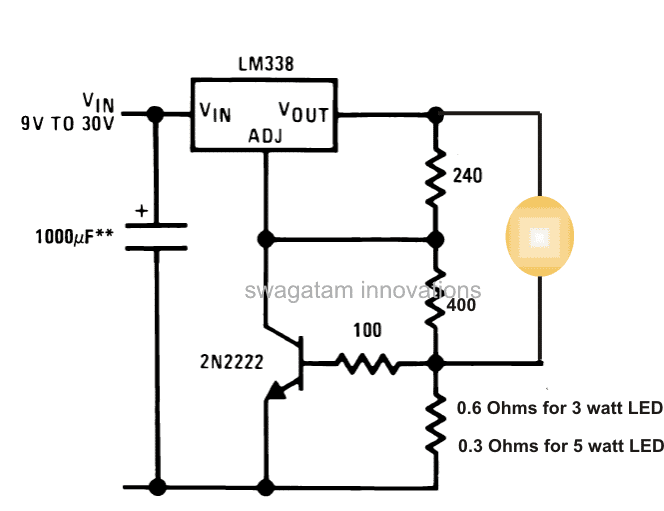
As shown in the circuit diagram below, in its standard mode the resistor 240 ohms is a regular placement, and the next resistor connected to it is the one which decides the voltage at the output of the IC. Here it has been calculated and set for producing around 3.3V at the output, which is the optimal voltage value for driving all types of white LEDs.

However the IC itself cannot control the current and normally would allow about 5 amp at the output.

We can see that the IC is associated with an additional active component which is the transistor connected to its ADJ pin.

The transistor here is employed solely for controlling the current at the output to the specified limits.

The resistor across ground and base decides how much current would be allowed to the output.

As indicated in the diagram, 0.6 ohms will pass about 1 amp maximum current which becomes suitable for driving a 3 watt led safely, and if a 5 watt LED needs to be driven safely, this resistor must be replaced with a 0.3 Ohms, which will allow a maximum of 2 amps of current.

The input to the IC can be derived from a standard transformer bridge capacitor power supply or from a suitably rated battery supply.
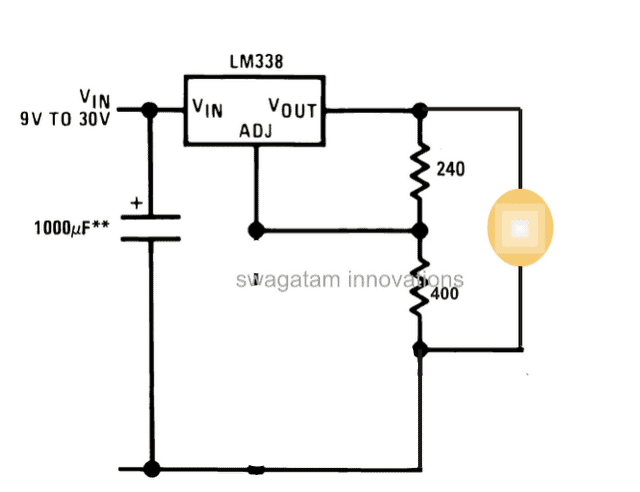
In fact, the transistor and the associated base/emitter resistors are absolutely not required, because once the voltage is set to precise 3.3V, the current would automatically get adjusted as per the LEDs specs.

So the correct circuit should be as given below:
Update:

The above suggestion is not recommended if the ambient temperature is above 25 degrees Celsius. Therefore users are requested to go with the first universal design using the BC547 as the current limiter stage, for enabling the intended current control function.

LED Driver Request

The following request for a customized 9 watt LED driver with constant current was requested by one of the avid readers of this blog

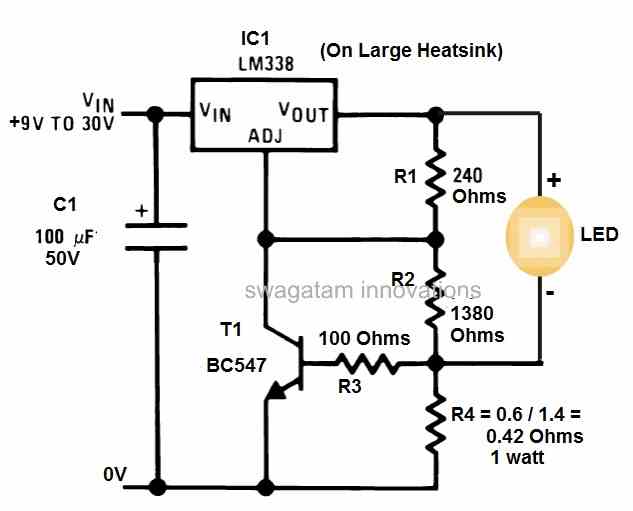
We need constant current LED driver. Supply in put is 11.0 vTO 15.0 vdcOut put required is constant current 1400 mA, 8.4VDC. The Load is 3 White Power LEDs, having Vf - 2..7 to 2.8V. This cluster will operate in flashing (Blinking mode). The circuit should have utmost high reliability, minimal number of components. We were using ONSEMI Linear LED Driver NSI 50350AST3G, (qty. 4 nos. connected in parallel)which is now not available Can you please suggest us some suitable Part or Circuit?

The following circuit diagram was suggested for the above application:
You'll also like:

  • Transformerless Current-Controlled LED Bulb Circuits you can Build at Home
  • candle 1Make an Electronic Candle at Home Circuit
  • meteor2BshowerLED Meteor Shower, Rain Tube Circuit
  • PIR LDR Solar Night lightPIR Solar Home Lighting Circuit

Filed Under: Lamps and Lights Tagged With: Constant, Current, DC, Driver, LED, Watt

About Swagatam

I am an electronics engineer and doing practical hands-on work from more than 15 years now. Building real circuits, testing them and also making PCB layouts by myself. I really love doing all these things like inventing something new, designing electronics and also helping other people like hobby guys who want to make their own cool circuits at home.

And that is the main reason why I started this website homemade-circuits.com, to share different types of circuit ideas..

If you are having any kind of doubt or question related to circuits then just write down your question in the comment box below, I am like always checking, so I guarantee I will reply you for sure!

Previous Post: « High Current Solar Battery Charger Circuit – 25 Amps
Next Post: Mains AC Xenon Tube Flasher Circuit »

Reader Interactions

Comments

nanigopal mahata says:
June 18, 2016 at 6:15 pm

sir i have a 12v 7.2 mAh battery,,, maximum how much 5 watt cree xm-l led can i connect in parallel? please send circuit diagram.. i have seen the cree- xm-l led driver,,, but i can't understand which one i use….. i have connected the led direct , it getting hot and ligts are flactuated,, …

Reply
nanigopal mahata says:
June 19, 2016 at 10:07 am

sir i got it,, but the input is there 12 volt 3 amps,, but my battery ratting is 12 volt 7.2 mah,,, is the current automatic controlled by LM338… and what is the Rx value for 12volt 5 watt lights… is it 0.24 ohm 1 watt.

Reply
Swagatam says:
June 19, 2016 at 5:32 am

Nanigopal, did you see the following article?

https://www.homemade-circuits.com/2013/05/cree-xlamp-xm-l-led-datasheet-highest.html

please do it as per the given details, and make sure to calculate the 0.24 resistance correctly as per your LED specs.

Reply
kiran says:
November 13, 2015 at 4:19 pm

Hello der v r using 12 v 20ah car battery and willing to connect 5w LEDs ..can you plz suggest d proper circuit for it..is it possible to connect them in series and what would be the proper size of the heat sink

Reply
Swagatam says:
November 14, 2015 at 7:01 am

please provide the exact specs of the LED in terms of voltage and current….and quantity

Reply
mrugendra says:
September 7, 2015 at 5:23 am

hello sir i want to power a single 12v 10watt led with bike battery of 12v 7.2ah
i tried finding circuits on goolge but no luck.
according to me powering direct throught battery amps will kill the led

i want to make a search light for night with the help of single led 12v 10 watt
please suggest some circuit sir

Reply
Swagatam says:
September 7, 2015 at 4:03 pm

…the LED will also require a large heatsink

Reply
Swagatam says:
September 7, 2015 at 4:02 pm

hello mrugendra, use the first design presented in the following article:

https://www.homemade-circuits.com/2013/06/universal-high-watt-led-current-limiter.html

make sure to use a big heatsink for the IC, and calculate the value Of R1 as per the given formula.

Reply
Swagatam says:
June 24, 2015 at 6:12 am

Hi Jaco, I have posted your requirement in the following article:

https://www.homemade-circuits.com/2015/06/cree-xm-l-t6-led-driver-circuit.html

Reply
Jaco Bezuidenhout says:
June 23, 2015 at 8:44 pm

Hi Swagatam,
Thanks for the great advice and circuits!
Have you had a chance to have a look at a circuit for the LED mentioned by Guruh above?
I would like to retrofit my 3 cell Maglite with this Cree LED and upgrade the batteries to Li Polymer. Do you have any advice on the battery voltage I should choose and how would I achieve changing the intensity of the LED to a high, medium and low state with the existing on/of switch?
Typical information on the LED:
CREE XM-L T6 Mounted on star board
2.9V-3.5V 3000mA 6500K
Maximum Drive Current 3 A
Maximum Power 10 W
Light Output 1040 lm @ 10 W
Forward Voltage 3.1 V

Regards and thanks in advance,
Jaco

Reply
srinivasula reddy says:
June 12, 2015 at 3:16 pm

Hello, for 10 number 3 watt cree LEDs , what capacity driver needed. thanks
Power: 1W-3W
Model Name: CREE XPE-R3
Emitted Color: Cool White (6500k)
Brightness: 1W:122LM 3W:320LM
DC Forward Voltage (VF): 3.2V-3.6Vdc
DC Forward Current (IF): 350mA~1000mA
Maximum Pulse Voltage: 3.8V
Maximum Pulse Current: 1200mA
LED Viewing Angle: 120 degree
Diameter: 20mm

Reply
srinivasula reddy says:
June 13, 2015 at 2:10 pm

thanks a lot

Reply
Swagatam says:
June 13, 2015 at 11:53 am

Hello, just multiply the voltage rating with the current rating of the particular LED and you will get the maximum wattage for the driver….and it also depends how you want to connect the LEDs…if in series then the current becomes equal to the rating of the single LED, but voltage ratings combines.

Reply
Hv Verma says:
May 7, 2015 at 8:44 am

Hello Sir….
I want to run 5 watt LED (normally runs on 9 volt DC) on 12 volt DC with the help of IC 7809 on my scooter Headlight. But both LED and 7809 got Very hot…. is there any risk to run with 7809…?
2. I want to run these LED on 220Volt. I made a circuit with bridge and capacitor with 100 ohm .. but light is dim… how can I increase light…coz when i run this LED with 9Volt DC it brights light…
pl solve my probs.. How can I run these LED..

thanx….

Reply
Swagatam says:
May 7, 2015 at 11:45 am

Hello hv, using 7809 is OK, and if the LED and the IC are getting hot, that's normal too and may be simply controlled by using large heatsinks for both.

However 7809 is not current controlled, therefore I would recommend you to use the first circuit from the above article, it has a current control feature and also a voltage adjust feature which you can set to 9V as per your LED spec.

for 5watt, 9V led the current requirement would be 5/9 = 0.55 amps

therefore the value of the lowermost resistor will need to be = 0.6/0.5 = 1.2 ohms, 1 watt

for 220V operation also you can incorporate the first circuit and feed the input from a 12V/1amp adapter

Reply
Raj says:
April 3, 2015 at 12:28 pm

So can I run a LED with the simpler circuit in India? In summer it goes to 40 degrees here.

Reply
Swagatam says:
April 4, 2015 at 4:13 am

with a large heatsink and a fan switched ON, it'll be OK

Reply
Raj says:
April 3, 2015 at 7:43 am

The second circuit diagram is a voltage regulator circuit, not a current regulator (wikipedia- LM317)! And LEDs should be run from current regulated source.

Reply
Swagatam says:
April 3, 2015 at 11:55 am

yes I know, this has been already discussed in one of the previous comments with Richard Hoad May 21, 2013 at 5:53 PM

the second circuit is also correct if sufficient heatsink is provided and the room temperature does not fluctuate by much.

a thermal runaway situation may arise only if the heatsink is not adequate or the ambient temperature gets too warm, as in tropical countries.

Reply
Haseeb Abdul says:
October 19, 2014 at 5:30 am

Sir, please send me a diagram to connect 4*3W LEDs in series with 230V.

Forward Voltage- 3.4 – 3.6V at 700mA
Output Power – 3W,
Luminous flux – 200-240.

My Email ID: haseebmaca@yahoo.com

Reply
Swagatam says:
January 2, 2015 at 5:54 am

Siddharth you will need a 12V, 2amp AC/DC adapter for this first, then connect the LEDs using the second crircuit as given here:

https://www.homemade-circuits.com/2013/06/universal-high-watt-led-current-limiter.html

use 1 ohm for the upper resistor and use three strings in parallel including the 0.7 ohm on each string for getting 9 leds in the circuit

Reply
siddharth gupta says:
January 1, 2015 at 7:01 am

Sir please send me diagram to connect 10 high power 1 watt led in series running on 230volt.
Forward voltage:3.4 to 3.6v at 280 ma
Email:siddharthgupta024@gmail.com

Reply
Swagatam says:
October 20, 2014 at 5:07 am

Haseeb, you'll need a 12V 2amp smps AC/DC adapter for this….you can connect the LEDs in series at the output of this adapter using a 0.6 ohm 1 watt resistor for limiting excess current

Reply
Jayanath Ranasinghe says:
July 22, 2014 at 3:20 am

sir but red green blue white 3w leds having various voltages. red-2.8v, green,white & blue 3.8v,
my question is 240ohm, 400ohm is suitable for any color 3w led?

Reply
Swagatam says:
July 22, 2014 at 2:13 pm

Which LED do you want to want use exactly,

the 400ohm will set the output to 3,3V approximately

you can alter the 400 ohm resistor accordingly using an online LM317 calculator.

Reply
Jayanath Ranasinghe says:
July 21, 2014 at 8:40 am

sir can i use LM317? with last circuit for one no 3W led. what will be the wattage of 240ohm and 400 ohm resistors.?

Reply
Swagatam says:
July 21, 2014 at 1:52 pm

yes you can use the last circuit, the wattage of the resistors will be 1/4 watt…

Reply
Tabby Katze says:
June 10, 2014 at 5:28 pm

Hello Swagatam,

I have tried doing circuit 2 on this page for 4 x 3.3v 700ma leds in parallel, circuit works and is great with my resistor values being R1 =270 and R2 being 440 but the LM338 is getting extremely hot, i have a heatsink attached to it but it gets hot to point of it hurts to touch.

700ma x4 = 2800ma so it's well within it's current tolerance, so why is it getting so hot?

Regards,
Emile

Reply
Swagatam says:
June 11, 2014 at 6:46 am

Hello Emile,

yes, even though 2800 may look within it's range, these linear ICs tend to generate a lot of heat.

The remedy could be to use higher voltage and to put the LEDs in series, this would greatly reduce the current as well as the heating up of the IC.

for 4 LEds you could use a 4 x 3.3V input meaning a 15V input so that all the LEDs could be wired-up in series, requiring just 700mA for the entire series.

Reply
Vimal Mehta says:
June 6, 2014 at 12:29 pm

Hi Swagatam! Posting this again because my first post simply disappeared! Really amazing blog.. appreciate the hard work you put in to keep this blog buzzing.

Regarding the 3 Watt, 5 Watt LED DC to DC Constant Current Driver Circuit,

1) If I need to run 6 x 1 watt leds from this circuit, what changes do I need to make in the circuit? The input voltage shall be from 12 volt car battery.

2) Instead of 6 x 1 watt leds, if I decide to run 3 x 1 watt leds, what changes should I make to the circuit?

Thanks…

Reply
Vimal Mehta says:
June 6, 2014 at 7:33 pm

Thanks ! Will try it and let you know how it works out.

Reply
Swagatam says:
June 6, 2014 at 1:13 pm

Hi Vimal,

Thanks once again, OK got it, here are the answers:

1) make two parallel strings each having 3 LEDs in series, change the 400 ohm resistor in the first circuit to 1.68K and use 1 ohm resistor for the bottom most resistor

2) for 3X1 use a single string having 3 LEDs in series, the 1.68K will not change, but the above 1 ohm will now become 2 ohms.

Reply
Vimal Mehta says:
June 6, 2014 at 5:17 am

Hi Swagatam! Really amazing blog and such simple circuits. Appreciate the effort you put in.

1) If I want to drive 6 x 1 watt leds, should I connect them in series or parallel? Also do I need to make any changes in the above constant current circuit?

2) Instead of 6 x 1 watt leds, if I want to drive 3 x 1 watt leds, what changes should I make in the above circuit?

Reply
Swagatam says:
June 6, 2014 at 12:58 pm

Hi Vimal, thank you! Due to a large number of comments the replies occasionally get delayed, although I try my best to finish them quickly.

Answering to your question the series or parallel specifications will depend on the voltage level that you are using.

How much voltage do you have or intend to use? Please provide me the data I'll let you know how to proceed with it.

Reply
Swagatam says:
May 21, 2014 at 5:54 am

Dear Vinod, cmake three strings each having 3 LEDs and a series 6omh/1watt ersistor.

put these 3 strings in parallel and connect their common ends to a 12V/2amp smps adapter.

use heatsink for the LEDs,

Reply
vinod kumar Umargakar says:
May 20, 2014 at 3:49 am

Dear Sir,
I want a circuit diagram to run12 numbers of 3W LED's using AC current…rep pls

Reply
Akshay gupta says:
May 11, 2014 at 7:28 am

Hello sir,
I need a 12v to 28vdc converter 3w/5 w. Want to light up 5 led of 1 each.
I have seen an ic circuit but the manufacturer has rubbed the number on it. So plus can u help me with an alternative circuit or anyone knows which ic is used in this kind of circuit

Reply
Swagatam says:
May 11, 2014 at 12:50 pm

Hello Akshay,

You can try the circuit given in the following link:

https://www.homemade-circuits.com/2012/09/led-emergency-light-circuit-using-boost.html

Reply
Sriram Kp says:
May 10, 2014 at 11:21 am

Thank you for ur quick response…. I am having one doubt… Suppose My LED panel needs 14v, 700mA. But if I connecting 14v, 2Amps battery to the LED panel means, wil it affect the LED panel lifetime due to the higher Amps from the battery? or the battery backup wil increase??

Reply
Swagatam says:
May 10, 2014 at 2:32 pm

if the voltage does not exceed the forward voltage of the LEDs then current will not matter….however if the ambient heat increases the situation could become dangerous, so use of a current controlled supply is recomeneded, for example using a LM338

Reply
Sriram Kp says:
May 9, 2014 at 7:41 am

I made a LED panel by placing four 1watt LED in series fixed on 4×4 inch 1mm aluminium sheet. Like that two panel connecting in parallel. This panel will work with motion sensor. Now I like to make a power supply and backup for that. The panels need 14vdc, 700mA and the sensor circuit need 5vdc. Please provide me a smps circuit for the follwing specification:
1. The circuit's input should be a AC main connection.
2. I need two outputs from the circuit. One should be 5vdc and another should be 14vdc, 700mA.
3. Battery backup should be there in the circuit for both output. so if AC main supply is there means , the light panel and the sensor should work with the AC main supply. Suppose if AC main power failure occurs means, instantly the sensor and the pannel should work with the battery backup.
4. Then if AC power supply comes means again the output should work with AC supply only and battery should start chraging.
5. The battery should contain overcharge protection.
6. The backup time should be 2-3hrs. so what volt and amps of battery i need??
Thankyou in advance…

Reply
Swagatam says:
May 10, 2014 at 4:56 am

Sriram,

for the SMPS you can try the following circuit:

https://www.homemade-circuits.com/2012/03/how-to-make-simple-12-v-1-amp-switch.html

adjust R6 to get 14V

for the automatic actions you can make the following design:

https://www.homemade-circuits.com/2013/02/make-this-automatic-10-watt-to-1000.html

just replace the shown transformer power supply with the 14V SMPS given in the above link.

Reply
Sriram Kp says:
May 8, 2014 at 1:40 pm

Can u pls provide me ur contact mail id??? so I can clarify doubts regarding my LED panel for home.

Reply
Swagatam says:
May 9, 2014 at 4:53 am

you can say it here, i'll do my best.

Reply
Sriram Kp says:
May 5, 2014 at 2:04 pm

Hai swagatam, your blog is awesome. I am following it. I made a water tank controller from ur blog. Its working great. Thank you. Now I am planning to make LED pannels for my home. If I connect ten 3watt LED in parallel means how much amphere should i need??
and how to calculate it??
LED specifications:-
Forward voltage = 3.5v
Forward current = 700mA
Power dissipation = 5w
Please help…

Reply
Swagatam says:
May 7, 2014 at 1:38 pm

yes it will be 35V, I confused it to be 3 in series.

Reply
Sriram Kp says:
May 7, 2014 at 8:38 am

How it wil be 12v ?? 3.5v per LED. If i connect ten LEDs in series means i need 3.5 x 10 = 35v. If I am wrong means can u pls explain me pls???

Reply
Swagatam says:
May 6, 2014 at 4:05 pm

in that case current will be 700mA, but voltage will need to be 12V

Reply
Sriram Kp says:
May 6, 2014 at 1:46 pm

So if i connect ten 3 watt LEDs in series means how much amphere should it require??

Reply
Swagatam says:
May 6, 2014 at 7:33 am

Thanks Sriram,

3.5 x 0.7 = 2,45 watts, so it cannot be 5 watts

10 in parallel would require 10 x 0.7 = 7 amps.

Reply
thurrmac says:
April 2, 2014 at 8:47 am

noted and wish me luck… thanks

Reply
Swagatam says:
April 16, 2014 at 8:31 am

my pleasure thurrmac:)

Reply
Swagatam says:
April 2, 2014 at 3:08 pm

Wish you all the best

Reply
thurrmac says:
March 31, 2014 at 12:47 am

here are the data of the leds.

3 Watts
DC forward Voltage: DC 2.8-3.8V
DC forward current: 700mA max
Rated power: 2.66W max

Reply
Swagatam says:
April 2, 2014 at 6:24 am

across the "out" and ADJ pins of the IC, it's clearly shown in the diagram.

for pinout details of LM338 you may refer to the following image:

4.bp.blogspot.com/-cQYYHQMayYc/UX4km7_cniI/AAAAAAAAEDQ/oYsD49dla0w/s1600/lm196+pinout+details.png

Reply
thurrmac says:
April 2, 2014 at 12:56 am

oh ok, last question before i proceed. where will be the placement of R1?

Reply
Swagatam says:
April 1, 2014 at 5:13 am

The discussed R1 is in the following post, pls don't confuse it with the above post:

https://www.homemade-circuits.com/2013/06/universal-high-watt-led-current-limiter.html

Reply
thurrmac says:
April 1, 2014 at 12:48 am

btw i want to get it right… R1 is the 400 ohms resistor or is it the 240ohms?

Reply
thurrmac says:
April 1, 2014 at 12:38 am

noted. will give it try and let you know of the result. many thanks

Reply
Swagatam says:
March 31, 2014 at 7:49 am

you can use 4 in series with a 12V input and use LM 338 as a current limiter as shown in the following post, R1 will be around 2 Ohms 1 watt

https://www.homemade-circuits.com/2013/06/universal-high-watt-led-current-limiter.html

Reply
thurrmac says:
March 26, 2014 at 9:11 am

Good day sir i want to connect 5 pcs of 3Watts leds to this circuit of yours please guide me thank you… power supply will 9v 1700mah

Reply
Swagatam says:
March 29, 2014 at 5:01 am

please tell me the operating voltage of the LEDs, i'll provide you with the required data.

Reply
thurrmac says:
March 28, 2014 at 12:52 am

unfortunately sir i dont have any background in electronics im not able to calculate. what would be the best position of the leds is it in series?

Reply
Swagatam says:
March 27, 2014 at 12:03 pm

yes will do, in that case you can make the first design from above, you will need to calculate the parameters as per the given instructions.

Reply
thurrmac says:
March 27, 2014 at 12:49 am

how bout 5V 6.5amps or maybe 12V 5amps???

Reply
Swagatam says:
March 26, 2014 at 2:33 pm

Good day thurrmac,

1700mAH will not support even one 3 watt LED properly, 5pcs is out of question, you may require at least 5AH input for it.

Reply
Nizamani says:
March 2, 2014 at 8:55 pm

hi sir i want to create a led lyts for my farm .. i want to connect 30 leds in parallel my problem is that i have 12volt 200amp battry when im trying to connect leds to battery they are going to be hotter what should i do brightness is very awsome but why they are going to be hot..?

Reply
Swagatam says:
March 4, 2014 at 4:33 am

Nizamani, you will need to fix the LEDs on a large aluminum plate so that the heat from the LEDs is sinked and dissipated otherwise the LEDs will get damaged within minutes.

While fixing the LEDs on the aluminum make sure the leads do not short with the aluminum plate.

Reply
Swagatam says:
January 20, 2014 at 4:25 am

Hi Muhammad, you can use the first circuit from the above article, no changes would be required except for the bottom most resistor which should be replaced with a 0.2 ohm resistor

Reply
Muhammad Waseem says:
January 19, 2014 at 4:20 pm

Hi There, Mr.Kapila and Specially Mr.Swagatam!
Sir if i need to connect these 3w X 3 LEDs in parallel then which type of modificatons to be required?

Reply
Greg Farino says:
January 14, 2014 at 6:15 pm

I forgot to ask what the power ratings are for the resistors in this circuit ?

Reply
Greg Farino says:
January 14, 2014 at 6:14 pm

You referred me to this page. I mentioned in my previous post that I wanted to convert a 110V 10W LED floodlight to 12VDC and also have the ability to flash as an emergency light. MY question is, this article is for a 3W and 5W LED. Can I still use it for my 10W LED and do I need to change any of the components ?

Reply
Swagatam says:
January 15, 2014 at 5:57 am

You did not mention 110V in your previous comment, you said that the LED had a forward voltage of 12V and current rating of 1amp and you wanted to operate it at a little lower current than the given max specs.

Anyway, here's what you need to do in the first circuit:
replace the 400 ohm resistor with a 1.8k, 1/4 watt resistor
replace the bottom most resistor with a 0.66 ohm 1 watt resistor

as already mentioned in the previous comment, you can use a standard IC 555 astable flasher circuit and connect its pin#3 with the collector of the transistor in the above circuit. connect pin3 via a 1N4007 diode, cathode should be connected to pin3.

Whenever you switch ON the 555 circuit will result in the flashing of the LED

Reply
Vedha Moorthi says:
December 9, 2013 at 8:25 am

Lot of thanks sir.

Reply
Vedha Moorthi says:
December 8, 2013 at 7:51 am

Hello sir,
I want to install my home 1w high power led's in series connection, using 12v 7.5 AH lead acid battery. Please give the method. Thank you sir.

Reply
Swagatam says:
December 10, 2013 at 7:23 am

an alternate circuit can be seen below with all the necessary formulas:

https://www.homemade-circuits.com/2011/12/make-hundred-watt-led-floodlight.html

Reply
Vedha Moorthi says:
December 9, 2013 at 2:57 pm

Sir,
1.Alternate method for changing LM338 Voltage Regulator.
2.Give the instruction 12 or 15 (4*3 or 5*3) led bulbs connections in the 12v 7.5 AH lead acid battery.

Reply
Swagatam says:
December 9, 2013 at 4:55 am

Hello Vedha,

Please refer to the diagrams provided in the following article, you can try them for your application, the input should be from a 12V 3amp smps AC/DC adapter

https://www.homemade-circuits.com/2013/07/making-led-halogen-lamp-for-motorbike.html

Reply
Jhunix says:
December 7, 2013 at 1:47 pm

Hi,

Can you please give the resistor value (ohms & watts) for 2 led in parallel?

what is the recommended capacitor volage for 12-14v circuit?

Thank You.

Reply
Swagatam says:
December 9, 2013 at 5:01 am

divide the wattage of the LED with supply voltage and multiply the result with 0.6, this will give you the wattage for the lower resistor, remaining will be 1/4watt rated.

Reply
Jhunix says:
December 8, 2013 at 8:30 am

Ok. noted. thanks.

one more question, is there specific Watts value for resistor or can i use any watts value?

thanks.

Reply
Swagatam says:
December 8, 2013 at 6:36 am

Hi, if you are using 12V then you should connect them in series.

Use 1.2k resistor in place of 400 ohms, rest of the values will be as it is

Reply
Abubaker Naseer says:
September 20, 2013 at 6:01 am

Can you Please upload the Schematics for Isolated Constant Current 6W, 8W and 12W SMPS used for LED drivers?

Reply
Swagatam says:
September 20, 2013 at 12:27 pm

You can use the following two circuits together to fulfill your requirements:

https://www.homemade-circuits.com/2012/03/how-to-make-simple-12-v-1-amp-switch.html

https://www.homemade-circuits.com/2013/06/universal-high-watt-led-current-limiter.html

Reply
krishna chaitanya says:
September 12, 2013 at 3:42 pm

Hello Swagatam Majumdar sir,

i want to install 2X3Watt 12 volt Led lights as a my bike Pilot lamps (parking lamps), i want the 12 volt constant current regulator for these leds please give me the Driver, thank you.
if possible please forward the details to my mail id chkrishnachaitanya9@gmail.com

Reply
Swagatam says:
September 13, 2013 at 8:29 am

Hello Krishna,

Please refer to the following post, you will get an idea of the required procedures:

https://www.homemade-circuits.com/2013/06/universal-high-watt-led-current-limiter.html

Reply
Swagatam says:
September 3, 2013 at 5:09 am

you are welcome!

Reply
Swagatam says:
September 1, 2013 at 3:52 am

You can use the first circuit.

If you are connecting the LEDs in series, replace the 400 ohm resistor with a 1.68K resistor, or a 1k and 680 ohm in series.

the vertical resistor at the bottom should be replaced with a 0.4 ohm 1 watt resistor.

Reply
Swagatam says:
August 31, 2013 at 8:06 am

Hi Tommy,

What's the operating voltage spec of each LED?

Reply
josef says:
August 28, 2013 at 3:19 pm

Hii…

Your blog is real cool.
i had a doubt regarding the forward voltage of the 5W LED. I thought it was 7V at If=700mA instead of 3.3V.
can you please provide the specs. or link to the datasheet of the LED used here..?

regards,
joseph

Reply
Swagatam says:
August 29, 2013 at 4:09 am

Hi thanks,

Different manufacturers may provide sightly different specs, one says it's around 4.5V as given here:

http://www.lumex.com/images/Lumex_New2w_3w_5w-HPleds.pdf

No issues, you can set the voltage as required by simply adjusting and selecting a different value for the 400 ohm resistor.

Reply
Swagatam says:
August 10, 2013 at 7:50 am

I'll inform you when it gets posted.

Reply
Jayaraju Lakkepogu says:
August 10, 2013 at 5:23 am

Thank u. Pls. just inform me when u post that.

Reply
Swagatam says:
August 10, 2013 at 2:45 am

Thanks Jayaraju,

you will see all these circuits in my blog very soon.

Reply
Jayaraju Lakkepogu says:
August 9, 2013 at 11:12 am

Thank u very much Mr. Swagatam. I am trying to implement those circuits. Pls. send some more links for the real time circuits which is useful for solar applications like solar converter for existing normal inverter, solar charge controller for different amps, solar LED driver circuits, solar lanterns 3w,5w circuits, etc.,

Reply
vineesh chandanattil says:
August 8, 2013 at 6:20 pm

hi
i want 5 x 1 watt blue led to be put in this circuit,
does it require any change in components…
and can i put a solar panel of 12 volt 5 watts as the input,,,

pls guide me

Reply
Swagatam says:
August 9, 2013 at 7:55 am

Use the first circuit and connect the lEds in parallel at the output, use a 0.5 ohm resistor in series with each LED and select 0.3 ohm as the current limiting resistor as shown in the circuit.

Reply
Swagatam says:
July 29, 2013 at 4:34 am

Use a bigger heatsink, it's as simple as that. Try increasing the size until it prevents any further rise in the heat.

If you diffuse it you would reduce the amount of light from it, so it's better not to look at it, which is a dangerous thing to do anyway..

Reply
Swagatam says:
July 22, 2013 at 4:35 am

I am sorry presently I have no info regarding it.

Reply
KENNY HO says:
July 15, 2013 at 5:39 pm

How can I run 3x1w led using this circuit? I'm using 9v batt, Any suggestion I can run with 9v batt?

Reply
Swagatam says:
July 16, 2013 at 4:38 am

if you are using 9V PP3 battery, then it won't work, it should be rated at least at 4AH.

With a 9V fixed supply you won't require any circuit or resistor, simply put the LEDs in series and connect it directly to the battery.

Reply
KENNY HO says:
July 15, 2013 at 5:31 pm

I would like to use 9v batt to run this circuit on my mountain bike, any modification? Please advice.

Reply
Back to Newest

Need Help? Please Leave a Comment! We value your input—Kindly keep it relevant to the above topic! Cancel reply

Your email address will not be published. Required fields are marked *

Primary Sidebar

circuit simulator image


Subscribe to get New Circuits in your Email


Categories

  • Arduino Projects (93)
  • Audio and Amplifier Projects (133)
  • Automation Projects (17)
  • Automobile Electronics (101)
  • Battery Charger Circuits (85)
  • Datasheets and Components (109)
  • Electronics Theory (149)
  • Energy from Magnets (27)
  • Games and Sports Projects (11)
  • Grid and 3-Phase (20)
  • Health related Projects (27)
  • Home Electrical Circuits (13)
  • Indicator Circuits (16)
  • Inverter Circuits (95)
  • Lamps and Lights (159)
  • Meters and Testers (71)
  • Mini Projects (28)
  • Motor Controller (68)
  • Oscillator Circuits (28)
  • Pets and Pests (15)
  • Power Supply Circuits (91)
  • Remote Control Circuits (50)
  • Renewable Energy (12)
  • Security and Alarm (64)
  • Sensors and Detectors (106)
  • SMPS and Converters (34)
  • Solar Controller Circuits (60)
  • Temperature Controllers (43)
  • Timer and Delay Relay (49)
  • Voltage Control and Protection (42)
  • Water Controller (36)
  • Wireless Circuits (30)


Other Links

  • Privacy Policy
  • Cookie Policy
  • Disclaimer
  • Copyright
  • Videos
  • Sitemap


People also Search

555 Circuits | 741 Circuits | LM324 Circuits | LM338 Circuits | 4017 Circuits | Ultrasonic Projects | SMPS Projects | Christmas Projects | MOSFETs | Radio Circuits | Laser Circuits | PIR Projects |

Social Profiles

  • Twitter
  • YouTube
  • Instagram
  • Pinterest
  • My Facebook-Page
  • Stack Exchange
  • Linkedin


Recent Comments

  • Swagatam on Arduino 2-Step Programmable Timer Circuit
  • Swagatam on Simple Buck-Boost Converter Circuits Explained
  • Swagatam on IC IR2111 H-Bridge MOSFET, IGBT Driver IC: Full Datasheet, Circuit Diagram
  • Swagatam on Electronic Circuit Projects, Tutorials, and Practical Engineering Solutions
  • Kadir on Simple 3 Phase Inverter Circuit

© 2026 · Swagatam Innovations