A simple, low cost set up I have explained in this article will give you a clear idea regarding how to desalinate sea water at a fast rate and in large quantities.
The conventional method of solar sea water desalination process is quite sluggish and cumbersome.
A simple, low cost but effective idea presented here will show you how to desalinate sea water much efficiently.
A Simple Sea Water Desalination Apparatus
A simple and a low cost set up (Exclusively Developed By Me) as shown in the diagram should be able to convert sea water into fresh drinking water in large quantity, depending upon the size of the sphere.
The main feature of this system unlike other conventional ways is the fast conversion rate of waste water into fresh water.
Also, since the whole process is solar operated, cost incurred is zero. Another great advantage of this design is that it's not dependent on the position of the sun and will work throughout the day as effectively.
Let’s study how to desalinate sea water through a simple the set up: The system is basically made up of a large hollow glass sphere with a “T” shaped glass tube extension coming out of its top portion. The sphere is made up of solid glass at the bottom, up to the focal point of the sphere.
This base surface may be painted black to increase the efficiency of the unit. As can be seen in the diagram, the short vertical arm of the tube which extends upwards terminates into a funnel.
The funnel carries a valve in the form of a tap. The long horizontal arm is bent at 90 degrees and terminates inside the reservoir tank.
The whole set up is placed outdoors in an open area where clear sunlight is accessible throughout the day.
Sea water is poured through the funnel and the glass sphere is allowed to fill completely, only up to the circumference of the globe. Now the tap is closed.
How the Desalination System Works?
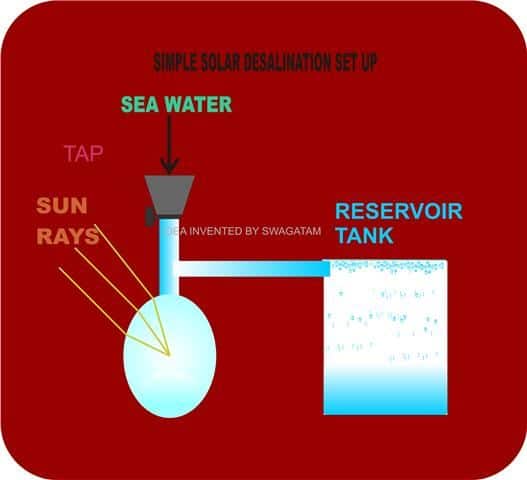
Once the sphere is filled with water, it behaves like a big, solid and a powerful convex lens. In our childhood days we all have played with this amazing piece of lenses.
We have seen how it is able to focus and concentrate sun rays at one single point when placed at a particular angle under sunlight.
(Click Image to Enlarge) The created focal point is in fact a concentrated beam of the sun rays collected and deflected at a small point.
This point is very hot, and is able to produce burning effect over anything placed under it. The above principle has been simply exploited in the present design.
Without water the sphere is ineffective and will act just like a normal glass. The sunrays entering into it thus cannot generate much of a heat. But the moment it is filled with water, it is transformed into a big solid convex lens having a focal point exactly at its center.
Sun rays hitting the glass sphere are instantly refracted through the entire curvature of the filled water to reach exactly at the center.
Here the rays concentrate into single hot spot. Water at this point starts heating up instantly and the heat is gradually transferred to the whole mass of the filled water.
As the temperature rises, water molecules are converted into vapor. The water vapor formed, rise through the “T” shaped glass tube and the reservoir tank.
The tank being relatively much cooler helps in converting the received water vapor into clean, drinkable water* (see comments) on its roof.
Water molecules accumulated on the roof of the reservoir tank slowly gather to form water drops which ultimately fall into the tank and pure water is thus collected inside the tank.
This water is absolutely pure, and free from viruses, bacteria or dust particles. The efficiency of this apparatus will decrease if the filled water is murky or muddy.
Because in such a case the focal point will be comparatively dull and won’t be able to create enough heat. The above method should have certainly made you understand regarding how to desalinate sea water simply and efficiently.
UPDATE:
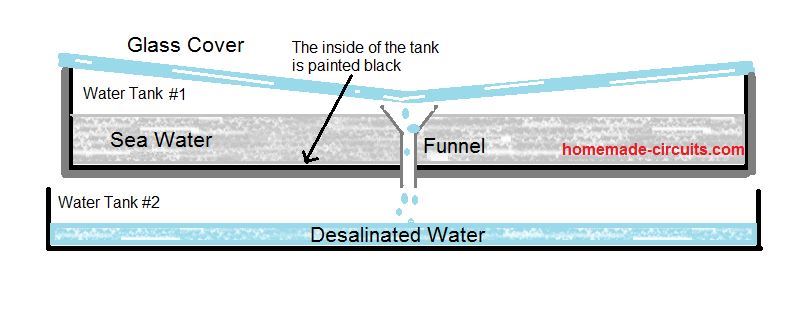
Th above design looks quite inefficient since the apparatus is cumbersome and difficult to implement for large scale desalination process. A much better and simpler design can be seen below. The diagram is self explanatory:



Comments
Hi Swagatam. Can you help me please. I want to modify my geyser thermostat so that can work with solar power (DC) in the day and (AC) at night. If i use the standard geyser thermostat the contacts will burn and short together if i use it in the day with the solar panels.
Can you help me with the right circuit please.
Thanks.
Hi Pete, do you mean the thermostat contacts burn when DC is used and not in AC?
In that case you can use an SSR triggered by the thermostat when DC is used from the solar panels.
So with DC, the thermostat operates the SSR input, and then the SSR output operates the DC switching for the geyser.
Can you please give the geyser specifications, like voltage current wats etc, and also your solar panels specifications, then I will try to figure it out. Alternatively you can use a DC to AC inverter for converting the solar DC into AC and use the same thermostat to power the geyser day and night.
Hi Swagatam. The geyser element use 230 volt 3000 watt and about 13 amps.
The solar panels is 280 watt plus minus 3% 36.7 volts 7.63 amps I want to use 6 panels and it will be 220 volts. I assume SSD stand for solid state relay. This is something i want to use and see how good it will work.
Thanks for your time and idees.
Thank you Pete, yes SSR stands for Solid state relay.
In that case you can simply divert the thermostat output voltage which goes to the thermostat relay, to the SSR input.
However, you will have to make some kind of detection circuit which checks the solar panel voltage and when it is above 30V, then it tells the thermostat to toggle the SSR instead of the thermostat relay, or alternatively, the detection system can be configured to connect the geyser with the SSR output during daytime.
If you have further questions on this topic, please feel free to comment under the following article:
https://www.homemade-circuits.com/solid-state-relay-ssr-circuit-using-mosfets/
I was thinking like a rooftop shape over water source with tilted gutters for collection from the inside. selected places painted black. much more surface area for vaporization/condensation. similar to figure 2 only inverted with 2 gutters instead of a central faucet.
Yes, that’s sounds to be a good idea! Thanks for your interesting feedback…
Where can I buy the sphere and holding tank for desalinization?
You can probably find it from a vendor who sells chemistry Lab glassware equipment.
Thank you for posting this post. I found it extremely helpful because it explained what I was trying to say. I hope it can help others as well.
sadly solar won’t work year round here in the U.K. Perhaps just in a hot summer.
You are right!
Does the diameter of pipe/tube between the sun-still and the collection tank matter?
Yes, the diameter should not be less than an inch
Very nice system.
Can it treat up to 8,000 litres in 8 hours.
Send me your WhatsApp contact number.
Thanks
Prince
Thank you, yes it can do it.
Can this setup be done using a water tanker truck
Your question is not clear, please elaborate?
This is the perfect webpage for everyone who really wants to understand this topic. You realize so much its almost tough to argue with you (not that I really will need to…HaHa). You certainly put a brand new spin on a topic that’s been discussed for decades. Excellent stuff, just great!
In your Desalination System, where could I obtain such a glass water tank & glass funnel? Would a fish tank work?
any circular glass vessel should work better than rectangular…so may be a large glass bubble bowl, or a cylindrical tube type glass vessel might do the job.
WONDERFUL Post.thanks for share..extra wait .. …
Your updated design is known as a solar still. The idea is the evaporate the salt water and let it condense on the bottom of the glass and trip into the clean water vessel. I have modified this design to great effect as follows: I replaced the 2 chambers with 5 gallon buckets. There is a spigot on the bottom bucket. The upper bucket is painted black to absorb solar radiation. The glass is replaced with a high temperature oven bag such as used to bake turkeys. The bag is positioned on an angle such that one corner naturally acts as a drip guide into the funnel. Now for the major improvement. Add a third bucket as a salt water reservoir to the stack. This bucket has holes drilled in the bottom to allow the contaminated water to fill the upper portion of the oven bag. You must seal the top bucket to the middle bucket to prevent leaking. Note that this arrangement provides a cool oven bag surface to promote condensation in the middle bucket. The water in the bag is also being preheated during the condensation process making more efficient use of the captured solar energy. All that remains is to add a tube to transfer water from the bag up and out of the upper chamber Into the evaporation chamber. Note, all chambers are sealed air tight to prevent a rapid siphoning from the upper to middle chambers. The flow should drip into the evaporator in an ‘as needed’ manner. I have achieved production rates of nearly one gallon of fresh water per day with this system. Hope this helps.
Thanks for the valuable feedback, appreciate it very much!
This idea won’t work. If you want to heat water using the sun, look to rooftop solar hot water systems. None use a round glass flask and for good reason.
Surface area presented to the sun is what matters. There is no lensing effect that heats water up at a concentrated point inside the flask. If the water is clear enough to make an efficient lens, then the sunlight and it’s infrared heat will pass right through. If the water is too cloudy to make a lens then it will heat up but only proportional to the surface area of the flask that’s seen by the sun (so a circle).
A hot water system, however, uses a flat black panel with water pipes on the back. That works.
Thank you for your opinion. I have updated a better design at the bottom of the post.
Dear Sir,
I am emailing from Cape Town. Cape Town (about 4 million people) has less than 100 days water left at 1 Feb 2018.
Please can I ask about your brilliant home desalinsation plant? I live near the sea.
Where would I get the correct glass sphere? Must it be round like a ball or oval? What size or type of opening should the sphere have at the top?
Just trying to think of the best type of supplier to source the glass sphere?
Is it best that the other components are glass?
I am keen to try build your desalinization plant, but just want to get a feel for the correct components?
Especially the size and shape of the sphere and where best to source it?
Thank you so much for sharing your knowledge and invention.
Kind regards Craig Cape Town email address as below 🙂 🙂
Dear Craig, I think glass sphere method has too many limitations, first of all you cannot desalinate large amounts of water at one go, and being glass it could be vulnerable to damages.
Instead you could try the following concept
https://www.homemade-circuits.com/make-free-drinking-water-from-sea-water/
this one will be much more effective
Dear Swagatam,
Thank you very much for your time and valuable guidance.
I am not a technical person so I am trying to find ways to understand evaporation and condensation and then how to speed up process. It is said 97% of water on Earth is sea water. To change sea water into fresh water cheaply would make a huge difference. Easier said than done. I see some researchers at Alexandria University have made some interesting discovery re converting sea water into fresh water. All the best and thank you so much for your valuable guidance 🙂 🙂 Craig Cape Town
You are most welcome Craig!
salt cannot evaporate with water molecules, salt will remain in the flask and only water molecules will evaporate and pass through the tube and finally condense in the reservoir tank.
after water become stream it flows through the pipe towards the reservior tank.but the salt still intact with the stream,so salt never been removed from water.atually in sea the sun rays evoporate the seawater as stream that goes up and form the cloud., the distance between the seawater and cloud is appriciable ,the sea wind remove the salt from the stream.but in ur project the stream never been exposed to wind and the salt and florid neverbeen removed completly .ultimately the water from the reservior tank is not drnikable.is it?
thoomsati@gmail.com
quick question,
Provided a person could find the necessary equipment to do this, (thinking along the lines of an event that would decimate drinking water) Approx. how many times do you think the aparatice would work before clouded out by the salt which doent disappear, but would remain inside the heating cyphere? Thanks in advance.
Okay another question, (since realisticly if someone were under such harsh conditions, a local lab supplier is not likely to available), What alternative items would you consider to build the apparatise? I can imagine a coffee pot being used and a fish tank for the resevoir, but how could they be attached to creat the T tubing. Thanks again.
Seems like this tech is no outdated. Try doing a search for "large scale solar desalination" and you will see why…
it needs to be extremely cheap, extremely effective and within layman's reach
Can I share this article?
Hi Swagatam,
This certainly seems to be a very good idea. Would like to go into more details of this.
Will it be possible for me to get in touch with you?
Regards
Sameer
it should be full from the top,
the inner bottom concave surface of the dome could be made mirror finish so that this issue is permanently solved.
Unclear regarding how much to fill sphere.Fill to top or to middle?
Thank you Sameer,
You can also read the following article which shows an alternative method of achieving the same, but in a more efficient way:
https://www.homemade-circuits.com/2015/09/make-free-drinking-water-from-sea-water.html
Please feel free to contact me at:
admin @ http://www.homemade-circuits.com
A demester layer above heated sea water should contribute reduces salty droplet carrying over to Reservoir tank.
OK, thanks for the input!
How can i make a RO system for desalination at home easily ?have u any idea?…
sorry i do not have idea regarding RO systems.