• Skip to main content
  • Skip to primary sidebar

Homemade Circuit Projects

Need circuit help? Post them in the comments! I've answered over 50,000!

Blog | Categories | About | Contact | Calculators-online
You are here: Home / Water Controller / Light Activated Water Level Controller Circuit

DIY Circuits | Learn Basics | Arduino Coding


Light Activated Water Level Controller Circuit

Last Updated on May 27, 2019 by Swagatam 2 Comments

The light activated water level controller circuit explained here has the advantage of being corrosion free and much reliable than the traditional moisture sensor type of water sensors.

Circuit Operation

One slight downside of this LDR based sensor is that the tank interior always needs to be illuminated by some kind of light source such as a bulb or a LED.

A  LDR sensor is configured with a IC 741 opamp and adjusted carefully such that the light falling over the LDR keeps the pin3 of the IC low in response to a focused light source and with reference with pin2 set voltage.

In an event the light across the LDR is disturbed, induces an imbalance across the pinouts of the IC triggering the opamp output to go high and activate the connected relay and the load.

In the present light activated water level controller circuit, an LDR is utilized and positioned across the the area of the tank where the level is to be monitored, or a relay is to be activated in response to a rise in the water level.

Circuit Diagram
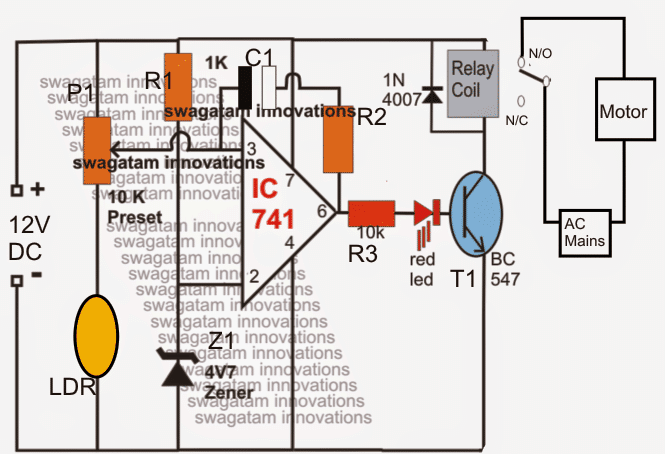
As long as there's an absence of water across the sensing zone, the LDRs experience the incident light (positioned from the opposite side, inside the tank) which in turn keeps pin3 of the IC low, however when water starts rising and tends to cover the LDR in the path, reverts to a high at pin3 of the IC which instantly prompts the opamp output to go high activating the relay and the pump.

A hysteresis control feedback resistor across the opamps (R2/C1)) make sure that the once the situation is sensed it stays latched for some predetermined time and the pump motor is allowed to run until the water has reached the bottom of the tank.

The time for which the opamp stays latched may be determined by adjusting the feedback resistor connected between the output and the input pins of the opamp.

You'll also like:

  • Industrial Tank water fill/drain controller Circuit
  • img 20170929 184835Simple Digital Water Flow Meter Circuit using Arduino
  • pumpPressure Switch Water Pump Controller Circuit
  • SMS based Water notification schematicSMS Based Water Supply Alert System

Filed Under: Water Controller Tagged With: Activated, Controller, Level, Light, Water

About Swagatam

I am an electronics engineer and doing practical hands-on work from more than 15 years now. Building real circuits, testing them and also making PCB layouts by myself. I really love doing all these things like inventing something new, designing electronics and also helping other people like hobby guys who want to make their own cool circuits at home.

And that is the main reason why I started this website homemade-circuits.com, to share different types of circuit ideas..

If you are having any kind of doubt or question related to circuits then just write down your question in the comment box below, I am like always checking, so I guarantee I will reply you for sure!

Previous Post: « Infrared Remote Control Safe Lock Circuit
Next Post: Simple Cellphone Jammer Circuit »

Reader Interactions

Comments

Chandan Parashar says:
September 16, 2015 at 4:42 am

dear swagatam,
what should be rating of R2 and C1 to have a latch up time of say 2 hours.
thanks in Advance.

Reply
Swagatam says:
September 16, 2015 at 11:27 am

Dear chandan, it'll have to be determined with some trial and error, it would be difficult to predict fixed values without a practical test.

Reply

Need Help? Please Leave a Comment! We value your input—Kindly keep it relevant to the above topic! Cancel reply

Your email address will not be published. Required fields are marked *

Primary Sidebar

circuit simulator image


Subscribe to get New Circuits in your Email


Categories

  • Arduino Projects (93)
  • Audio and Amplifier Projects (133)
  • Automation Projects (17)
  • Automobile Electronics (101)
  • Battery Charger Circuits (85)
  • Datasheets and Components (109)
  • Electronics Theory (149)
  • Energy from Magnets (27)
  • Games and Sports Projects (11)
  • Grid and 3-Phase (20)
  • Health related Projects (27)
  • Home Electrical Circuits (13)
  • Indicator Circuits (16)
  • Inverter Circuits (95)
  • Lamps and Lights (159)
  • Meters and Testers (71)
  • Mini Projects (28)
  • Motor Controller (68)
  • Oscillator Circuits (28)
  • Pets and Pests (15)
  • Power Supply Circuits (91)
  • Remote Control Circuits (50)
  • Renewable Energy (12)
  • Security and Alarm (64)
  • Sensors and Detectors (106)
  • SMPS and Converters (34)
  • Solar Controller Circuits (60)
  • Temperature Controllers (43)
  • Timer and Delay Relay (49)
  • Voltage Control and Protection (42)
  • Water Controller (36)
  • Wireless Circuits (30)


Other Links

  • Privacy Policy
  • Cookie Policy
  • Disclaimer
  • Copyright
  • Videos
  • Sitemap


People also Search

555 Circuits | 741 Circuits | LM324 Circuits | LM338 Circuits | 4017 Circuits | Ultrasonic Projects | SMPS Projects | Christmas Projects | MOSFETs | Radio Circuits | Laser Circuits | PIR Projects |

Social Profiles

  • Twitter
  • YouTube
  • Instagram
  • Pinterest
  • My Facebook-Page
  • Stack Exchange
  • Linkedin


Recent Comments

  • Swagatam on 9 Simple Solar Battery Charger Circuits
  • Gagana on 9 Simple Solar Battery Charger Circuits
  • Swagatam on Arduino 2-Step Programmable Timer Circuit
  • Swagatam on Simple Buck-Boost Converter Circuits Explained
  • Swagatam on IC IR2111 H-Bridge MOSFET, IGBT Driver IC: Full Datasheet, Circuit Diagram

© 2026 · Swagatam Innovations