The post presents a simple Li-ion emergency light circuit with over charge and low battery cut off features. The Circuit was requested by Mr. Saeed Abu and Y0f4N.
Technical Requirement
My requirement is:(1) Circuit is Operated by Nokia standard cell phone charger
(2) Battery nokia 3.7 volt
(3) Auto ac to dc changeover system when ac fail
(4) Battery overcharge protection system(auto battery full charge cutoff) with LED indicator.I have tried many times to develop such type of circuit but i failed. So Please bro help me urgently. Please design it simple.
The Design
The proposed Li-ion emergency light circuit with over charge and low battery cut off features functioning may be understood with the the following points:
Transistor T6 is basically configured to automatically sense and shut off the LED during the presence of mains AC and vice versa. Here a mobile charger is used for powering the T6 circuit.
As long as the mains input is available, the 1 watt LED stays switched OFF due to the presence of a positive potential at the base of T6, T6 starts conducting the moment AC mains fails illuminating the connected LED with the help of the attached Li-ion battery power.
T1 and T2 form the low battery detector stage and does the same when the Li-ion battery voltage falls below a certain predetermined level set by P1.
When this happens, T1 just stops conducting forcing T2, T3 to switch ON hard.
T3 passes the battery voltage to the base of T6 choking its conduction thereby shutting off the LED and inhibiting any further loss of voltage under the situation.
T4 and T5 are configured for the opposite function, that is for detecting the full charge of the li-ion battery.
P2 is appropriately set such that T4 conducts fully at this battery voltage.
With T4 fully ON, the base of T5 is unable to acquire the required negative biasing via R6 and thus is prevented from supplying the charging voltage to the battery, which in turn protects the battery from getting over charged and damaged in due course of time.
The red/green LEDs indicate the relevant states of the battery and the cut off conditions.
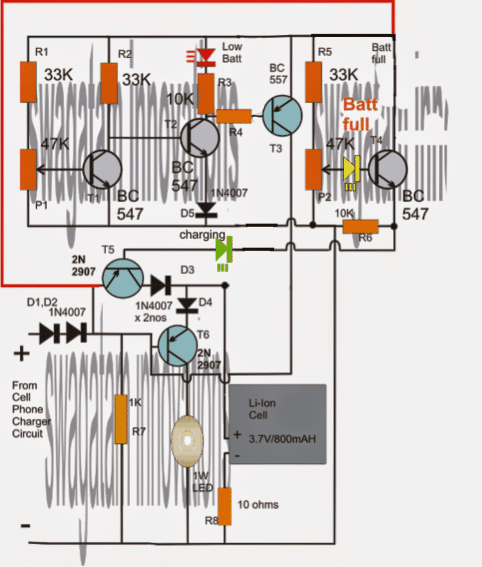
The 10 ohm with the negative of the battery may be eliminated, it's not worth with so many existing protections.
For getting a better response from the over-charge cut-off stage, the above circuit could be modified further with an additional transistor stage T5, as shown below:
Referring to the following circuit, we are able to the see a few crucial additions and removals:
IC 7805 has been added, diode at T6 collector is removed, and D1 position changed. These changes ensure that an exact 4.3V is able to develop across the emitter of T6 and ground, irrespective of the input voltage level.
D5 has been removed in order to provide a better illumination for the LED at the collector of T2.
All high value resistors have now been reduced to 1K for an increased current biasing for the BJTs.
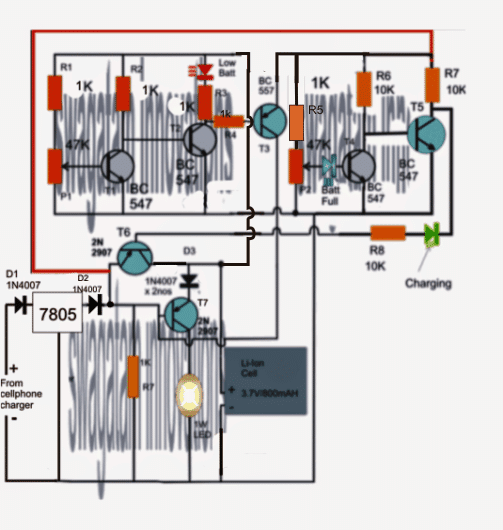
As suggested by one of the avid readers of this blog Mr. Syed, the above diagram needed some corrections.
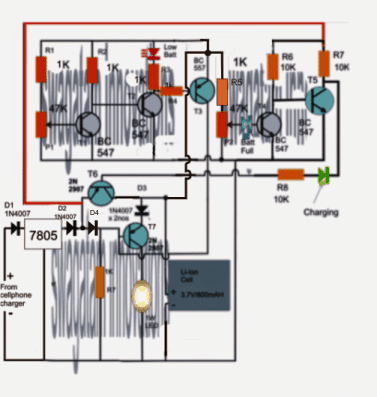
The finalized diagram of the Li-ion emergency light circuit with over charge and low battery cut off featurescan be seen below:


Comments
Hi sir,
I hope you are doing good.
I have some LiFe 18650 (4.5 v 2500 mah) batteries which is removed from old laptop battery. I have used it to make emergency light, I used smd leds which is removed from old led buld. When I connected it to the led its glowing very good but heating up very quickly. The led forward voltage is 4v, 50ma. Do I need to use resistor? Pls advise me.
Hi Naresh, yes definitely you will need a resistor for the LED to drop the excess 0.5 V.
The formula is R = (Supply – LED V) / LED Current
Hi sir
I have added a 10 ohm 1/4w resistor in series with battery positive, now the resistor is heating up. What would be the problem sir.
Hi Naresh, please specify what kind of load sre you using, I’ll work out the resistor for you, but 1/4 watt will not do, it must be at least 1 watt.
Hi sir,
I am using 4v 50ma smd leds 10nos in parallel.i have tried with 10 ohms 1 watt resistor also but when I use it the brightness is going low.
Sir iam using 4.5v 2500mah Life battery not 3.7v
Then 10 ohms is correct, and you should use 10 ohm separately for each LED
Hi Naresh, for 4 V 50 mA LEDs, and 3.7V Li-ion cell you will not require any series resistor. Simply connect the LEDs in parallel without any resistor.
hi swagatam
i have a question, in 3.7v li-ion battery the charging voltage is 4v how about lead acid battery rated at 4v what will be the charging voltage ?
Hi Abba, you can use any type battery as per your preference, Li-ion batt can be charged quickly that’s the only advantage of it
Hi, how can I modify this circuit to use it as mobile power bank?
too many modifications might be required, so I would recommend the following concept instead
https://www.homemade-circuits.com/2013/12/usb-automatic-li-ion-battery-charger.html
use a cellphone charger for supplying the above linked circuit.
I set cut off preset I adjust 4.2v voltage unplug adapter then used the battery voltage is decrease 4.1v connected circuit then not charging I check circuit out voltage 4.1v or 4.2v then adjust cut off preset voltage increase 4.3v or 4.4v then battery charging then over charging again I set cutoff voltage 4.2v again and again I set cutoff voltage I want to parent one time set the cutoff voltage sir please update any mobile charger supportable single ic used low cost circuit diagram please sir
5V input is used through the show diodes to finally make it into 4.2V for the battery
This circuit who many voltage used input this circuit cutoff voltage please tell sir
if you are having difficulty with the above design you can try the following more accurate one:
https://www.homemade-circuits.com/2013/12/usb-automatic-li-ion-battery-charger.html
charging cut off led glowing in unplug adapter Glowing led then charging led glowing in unplug adapter Glowing led this problem please sir solution
remove the battery when unplugged, that's probably the only solution…
How to set cut off voltage p2 & how to set low battery cut off voltage p1 please tell me sir
Please see the second comment from top.
p1 & p2 is variable resistor in 1st diagram??? I will use 3.7v 1a (Sunca match box size battery) battery to this circuit. so what fixed resister I have to use in place of p1 & p2??
p1, p2 will need to be practically experimented a lot to learn about the required exact fixed value replacement…
dear i have a circuit with birthday tone but how can i convert it as a calling bell?
dear I'll post the an amplifier circuit soon which you can use with the tune for implementing a door bell.
dear i need temperature controlled AC Fan Dimmer circuit and Birthday song tone Calling Bell circuit diagram.do u have this pleas share it.
dear, I have one related circuit posted below:
https://www.homemade-circuits.com/2013/01/automatic-temperatureclimate-controlled.html
the birthday song tone calling bell can also be designed but first you'll have to procure the "birthday" tune COB (chip on board) without which the song cannot be implemented.
Ok sir. ill check on breadboard first. Another thing, how do i change the output voltage to 1.5v instead 3.7v? as i want to run a 1.5v (150mA approx) dc motor instead LED.How may i do that?
add 3 more diodes in series after 7805 while charging the 1.5V batt
a 10 ohm will affect and reduce current to the load, using 3 diodes will keep current intact, but reduce volts to the preferred limit.
sir, if I use 1.5v battery, then what's need to be changed? and on 3.7v battery, you told to use 3 diode in series. Why not a simple 10 ohm resistance? will you kindly explain?
for changing the output to 1.5V you can either change the battery to 1.5V or use 3 nos 1n4007 diodes in series with the output positive
Dear sir, what will be the input voltage? as there is a 7805, i need more then 5v for that, right? but as schematic, it says to use 5v cell phone charger.what to do?
Please help!
Thanks.
since D2 is introduced, therefore only one diode at the emitter of T7 is sufficient, no need of two diodes here.
before designing a PCB I would recommend to test it out over a general purpose board for a trial and verification.
Oh i see. i didnt know that. 🙂 thanks for the prompt reply. I am designing a pcb of this schematic. Another thing i don't understand. On 3rd schematic, from the collector of T6 toward emitter of T7, it is shown to use 2 pcs of diode, but shows only one. do i need to add 2 diode parallel or serial to there?
Thanks.
Dear white dragon, a cellphone charger will normally have a slightly higher voltage than 5V, so it's OK to use a cell phone charger as the input, the 7805 is only for ensuring that the li-ion cell does not get an over voltage due to a wrong high voltage input
hi swagtam,
i want to ask u that same configuration can be use for 12v battery and 12v charger application….???
…7805 will need to be removed, and a precise 14V will need to be applied at the emitter of T6
hi jignesh, yes the above same circuit can be used for 12V batts also
bro is ur last updated circuit has overcome all of it's drawback? did u test it practically the updated circuit?
bro i haven't tested it but it looks perfect because most of the issues have been corrected in the last design and it should work as proposed if it's done exactly as shown.
The reason why i am skipping the series config. is that if an LED fails in a branch all the LEDs associated with that LED in that particular branch will be turned off affecting the overall brightness considerably
Today all LED lamps depend and use series LED configuration, some street lights even use 50 LEDs in series. Good quality LEDs will never fail no matter how these are configured, as long as everything's done as per the specs.
Sir,
I need a simple LED light circuit to fit inside a car….
I am using 10 no.s of white LEDs… The LEDs are connected in parallel for maximum efficiency… So 10 parallel connections are there… Power for the bank is taken from the Car battery voltage… I need to drop a maximum of 600 mA from the source ( 60 mA for each LED ) for maximum brightness….
By calculations i have found the following ;
Resistance needed for a single LED to draw a current of 60 mA is:
( 12 – 3.1 ) / 0.06 = 148.33 ohms
Power rating of that resistance :
( 12 – 3.1 ) * 0.06 = 0.534 W
150 ohm 1W resistance can be safely used…
So 10 no.s of such resistances have to be used… The main drawback of this config. is, more of the board space is getting utilized.
Now i am gonna chose for a simplest design which uses only one main resistance instead of placing separate limiting resistances for each LEDs…
So
The total current required = 600 mA = 0.6 A
Voltage = 12V – 3.1V = 8.9 V
So R = 8.9 / 0.6 = 14.833 ohm
Power rating of the resistance = 8.9 * 0.6 = 5.34 W
Are my calculations correct sir ??
I need your valuable comments on these
Arun, series connection gives more efficient results for LEDs, make two led strings with 3 leds in series on each string, and connect them in parallel.
the series resistor on each string would be then:
12 – 9.9/.06 = 35 ohms, 1/4 watt
Sir,
Sorry for disturbing you much…
All the problems facing by me are due to my carelessness while making out the circuit on BB…
I got the result of the above circuit in a fruitful way so that i can proceed further…
Hope you will understand my lack of time in concentrating much on the electronics due to a lot of works related to my profession to be completed …
Also expecting your valuable help in future projects that i am planning to do..
Thank you sir
Sure Arun, thanks! and keep posting.
Sir,
On checking today,
the diagram i have sent to you via email, when assembled on the bread board, acts as the same in the VERO board..
The Battery full indicator illuminates even on power failure… also the following points were noted
– Battery full voltage is 4.7 V
(1).
the Base of T7 gets voltage about 6.4 V when a 7.0 V charging source ( to charge the 4 V 1000 Ah battery taken from the mosquito bat ) source is used, thereby the LED bank connected between its collector and ground is not active…
but when source is disconnected ( power failure ) the base voltage is getting reduced only to 3.8 V not to zero, even-though the LED bank begins to illuminate
(2).
The battery full indicator LED continues illuminating even after power failure
(3).
Correct adjustment of Higher voltage cut of can't be achieved
(4).
Even if the higher voltage cut off is achieved, the charging voltage available for the battery doesn't becomes zero..
I am expecting better solutions for the mentioned problems in the above points
Arun, others have also tried the above circuit they are quite satisfied with it, I am not sure why you are facing so many issues.
Anyway here are the answers:
"Battery full" LED will stay illuminated because it's connected with the battery line, so it's fine, you can eliminate this LEd entirely and just keep the red and green LEd for the indications.
1) This case is also normal, D2 is dropping the 7V to 6.4V, however despite my of repeated suggestions you have not used a 7805 IC that means you will get all the wrong and dangerous results while the battery gets fully charged.
On power failure T6 gets activated via R7 that's why you see 3.8V at its base, it's due to battery voltage minus the 3.8V which could be 0.6V, which is exactly what a BJT needs to conduct.
2) i have answered this above.
3) This is because you have not used 7805 IC and did not take care about making the emitter of T6 exactly equal to the full charge level of the battery.
4) the answer is same as above
bro ur given last circuit is overcome all the drawback of over charge cut off feature which i have faced during build it?
…sorry the above recommendation is not correct, rather another diode needs to be added between the emitter of T6 and the base of T7 so that the battery voltage does not reach the emitter of T6 during backup.
Thanks for the feedback bro, that's great… a small additional refinement could make it more perfect, the emitter of T6 needs to be shifted to the anode of D2 from its existing position, this will make it more reliable in my opinion.