It is possibly the smallest LED flasher to date, which is able to flash an LED ON/OFF infinitely using a single transistor, a resistor, and a capacitor.
Can you imagine making a great looking LED flasher or blinker with just a single transistor and a couple of other passive parts?
That's exactly what I have explained in this post! This is perhaps the world's simplest and the tiniest LED flasher you can get!

How it Works
I came across this phenomena some eight years ago (2006), accidentally, while trying to make a smallest possible motorcycle side indicator flasher, and was surprised by the phenomenon.
However, then I realized that the phenomenon was already discovered by Mr. Dick Cappels while investigating the negative resistance theory in BJTs by the Japanese researcher Mr. Reona Esaki (Aka Leo).
Reona Esaki's thesis work in the relevant field and on tunnel diodes ultimately won him the Nobel Prize in 1972.
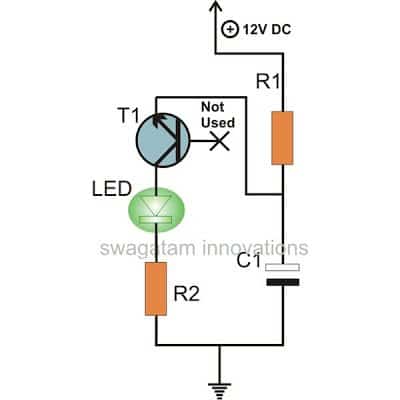
That looks too good to be true, however the following diagram will simply prove that it's really possible to create a working LED flasher circuit using just one general purpose transistor as the main component.
At that time, I was unaware that this was occurring as a result of the transistor's negative resistance characteristics.
The circuit actually exploits the negative resistance factor in transistors to produce the blinking effect.
I'll be soon writing a comprehensive article on this and we'll see there how the concept can be modified in many different ways.
Parts List for the proposed single transistor LED flasher circuit
- R1 = 2K7,
- R2 = 100 Ohms,
- T1 = BC 547,
- C1 = 100 uF to 470 uF
- LED = Any Type, any color
The flashing rate could be varied either by changing the value of R1 or C1 or both together. But the supply voltage not be less than 9V otherwise the circuit might fail to work correctly.
You may also love to read this article: Blinking LED Circuit using LDR
Circuit Diagram
Calculating the LED Flashing Frequency
You can use the following formula for approximately calculating the LED ON/OFF blinking rate
Frequency (f) ≈ 1 / (2.1 * R * C)
Where:
- R is the resistance in ohms
- C is the capacitance in farads
This formula gives us a rough idea of what the flashing frequency might be. But the actual frequency can be affected by a hand full of different factors, for example like the specific components you are using in the circuit, the voltage of the power supply and also the temperature.
To adjust the flashing rate:
- Increase the resistance (R): If we make the resistance higher, it will take longer for the capacitor to charge up which means the flashing rate will be slowed down.
- Decrease the capacitance (C): On the opposite side, if we lower the capacitance vaalue, the capacitor will charge up faster causing the flashing rate to speed up.
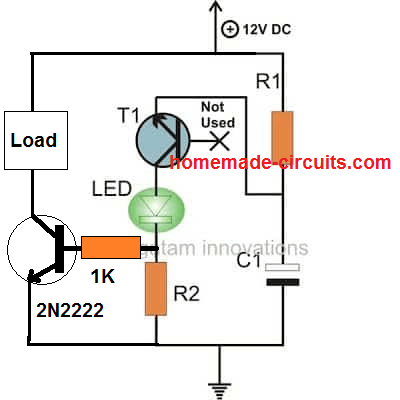
Connecting an External Transistor for Higher Loads
Video Clip:
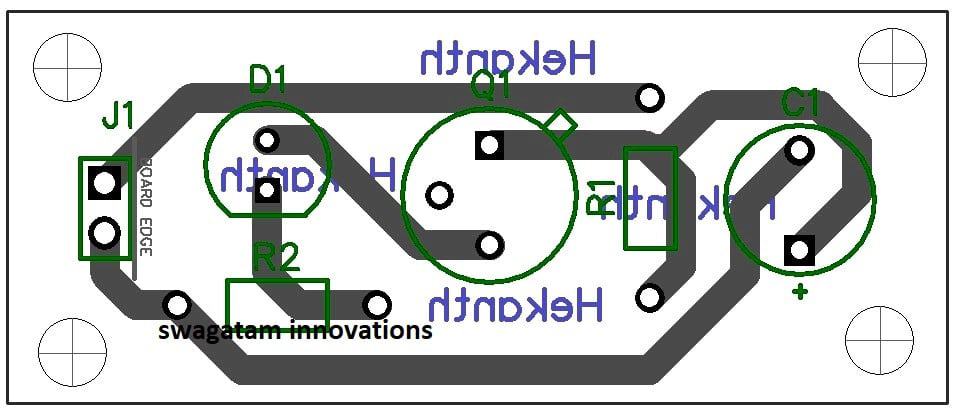
PCB Design
Circuit Basics
In this circuit we are using one NPN transistor which is BC547, one electrolytic capacitor of 330 uF, two resistors of 2.7 k and 100 ohm, and one LED, and supply voltage is +12 V.
Here the LED is connected in the collector path of transistor, while the base of the transistor is not connected directly to the supply, but instead it is controlled indirectly through the RC network made by the 2.7 k resistor and the capacitor, and this indirect base control is the main reason why oscillation becomes possible.
Start Condition When Power Is Applied
When power is applied then the capacitor is in a fully discharged condition at the start, and because the capacitor is empty at this moment, current immediately starts flowing from +12 V supply through the 2.7k resistor into the capacitor.
At the same time a small voltage slowly begins to appear across the capacitor and this rising voltage also starts appearing at the base of the 2N2222 transistor, but the transistor still remains in the OFF state because the base voltage is not yet high enough.
Capacitor Charging Action
As time passes, capacitor continues to charge slowly through the 2.7 k resistor and because this resistor limits the current, voltage rise at the capacitor and at the transistor base is gradual and not sudden
When the base voltage reaches around 0.6 V to 0.7 V then base-emitter junction of the transistor becomes forward biased, and at this point the transistor suddenly turns ON.
LED Turns ON And Rapid Discharge
When the transistor turns ON then collector current starts flowing through the LED and 100 ohm resistor, and because of this current flow the LED lights up.
Now the important thing happens because the transistor in ON state provides a very low resistance path for the capacitor, so capacitor discharges very quickly through the base-emitter junction and through the transistor itself, and this fast discharge is the key feature of the Esaki oscillator.
Transistor Turns OFF
As the capacitor discharges rapidly, then base voltage falls sharply.
When this base voltage drops below the required base-emitter threshold then the transistor immediately switches OFF.
When the transistor switches OFF then the collector current stops flowing and the LED also turns OFF, and circuit returns back to its initial condition.
Cycle Repeats Continuously
When the transistor is OFF again then capacitor once again starts charging slowly through the 2.7 k resistor, and this slow charging followed by sudden discharging keeps repeating again and again.
Because of this continuous repetition the LED keeps flashing ON and OFF as long as the supply voltage remains connected.
Why This Circuit Is Called Esaki Oscillator
This type of oscillator works because of non-linear behavior of a semiconductor junction, mainly the base-emitter junction of the transistor.
And the sudden ON OFF action caused by fast discharge of capacitor creates a behavior that looks similar to negative resistance effect observed in tunnel diodes, which were studied by Leo Esaki.
That is why this simple single-transistor relaxation oscillator is often referred to an Esaki oscillator.
Flashing Speed Control
The flashing speed of the LED mainly depends on the RC time constant formed by 2.7 k resistor and 330 uF capacitor, so when the resistor value is increased then the capacitor charges more slowly and LED flashes more slowly.
When the capacitor value is increased then OFF time becomes longer and flashing rate reduces, but the 100 ohm resistor does not affect oscillation frequency because it is only used to limit the LED current and protect the LED and the transistor from excess current.
Why This Esaki Oscillator Does Not Work At 5 V Or 6 V
Now we see this circuit works fine at 9 V or 12 V but when we try at 5 V or 6 V then the circuit stops working or works very weak.
The reason is simple, the voltage becomes too low for this type of oscillation.
When we give supply then the capacitor must charge and push voltage to the base of the transistor but the transistor base-emitter already needs around 0.6 V. And the LED in the collector also needs voltage to conduct, and the resistors also eat some voltage.
So now when supply is only 5 V or 6 V then very little voltage is left for proper action.
So the capacitor charges very slowly and also cannot reach a strong enough level and when the base voltage reaches near 0.6 V then the transistor only turns ON very weak, not strong.
Because of this weak ON condition the capacitor cannot discharge fast and without fast discharge the oscillation cannot happen properly.
When the transistor does not switch sharply then the circuit stays stuck in between ON and OFF and the LED either stays dim or does not blink at all. This is why at low voltage the circuit fails.


Comments
Hello dear friends
It is a very good and economical circuit, I have made it, I suggest you make several of it using different R&C. As a result, the frequencies of each will be different and when they are together in one place, they create a beautiful set with unpredictable combinations. Also, using two transistors (one oscillator which is seen in the circuit above and oneA current boosting transistor (preferably a 2N2222) can drive up to 4 LEDs. If 4 circuits are made with 4 LEDs, we will have 16 attractive LEDs. To boost, remove the LED and replace it with a 100k resistor, and connect the base of the boosting transistor to the collector of the oscillator transistor.
thanks
Sounds like a great idea, thanks for your interesting feedback!
Hi Swagatam,
In the single-transistor circuit, if there’s no connection to the base of the transistor, isn’t it just a diode?
Hi Tom,
For the BJT to work like a diode, its base must be connected to its collector.
Here the base is open, and furthermore the emitter is connected to the positive, which is rather supposed to be connected to ground in a standard configuration, so the design is indeed weird.
Very interesting phenomena! Can you explain please WHY this is working? I replaced the EC junction with a series of diodes with the same overall forward voltage (about 7.5 V). All I got was few burned LEDs… Thank you!
Thanks, and I appreciate your curiosity regarding the circuit working. I have updated the full explanation at the end of the above article.
Did you connect a limiting resistor in series with the LED? But anyway, diodes can be be used in place of transistor for the circuit replication…
Thanks a lot for your quick answer!
I still cannot figure out how the base-emitter voltage can become forward biased and reach 0.6- 0.8 V. but I will mull over… Maybe using an oscilloscope.
Thanks again and have a great weekend!
The working characteristic of the BJT in this circuit is not standard, that is why we are finding it difficult to simulate it…Yes, an oscilloscope might correctly explain the working behavior of the transistor.
Thanks for your feedback!!
Thanks for the clarification. We’re agreed that the design is a little weird. 🙂
Yep :p, thanks for your feedback…
Hi Swagatam,
Any reason why this would not work? I have checked the components and re-checked the breadboard placements. I am using a 12V power source. Using 470uF (but have also tried 100uF).
Hi Michael,
There could be 3 possible reasons.
Transistor is faulty, or connected the wrong way.
LED is faulty or connected the wrong way.
Supply connected the wrong way.
Thanks Swagatam.
Thinking it must be the transistor. LED works fine. 12V power reads correctly on the multimeter. I am using an N2222a NPN with the collector to the cathode of the LED. Breadboard check out ok too. Weird as I had this working a few months ago, boxed it up, took it out last week and it is not working now and no reason for it. Should I specifically use the BC547? As I said though this circuit was working originally.
That looks strange indeed?? If it was working earlier that means the 2N2222 is fine to be used here.
Since the transistor is the heart of the circuit it makes sense to try a different version, for example the BC547.
In my experiment I had used a BC547 so i would specifically recommend this BJT over any other variant.
Let me know if it solves the problem or not.
Hi Swagatam. Changed out the transistor and nothing improved. Changed all component positions on the breadboard. Nothing improved.
Changed breadboards. Nothing improved. Changed out the transistor again. Starts flashing. What the?!! Frustrating but glad it works now.
thanks for your help.
Hi Michael, as you can see the circuit design is not standard rather uses an unusual “negative resistance characteristics” of the BJT through a non-standard configuration, maybe that is why things can be unpredictable sometime…
Anyway, I am glad your LED is flashing again now. All the best to you…
Hi Swagatam. Got it working eventually. It’s very voltage sensitive. 9V works. 12V it stops. But it works. Instead of an LED on a 9V circuit, could I just use this as a timing circuit to open and close a higher voltage circuit with a brighter LED? I need a really bright red LED. Ideally red, white and yellow cycling on consecutive pulses from the timing circuit. Can you suggest some really bright really LEDs? They will run on a 20V circuit.
Thanks again.
Hi Michael,
Glad to know you could eventually figure out the issue.
As you said the circuit is too sensitive, that means removing the existing LED might again cause it to malfunction.
So I would recommend keeping that LED as is, and configure the external LED as shown in the second diagram.
But for 3 consecutive LEDs you will need a 4017 IC to be configured with the above flasher circuit.
Let me know if you want that circuit.
Thanks. Yes. That would be helpful. What are the smallest and brightest LEDs you have come across? I am finding 12V on a standard LED is not bright enough. The input is a 20V line so I need to divide that to a 9V circuit for the flasher and a small motor. The three colour LEDs will get 20V.
Thanks
Just 3.3V is enough to get super bright illumination on any good LED, so 12V might be sufficient for even 4 LEDs in series.
The LED brightness depends on the quality of the LED and its series resistor value.
The 20 mA red LEDs which I have are so bright that it is painful to look at them even for a second.
The red ones are normally the brightest and the green ones are normally not so bright.
You can probably check the datasheet of a particular make and check its lumen rating verify its brightness level.
You can try the following design for your specific application.
https://www.homemade-circuits.com/wp-content/uploads/2025/03/configuring-simple-flasher-with-4017-IC.jpg
Hi. Why doesn’t that work so well with a small blue led?
Hi, it should work well with all types of LEDs regardless of color or any other specifications, as long as the voltage input is between 9V and 12V DC. Try adjusting the resistor value for optimal illumination.
Thanks. Blue led works fine with a 1K resistor.
Ok, sounds great, thanks for the feedback…
Dear Swagatam, i have 2 diff. questions.1. For flasher with single transistor, as per the diagram, Not sure what is the issue, only when i touch the emitter or collector , ( Some earth effect), the flasher is working. Not sure why. I verbatim did as per your diagram. can you help.
2. A FEW Weeks back i sought your advice for spike arrestor / suppressor circuit, and With GDT / MOV, You were very helpful. I have a doubt, that the client site, is basically an explosive environment kind of, since any unsafe act will lead to probable safety issue. Is the GDT usage, is common for all environments or it should not be used in an exploisve or fire hazard environment. I ask this query since, i saw some videos on nice working of GDT, but it conducts in the hydrogen gas environment within the tube with pop up sound. Is it a safety issue for a fire / explosive hazard environment pl.
Thank you KRAB Babu, for posting you questions.
The above flasher circuit is tested by me and I did not encounter any such issues. The flasher that I build started working immediately upon switching ON.
Make sure the transistor you are using is a good quality one and not a duplicate one, also make sure the power supply is a 12V DC.
Let me know how it goes.
As for the GDT issue, yes it can be hazardous to use GDTs in explosive environments because GDTs are not intrinsically safe.
In explosive environments, make sure to use only those devices that are certified as intrinsically safe.
Also, for a given transistor you might find it helpful to “play around” with the power supply voltage.
Dear Swagatam, thank you very much for your rpely. i dont know if i used poor quality as i buy that from market. I WILL Try that again, as you said.
Thanks for your inputs on GDT Also. your support is excellent and prompt.
You are most welcome Dear KRAB Babu, all the best to you.
Let me know if you have any further questions.
May I ask you question, but a bit diff.. Along with the flasher circuit with one transistor, I plan to drive using a Toggle switch for alerting an Operator . In addition, upon this flashing signal, the OPERATOR has to push down a push button switch ( Latching – to Normally closed position ). But, upon changing the push button switch to NC condition, the flashing must stop. I am setting up the circuit, that current flows to low resistance path and it will work.
The latching and unlatching of the relay should be through a single push button, right?
The application looks possible to me.
thanks for the reply swagatam. THE LATCHING and unlatching of the relay is one part. But, some flashing action, i want to happen , that needs to be stopped by a push button that is part of latching circuit. i also shared some pictures to you by mail. could you please advice me.
Thank you KRAB Babu, I think it is possible to design a circuit diagram as per your requirement. Once the relay is latched and then unlatched the flashing LED would stop simultaneously.
In which email ID did you send the pics, I checked my two email IDs but could not find your email.
Thank you for your reply. i sent the pictures in this mail id sorry though for confusion from me. since, i did not have any other mail id . no-reply@homemade-circuits.com
Sorry, that’s not the correct email ID.
You can find the email IDs on this page:
https://www.homemade-circuits.com/contact/
Hi Swagatam.
Thanks for your enthusiasm and willingness to answer questions.
Do you think it would be possible to put a capacitor between T1 and the LED to make that fade in and out?
I’ve developed spinal cancer and getting back into electronics as I’ve lost mobility.
Hi Dave,
I think a capacitor put in parallel to the LED will be enough to produce a certain of fading effect.
I am sorry about your illness, I wish you a speedy recovery.
I dont think the circuit works looking at the diagram for how can the current flow from positive to ground in that npn transistor?
Well this may have been a typo error, the collector and emitter should be interchanged.
The diagram is actually correct. The configuration indeed appears to be wrong, but it actually works, and it works only when connected in the way it is shown. It works by using the transistor’s negative resistance characteristics.
hi i was wondering if there was a way to make a 5v “flasher” i am building a simulator with a real dash out of a truck and want the original turn signals to work on the dash i have replaced the 12v lights with 5v leds and want them to flash when i use the turn signal switch and hazards button any help is appreciated
You truck flasher will have a relay….so the 5V LED can be wired parallel to the relay coil or the contacts with a series resistor, for getting a synchronized flashing action.
but the factory flasher and relay are 12v im using a generic joystick controller to power the turn signal switch and thats 5v i was looking for something to use in line the original circuit to replace the factory flasher and relay
Would the circuits from this article work for you? You can use 5V for these circuits with slight modifications:
https://www.homemade-circuits.com/3-pin-solid-state-car-turn-indicator-flasher-circuit-transistorized/
The post indicates the BC547 which is an NPN yet the schematic indicates the Emitter connected the + potential down stream of a current limiting R with a voltage dropper from the collector to the LED. Is this correct? I was under the impression the junction of the transistor would not allow current to pass reverse such as indicated here. Just curious as I never tried working with negative resistance as in stated in the text above, for that matter I never heard of negative resistance until here as far as I can remember. Just wanting to know if this a was an oops in the drawing or the way it actually works. I suppose I could just build it as is since I have all the parts on hand. I have a perfect use for this circuit in a project I’m working on now, if works that’s great, other wise it’s a flashing LED when they arrive in the mail in a week or so.
Yes, the circuit really works, as you can see it in the video.
It is actually a special type of configuration in which the BJT works using its negative resistance theory to conduct in reverse.
You can try it, it will surely work.
I came across this by accident as well, it does work and I have been wondering
Well I can say that it did work for a while. It appears the bread board I’m using is wore out. Darn it. I was attempting to adjust the flash rate and had the capacitance up to 1000uf to get the flash rate slowed down to a more suitable timing, was pretty happy with it but would like to have had it a bit slower for my purpose. I like the bright on and the short duration but would like to have the duration on a bit longer. I guess I will try a different board to see if I can get it flashing again and then experiment with the On duration and pulse rate. But the idea is the simplicity and very low component count, kind of defeating the purpose going beyond what it is. I guess the ever popular 555 is my alternative now so it’s good to know what I have learned here today.
Thanks for the feedback!! You can also try varying the R1 resistor to adjust the flash rate
A DC load cannot be used with a triac, it will get latched. You can probably try the second circuit from the above article. You can replace the 2N2222 with a bigger transistor such as TIP142 and connect your LEDs across the load points.
Specifications are difficult to find. The strips are mostly available in 12V, 300 LEDs, available batteries are 5V, time on is 300ms, frequency is ~2HZ. So the circuit has to boost the voltage. The operation period will be <2 minutes usually. I have some BTA16 800B if they can be used.