Designing an inverter transformer can be a complex affair. However, using the various formulas and by taking the help of one practical example shown here, the operations involved finally become very easy.
The present article explains through a practical example the process of applying the various formulas for making an inverter transformer.The various formulas required for designing a transformer has been already discussed in one my previous articles.
Update: A detailed explanation can be also studied in this article: How to Make Transformers
Designing an Inverter Transformer
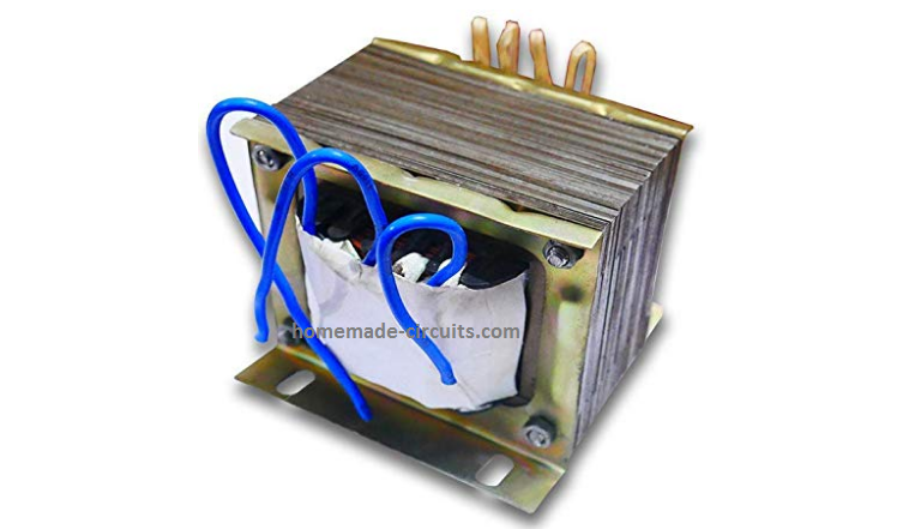
An inverter is your personal power house, which is able to transform any high current DC source into readily usable AC power, quite similar to the power received from your house AC outlets.
Although inverters are extensively available in the market today, but designing your own customized inverter unit can make you overwhelmingly satisfied and moreover it's great fun.
At Bright Hub I have already published many inverter circuit diagram, ranging from simple to sophisticated sine wave and modified sine wave designs.
However folks keep on asking me regarding formulas that can be easily used for designing a inverter transformer.
The popular demand inspired me to publish one such article dealing comprehensively with transformer design calculations. Although the explanation and the content was up to the mark, quite disappointingly many of you just failed to grasp the procedure.
This prompted me to write this article which includes one example thoroughly illustrating how to use and apply the various steps and formulas while designing your own transformer.
Let’s quickly study the following attached example: Suppose you want to design an inverter transformer for a 120 VA inverter using a 12 Volt automobile battery as the input and need 230 Volts as the output. Now, simply dividing 120 by 12 gives 10 Amps, this becomes the required secondary current.
Want to learn how to design basic inverter circuits?
In the following explanation the Primary Side is referred to as the Transformer side which may be connected at the DC Battery side, while the Secondary side signifies the Output AC 220V side.
The data in hand are:
- Secondary Voltage = 230 Volts,
- Primary Current (Output Current) = 10 Amps.
- Primary Voltage (Output Voltage) = 12-0-12 volts, that is equal to 24 volts.
- Output Frequency = 50 Hz
Calculating Inverter Transformer Voltage, Current, Number of Turns
Step#1: First we need to find the core area CA = 1.152 ×√(24 × 10) = 18 sq.cm where 1.152 is a constant.
We select CRGO as the core material.
Step#2: Calculating Turns per Volt TPV = 1 / (4.44 × 10–4 ×18 × 1.3 × 50) = 1.96, except 18 and 50 all are constants.
Step#3: Calculating Secondary Current = 24 × 10 / 230 × 0.9 (assumed efficiency) = 1.15 Amps,
By matching the above current in Table A we get the approximate Secondary copper wire thickness = 21 SWG.
Therefore the Number of Turns for the Secondary winding is calculated as = 1.96 × 230 = 450
Step#4: Next, Secondary Winding Area becomes = 450 / 137 (from Table A) = 3.27 sq.cm.
Now, the required Primary current is 10 Amps, therefore from Table A we match an equivalent thickness of copper wire = 12 SWG.
Step#5: Calculating Primary Number of Turns = 1.04 (1.96 × 24) = 49. The value 1.04 is included to ensure that a few extra turns are added to the total, to compensate for the winding losses.
Step#6: Calculating Primary Winding Area = 49 / 12.8 (From Table A) = 3.8 Sq.cm.
Therefore, the Total Winding Area Comes to = (3.27 + 3.8) × 1.3 (insulation area added 30%) = 9 sq.cm.
Step#7: Calculating Gross Area we get = 18 / 0.9 = 20 sq.cm.
Step#8: Next, the Tongue Width becomes = √20 = 4.47 cm.
Consulting Table B yet again through the above value we finalize the core type to be 6 (E/I) approximately.
Step#9: Finally the Stack is calculated as = 20 / 4.47 = 4.47 cm
Table A
| SWG | AMP | Turns per Sq.cm |
|---|---|---|
| 10 | 16.6 | 8.7 |
| 11 | 13.638 | 10.4 |
| 12 | 10.961 | 12.8 |
| 13 | 8.579 | 16.1 |
| 14 | 6.487 | 21.5 |
| 15 | 5.254 | 26.8 |
| 16 | 4.151 | 35.2 |
| 17 | 3.178 | 45.4 |
| 18 | 2.335 | 60.8 |
| 19 | 1.622 | 87.4 |
| 20 | 1.313 | 106 |
| 21 | 1.0377 | 137 |
| 22 | 0.7945 | 176 |
| 23 | 0.5838 | 42 |
| 24 | 0.4906 | 286 |
| 25 | 0.4054 | 341 |
| 26 | 0.3284 | 415 |
| 27 | 0.2726 | 504 |
| 28 | 0.2219 | 609 |
| 29 | 0.1874 | 711 |
| 30 | 0.1558 | 881 |
| 31 | 0.1364 | 997 |
| 32 | 0.1182 | 1137 |
| 33 | 0.1013 | 1308 |
| 34 | 0.0858 | 1608 |
| 35 | 0.0715 | 1902 |
| 36 | 0.0586 | 2286 |
| 37 | 0.0469 | 2800 |
| 38 | 0.0365 | 3507 |
| 39 | 0.0274 | 4838 |
| 40 | 0.0233 | 5595 |
| 41 | 0.0197 | 6543 |
| 42 | 0.0162 | 7755 |
| 43 | 0.0131 | 9337 |
| 44 | 0.0104 | 11457 |
| 45 | 0.0079 | 14392 |
| 46 | 0.0059 | 20223 |
| 47 | 0.0041 | 27546 |
| 48 | 0.0026 | 39706 |
| 49 | 0.0015 | 62134 |
| 50 | 0.0010 | 81242 |
Table B
| Type | Tongue Width (cm) | Winding Area (cm²) |
|---|---|---|
| 17 (E/I) | 1.270 | 1.213 |
| 12A (E/12I) | 1.588 | 1.897 |
| 74 (E/I) | 1.748 | 2.284 |
| 23 (E/I) | 1.905 | 2.723 |
| 30 (E/I) | 2.000 | 3.000 |
| 21 (E/I) | 1.588 | 3.329 |
| 31 (E/I) | 2.223 | 3.703 |
| 10 (E/I) | 1.588 | 4.439 |
| 15 (E/I) | 2.540 | 4.839 |
| 33 (E/I) | 2.800 | 5.880 |
| 1 (E/I) | 2.461 | 6.555 |
| 14 (E/I) | 2.540 | 6.555 |
| 11 (E/I) | 1.905 | 7.259 |
| 34 (U/T) | 1.588 | 7.259 |
| 3 (E/I) | 3.175 | 7.562 |
| 9 (U/T) | 2.223 | 7.865 |
| 9A (U/T) | 2.223 | 7.865 |
| 11A (E/I) | 1.905 | 9.072 |
| 4A (E/I) | 3.335 | 10.284 |
| 2 (E/I) | 1.905 | 10.891 |
| 16 (E/I) | 3.810 | 10.891 |
| 5 (E/I) | 3.810 | 12.704 |
| 4AX (U/T) | 2.383 | 13.039 |
| 13 (E/I) | 3.175 | 14.117 |
| 75 (U/T) | 2.540 | 15.324 |
| 4 (E/I) | 2.540 | 15.865 |
| 7 (E/I) | 5.080 | 18.969 |
| 6 (E/I) | 3.810 | 19.356 |
| 35A (U/T) | 3.810 | 39.316 |
| 8 (E/I) | 5.080 | 49.803 |



Comments
please transformer laminations are very scarce to get, I checked online to purchase for 5Kva, their minimum quantity is in 100kg to 1 tonnes. please sir is there any guide?
Seun, in that case you can consider buying a readymade transformer and rewind it as per the calculations, or go for a ferrite based transformer…
Sir, do you mean ferrite based cores are readily available online easily?
Yes, ferrite cores are easily available and iron core readymade transformers are also available…
Thanks sir. If I want to make the secondary voltage 300v output for the iron core, please how will I calculate the turns.
Thanks Seun
For 300V secondary output, you just have replace all the 230V entries given in the above calculations, with 300V.
please I need a 2000Watt transformer with the following v
alues: Primary:18V-18V,12V center tap, Secondary:600V,230V-0V ,12V-0V
Please can I wind the inverter transformer 350vac? Thanks sir
Yes you can do it..
Hello sir, please how can I use 1 single transformer with secondary output with 8 ends to charge a 4 battery sets in series, 48v. I want to use the trafo to charge the batteries individually not as a whole.
Hello Daniel, What are the voltage and current specifications of the 4 batteries and what are voltage and current specifications of the transformer output wires? Please let me know this, i will try to figure it out.
Thanks sir, Engineer Swatagam, I appreciate. The batteries are lead acid 26ah/12v each, 15v, 3A trafo rating.
output rating of the trafo is 15v, 3amps for each of the secondary windings
Ok, thanks, however, unfortunately if the batteries are connected in series then they cannot be charged directly through aa DC supply, rather it will require an automatic changeover circuit which will detect the low charge levels on each of the batteries and connect the supply to those specific batteries in a sequential manner.
Here’s one example circuit for your reference:
https://www.homemade-circuits.com/lipo-battery-balance-charger-circuit/
Thanks Daniel, ok, but the voltage and current values of each output from the transformer will be also required…
Hi!
I would like to buy a 72V VDC transformer for 72v Li-ion battery to 220VAC on 15kw. Where Output 220VAC 50Hz on 80 Amperes if it can be done, and input VDC 72V with a few Amperes to connect the battery to it. So I need an inverter transformer, capable of powering 2x 4000 watt server computer power supplies that will have 16 Amperes each. Does this transformer work in your opinion? Or should I buy a 220V VDC transformer?.
Hi, If your load is rated to operate at 220V AC 16 amps then your transformer must be able to satisfy this much power, that is all is required from the transformer.
If the primary side of the transformer is 72V, then its current rating must be 4000 / 72 = 56 amps.
Hi! thanks the response!
The batteries Li-ion is 72v 50Ah 150Ah BMS, it work?.
72 * 50 = 3600 watts, which cannot power 2 * 4000 = 8000 watts.
You will need at least a 120 Ah battery, which may provide a backup of not more than 60 minutes.
Hello sir, for experiment purpose, is it possible to build a 80v input transformer to 12v output, Stepdown
Hello Daniel,
Yes that’s possible, you can create a transformer with any voltage ratios, as you like.
If I use double 15awg wire in primary will it work? Current rating will increase?
Yes it will increase the current capacity of the transformer, make sure to upgrade the secondary side also.
Ok. Thanks
Thanks a lot
Please help me, I want to build a 66-84v(72) 1500w, H-bridge inverter, how can I select the quantity of MOSFET to design the inverter, thank you
Hi,
No need of adding MOSFETs in parallel. You can use the following MOSFET, just 4 will be enough for your H-bridge configuration.
https://www.mouser.in/datasheet/2/196/Infineon_IPP045N10N3_G_DataSheet_v02_09_EN-3362488.pdf
Sorry, this MOSFET model PP045N10N3 is not within my reach. I can use some of these serial MOSFET example: Irfp264
Irfp460
Irls4030-7P
Irfp4468
104r5ns
The IRLS4030-7p appears to be the best candidate, you can use four of these in your H-bridge:
https://www.infineon.com/dgdl/irls4030-7ppbf.pdf?fileId=5546d462533600a401535671d8902713
Can I use microwave transformer as inverter transformer?
You can use any transformer for making an inverter as long as its winding matches the required voltage specifications.
Please kindly assist me in producing my mini inverter that can power my home appliances up to 220v in AC.
Please build the 3rd modified sine wave inverter schematic from the following article, which uses MOSFETs. First build and test this, if you succeed then I will tell you how to upgrade it for more power:
https://www.homemade-circuits.com/modified-sine-wave-inverter-circuit-2/
Please I need help I have a toroidal iron core transformer I want to use and design inverter transformer frequency is 50Hz the core dimensions are: OD=16.8cm, ID= 7.6cm and H=10cm how do I calculate the power of the transformer, core area and turn per volt.
Thanks
Sorry, I don’t have the formulas for calculating toroidal transformers…
I’m confuse on inverter transformer and stabilizer transformer my challenge is that can I use stabilizer transformer core to design inverter transformer I have an 8kva stabilizer transformer core ring type can I use it to design inverter transformer of 7.5kva/72v.
Yes, that’s possible, you can use a stabilizer transformer core to design an inverter transformer.
Hello! How much Ampere should I use when using a power inverter that is 1000 watts? Lets say, is it sufficient or safe to use a 30 or 50 amperes of transformer?
The transformer can have any specifications depending on the requirement, it is not an issue. For 50 amp transformer the battery voltage will need to be 1000/50 = 20 V
What do you mean the battery voltage? For example, I have 12-0-12 volts, 1000 watts. So I need my battery would be 24 volts?
The battery that you use for the inverter. For 12-0-12V transformer the battery voltage will be 12V not 24V.
Yes that is correct….but without an oscilloscope a sine wave inverter cannot be built.
Yes that is the design that I used.
But I don’t have oscilloscope to confirm the waveform of my SPWM generator.
What i really want to understand is that if i should get 6v at my MOSFETs gate/source terminal it means that my transformer will be 6v 0 6v in it primary and the secondary will be 230v?
I guess you have used the concept explained in the following article.
https://www.homemade-circuits.com/designing-a-sine-wave-inverter-circuit-from-the-scratch-tutorial/
In that case you will have to confirm the SPWM waveform with an oscilloscope, without an oscilloscope it can be impossible to know what is causing the SPWM to drop to 1.5V.
You can also check the SPWM average DC voltage directly across the op amp output, ad see whether it is 1.5V or not. In any case an oscilloscope will be required.
https://www.homemade-circuits.com/dso138-best-small-oscilloscope-for-electronic-hobbyists/
Yes is still 1.5volt without transformer connected to it.
I’m designing the configuration of a PWM to SPWM CIRCUIT type of oscillator circuit that you shown in your other post. When the oscillator is on PWM mode (that is without attaching the other high frequency PWM circuit that will break down the low frequency PWM), i do have 4.8volt in my gate to source voltage but when I attach the high frequency PWM circuit, it brings down the gate to source spwm voltage to about 1.5volt.
So could it be that I need to boost the gate to source spwm average voltages with an amplifier stage driver?
Thanks in advance.
Please check it without a transformer. If still it shows 1.5 V then something’s wrong with your SPWM generator, it cannot be so low….it should be around 4 to 6 v for a 12V battery.
My gate to source spwm average voltage of the MOSFETs is somewhere 1.1volt to 1.5volt, it varies depends on the load. So what will be my transformer primary voltage?
I am assuming that you already have a sine wave inverter/oscillator circuit setup with you. In this situation if you measure the gate/source DC voltage of the MOSFETs, that will give you the primary voltage of the transformer.
Thanks for your quick response ????.
If I should get you right, you mean that if I should have 5volt DC in my SPWM circuit as my gate to source spwm average voltages then the transformer primary voltage will be somewhere 5volt to 7volt?
Thanks in advance
First you will have to build the inverter circuit with SPWM fed across the gate source of the MOSFETs, then manually measure the DC voltage across the base/source of the MOSFETs. This result will be equivalent to the value of the primary voltage of the required transformer.