In this post I have explained a super capacitor charger circuit for charging super capacitors which converts a 12V car battery voltage to an elevated 16V for charging a bank of super capacitors. The idea was requested by Miariver.
Super Capacitor for Peak Power Compensation
First thanks for keep publishing this blog is very helpful, I have a question and I don't know if this is the right section!!! sorry for any inconvenient.
I am working from my car, running: a laser copier/printer, a die sublimation photo printer, a note book, 2 cellphones, and plus plus.
My inverter is (1500w 12dc-Battery in to 120ac out) a very good one.
after 4 hours of working the battery is getting too low, so the inverter starting to run on protection mode and beeping like crazy. So I decided to run a 6-pack of super capacitor in parallel with the battery to support the (peak moments) the problem is the super capacitor bank need to be charged to 16.2dc volts (6 times 2.7 volts each capacitor)
So do you have any idea how to get 16.2 volts from the 12 volts battery in order to keep the capacitors charged in order to hold the peak load when would be needed.
any idea, advise or circuit, would be highly appreciated.
The Design
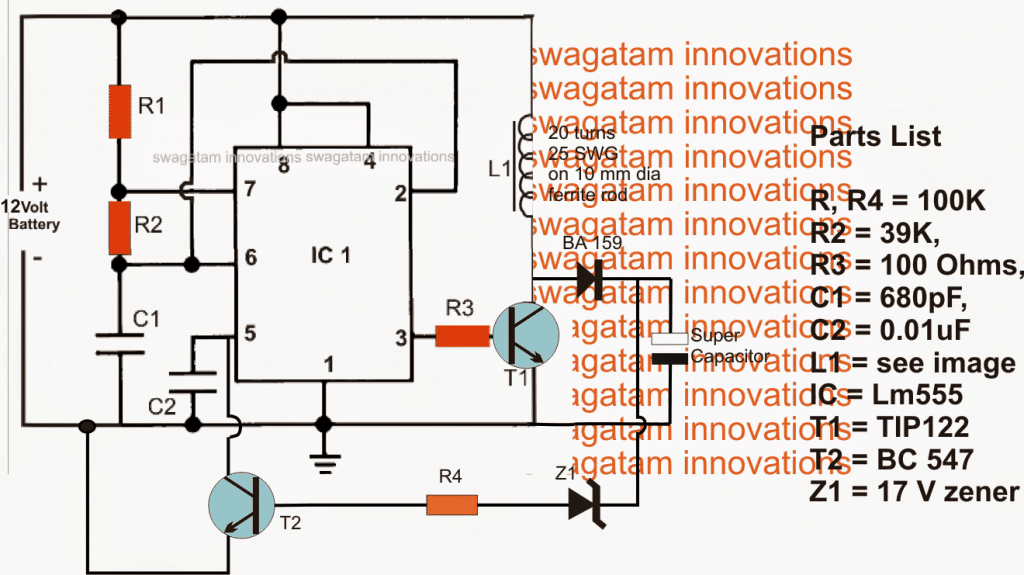
The proposed super capacitor charger circuit for charging super capacitor banks may be witnessed in the above figure.
The entire circuit can be seen wired around the ubiquitous IC 555, configured as a high frequency astable.
High frequency is required in order to drive a compact ferrite coil which becomes responsible for producing the required boosted voltage.
The relatively low current output from the IC is amplified using T1 which switches the connected ferrite inductor at the rate of the fed astable frequency.
The above action induces a calculated boosted voltage across the coil which is appropriately rectified using the attached BA159 fast recovery diode.
The resultant voltage at the cathode of the diode is fed to the associated super capacitors for the intended charging of the devices.
A feedback loop can be seen from the output to the base of T2 which ensures a perfectly stabilized voltage for the super capacitors....in case the voltage tends to rise above the predetermined fixed value, Z1 gets forward biased and switches ON T2 which in turn grounds pin5 of the IC choking the pulse width of the pin3 frequency.
This procedure quickly reduces the output to the safe limits and the cycle keeps switching ensuring that the voltage always stays within the set thresholds.
PWM Control
In the above design, R2 can be replaced with a 100k pot for achieving a PWM output across the load, although it may be not applicable for charging super capacitors, rather for some different relevant application .
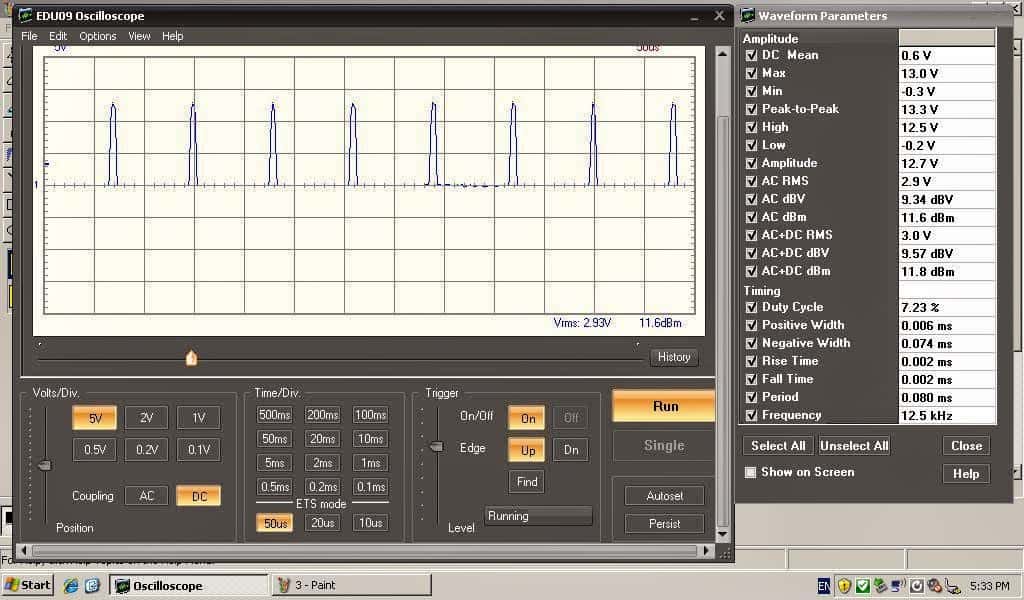
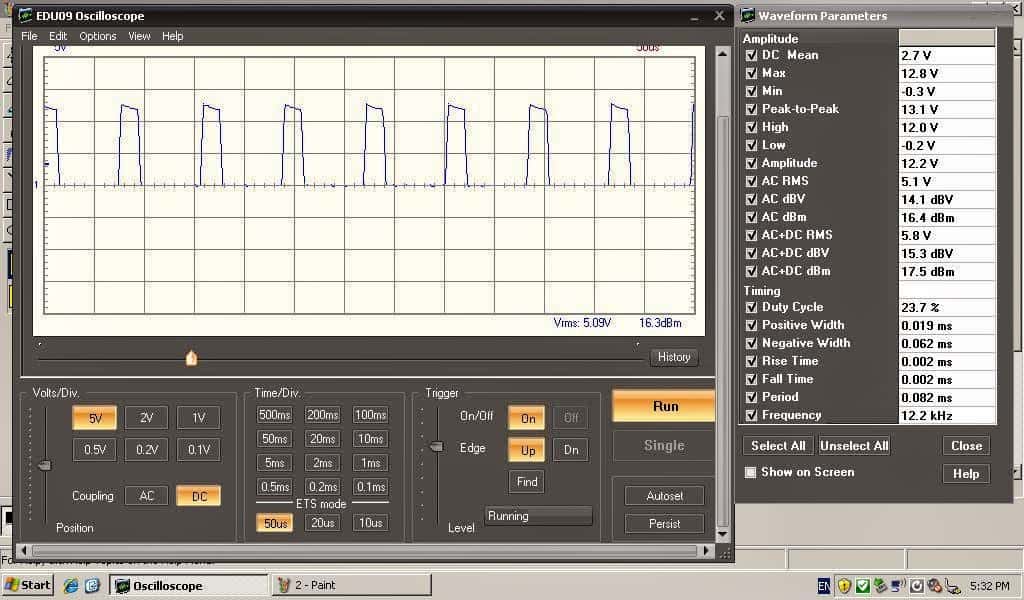
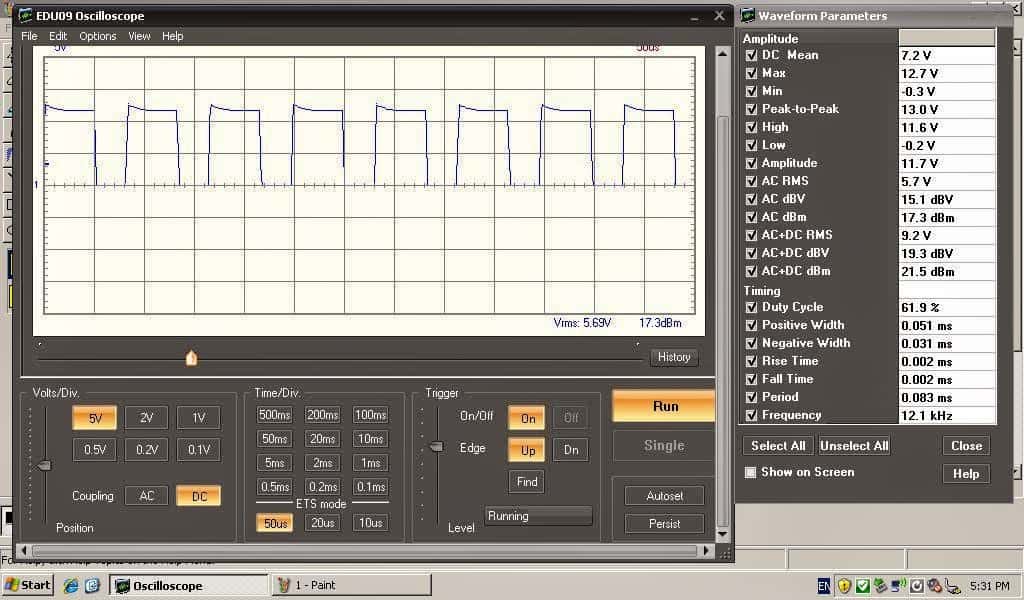
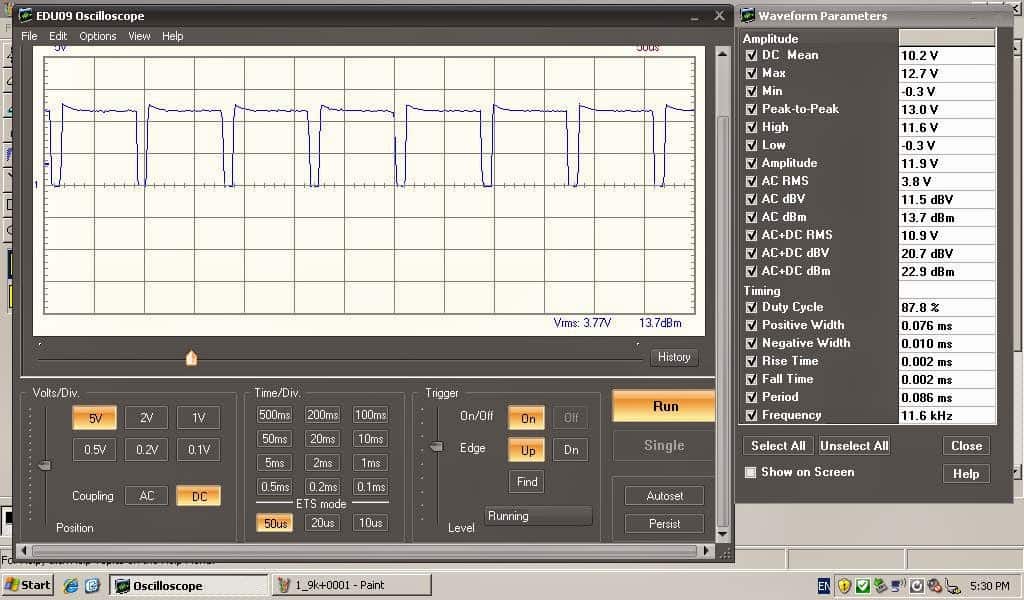
The above super capacitor charger circuit was tested and implemented by Miss Claudia who is an avid follower of this blog and a vehement electronic hobbyist, the verified results for the same may be witnessed with the following images, tested by Miss Claudia:
Another Useful Boost Converter Circuit for Charging Super Capacitor Banks from a 12 V Car Battery
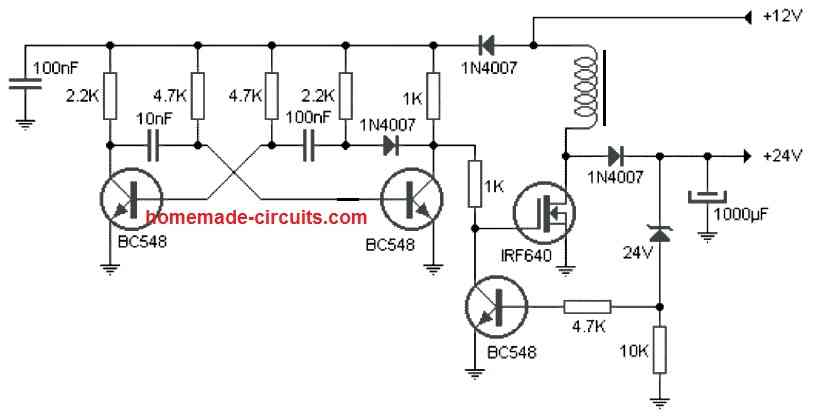
Here's a voltage booster circuit which can be used for charging a super capacitor banks from a car lead acid battery.
The boost circuit has an oscillator stage using a BC548 transistor astable.
This transistor astable oscillator generates a high frequency output which drives a MOSFET based boost converter stage.
The circuit also has a feedback circuit stage using the 24 V zener diode which controls the output voltage level by switching the gate of the MOSFET appropriately.
This zener value can be adjusted for getting a customized boosted output voltage for the super capacitors
The inductor can be built by winding 30 turns of 1 mm super enameled copper wire over a 1 cm thick ferrite rod or a ferrite ring.



Questions & Answers
so where i s the flux capacitor ? at and if you know any thing about the the e bike battery chargeing circuit .what keeps me from chargeing it up
I made a capacitive charger for desulfation car battery capacitor and bridge and I would like to know if 15.7v is normal for a battery or is it too much
15.7V can be tried on a 12V battery for desulfating it.
Dear Mr. Swagatam,
What is the current output of the circuit? how long it will take a to charge an 83 F capacitor bank from zero to 15V?
kind regards,
Job.
Dear Thykkoottathil Job
sorry I do not have the necessary calculations for the results, it will need to be checked through a practical experimentation
If you have a super cap, they say you can’t charge and discharge at the same time. Can you rotate the charge discharge cycle, so that the capacitor will charge then discharge.
Jim
It can be switched through a relay timer, for example the following circuit can be employed with its connected contacts appropriately wired with the super capacitor, load and the charging source.
Switching Two Alternate Loads ON/OFF with IC 555
Dear brother…
I had wasted my time for two days just looking for BUZ10 at many electronic shop on my town… To make your circuit of driving 2x 100watt led with a couple ic 555. I am finding there are many kind of mosfet here, ex IRF540, and etc, but i can’t to change the part that you are posted without your guide…
But now… I found something interest to read more of your article like this one, more simple, and looklikes easy to build, so i read this article for 3 hours.
My question is…
Which one is better between this circuit and https://www.homemade-circuits.com/underwater-led-boost-converter-with/ this circuit…?
I only need to drive 100w led 33volt from 12volt battery. Built in protection circuit, dimming 100k preset and also safety switch
Many thanks for your time…
sorry, the above IC555 Is a better and easier one since it uses a PWM, so I am changing my suggestion and referring you back to the above design:
you can also simply use a TiP35 BJT for T1, and remove the coil, the diode, the zener diode and the capacitor, and replace the coil with your LED.
and configure the BC547, just as shown in the first diagram from this article:
https://www.homemade-circuits.com/calculating-inductor-value-in-smps/
and yes instead of BC547 use 2N2222
Don’t waste anymore time bro, I would suggest you make the first design from this article:
https://www.homemade-circuits.com/designing-customized-battery-charger_13/
But make sure the input DC does not increase over 38V, that would be bad for the LM338 ICs.
also make sure to replace the 5K pot with a 22K pot
R1 = 1.25/LED current
Thank you very much brother….
I worker hard here as community consultant development, so i only have weekend time for keeping my hobby making useful circuit at home.
I keep insist on trying your circuit as long as i can do. So you don’t think that i will leave from your site :)… I will try step by step and will post it with lucky 🙂
After this project, i will need your advise to built subwoofer controller with volume and frequency control from single supply source.
I have already make it from TL 084, LM5812, LM324, LM741, 062, but no ones better works at single supply.. I feel dizzzy make 2.1 ch satelite huft 🙁
You are welcome bro! I am sure you will not leave, nobody has done so far 😉
However I am not so good with audio circuits, so I am not very sure whether I will be able to guide with regards to a subwoofer design but I may be able to show you some good related links within this site.
Yeah… I feel sure that power supply is heart of electronic, so this site should be the first step for building everything project circuit.:)
By the way i’m not a technician, but i keep learning….
that’s great hilman, keep up the good work!
Hi, I am going to design buck converter and requirement is as follows
Input voltage: 72 V
Output voltage: 54 V
Output current: 15 A
Switching frequency: 10 kHz
I tried to design inductor and capacitor values but did not get good achievement. you may please help to design the same.
Hi, I have posted a few easy to understand posts regarding how to design and calculate buck converters, please use the search box on top to find those, I am sure once you read those posts it will become extremely easy for you to get the best optimization for your application
Back for a moment, i had no time yet to try this solution because i am in the middle of a documentary shoot. But a friend of mine is fighting also with a LED driver. He bought a LED driver that should do between the 28 and 48 Volt….BUT….there is no pot or switch to find on it to adjust the voltage to 33V. Do you know something how this kind of drivers works?
https://drive.google.com/file/d/0B8P7WWCVO6Nwb0JtSktqMlAxZ3M/view?usp=sharing
For me it is a miracle.
you are welcome 🙂
I must thank you very much, his LED's works now with the resistors:-D
may be it's due to the driver's overload feature getting triggered.
remove the transistor buffer circuit which I suggested, and connect the LED directly with the driver through a resistor
resistor value can be calculated as follows:
R = (U – fwd.LED)/I.
R = resistance value required in series
U = driver o/p voltage without LED connected
Fwd.LED = 33V
I = 3amp
He thanks you for your answer, but he says that the LED is blinking, is that correct? It doesn't give continuous light. Can that be solved with a big capacitor?
no problem dear:)
Sorry i was in a hurry …blush
PS: Does the resistor stay's the same?
Thank you mr. Swagatam, i will pass the information throe.
It's an SMPS circuit, like the following one:
https://www.homemade-circuits.com/2014/03/12v-5-amp-transformerless-battery.html
for dropping the volatge to 33V, you can try using a emitter follower circuit using a TIP142 transistor as shown in this example circuit, but make sure to use a 33V zener diode instead of the shown 9V, and 1K 2 watt for the resistor, use a large heatsink on the transistor
https://www.homemade-circuits.com/2012/08/simplest-dc-cell-phone-charger-circuit.html
This link shows the circuit diagram how it is now.
https://drive.google.com/file/d/0B8P7WWCVO6NwdDkzY0RTLS1mNW8/view?usp=sharing
I think there need a diode between each of them, but the one's i have tried don't do the job. I have tried the SB560 and the P600G and both don't stop the influencing from the inductors to each other.
I cannot guarantee whether my "buffer" solution will solve the issue, but you can try it.
first disconnect the center leads of the pots from A1, A2, A3.
take BC547 transistors 3 of them, connect their bases with the center leads of the pots, connect the emitters with A1, A2, A3…and the collectors with the +5V…see if this works
This is how it is connected to the Ardiuno Uno, it are 4k7 pot's
https://drive.google.com/file/d/0B8P7WWCVO6NwRlU0RzZ2R1BObGM/view?usp=sharing
although I am not entirely sure how things are configured, you can try using emitter followers BJTs as buffers with the pots….if you could show me how the pots are wired I'll tell you how to configure the buffers with them…
if ground is a part of the pot connection then it cannot be removed.
I found the problem 🙂
The problem is that i had replaced the circuit for a Arduino Uno, and the pot's are in that system connected with each other by +5V and the gnd. With as result that the pot meters are influencing each other. So it is not the booster part but the pwm part. I just don't know how to separate the pot's from each other. Do you have any suggestions? Removing the gnd connection is that an option?
Hi Miss Claudia! How are you?
If it's cross interference that's causing the issue, it possibly could be controlled using separate inductors in series with the positives of each of the circuits and the battery positive
this inductor could be an air cored type, which will need to be experimented for the turns, probably 50 turns/ 1 inch diameter could do the job
Good morning mr. Swagatam,
I have tried it with 1K ohm and they keep influencing each other.
the connections are OK, but 3 amp for each LED would mean 9 amps from the battery so the battery needs to be at least 100AH rated otherwise the voltage might see a significant drop when all the LEDs are connected together
diode might not be required….try low wattage LEDs or connect a 1K resistor with each LED just to see the response, if it solves the issue then the battery AH rating could be the culprit
So i replace then the 5x 1 ohm resistors for 1 x 1k resistor? is a 0.25W 1k resistor good or must i have 3 or 5w resistor for that?
use a higher watt resistor because 1/4 w could burn…this is to decrease the LED current drastically and check whether the issue is with the current consumption or the frequency interference.
you can also try increasing the filter capacitor value attached with the coil
Ok, i have made the capacitor from 1000uF now 2000uF and the result was the same that they keep influencing each other.
I made 3 boost converters, like in the circuit above here, just the LED is parallel with the capacitor (in your circuit called super capacitor) from 1000uF.
The 3 boost converters i connected parallel together on a battery. So each boost converter got 1 LED from 100W.
Hello mr. Swagatam, how are you doing?
With me all goes great. But i have a question about this circuit. I am using now 3 of these circuits next to each other with one battery, on it self it works but i noticed that when i change the power from one LED, the others are changing to while i don't want that. It looks to me that the coil inductance from all 3 coils are driving power to each other. How can i change this? I have tried to separate the circuits with p600g diodes, but those diodes get fast very hot. Do you have any suggestions how to solve this?
Hi Claudia, welcome back.
how did you connect the three circuits and their coils with the LED? sorry I couldn't figure out the idea??
is there a single LED or three separate LeDs?
I will try tonight to make a other coil with 4 nos of 0.8, i think that when the wire is to thin from the coil, it will change its behavior and the DPDT and capacitor gets hot?
OK great! thanks for updating, I am sure this will help the readers a lot.
I just want to add, that i have changed the diode for a Schottky 60V 5amp diode. With that and the EE core for the coil and a wire AWG from 15 and 6 turns, i tested the 100Watt LED for 4 hours and nothing got hot. The rectifier diode i replaced because it became hot in the first minute even it was a 400V 50Amp diode, but that can come because i worked now with a higher frequency.
Hmmm…that sounds interesting 🙂
wish you the same…keep up the good work
I told you we Romanian woman don't give up where we put our teeth in 🙂
Happy holiday's and a wonderful Christmas!
I can't believe it 😀 but if it's true then I am the happiest man right now…and I congratulate you for your relentless effort, patience and and intense passion for electronics.
being a newcomer this achievement is indeed huge!
It's me who should actually thank you,,,,well done, and all the best.
ok, i got it done finally!
R2 must be always bigger then R1. So i used r1 a 1Kohm, and for r2 a 2kohm in serie with a 10k pot. Then the freq. is around the 60kHz and it works great. To protect the pwm i have put a 7812 regulator in front of the pwm power.
Thank you very much for your patience, i am happy now that i have learned this part 🙂
PWM stands for pulse width modulation, so it is supposed to be the optimized ON time and OFF time adjustment of the pulses at pin3….20kHz is the frequency not PWM.
Calculating all the parameters can be time consuming which at the moment will be difficult for me….
you can do one thing, Google "555 boost flyback converter circuit" and build one of these circuits that you find online, it could help with some alternative idea….
Ok, if i have calculated it right, then the coil must be 123uH with a PWM from 20kHz freq.
And the shottky diode should have a forward current from 2.8Amp with a power dissipation from 100.8V. Can that be correct? So with the coil that i have from 41uH i need a frequency from 60kHz.
😀 you see, i am learning it….well thanks to a patient tutor.
PWM is definitely crucial because it sets the duty cycle correctly for the converter…so it must be considered too.
I think, it's the inductance and the wire thickness that needs to be considered basically, the size and shape of the inductor does not matter much.
You can refer to the following article, page 6, which provides a clear formula for determining the ripple current or the average current in a boost current.
http://www.ti.com/lit/an/slva372c/slva372c.pdf
the formula will allow you to calculate all the parameters correctly.
As for the E cores, as I mentioned the dimension does not matter, use the one which is able to accommodate the required number of turns at the specified wire thickness.
Well, there are a lot of sizes for EE core 😐
From ETD29 till ETD 70. It is sold by two pieces, must i put the two peaces against each other? For the ETD39 there is also a plastic housing with connectors. What size do i need you think?
A ferrite rod is difficult to get here, but a EE core i can get here. Must i then wind the wire around the middle pale from it?
And what if i raise the frequency, can it then still get saturating? Wouldn't that lower the voltage to then? In my logic i think that when there is a higher frequency, then the inductor got less time to load, and gets faster unloaded? Because some of those boosters i see on ebay works with 180Khz with such small coils. Like on this one:
http://www.ebay.com/itm/DC-4-5-32V-to-5-42V-High-Power-Wide-Voltage-Regulator-Booster-Converter-Module-/371242188430
I just don't see the pwm there.
yes definitely that could be the problem in your case too…try using an EE core based inductor or simply use a ferrite ROD which the earlier MW radios used to incorporate for their antenna coils
Back…. i am not the only one with this problem i see. One of the explanations i found was:"Your toroidal coil doesn't have enough inductance for this application, and it's saturating. This limits the amount of energy it can store, and it also causes the current through the MOSFET to be way too large."
I don't know what it means, but can that be the case for me to that the coil have not enough inductance?
I got it from this site: https://electronics.stackexchange.com/questions/110843/why-my-boost-converter-is-not-working
OK, but it would be difficult for me to make it for you due to my busy schedule….you'll have to keep trying until you succeed, or may be purchase a similar unit from any online store, I'm sure somebody would be selling this online.
Well i must admit, when i was a little girl i wanted to be a boy but we can't change nature….well it is possible but it is not the same i think. But well, in the television world you can't really be a woman and dress up elegant when you work behind the camera, but it is my passion and i know what i want and that is a lot of LED light that i can influence from behind the camera while i watch my monitor.
I know my creations are strange, i will now make a pcb for it and make it as the one you made in the other article were the frequency can be modified. If this doesn't work ether, then you must let me know what it will cost me when i send the project to you. Because i really want to make better recordings then any one else.
I'll fix it for you…but still I do not know if you are pretending to be a woman, and may be actually are a boy…the circuit should not have problems even with a high current…because the circuit has no relation to high current only the mosfet is….
hahahaha yea i know, it became a long episode 😀
I will try now to make a pcb for it, maybe the parts were to close to each other.
No, not forever lol. If i really can't manage it, then i send you the components with a sweet smile if you want to fix it for me 😉
I think my problem is that the frequencies from the PWM and the coil are not matching and then the mosfet conducts to long so it generates a high amp. The efficiency is then maybe 10% while it should be around the 90-94%. In principal it works, it is just a matter of fine tuning i think. But i agree, i have some miracle results. Maybe high current circuits are not the best way to start electronics with. But i am thank full for your patience with me.
sure…we all hope and pray you succeed soon with this project…or you can also just continue commenting here forever:-) and I keep advising you forever…
I am not asking, I trying to make you understand your silly experimental results :-D…well the whole episode has already gotten too funny by now…because you are still pursuing this circuit and God knows when you'll actually succeed..:-D
I must start all over again, my pcb became a chaos. The problem is that i must fabric something myself because the stores here are idiots. They sell 36V LED's and 12V sources. So no matter what you buy, nothing fits with each other. In the past i had those small booster circuit buyed with the LED's in China, but those burns out in no time. So some how those LED's are a problem to deal with.
Now it gets funny when you are going to ask me the questions 😀
…the BC547 current limiter does not have any relation with the IC so how can it affect the IC performance??
the BC547 current limiter does not any relation with the IC so how it can it affect the IC performance??
yes that will do…:-)
It does not work, it stabilizes the voltage at 11.41 volts no matter what i do with the pwm.
GREAT :-), then i will create 0.6 ohm resistor….three resistors from 1.8ohm parrallel would do the job.
yes the BC547 transistor and the 0.6 ohm is designed to solve the over current issue
the 0.6ohm is with reference to the base potential of the BC547, so the circuit will cut off at 0.6/0.6 = 1 amp…so the max current cannot exceed 1 amp
In the above calculation the other 0.6 is the BC547 base trigger limit.
therefore the formula is R = 0.6/current
this formula will tell you what resistor you might want to include for the current limit
Well, i connected a 10ohm 5w resistor in series between the – from the battery and the input terminal to see what happened. The boost was of course smaller, just around 18V but the DPDT didn't got hot when nothing was connected to the output terminals. So i think that when the mosfet conducts that the amp becomes up to 30 Amps. The resistor became of course warm during this test. With a adapter from 12V 3Amp the adapter gets warm very fast. In the other circuit from https://www.homemade-circuits.com/2015/10/calculating-inductor-value-in-smps.html i saw that you have used a 0.6 ohm resistor behind the mosfet, and a bc547 and behind the BA159 diode a 1K resistor. Do you think i can solve my problem when i put that to in my circuit? But 0.6 Ohm would create 55 Amp with 33V? The PWM is not the problem that one works good.
Ok, i will try to find such one. A resistor between the minus from the battery and the input terminal wouldn't do the job? I was looking back to the other circuit where we started with.
You can try a 12V, 2 amp transformer power supply, it will not allow the current to increase to extreme levels.
I have a 12V 8Ah accu for it to test with.
hahhahaa i am a Romanian woman, we don't give up when we put our teeth in something 😀
what's your input power supply amp spec….you can simply use a 2 amp or a 3amp power supply at the input to prevent excessive current from getting in….
you are definitely not a woman, because it's quite unlikely that a woman may have so much interest in a strictly technical thing such as electronics 🙂
Cant i use a 220V 400Watt light bulp dimmer and limit it to 33 Volt with resistors and put a diode between? Or do i get then a blinking effect on my video recordings?
Well, i made the coil with 4 wires, and get minimal 31V, but with the two 22ohm 5W resistors in series on the output terminals, the dpdt gets warm and brake the circuit, also the resistors gets warm and the high frequencies sounds stays to. So i think the pwm and coil and mosfet are not the problem, but some how it creates very high amps after the coil. 31V with 44 ohm should be 0.7 Amps. I don't see what component i used that can not handle that. Everything i used is for above the 10 amps. So the only explanation i can find is that when the mosfet is conducting to ground, the ohm value is close to 1 ohm and it generates 31 Amps, the dpdt can't handle that amount of amps. Can't i bring that kind of amps down with a 10ohm 5w resistor between the dpdt and the drain from the mosfet? then the amps would be 3.1Amps when the mosfet closes and when the LED in series with a 10ohm resistor is 24ohm then the resistance on the LED site is still higher then when the mosfet conducts…..in my woman logic 🙂
OK sure!!
euw, wait you wrote that in your explanation from your other article i see now.
As i see it, in general it is the same circuit, a pwm with a boost circuit with a coil and mosfet. The only thing that is different is the 1K resistor over the output and the 2200uF capisitator. The PWM i built works on it self good, but the boost part is a other story, that is where it goes wrong for some reason that is unknown by me, because the mosfet is for 500V 50Amp or something, the coil is 0.8mm magnetic wire, the DPDT should do 75V and a few amps, and the diode should be big enough to, the capacitor is 1000uF 63V….but maybe that one gets hot when there is used 40V 1 Amp? btw…..is 0.8mm wire for the coil enough or should i wind it with double wire, i have seen that on some boosters to?
it includes the important current limiting feature which makes sure nothing burns and it also allows you to test the frequency and the PWMs together in one circuit, so it's equipped with many test and protection features…..nothing can go wrong if you test with this circuit and is better suited to the newcomers.
I am back mr. Majumdar 😀 well, if i got the pot in the lowest position with 44ohm 5W resistor over the terminals, then i got 19V but i hear a very high frequence that goes higher when i turn the pot up. When i go up with my pot, then at 38V the DPDT becomes hot and also the + pin from the capacitor becomes hot. The PWM just does 6.8Khz now. I have not connected the bc547 now. With 44 ohm over the out terminals the amp is not more then 0.9A. So i can forget my 100W 2.5Amp LED to connect on it. Any suggestions?
It can be difficult for me to judge your circuit, I think you can use the first circuit from this article:
https://www.homemade-circuits.com/2015/10/calculating-inductor-value-in-smps.html
You are not going to believe this 😀
I blew up the giant diode :-))))))
https://drive.google.com/file/d/0B8P7WWCVO6NweWV4R3M1UzJlTXc/view?usp=sharing
First it worked good, nothing wrong, i set first at 32.9V then i connected the LED with a 22 ohm resistor in series, the dpdt jumped after 10 seconds at 29.7 Volts i didn't reached the top from 32.9V. So i disconnected the LED and waited till the dpdt was recovered. And i connected it again without the LED, and the diode exploded.
It' always better to use lower frequency and higher number of turns, which becomes more manageable, anyway, you can go ahead with the existing set up, just make sure the capacitor is rated at 100V
Ok, i have just 5 turns left on the coil and i don't come lower then 79V. So i am afraid when i connect the capacitor again, that it will blow up even it lowers the voltage.
Yes, i won't give up. I am going to try that. It will work some day 😀
OK nice…
higher frequency will allow you to use lower number of turns for achieving the same required boost, so it's not bad….now let's see how you progress from here:-D
Ok, the problem was the preset from 10k. Now i removed it, i had at once a boost to 88.7V with the pot in the lowest position. But i noticed that on the center terminal from the mosfet the freq is 65kHz and at the output terminal the freq was 125kHz, I am sure you never reached that with a mosfet 😀
yes that's possible, simply use a 0-24V/3amp transformer, rectify the output using bridge diodes and a filter cap…the output will be roughly around 33V….just what we need…for extra safety you add a calculated series resistor for limiting current to the LED…:) the resistor value can be changed for changing the illumination.
I agree with you about that. I have removed the capacitor and replaced the diode but the voltage stays stable at 11.7V. The pwm works normal so i guess that the mosfet is not functioning anymore. Because no matter how i move the pot, the voltage stays at 11.7v. Now i am wondered how the mosfet could be blown up because that one does 500V at 50Amp and got a big radiator and it went wrong at 29V. Is it simpler to make a 100W LED driver that can be variable from 220V so that i don't have to boost?
…hmm but electronics always works and responds with strong reasons so nothing can eb strange here…
do one thing just remove all that's connected at the cathode side of the diode…and check again with a new diode…because something across the cathode of the diode is possibly causing a short circuit.
hahahhaaa and thank you again lol
I have no idea ether, there is no logic in to find. I mean i have used giant mosfet, giant diode, giant cooler the resistance is not less then 36 ohm, so there cant come a huge current. And yet that diode connectors went hot like hell and the second time it explodes. 36 ohms on 29 volts that is less than 1 amp. With a 400v 6Amp diode???
I certainly believe this because it's being done by you 🙂
but I do not have any explanation or remedy for all these because I have no idea what exactly you are doing and what's causing such bizarre things to happen 😀
Question,do you have a project some where to connect two gas detectors together?
The problem is this: we have on two places a gas using device, a central heater and a stove. Near every gas using device we must have a gas detector by law. But what i would like is when one of the gas detectors gives alarm, then the other one must give alarm to, because my mom is a bit deaf so she dont hear the alarm from the other side of the house. So i want to connect these detectors with each other. Is that possible with two bc547 transistors or something?
how do you want to interconnect the both…with wires or without wire (remotely)
Before i replace the diode, i thought to test the mosfet first without a coil but instead a light bulb. It does dim. The new mosfet does not swet. But i think i found out why the diode blew up.
For some reason with the new mosfet the freq. went down to 20Khz with the pot in the lowest position, and 29Khz in the highest position. With the BUZ or TIP it was around the 32Khz. Is there a explanation for?
…that's strange…still, a rectifier diode will never burn due to high frequency.
frequency will not have any affect on the coil output. ….but PWM will..
But there was nothing connected behind the diode, just the 1000uf capacitor. Is it not that when the freq gets lower that then the voltage is increasing by the coil?
the diode might have blown due to over current not because of frequency…frequency can have no effect on a diode…
I meant the resistor like R9 to protect the mosfet as in this circuit.
https://drive.google.com/file/d/0B8P7WWCVO6NwdDU4M1ZzWTJUUXM/view?usp=sharing
yea, i noticed that to.
you can try it…but it'll produce less illumination on the LEDs proportionately….
what i see is that the TIP122 can handle 65Watt and the BUZ11 does 75Watt, but i don't know if i read that well in the data sheets. While the LED is 100Watt and the lightbulb 15watt. In my logic the IRFP260N does 500V 50A and 300W. What IF i put between the coil and the draine, a resistor from 350ohm so that when the mosfet closes that the current is not more then 0.2Amp? or will the voltage then go throe the LED because it got a lower resistance?
6A4 is a 6amp diode.
the gate resistor is irrelevant to the whole thing, even if yoy don't use resistor still it would work….so no point in changing this
yea, it is a 12v cooling fan as you can find on cpu's to.
The eq. from 6A4 is the P 600G-6A/400V i think, the 6A4 we don't have here. But is the resistor 100 ohm to the gate good?
opamp error amp can be a little complex…but if you insist I can explain.
by ventilator do you mean a cooling fan?
you can try a 6A4 diode because fast recovery is not important, just a reverse blocking is intended with the diode
Well, the IRFP260N didn't get warm, the DPDT didn't get warm ether, but the BA159 smoked out completly instandly. There was nothing connected to the output terminals. Must i use a different resistor to the gate from the IRFP260N?
And how do i make that?
Maybe making a regulator behind the battery would already be helpful because the full battery is 14.4V and when it is a bit used it gives 12.4. Now i am using a 8Ah battery to test, but in the future when i work on locations with the light i will take some 65Ah battery. I really need the max of light i can get with these LED's. And i noticed that when i put on the ventilator on the heatsink from the LED, then the voltage drops when i turn on the LED to. On it self i don't mind that very much, because a silent ventilator is always better then one that makes a lot of noise that i must cut out of my audio in post. But it must cool the LED heatsink of course.
perfect accuracy cannot be expected from transistors, you may have to use an opamp based error amplifier for getting an accurate regulation….
The problem is in the preset. If i come with the preset on the GND side above the 1K then there comes a hugh peak voltage that cooks the mosfet. So i thought i will calculate a resistor divider. The BC547 would switch at 0.6V so in my theory when the voltage becomes 33 volt, then it must switch. So i calculated instead of the preset with a 100 ohm resistor on the GND side to the base of the transistor and a 5k on the + side of the LED to the base of the transistor. In principal it should work,,,,but i get a study 45V instead of 33V. When i calculate with 30V then i get 100 ohm and 4.5k ohm and the output stay stable on 45V. So what is wrong then?
OK..
Ok, no problem. anyway i got now a radiator from 124x35x60 mm, it was the biggest that i could find that would fit in the box where i want to build it in. And some IRFP260 to, and 5W 22 ohm and 10 ohm resistors, so i will try this weekend.
sorry, unless I check it practically I wont' be able to judge the fault in your design, because when I made this circuit, it worked wonderfully well at the first instant, and I could light up a chain of twenty 1watt LEDs in series at full brightness….with an input from a 12V battery (7ah)
What happens to that coil when there goes 5 Amp throe? I mean it is just 0.8mm wire should that be able to handle it? I am just asking because it is strange this behavior. Without LED i can set it easily to 45V but when i put the LED on it, then the volt drops down and when i try to turn up the voltage then at 33.1V the mosfet burns instantly. I think the reason is that when the power goes throe the LED, then it is 33v but when it goes throe the mosfet then it is more then 100V because the limiter BC547 works from behind the BA159, so it doesn't limit for the mosfet….in my female logic…i think.
at 33V…the TIP122 would be able to deliver only 33 x 5 = 165 watts…so I think it would still work
a 350 ohm resistor would not allow even 500mA to the LEDs so that won't work….you can try some lower value, may be around 33 ohm or 20 ohms etc
The heatsink i am using is a 4.6 x 2 x 1 cm TO220.
Good!
yea i like big to…..i mean for heatsink of course 😉
I will go tomorrow for it.
make it bigger…the bigger the better:)
The IRFP260N would that be something you think?
Transistor N Channel Power Mosfet 500V 50A That should be impossible to blow up not?
that's not required…..
Done that, till 32.9 volts it goes good, nothing gets warm or hot. But at 33.1Volt as well the tip122 as the BUZ11 gets up in smoke. Isn't there a super mosfet to find who can handle it? I mean one that can do something about 400V with 100 amp? Something that really can't smoke.
here mosfet amp rating is more important…you can try the mentioned mosfet if you are able access it, no issues about it, but a smaller one could also have worked
Yes, i have a heatsink connected to it, but maybe it is to small, it is hot in a second. But now i need to get new mosfets because i blew them all. The point is that when i put no LED with lightbulb on it, then i can easily get the voltage at 46V, and nothing happens. But with the LED and lightbulb on it then the mosfet smokes att 33.1V. So this is why i was thinking on a bigger mosfet that can handle a bit more. If i have read it well, the IRFP260N should be able to easily handle it even for longer terms. It also got a resistance from 0,04 ohm and a reaction time from several mega hertz and the min. threshold gate is 2v. So maybe that way i can avoid that the voltage is dropping when i connect the LED, and blew up the mosfet?
try 32V then with the LED it too would provide a good illumination…..precise 33V is not compulsory.
the transistors are getting warm may be due to incorrect optimization od the frequency with the inductor.
use a heatsink on the transistors…which is a must to secure them from high temperatures.
I have replaced the BUZ for the TIP and i got 36V again. I don't get it why the power drops down when i connect the LED with the resistor, and why the BUZ blew up when i turned up the resistor.
Must i secure some how that there doesn't goes to much current throe the LED?
Because i blew up a BUZ11 again when i turned it back on after dinner, i had left the pot completly open when i turned it off and on again. The DPDT did get warm and disconnected the coil, but the mosfet was history so the DPDT did safed the rest of the pwm. I should had used the TIP i am thinking now. Some how there is a peak voltage at start up maybe? Anyway, i replaced the BUZ and it works again. So i think about to get some fuses for the LED's.
the more you think the better you'll perform….so think harder:)
I am afraid you are right about the 33volt. The seller said 38Vcc max, but on the packadge was written 30 -36Vcc. But if there are 10 rows of 10 diodes from 3V then 30V or 33V is more likely indeed. Can that be the reason that at 33,1V the mosfet is going to smoke? Some people also advice to calculate with transistors and mosfets with half of the value that is written in the data sheets as max to use value. Well i am thinking a lot at the moment because i have had visitors and didn't had time to try something out.
you can use a 12V car headlight lamp in series with the LED just for the time being until you finalize the circuit functioning….
Euw, it was what the sales man said to me. But if you say that it is 33V then i keep that. What resistor must i use then?
A 100 watt LED voltage rating is 33V…not 38V, 38V could be dangerously high.
It are 100Watt 38volt leds, they say the max current is 3.5 Amp, but i have my doubts about that last one because 100/38= 2.63Amp.
1K is just too high….what's the value of the LEDs that you are using???
I tried it, with a 1k 1 watt resistor in series with the LED. At first it worked good, but the starting voltage without LED i measured on 26V, when i connected the LED it dropped down to 18V, measured over the LED. So i tried to screw up the preset and at 26V measured over the LED, the BUZ11 blew up. The DPDT protection works, i just have to replace now the mosfet every time, the PWM is safed.
Ok, i am going to try that….cross your fingers
for the time being just use a high watt ersistor in series with the LED chain, that will restrict over current to your LEDs.
I have put it in the simulator, and i get the same results as what i have measured. So i made a print screen from what i have now. R4 and R5 is the pot, R7 en R8 is the preset. No matter how i change those 4 values, the result stay's the same on 11.4V.
https://drive.google.com/file/d/0B8P7WWCVO6NwYkU2bWs5djJ0eGs/view?usp=sharing
OK no issues, keep it up 🙂
Yes, i noticed that to that there is a difference between simulators and real componencts. But i learned now how resistor deviders works, and pwm control, and the mosfet switch, and the induction of coils. So i make progress 😀
the better idea would be not to rely on simulators, keep trying it practically it would help you understand the proceedings better.
I know, but that program don't have presets or pot's where i can work with to simulate so i use two resistors then instead to test. I really do all you tell me to do, even it doesn't show on the picture 😀
BUT!!!!!!!!!!!
IT WORKS!!!! 😀 😀 😀
I have 36V sharp….without LED balast, but i have 36Volt :-p
you must use a preset in place of R7/R8, the image shows fixed resistors…I told you to ground the preset slider arm completely initially….in which case the BC547 would be completely off, from there on you can slowly take it up.
On the base of the bc547 there is 0.6volt, at pin 3 from the 555 there is 0 Hz and -0.2v. There is 0v on the collector but the collector emitor is 365ohm from the bc547….does that helps?
you may check the voltage at the center lead of the preset….never at the base of the transistor.
Initially keep the preset slider arm completely towards the ground side this will allow the full 70V to be available across the output, after this you may very slowly slide the preset center arm upwards and check the response over the meter.
try using a 100k preset if possible
hahaha yea i got the idea, i go to measure what is on the base of the BC547. Because i have no freq anymore on pin 3 from the 555…..or it is to fast to measure. It is because i am from venus i think 😉
OK got it…I think if the transistor does not work then we may have to go for an opamp circuit which can be expected to provide a 100% correct results
Done that, then the output voltage gets fixed on 11.6 V. No matter what i do with the pot or the preset, the voltage stay's fixed on 11.6V.
again that's strange (and impossible)…your circuit is a special one with unique outcomes :-D…so I really can't suggest or recommened much because the results are always something unpredictable…??
ow cool….how much ohms would be good for this preset?
a 10k would be fine…connect its outer leads across the filter capacitor and connect the center lead with the transistor base resistor. The zener could be eliminated in this case
Back from holiday 🙂 Have you missed me? 😉
I made a circuit drawing from what i have builded now and what does not explode, but what gives the above values from august 20th. The 1K resistor is a 1W to replace the future LED.
https://drive.google.com/file/d/0B8P7WWCVO6NwamlaZ2w0NU5Ua3M/view?usp=sharing
Now the meaning is to change something so i have a variable boost from between the 20 and 36 volt without cooking the LED 😀
the over voltage to the LEDs can be simply protected by regulating the boost voltage with the help of the BC547 transistor across pin#5 of the IC 555..
you can replace the BC547 base zener with a preset…the base goes to preset center….the other two leads of the preset go the boost source and the ground respectively.
Ow then i wait with the Arduino a bit.
But! I found on a other website an other development from you
http://www.brighthubengineering.com/consumer-appliances-electronics/68396-over-voltage-and-low-voltage-protection-circuits-easy-home-projects/#imgn_1
The "over voltage indicator and cut-off circuit" it is on the middle of the page. Now before i run for the zeners, is it a idea to use that circuit to protect the LED's against over voltage? Because i had to order those LED's in China and have waited for them 3 weeks. So i would like to protect them a bit you know 😀 If with that circuit i can limit it to 37.5 V then i cant blow up the LED's i think.
I have not yet mastered Arduino and MCU stuff, so I won't be able to help you with this subject.
you seem to be quite well versed with the boost circuit at the moment…so surely you'll be able to finish it soon…successfully.
hahaha no i don't leave so quickly, for sure not without thanking somebody who is so patient and helpfull like you. I just saw that you made projects about the Arduino to, there i want to work with after i finished with these LED's. I think when i understand this circuit then i can start to control the light with the Arduino maybe.
Well if i reduce the number of turns then the voltage goes up for some reason. I know it is not logic, but it is what i measure.
I can try to use the BC547 i just need to get the 17v zener for it, because i just have 2v7 zeners. And otherwise i need to bring the frequence up i think to bring the turns down. Is 0.8mm wire enough for a 100Watt LED?
wow welcome back…yes, I usually miss anybody who may leave my website without an intimation…;-]
that's a great progress…did you try reducing the number of turns to bring down the voltage to the desired limit?? just try it, or alternatively you can use a BC547 stage at pin#5 of the IC as shown in the above article diagram.
ok, i got 25.3v with 45 windings, but when i move the pot a little bit up then it moves fast to the 60 volts.
measurments are: 10k pot in lowest resistance
20 windings = 47V
25 " " = 40.3V
30 " " = 35.4V
35 " " = 30.1V
45 " " = 25.3V
BUT! "Mumbai!, we got a boost" 😀
Ow, and a request for a topic 😀
Can you make a topic about how to read and understand datasheets please? Because for engineers it might be logic, but for people who try to learn electronics it is a chaos of data.
OK…. I'll surely consider it once I finish my previous pending assignments..:)
No, i am kidding, i know i do something wrong and try to find out what but without blowing up my pwm every time again. I almost can make a pwm blind so many times i made it.
yes TIP122 is a BJT and I have more faith on BJTs because they are not as unpredictable as the mosfes….I had tested these circuits using TIP122 and I could get the results immediately.
a 19V from 12V is a good improvement, however you can still try increasing the number of turns and check whether it multiplies proportionately or not…because the turn ratio determines the voltage level…if this happens then you can be sure of the circuit working correctly.
Ow and i used the tip122 instead of the buz11. Because the tip 122 does 100v at 5 amp, and the dpdt secures at 75v at 3.75A. And the buz11 does 50v at 30A. So it was safer to use the tip i thought.
hahahhaa i am not good in cooking that burns always worse then my electronic components 😀
Yesssssssssssssssss Sir Swagatam!!!!
I blew up nothing today and i made 19Volts out of 12.1V 😀 😀 😀
With the fixed resistor it worked, but i had put a 1k 1w resistor over the capicitator, and then it was 12V exact. Then i removed the resistor over the capicitator and i got 18.65V and loading up. Then i replaced the fixed resistor for a pot from 10k, when it was up, the capicitator was loading up till 19V and kept loading. And when i moved the pot down, then the capicitator was unloading. This means it is good right??? 😀
lady why don't you just quit and start learning to cook some good recipes?…electronics might not be your cup of tea, it seems 😀
jokes apart…..I have no idea what might be causing so many issues in your circuit, just keep trying and keep your fingers crossed
I don't understand the datasheet completly what they mean. I think they mean that at 3.75Amp it switches off till a voltage from 72volt. Would that protect my BUZ and pwm then you think when i put it in serries with the coil?
http://www.digchip.com/datasheets/parts/datasheet/1721/RXEF375.php
you are making a simple concept extremely confusing and difficult…all these are not required.
there may be something seriously wrong with your circuit, I am not sure what…. but believe me a boost converter is one of the easiest thing to make on this planet….:)
And the BUZ 11 can handle till 50V 30A.
I asked about the BUZ datasheet. not the DPDT….the DPDT does not need a datasheet for the explanation, it's too easy and just about identifying how the 6 pins are positioned and use it accordingly:)
well, that is a bit difficult to check. Because the code on the DPDT is : "XXX 375 A11E" if i google on that i see a lot of things that got absolutly nothing to do with electronic components. 😐
did you check its datasheet? i think it can.
No, it is 12/(4-3.9) = 12/0.1=120volts
Input Voltage / (period – positive with) = output voltage
a DPDT may not be required…..just connect a high value capacitor as shown in the diagram, that would take care of the reverse EMF and safeguard the mosfet
Yes, that is my meaning indeed.
you mean to say that you want to connect a switch which will make sure that when the LEDs are not connected, the coil also remains disconnected from the FET drain…right?
yes that can be easily done through a DPDT switch.
Listen 🙂 Is it an idea to protect the circuit with a PolySwitch Resettable Device 72V 3,75 A between the coil and the BUZ11 ? I mean in my logic the BUZ11 can handle 50v x 30A=1500W. 72V x 3.75A = 270W. Could that save my PWM and BUZ? Because i know i stay slim from running throe the town, but it costs something you know and i would like to protect my circuit to when the LED's are not connected and by accedent the power is turned on.
sure claudia, please go ahead…
I will build it now first with the fixed resistors to be able to measure the coil.
First the coil was 140uH, and now i reduced it to 48uH. Because something is to big i think.
output voltage will depend on the number of turns of the coil…
Ok, i think the current is to high.
As i calculate it with the measurments from the osci
Then V out = 12v/ (0.040ms – 0.039) = 12v / 0.001ms = 12000v
I dont know if i calculated this correctly, but if i did then i am not wondered that everythings burns out to me 😀
that's a weird calculation and result 😀 not correct
current can be measured by simply connecting an ammeter in series with the positive supply
There was a copper lane from the + blown off the PCB, the pwm still works, but on 1.2kHz. I checked the resistors and the capacitors but those are ok, the mosfet also still functions. Is the 555 then damaged? As i see it, is that the coil makes a shortcut that gives a high amp? Must there not be a resistor or something between the mosfet and the – ?
yes that might be correct, you are supposed to include the capacitor after the diode…although mosfets have a protection diode internally so I am not entirely confident regarding this factor…
I just studied the boost principal, and i see it needs the capacitor to be able to function. Without the capacitor, the full load of the coil goes throe the mosfet to minus and it gets smokey. Is that correct?
ok, i will try it with a bulp in series then it shouldn't be able to burn out…..again.
the track blew due to the high current from the coil…the IC could be still fine.
it's not required…however for testing sake only you can try putting a bulb in series with the coil….but not at the source of the mosfet, because the source needs to be connected directly with the ground…
welllll…..all went ok, till i connected the coil and then all blew up. It is now a bit smokey so to say. I checked the pwm before i connected the coil, and all looked ok.
you enjoy and laugh even after so many failures;-) you seem to be a stubborn candidate (just joking)
hahahahha then i would really feel blond if it is so simple and i am fighting for weeks with it 😉
I wish I could make it for you and show how simple it is…anyway right now there's nothing much I can do.
What would happen when i put between the s pin from the mosfet and the – a resistor from 1k, to avoid a shortcut from the coil when the mosfet opens? If i calculated it right then the power throe the mosfet would be something like 0.04 Amp. And over the coil i put a light bulb from 220v to see if something will happen and i can measure the voltage?
I don't know ether. Maybe i must let the idea go to put those LED's on a 12V battery, it would had been handy but i think i better look to make something from 220v to 38V, but then i get the same problem i think because a dimmer works by default with a pwm? I don't know at the moment, i think those high power LED's are a bigger problem to get them work then i thought it would be.
I am clueless why it's not working for you…when I built this circuit, I could make it work instantly, in fact I blew a few of my LEDs due to the high voltage from the coil, and because I had no resistor connected in the LED series.
the voltage I could generate was over 70V from a 30 turn coil over a ferrite rod.
I don't know that, i have now just the right PWM signal, i didn't connected anything else then the light bulb.
Can i connect the coil as shown above here, but instead of the 100W LED i use a 1 watt 1k resistor to test the voltage?
Ow, i must add that i didn't used T2, R4 and Z1. And instead of TIP 122 i used the BUZ11.
….so now are you getting the required boost voltage across the coil??
I am back 🙂
Well, i made a oscilloscope print from Velleman the edu09, so i can see the signal. Don't laugh, but it works good. Now i can see the signal moving that it get wider while the peeks stay max on 12.4v and min on 0.2v. With a variation from between the 1.14KHz and 28 Khz. BUT! when i connect the mosfet and the LED's with the 1k resistor, the dimming is just a little bit at half of the pot meter but further it does not dim. Please don't ask me why the oscilloscope print does work and the PWM not, because the logic is missing to me completely. How are you doing?
I am afraid, the PWMs appear the same for all the images, it means that you are not getting any modulation across the range…and that's the reason the LED is not dimming
see the following image…it should be in this manner:
https://drive.google.com/file/d/0B8P7WWCVO6NwTERHLWJTRWxJajQ/view?usp=sharing
https://drive.google.com/file/d/0B8P7WWCVO6NwQVpSc3MxOXdjMVE/view?usp=sharing
https://drive.google.com/file/d/0B8P7WWCVO6NwOGdUbU9ZWTJHdUE/view?usp=sharing
https://drive.google.com/file/d/0B8P7WWCVO6NwbkViMEJQd2N4TE0/view?usp=sharing
Here they are. I am now using a mosfet for the LED's But it does not dim so much.
that's a great news….however without seeing the images it would be difficult foe me to judge the results.
the range from 12V to 0.2V looks pretty good, it should dim the LEDs to zero.
by the way are you using a transistor as the control device or is it a mosfet?
how much henry must the coil be approx? and what resistance?
Inductance value is not important, even a 10 turn coil will start giving a boost voltage at the output.
just Google "555 flyback boost converter circuit" and check those designs for more info
ok…i did 40 turns and the mofset burned out completely, the coil became also extremely hot and the wires where i connect all with are melted. I have no measurements because it went very fast. I putted the coil in the place of the lightbulb.
It seems you are gradually learning and improving, that's good,
actually the dimming should be consistent from almost zero to maximum brightness. and you should connect a 1K resistor in series with the LEDs, a 100 ohm is too low.
a 1K pot will not do anything, it should be above 22k to produce any kind of variations in the PWMs.
you may verify the voltage at pin3 which must change from minimum to max when R2 is altered
Ow that wouldn't wonder anybody when those would nock on my door while i am testing my electro skills :-)) But i am glad you have trust in me.
Ok, done it and the results i could measure with the multimeter is:
6.28kHz = 8.4v
10.61kHz= 9.9v
13.8kHz= 11.4v
14.07kHz= 11.8v
12.10kHz= 12.38v
11.93kHz= 12.55v
On the drain from the mosfet i putted 2 led's in series with a 100ohm to the +.
It dimmed a lil bit with a 100k pot, i had to look on the seeling to see the differences. With a 1k pot nothing was visual changing. Nothing burned out this time.
Now i have seen a video last night about PWM, and how it changes the signal, but i have not a oscilloscope but just a Hz meter on a multimeter, so i cant see it very exactly….but there is movement.
I appreciate your interest and determination and I am sure you will succeed soon,
yes, solder it on a general purpose pcb and first confirm the frequency and PWM response,
and don't make explosions, otherwise the cops will come knocking on your door, and will be surprised to find a female terr0rist 🙂
I don't know ether why i have such a fight with it, but i am decided i am going to win from this mountain of silicon 😉
Ok, i am going to soldered it like you say and make a picture from it….or a video when it really starts to burn. If you hear nothing anymore, then it has exploded 😀 My family already considers me as a terrorist because i blow up the components.
the above circuit is very straightforward and not so confusing or complicated as you are experiencing….it should have started working in one shot, I am not sure why you are getting so many issues.
Only R2 should be a pot, R1 can be a fixed resistor, because frequency needs to remain fixed.
use 100k for R1 and any capacitor in the pF range for C1, this will enable an appropriate frequency for your ferrite coil.
frequency needs to be constant, only PWM needs to be changed.
I think the issue may be because you are building it on a breadboard…the circuit needs to be soldered on a PCB for getting accurate results.
The trick is r1, r2 and c1 to get those right. where r1 or r2 must be replaced for a pot.
I tried a lot of combinations, with the results that or the freq is stable and don't move but the voltage on pin 3 goes up and down, or the freq goes from 12kHz to 48kHz but then the voltage is stable on 7volt. But i need it to be stable at 10V with a variation from freq. from 30khz to 60kHz?
He coil looks OK, and it should work, just make sure your IC is oscillating at some high kHz frequency.
https://drive.google.com/file/d/0B8P7WWCVO6NwMF9TYUwtcGN6VFU/view?usp=sharing
https://drive.google.com/file/d/0B8P7WWCVO6NwQjFaLUZzS2xfdWM/view?usp=sharing
Here are the pictures from the coil i made and the test board.
Yea, i will take those tomorrow to with me. It smells like hell, but i better take a bit more from everything :-)))
why don't you first try the circuit with a TIP122 transistor, I did it using this transistor twice and during both the occasions I could make it work at the first shot.
ok, that is possible….then i don't know. I must first buy new mosfets because they all burned out. i am fighting with resistors to get the right frequencies. I reached today 116kHz and 80kHz to 2.2kHz. I will make a picture from the coil, maybe i do something wrong there. Thank you for being so patient with me, i truly appreciate it.
if your supply voltage is 12V, the pin3 voltage will also be approx 12V…what you are measuring is the average voltage caused due to the frequency which is breaking the pin3 voltage into pieces…but the peak voltage is still around 12V…the peak voltage is always stable…the average volt might change while the pot is moved due to the change in the PWM (pulse widths)
I think i know why it didnt worked. The VGS from a buz11 needs 10 volts to switch and the output from the pin 3 555 was between the 5v and 8v. So that if i understand it right, the frequentie must regulate to switch the mosfet to make the voltage higher or lower throe the coil. But the voltage must be stable at 10v.
At this moment i don't know anymore. I understand the principle but i can't get it working for some reason.
OK, but R2 will not change the frequency by much..R1 is the resistor which will change the frequency quickly and effectively, and also C1.
you can use a 8 ohm speaker through a 10uF capacitor or any capacitor at pin3 for listening to the frequency
yes without load the back emf can damage the mosfet, but in that case the mosfet will not heat up rather get damaged instantly without any indications….moreover mosfets already have in-bult diode so this possibility may not be so serious with mosfets.
to avoid this danger I had advised you to use a bulb, and check whether or not it's dimming and brightening thoroughly with R2 adjusted from min to max.
if it's heating simply means that the coil is nt proper or there's no frequency at its gate.
no, R1 is 100k, that one i didn't replaced. I replaced the r2 for a 100k pot and last night i changed it for a 1K to avoid that the freq comes beneath the 30kHz. For the headphone i must make a PAD then because that one works with 0.775v unbalanced and 1v balanced audio. But i googled on the article you said, and i found the principle. Is it possible when the diode and load is missing that the coil can't release its power and it heats up the mosfet?
with R1 at 0 ohm your 555 IC will instantly get damaged, and may be you have already damaged it by now…that's why I warned you not to reduce R1 below 1K in the other comment.
I told you to hear the frequency with a headphone in the other comment.
with a 1k pot the freq is stable on 40.1kHz. But i think the pot is drunk because it goes on pin3 from the 555 after the 10ohm resistor from 9.24v to 9.40v to 9.28v when i turn in the same direction totally. With the coil mounted, the voltage is stable on 12.2v no mater what i turn on the pot meter, and with a radiator the mosfet still get hot like ….cooking time. But i saved the mosfet with a radiator this time. The freq with coil is also 40.1kHz now on the gate.
Correct. Only the mosfet was damaged and some wires. What happens is that when i turn the pot above the 6.1k ohm, then the frequencie collapse beneath the 30kHz till 4kHz when the potmeter is at 100k. At 0 ohm, the freq is 40kHz. At 10k it is 23.4kHz.
the mosfet will burn if there's no frequency.
I have tested this circuit with a TIP122, and I could light up and 20 numbers of 1 watt LEDs in series…that means the circuit could generate about 20 x 3.3 = 66 volts with a coil wound on a ferrite rod with 40 turns, diameter 1.5cm
Let's go on here 🙂
Ok, i built it as far as with R1, R2=100k pot, c1=0.2nf, c2= 10 nf and 555.
The measuring results are now:
6.76v = 18.82kHz
6.84v = 20kHz
7.87v = 29.2 kHz
9.66v = 33.7 kHz
on pin 3 from IC1. With a light bulp there is a small variable change visual between pin 3 and ground. The battery measure 12.5V
OK, so now you can try putting the coil in the shown position and check the voltage response across it.
remember wind at least 30 turns.
But i do see the bulb getting a bit brighter when turning the pot.
Done! The values from turning the pot from left to right completely:
12.3v at the bulb, 34.3kHz at pin3
9.82v 28 kHz,
8.72v 20.3 kHz,
8.59v 20 kHz,
8.53v 19 kHz,
Lower then 8.53v it does not come.
OK, but you must check the bulb illumination by connecting it across a mosfet drain and positive, that will produce a more effective response…..mosfet gate should connect with pin3 of the IC via a 10 ohm resistor
If one where to use a TEG as a power source the input would be a lot less than 12V, more in the range of 1-2V in my intended application. But this circuit would still work, since it's still above the volt needed to trigger the diode, correct?
the IC 555 will need minimum 4.5V to initiate so I am afraid it won't work with voltages lower than 4.5V….a joule thief circuit might work better:
https://www.homemade-circuits.com/2012/10/1-watt-led-driver-using-joule-thief.html
Super capacitors are supposed to be connected parallel with your battery ( charge it to same voltage first ) . I got 500F cap with max voltage 16.2 V , I never want to go any higher than 15 V .
thanks Paul for the valuable feed back!
Hi bla, if it's possible I'll surely try to design the same and post it for you.
Hi Mr Swagatam
I
am a continuous blogger of ur site and I visit your site regularly if I need any circuits for my project I refer to your blog for information …Recently I brought a 100w led from ebay along with a 12volt to 32volt 3.5amps adjustable boost driver for the led but unfortunately the driver failed so I thought of building my own circuit.
kindly post a circuit in the blog which would be greatly appreciated
regards
Balaram
Hi Balaram, in that you can try the circuit that's shown in the above article, the coil can be easily tweaked to produce rthe required 32 V for your LED tube light
Hi Mr Swagatam
I have already purchased this Ac to Dc driver but I need it to run on a 12volt dc source like dc to dc boost converter for 100w led…
regards
Hi Balaram, thank you for visiting my blog, please refer to the following circuit, I think it's exactly what you may be looking for:
https://www.homemade-circuits.com/2014/09/32-v-3-amp-smps-led-driver-circuit.html