A rather cheap yet reasonably effective short circuit protection circuit is I have explained below which can be used for safeguarding power supply circuit
Introduction
A power supply unit is an indispensable unit for every electronic enthusiast and engineers working in the relevant field. Though today all of us use hi-tech power supply units having built-in protection, there are folks who still rely on ordinary types of power supply units with no protection facility.
The biggest enemy of all power supply units is a possible short circuit that might occur at its output terminals due to an accidental connection or due to the fault with the connected load.
There are various electronic circuits that might be employed with a power supply unit for checking this problem, however these circuits sometimes themselves are at risk of getting damaged due to the limitations with many electrical parameters.
A very innovative way of rectifying this problem has been shown in this article. A single relay is used for sensing as well as tripping the output from the involved malfunction.
Circuit Operation
Referring the circuit diagram, we see that a relay is connected directly to the output of the power supply DC output, however the connection is made through the N/O contacts of the relay. These contacts are also terminated as the output of the unit.
N/O means normally open, that means the contacts are open initially, which in turn keeps the output disconnected from the positive of the power supply.
Now when the shown push button is momentarily pushed, the N/O contacts are bypassed allowing the current to flow across the relay coil.
The relay coil energizes, closing the N/O contacts, which in turn latches and sticks to the position even after the push button is released.
The relay latch maintains this latched position as long as the output is used under normal conditions, but in an event of a short circuit across the output terminals, there may be a sharp drop in voltage, the instant this voltage drops below the coil voltage of the relay, it loses its holding strength and immediately releases the contacts, and trips, cutting OFF the supply to the output and in the course switches OFF the latch preventing the short hazard conditions.
This brings the relay to its initial condition and needs resetting in order to restore power at the output.
The circuit diagram for the power supply short circuit protection is shown below:
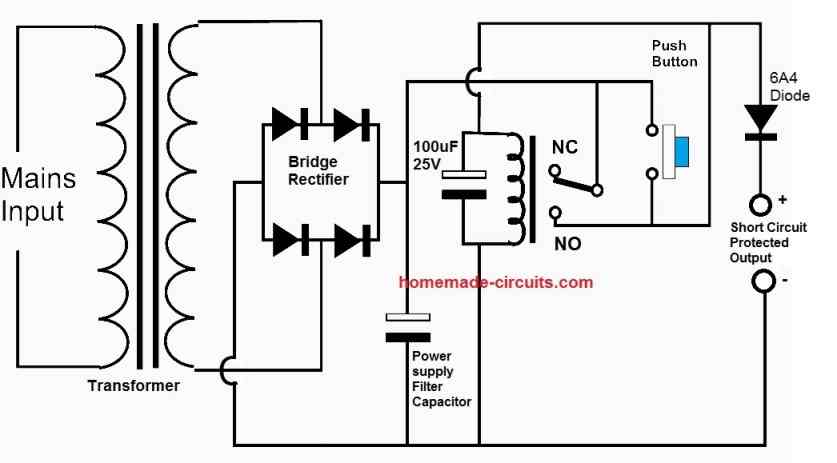
Power Supply Short Circuit Protection using SCR and Relay
The next circuit is another over current protected power supply circuit which employs an SCR and a relay for the required protection and cut-off.
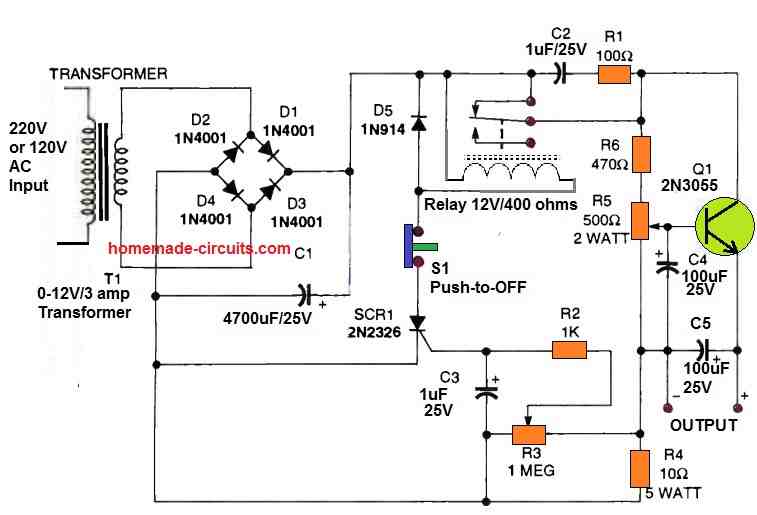
It's basic yet efficient in managing up to 24 VDC. The maximum voltage output may depend on the secondary voltage of the transformer. With the help of the 500-ohm potentiometer, the output voltage could be changed.
As soon as the protecting circuit detects an upsurge in current, the SCR will activate the relay coil, shutting the load's power and placing the circuit in idle mode. S1 should be pressed to deactivate the SCR once the over current issue has been fixed.
The 2N3055 transistor works like the voltage regulator pass transistor. However, this transistor section could be entirely replaced with any other standard voltage regulator IC such as LM317.
The 1-megohm variable resistor can be used to control the sensitivity of this SCR protection circuit.
Short Circuit Protection for Variable Power Supply Circuit
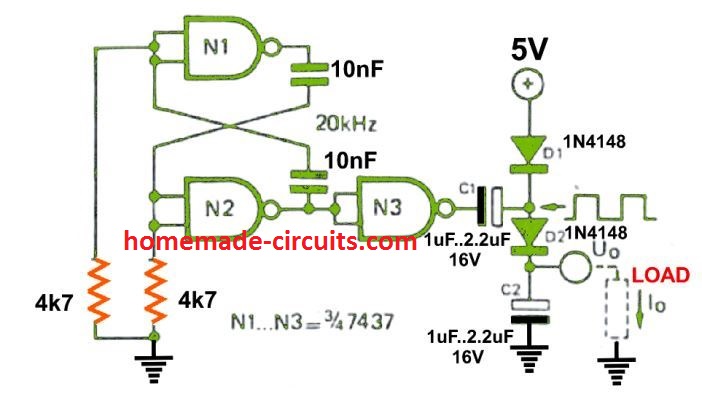
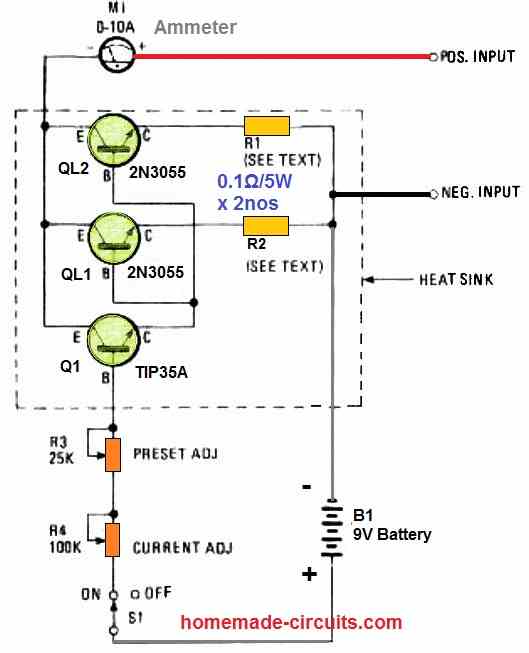
If you are having a variable power supply and want the short circuit operation to work even at voltages below 3 V or 1.5 V, then you can try adding the following short circuit protection circuit to your power supply circuit.
The idea was designed and submitted by one of the avid readers of this blog.
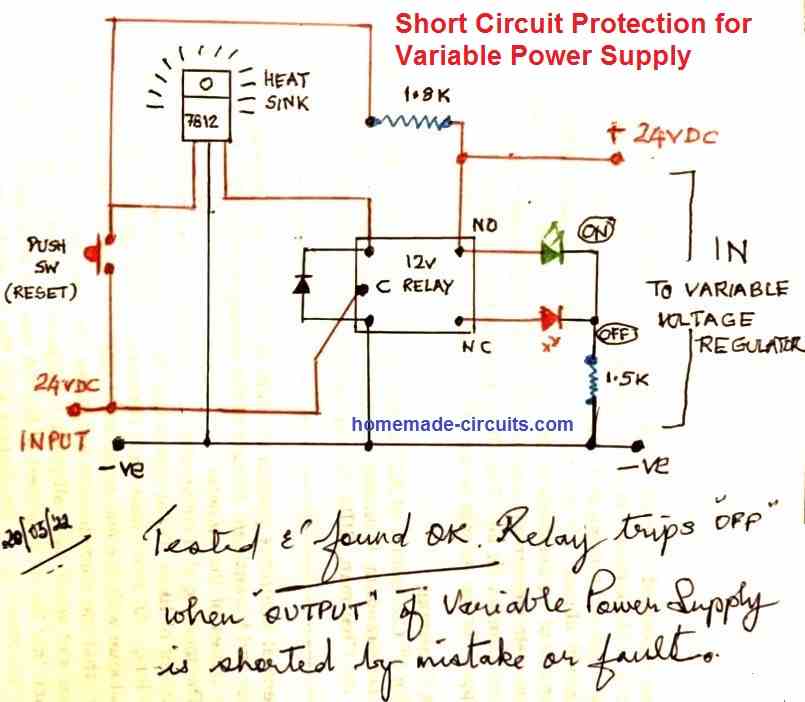
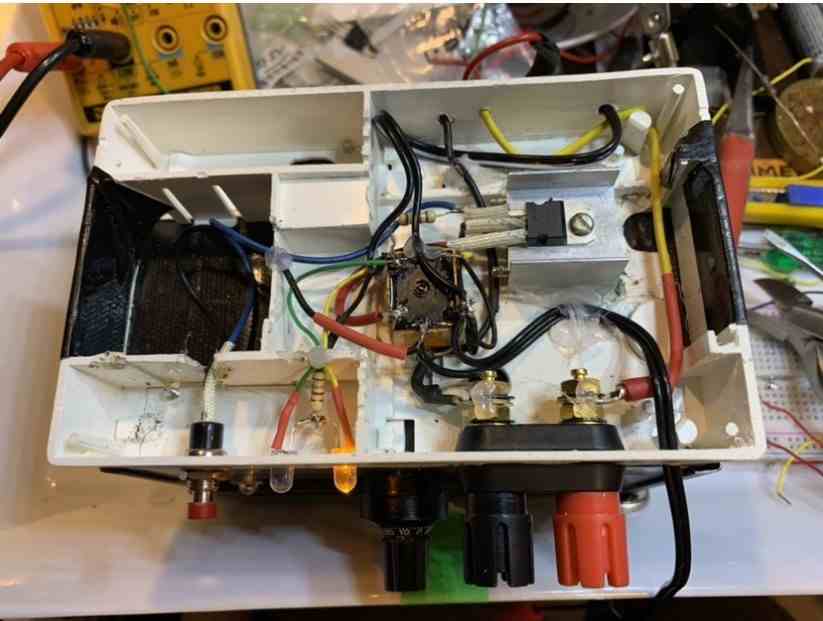
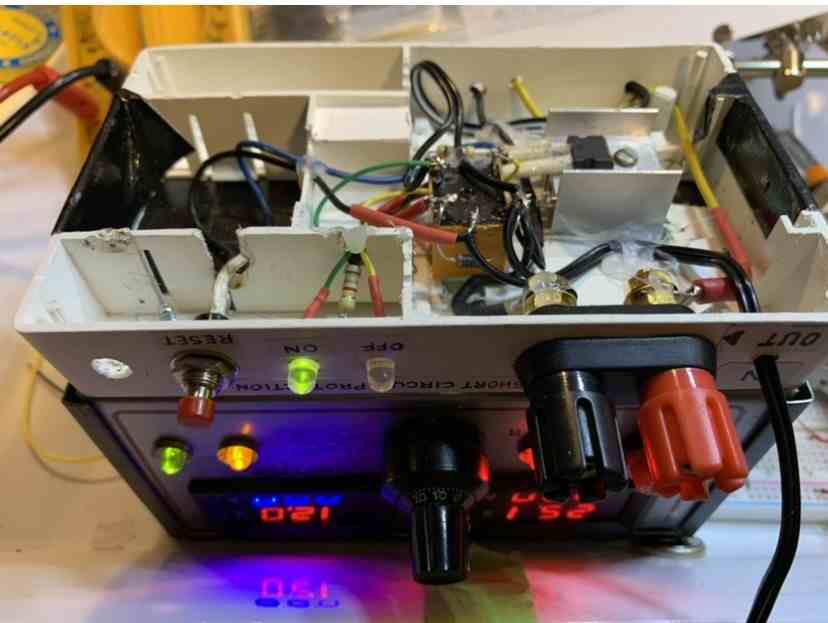
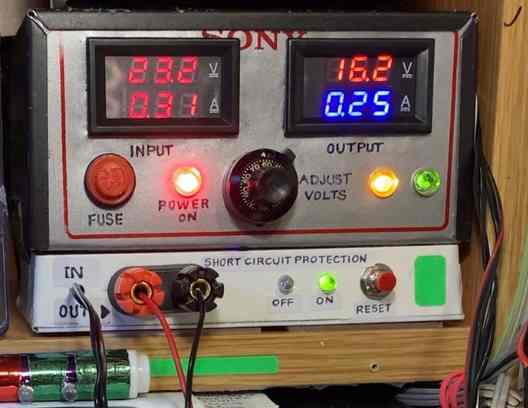
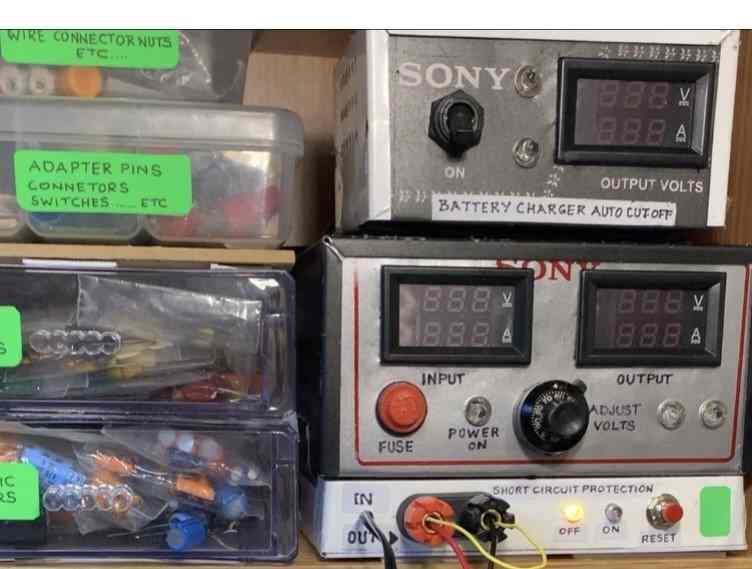
The above was tested and found to be working satisfactorily. The images show how the circuit was practically implemented into a variable power supply unit.


Questions & Answers
Hi,
Can the short circuit protection using relay work with a SMPS? I was not sure if the SMPS output voltage would drop sufficiently in time (before the load is fried) for the relay coil to demagnetize. I thought the SMPS would not drop its output voltage till it’s current limit is reached. In my case the current limit is too high.
I was considering building the “Short Circuit Protection for Variable Power Supply Circuit” for loads using a Meanwell 12V SMPS.
Thanks for your great work.
Your assumption is right, it won’t help with SMPS designs. So it is better to configure a current limiter inside the SMPS, possibly at the source pin of the power MOSFET of the SMPS oscillator.
Alternatively, you can also consider a current limiter circuit externally at the output of the SMPS, such as this one:
https://www.homemade-circuits.com/wp-content/uploads/2019/08/variable-current-limiter.png
Thanks. I think I’ll consider putting a buck converter with adjustable current limit after the SMPS to be reasonably efficient. I think I can bump up the SMPS output to 12.7V to compensate any loss due to the buck converter.
Sounds good, probably the XL4015 5A DC-DC Step Down Adjustable Power Supply Buck Module might do the job…
Yes, you’re right. Thanks!
Hello, do you know any Short Circuit Protection for Variable dual (simetric) Power Supply?Thank you
Hello, I will need to see the schematic to suggest a possible protection circuit.
Thank you for your reply. If you please, take a look at the schematic of my simetric power supply. i need help for creating a short circuit protection. Thank you.
https://drive.google.com/file/d/1ziIz8BmFbfvUCVRtxKwDbViO3EUqwR1T/view?usp=sharing
No problem Maia, I checked your schematic, it looks similar to the concept explained in the following article. You can incorporate the current limiting feature provided in this article:
https://www.homemade-circuits.com/0-to-50v-0-to10amp-variable-dual-power/
Why is the 1.8K Ohm resistor needed
It causes the circuit to latch so that the 7812 and the relay remains powered even after the push button is released.
Hello, I’ve created a short-circuit protection relay circuit, but instead of using the 7812 integrated circuit, I used a 24-volt relay directly. Initially, it worked flawlessly. My power supply is 19 volts AC. After converting it to DC, the voltage becomes 23-24 volts DC. When the AC voltage rises to 20-21 volts, the DC voltage becomes 25 volts or higher, and the short-circuit protection stops working. The LM317 TO3 transistor becomes unusable during a short circuit. What should I do?
Hello Koray,
I will need to see your circuit diagram to understand its design and only then I can provide you with a solution…
https://www.homemade-circuits.com/wp-content/uploads/2026/03/LM317-current-boost.jpg
I built the above circuit, and it works flawlessly. I can use it with a maximum load of 4A.
I built the circuit shown on your page as a short-circuit protection system. It worked flawlessly, but when the voltage increases, the short-circuit protection stops and the relay doesn’t disconnect.
That is a LM317 power supply using an outboard BJT for current boost.
You can add a current limiting feature simply by inserting a calculated resistor in series with the emitter of the PNP BJT.
For more info you can read the following article:
https://www.homemade-circuits.com/lm317-with-outboard-current-boost/
Thank you very much for your interest. Is there any way I can use the relay circuit described in this article?
The relay circuit explained above is a very crude way of adding a short circuit, I won’t recommend it… better to add an extra BJT with the existing PNP for efficient current limiting using smaller sensing resistor or add an emitter series sensing resistor, which can be relatively larger in size..
thanks
Hello, just add 2 diodes “1n4007” before LEDs. At the beginning, circuit has output voltage. so with these diodes we have zero volt in circuit’s preset.
Thank you for the suggestion. Appreciate it!
Have a nice day bro. I made a spms circuit that produces a constant output of 74 volts from the voltage I get from your 220 volt network. What can I do to protect my mosfets in my circuit from overcurrent. I trigger my mosfets with a pwm signal. I do this triggering with 3 trigger transformers. I have a 25 khz voltage reducing transformer. How do I make a short circuit for this spm circuit. I am waiting for your help. Thank you in advance.
Hello, have you used any IC based controller in the SMPS, if yes then you can put a series resistor with the MOSFET source, and use the voltage drop across this resistor with the shut down pin of the IC, during an over current.
Please how can I extrapolate this circuit to work for shut down pin on inverter module.
Which IC are you using for the inverter?
Sg3524 Ic
You can refer to the following post and see how the feedback for the over voltage and over current are included in it: Over voltage cut off at pin1, over current cut off at pin4/5
https://www.homemade-circuits.com/inverter-circuit-with-feedback-control/
Please how can this circuit work for AC power supply, it is not clear to me, Sir
No, This is recommended only for low-power power supplies…
What should be the value of the 2 capacitors in the input for the regulated power supply.
left side is 1000uF, right is 220uF
Is there a solution with a transistor to protect the relay coil in case of hight current , and adjustable to set at which amperage the relay cut off !?
relay coil will not get affected with high current, rather it is a high voltage that can damage it. So if the voltage is constant, current won’t matter.
i must admit this took longer than it should have for me to understand, it’s quite a neat idea, but you said “there may be a voltage drop” so what happens if there isn’t one ? like if i’m using a constant voltage power supply ? also what if the voltage drop is not enough ? for example a 12v relay still works at 9.8v (don’t know where it stops) and i’m guessing this doesn’t work at all in a variable power supply.
Also your relay has to match the voltage output of the power supply, do they make relays that work on 5v ? or 19v ? i’m guessing you are limited to the common ones, like 12v.
Whether it’s a constant voltage or whatever, when there’s a short circuit the supply will drop rapidly towards zero V, and the moment it drops below the holding voltage of the relay, it will trip…so it’s a fool proof design.
This circuit will work for variable power supplies also, you just have to add the variable circuitry at the “load” side of the design.
I hope that clears the doubts.
HI swagatam… i tested this one with 5V relay … it works perfectly when i am using this circuit with normal 5V 2A smps but when i am using this circuit with 5V 60A smps it does not work. i got just big spark when circuit shorts but relay doesn’t trip. what should i do
Hi Manish, to work with 60 amps the relay contact must be rated at 100 amps, otherwise the relay contact will fuse instantly when the output is shorted.
cool, thank you for the quick reply, are the 2 capacitors part of the rectifying circuit or are they for the relay somehow ? if the later, what values would you use for a 12v power supply ?
The reason i landed on this page was because i was looking for a way to protect my power supply from shorting out because i’m trying to power a reversible DC motor with 2 relays to switch polarity, but if both relays are switched on at the same time by accident they would short the power supply. And because of your design i got the idea that maybe i can cut of the power of one relay while the other one is powered (with the 1st relay), i’m gonna pass the negative of the signal of the 2nd relay through the NC pin of the first (and vice versa), so when one is on the 2nd one cannot turn on, not sure if that will work.
If you use a DPDT relay method, there won’t be any chance of a short circuit as both the contacts would switch together in this case, for the required bidirectional movement.
yeah, in the end i figured that out as well, it’s just that i was also using the relays to turn the motor on and off (this is for my new front gate that i am automating), so the motor going endlessly in one direction or another was not a good thing, but then i remembered that i was gonna install limit switches anyway, so i’ll just use those to turn the motor off at the right time.
Question: can a relay stay on (latch) forever without breaking ? i’m gonna use the NC loop/side of the relay to close the gate to avoid the relay staying on for a long time.
yeah, i know, i saw some say they have silver and such, but i wasn’t asking about the contacts, i was asking about the thing that makes the contacts move.
A relay basically is an electromagnet with a spring loaded magnetic shaft operated by the electromagnet, you can get more details below:
https://www.homemade-circuits.com/how-a-relay-works-in-circuits-how-to-connect-it/
by ‘latched’ i meant ‘powered on’ not fused shut, so i was wondering if the device that powers the relays contacts can get worn out for staying on to long, i presume it’s an electromagnet and a spring.
I’m using a windshield wiper motor (12v@5A) that i think i might be powering with a variable voltage circuit (so i can adjust the speed) that has a constant current function, so i don’t think i will be needing that current limiter, but thanks for the link anyway.
The contacts are coated with special alloys so they are usually very resilient to all forms of wear and tear….
A relay can get latched typically due to fusing of the contacts, in case the contacts are subjected to higher current than the rated specs. The best way to avoid this is to add a current control stage in between the contacts and the load. A few simple current control stages are explained in the following article which can be tried:
https://www.homemade-circuits.com/universal-high-watt-led-current-limiter/
Olá Swagatam,
Este circuito suporta 50v 10A, ou quais modificacoes devo fazer?
Poderia postar circuito de fonte 50v 10A, quando regulada para 10A a tensao nao cair ou seja estabilizada.
Hi Joao, yes you can use it for 50V 10amp, just add a small value resistor in series with the relay coil, may be a 22 ohm… and make sure the contacts are rated at 20 amps or 15 amps minimum.
Hai sir….*
I tried this circuit it’s working well…
I have one adapter type smps…
O/p 12v 1.5A …
Its working good…This smps contains short circuit protection…
If i short it…smps power led goes OFF…if i un short it…smps power led ON…
I can’t able to find the circuit diagram…fully molded …
So pls guide me sir…
Is there any circuit same like…
Whenever short happen….smps power led off and in normal condition smps power led ON….
Pls guide me sir….*
Thank u sir
I need Circuit diagram sir….
Kesav, you can refer to the following article for all the details:
https://www.homemade-circuits.com/2015/04/how-to-make-variable-current-smps.html
Hi Kesav, it is normally done through a current sensing resistor at the output side of the SMPS, when current exceeds across this resistor, the feedback optocoupler gets activated which switches OFF the primary side of the smps preventing the short circuit