The proposed circuit was requested by one of the avid readers of my blog. It is a low battery warning indicator circuit using op amp IC 741 and can be used for monitoring a particular low battery voltage threshold.
Circuit Operation
The circuit may be understood with the following points:
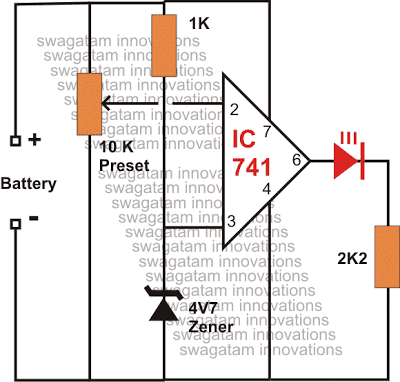
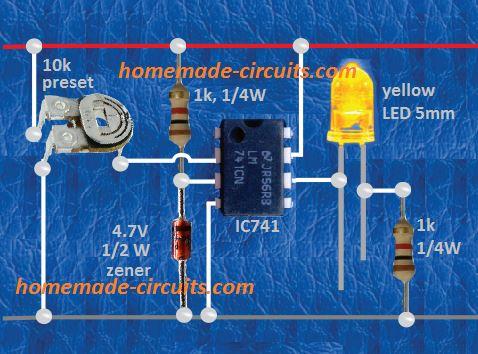
The entire configuration is wired around the IC 741 and it becomes the heart of the circuit.
Basically it is configured as a comparator with one of its inputs clamped to a fixed reference level while the other input used as the sensing terminal.
Here as can be seen in the diagram, the non inverting input is provided with a fixed reference voltage through a resistor zener network.
This input is fixed to about 5 volts.
The other inverting input pin #2 is wired via a preset to sense the input supply voltage from the source.
The preset is adjusted such that the voltage level at this input becomes lower than the fixed reference voltage at the other pin of the IC as soon as the source voltage becomes lower than the desired threshold level.
When this happens the output of the IC immediately becomes high, illuminating the connected LED.
The illuminated LED immediately provides the indication of a low voltage situation so that the required actions may be initiated.
Optionally, the output may be replaced by a piezo buzzer instead of the LED for getting an audible response of the above situation, eliminating the headache of monitoring the LED condition every now and then.
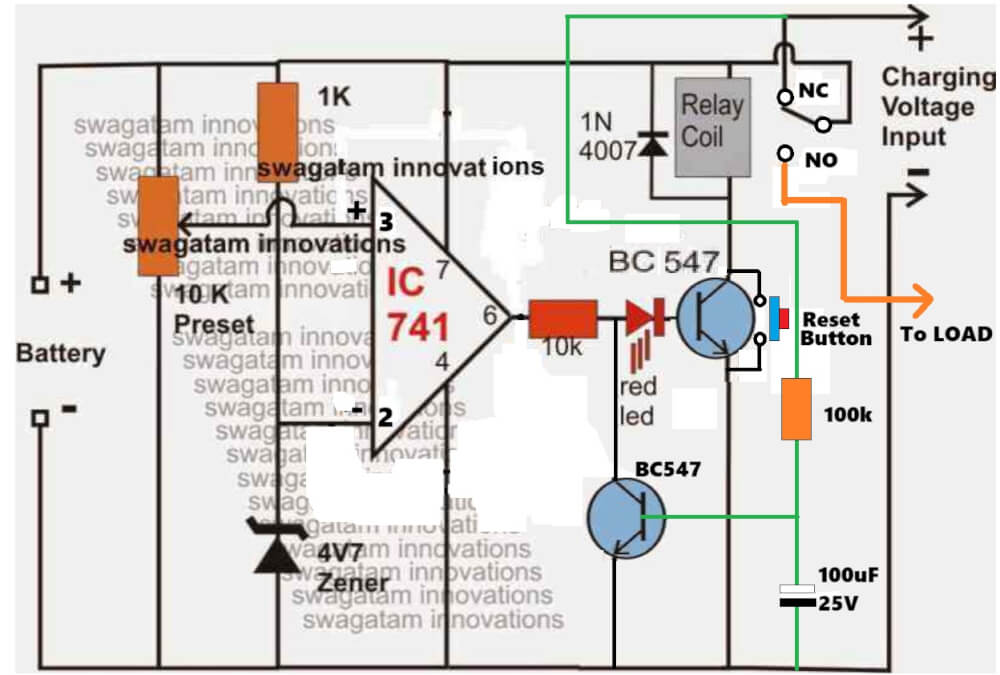
The above circuit can be modified by adding a relay stage for a latching facility, so that the relay latches and stops oscillations at the set low battery thresholds.
How to Setup this Low Battery Indicator Circuit
The above low battery indicator circuit can be even further improved in the following manner for controlling both lower and the upper charging thresholds:
Initially keep the 100K preset link disconnected.
Apply a 14.4V source from the "Battery" side and adjust the 10K preset such that the upper relay just activates, confirm the triggering by subsequently moving the preset to-and-fro.
Glue it once fixed.
The LED will respond by switching ON to the fixing of this preset.
Now reconnect the 100K preset feedback link, and reduce the input supply to about 11.2V. Make sure it has a high resistance initially.
Next, slowly adjust the 100K preset such that the relay just deactivates (at the 11.2V).
Confirm by flipping the preset as above. Ignore the lower relay as it will switch ON as soon as the input supply is switched ON, so its operation is obvious.
That's it, the low battery warning circuit is all set now and will accurately respond to the above settings or any different setting that may be preferred and implemented by the particular user.
IC 741 Low Battery Indicator Circuit with Relay Cut-off
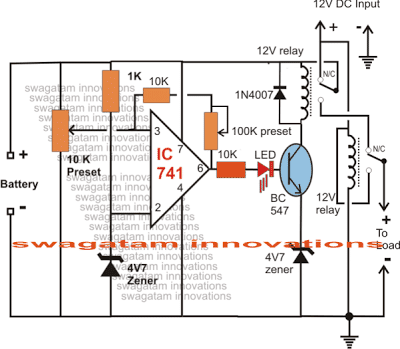
The following circuit shows how the above low battery indicator can be enhanced with relays for achieving an automatic low charge and full charge cut for the connected battery, and also a cut off for the load during a low battery situation.
The upper relay becomes responsible for cutting off the battery during over charge and low discharge level, while the lower relay cuts of the load as soon as the battery reaches the unsafe low discharge zone and as soon as the upper relay reverts to charging mode


Questions & Answers
Hello sir. My question is, my relay flickers when the battery voltage reaches 10.5v which is the cut of point. I used lm358 OpAmp. Is it okay
Hillary, please try adding a diode between pin#3 and pin#6 of the opamp, as shown in the following diagram, and let me know if solves the problem or not.
https://www.homemade-circuits.com/wp-content/uploads/2025/02/op-amp-latching-effect.jpg
What zener diode should I use if my battery is a 3.7v 300 – 3500mah Li-ion battery (includes Li-po batteries too)
You can use a 3V zener diode, or, 3 or 4 1N4148 diodes in series, connected between pin#3 and ground….cathode towards ground.
Hello swagatam sir, I need to design a power supply failure indicator using IC741 op Amp,can you help me to design this mini project.I tried a lot but still there is no out come . Please accept my plea
Hello Sujal,
Can you provide more information about the project. Bceause power supply failure can be detected simply by putting an LED. If the LED shuts off that would mean there’s no power supply. How do you want to use the IC 741 and where exactly?
Sir, basically by using ic741 ,led,resistors capacitors and diode I need to make a small power supply failure indicator. The working should be in such a way that that the LED should glow when there is fluctuations in power supply or when the power supply is cut.
OK Sujal, let me see, I will try to figure it out and let you know soon….
Thank you sir
Sujal, there’s one question, if there’s no power supply, how will the op amp and the LED indicator work?
Sir even I am unaware of the answer for your question, but I found out an article for this problem with circuit diagram. can I know your mail so that I can send it to you.thank you
You can send the image to contact@homemade-circuits.com
Hi Sujal,
I saw your diagram in the email. The circuit uses a battery, so if you use a battery in your circuit then it is possible to build it. The battery can be a 9V battery.
Sir I have sent you another mail please do check it.
Sujal, I have uploaded the diagram in the below link. There are a few things I cannot understand myself. Where is the source of the external power supply? Which is the reset switch SW1, or SW2. I guess it is SW2. And, is your circuit working?
https://www.homemade-circuits.com/wp-content/uploads/2023/11/power-filure-indicator.jpg
Yes sir I assumed reset switch as SW2 and I gave 9v battery as the power source, when I give power to the ckt the light blinks and when I take off the power supply it blinks. I am unable to understand what’s happening inside the circuit.i will refer to the circuit given by you
I can provide you the op amp circuit which will illuminate an LED when the external power supply fails or becomes low. But my circuit will require a battery also, a 9V battery….
yes sir please provide me with the circuit you are discussing about,I have a 9v battery .It would be a great help to my project
Sujal, You can try the following circuit:
https://www.homemade-circuits.com/wp-content/uploads/2023/11/power-supply-failure-indicator-circuit.jpg
All diodes are 1N4148….
Sir thanks alot. Just one last doubt,what value of power supply should I provide to the ckt. also can you provide me with the working of this circuit if possible
Hi Sujal, the power supply DC should not be above 15V otherwise the IC 741 will burn.
It is a comparator circuit, with its non-inverting input (+) clamped to a 1N4148 to create a 0.6V reference. The inverting input (-) is connected between two diodes to ensure that it is able to detect only the external power supply DC and not the battery DC.
As long as this external power supply on pin#2 of the IC is higher than the pin#3 potential of 0.6V the output of the op amp remains 0V and the LED remains shut off.
In an event when the external power DC on pin#2 goes lower than the pin#3 0.6V, the op amp output swings to +9V battery level and thus illuminates the LED.
Thankyou soo much sir. ❤
You are welcome Sujal!
Sujal, please add a 1N4148 diode from the battery +9V side also, otherwise the external power supply +DC will try to enter the battery and damage it.
Ok sir , sir one more doubt, can I use 1N4001 diode instead of 1N4148 as they are equivalent….
Yes, you can use 1N4001 diode for all the diodes shown in the diagram.
sir i made the circuit and it is working perfectly. Once again i thank you whole heartedly for your help and will stay connected with you for your help in my future projects <3.
Thank you Sujal, Glad it worked for you. Please feel free to comment if you have any further doubts
I am after a simple cct to operate a relay to showw high dc voltage of 40v and must run between 24v to 45v.
Can you help please.
Please elaborate, I could not understand the exact functionality you require.
I have a battery charge that needs a simple cct that turns off the charger when the voltage gets to 41.0v. It need s operate a relay that can switch 240v ac 2a max
You can try the following concept:
https://www.homemade-circuits.com/wp-content/uploads/2023/10/42V-auto-cut-off-charger-using-IC-741.jpg
Hello sir, I have tried the circuit today but the second relay that is connected to the load is not bringing output
Sir, my requirement is how to make low voltage indicator and cut off circuit for inverter
OK, then you must try the second circuit from the above article. Just make sure to swap the pin#2 and pin#3 with each other, and replace the “charging input” with your inverter +/- supply inputs.
Also please remove 100K preset feedback link, we can modify it afterwards when the circuit is confirmed by you.
Hello Micheal,
Please tell me your exact requirement, I will try to suggest the right circuit for you.
how to prevent the charging circuit from very high current drawn from 12V car lead acid battery when they are as low as below 8V. My own circuit have often burnt by bridge rectifier and transformer.
You can take the help of a current limiter circuit as explained in the following article:
https://www.homemade-circuits.com/universal-high-watt-led-current-limiter/
Hi Swagatam,
We exchanged some comments on one of your other pages (IC 741 Car Alternator Voltage Current Regulator Charger Circuit) and you suggested I take a look at the first circuit in this article. If you remember I was looking for a circuit to add an ignition warning light to an old motorcycle.
I picked up a few 741’s from a local webshop and have been playing around with the circuit on a breadboard. With the LED in the circuit it works as described. I have been testing with an old lab power supply to alter the voltage supplied to the circuit. Trouble was I need to modify it to get a 12v signal from the output (pin #6). The “dashboard” of the bike has fittings for the small BA9 lamps and I have installed LED replacements, but of course they are modified internally to work on 12v.
I read up here and other sites on the working of the 741 and it seems like to get 12v out I needed to put a 12v reference voltage in (pin #3). So I looked into the working of the resistor zener network and changed the 4V7 zener for a 12V example. The 1K resistor seemed to work OK and I get a reading of 11.9V at pin #3 which lights the 12V LED OK. Now this needs to go out when I turn up the voltage to around 13- 13.5V, but adjusting the 10K pot feeding the inverted input (pin #2) never raises the wiper voltage to be above the reference when the lamp should go out. I tried a couple of other pot values without success and the only change that seems to work is removing the 10K pot and feeding the changing input voltage (as would be put out by the bike’s generator) direct to pin #2.
So my question is – does this seem like a suitable modification to create a stable project? Or would you modify it differently? Looking forward to your thoughts, thanks.
Hi Martyn,
The 12V zener at pin#3 of the IC is not necessary. You can use any zener diode below 9 V and still setup the circuit to cut off at the desired threshold. The 10K preset adjusts the pin#3 threshold in accordance with the zener reference, so any zener below 9 V should work.
However if you are able to get a zener diode whose value is exactly equivalent to your desired cut-off threshold, then you can replace the 4.7V zener with this zener diode. In that case you can also eliminate the preset and connect the pin#2 of the IC directly with the source DC.
As far as the working of the preset/pot is concerned, it will definitely allow the voltage at its wiper arm to be adjusted right from zero to the maximum supply voltage level. If it is not doing this then either your preset is faulty or you may have connected it wrongly.
OK – so I looked at again and you could be right about the 10k pot. It was from a cheapo assortment from China. I found a better enclosed version which seems more reliable and that performed better with the 12v LED lamp. Couldn’t find the time to etch a board for it so just soldered it all to a small project board and it seems to work as hoped with the old lab supply. Just need to get the bike running and adjust it to function correctly with the alternator supply. Many thanks.
Sounds good! Hope it works correctly in your bike. Wish you all the best!
Sir, if I need to use the first lm741 circuit for batteries of 4v or 6v, do I need to change the zener value or any other component values? If possible, how can I set up the cutoff using the preset for a 4v and 6v bat?
Binoj,
for 4 to 6V battery you can replace the 4.7V zener diode with a 3V zener diode or you can use 3nos of 1N4148 diodes in series. Cathodes will go towards the ground line
Sir I think the the n/o contact of the relay so that when the battery reaches the full voltage level and the op-amp becomes high at its output and triggers the transistor to switch on the relay (turns to the n/c contact) and with this the battery is unable to charge further. Sir this is just a suggestion
Melvis, which circuit are you referring to?
Hi swagatam.
1)Can i use the first circuit (the one without a relay, with just the LED) with a 12v battery source?
2) if yes, can i replace the LED with a buzzer because i want to build this circuit so that the buzzer would sound at exactly 12.0vdc
3) In other to achieve the above requests, do i need to change any of the components (e.g the zener diode)
Thanks.
Hi Chris,
1) yes you can use the first circuit with a 12V supply
2) Yes you can replace the LED/resistor with a piezo buzzer unit.
3) You can do the above without changing anything in the design
Thanks for the quick response Swags.
If i build this indicator circuit for a 12.0vdc battery (for my inverter) and the piezo buzzer is activated(as in a low battery condition) how about if i connect the battery to a charger(my solar panel) and the battery voltage rises above 12.0v would the buzzer be deactivated automatically?
Hi Chris, yes as soon as the battery voltage increases above set low level threshold, the buzzer will stop buzzing, and vice versa.