In this post I have explained through calculations how to select and interface the solar panel, inverter and charger controller combinations correctly, for acquiring the most optimal results from the set up.
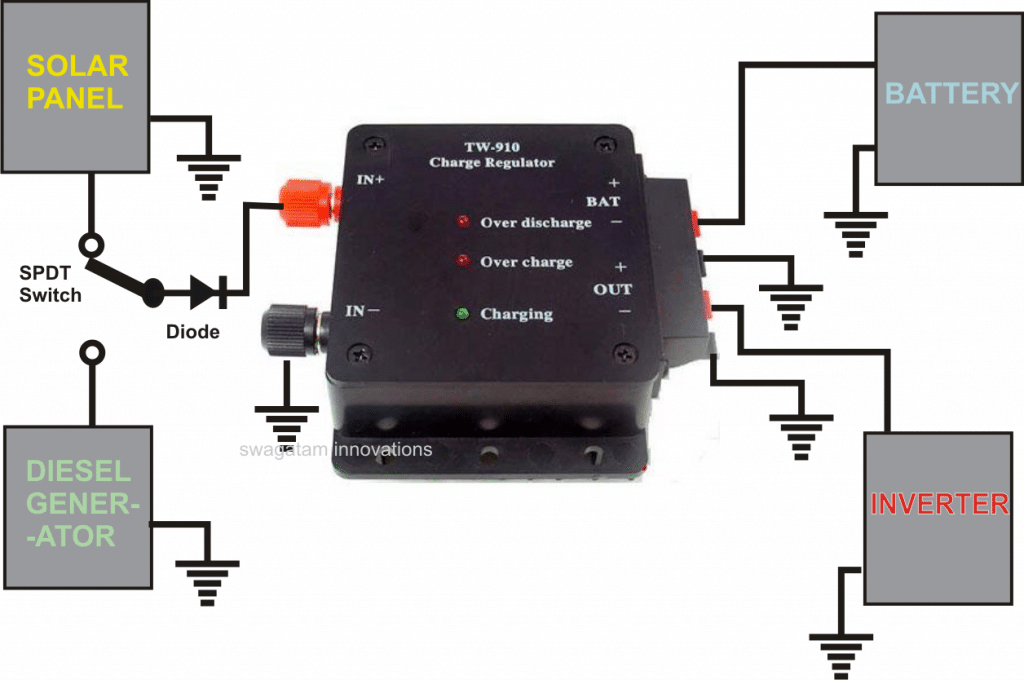
Calculating Solar Panel, Inverter and Battery Charger Specifications
For the sake of convenience, let's believe you possess a a 100 watt appliance or load that you would like to operate, free of charge through solar power, for around ten hours every night.
In order to exactly determine the dimensions of the solar panel, batteries, charge controller and inverter the following mentioned parameters will need to be strictly calculated and configured.
If you do not want to do all the calculations manually, you can simply use the following calculator for getting the results quickly:
Solar Panel, Inverter, Battery Calculator
Solar Panel, Inverter & Battery Calculator
This calculator determines the required solar panel wattage, inverter size, and battery capacity based on your power consumption and backup time.
Results:
| Solar Panel Wattage | Inverter Size | Battery Capacity |
|---|---|---|
| 0 W | 0 W | 0 Ah (12V) |
Estimating Load Wattage
1) First you will need to estimate how much watts of electricity you may require for the specified load.
Let's say you have a 100 watt load that needs to be operated for approximately 10 hours, in that case the total power required could be estimated simply by multiplying the load with hours, as given under
100 Watts x 10 hours = 1,000 Watt hours. This becomes the absolute power necessary from the panel.
Determining Approximate Solar Panel Dimension
2) Next, we need to determine the approximate dimensions of the solar panel for satisfying the above estimated load requirement. If we assume a roughly ten hour daily optimal sunshine, the specifications for the solar panel could be simply and quickly calculated as explained in the following expression:
1,000 Watt hours / 10 hours sunlight = 100 Watt solar panel.
However, you may notice that mostly during the summer seasons you may normally get around 10 hours of reasonable amount of sunshine, but the winter season may produce roughly around 4-5 hours of effective sunshine.
Contemplating the above scenario, you too might agree and recommend considering the worst possible sunshine hour into calculation so that even on the weakest of sunshines your load keeps running optimally.
Therefore taking into account the 4 to 5 hours sunshine per day consideration, we calculate the true power for the solar panel which would enable your load to keep running throughout the year .
1,000 Watt hours / 5 hours sunlight = 200 Watt solar panel.
Calculating Battery Ah
3) Once you have calculated the solar panel as per the above calculations, it's time to calculate the AH rating for the batteries that might be required for operating the specified load under all conditions. If the selected battery is rated at 12V, in that case:
Dividing 1,000 Watt hours by 12 Volts = 83 Amp Hours of reserve battery power.
Let's upgrade this value a little more with a 20% added tolerance, which finally gives a rounded up figure of around 100 AH. Hence, a 100AH 12V battery is what you may finally require for the inverter.
Evaluating Charger Controller Specifications
4) Now, to figure out how big your solar charge controller would need to be for the above calculated parameters, you might need to take your solar panel current or the Amperage specs into consideration, which may be simply gotten by dividing the panel's wattage rating with its voltage rating (Ohms law remember?)
100 / 12 = 8.3 Amps.
We have so far applied a "plus tolerance" to all the previous parameters, so let's show some generosity to the Amp spec of the panel also, and instead of sticking to the 8.3 amps limit, you might be happy raising the level to around 10 Amps? That looks good, right?
Assessing Inverter Specifications
5) Finally we boil down to the inverter specifications, and determine the reasonably exact capacity that would keep the unit compatible with the above discussed results, and keep the load running without issues, whenever required.
Well, calculating the inverter specs doesn't look difficult at this point of the discussion.
Since we already know the maximum load wattage which is 100 Watts, implies that we simply choose an inverter which might be capable of handling a 100 watt comfortably.
That implies, we simply need to get an inverter rated at 100 watts,.... OK, you may be thinking of adding some tolerance to this candidate also, not an issue, instead of 100 watts you can opt for a 125 watt inverter, allowing all the gadgets to happily "shake-hands" and your house powered round the clock forever, free of cost.


Questions & Answers
please get me a practical circuit to make a 2000w inverter to work from 300v dc to 230v output
dear Swagatam
in calculating the actual power delivered by a solar panel do we have to consider the efficiency of that panel so as not to undersized the panels required?
Hi Richard,
Yes, when calculating how much power a solar panel really delivers, we need to consider its efficiency. Efficiency tells us how well the solar panel turns sunlight into electricity. If we ignore this, we might end up with a system that’s too small and can’t provide enough energy to meet our needs.
What does c37 & c38 stand for and what it does in the circuit.
Thank you
Which circuit are you referring to?
very insightful. thanks.
pleas tell me How much the design insulation (ESH)?
Your Discussions are very helpfull
I have 900w,72v DC brushless intelligent self-priming pump, how many panels are needed to run it.
How many solar panels are needed to run a 850w DC BRUSHLESS INTELLIGENT SELF-PRIMING PUMP ON 72V
You will need a 900 watt 72 V solar panel, you can create this by adding many small panels in series and parallel.
Sorry, I do not have it at this moment.
Not 5000 load is 500 load for 12 hours
I have explained the procedures in the above article. Please use the above data to calculate it yourself.
Pls help me to size panel, charge controller, inverter and battery (5000 load, 12 hours night run) God bless you
What is the fault of my inverter displaying zero input and output voltage
I really appreciate the presentation on this site. Very beneficial, precise and informative. Thank you.
Thank you Engr. Abdulhafeezh
After going through the tutorial above, the question i want to ask is how do I calculate or determine the amount of voltage and Ampere to charge 2 units of 200ams battery and 4 units of 300watts solar panel
For a 200 Ah battery, you will require minimum 20 amp current.
I have a total load of 600w to run for 6 hours, what is my calculations to know the batteries, inverter, panels and charge control I should have
Thanks for the good works. Plz can you help on printed circuit?
Sorry, I can’t supply PCBs.
I have a 4kva inverter with 4 batteries if i am charging it with 8 unit of 300watts solar panels how fast can the sun charge the batteries while supplying light after the sun has gone down
Please provide battery voltage and Ah specifications, and how are they connected, in series or parallel?
Thanks
Please, what can i alter to change to the desired solar charge controller(referring to solar charge controller circuit)
You will have to alter the solar panel and the battery to match your solar controller
thank you
Pls what is the best way to connect panels, is it series or parallel when using a 4x 220amps batteries and a 60amps charge controller.
Mind u my panels are in 200watts.
It will depend on the battery voltage and current.
Hello our able instructor,I ‘ll need your attention on transformer less inverter circuit with a clearer analysis sir, since I have little knowledge about the construction remain bless sir and more grease to the elbow
Hello Olufemi, for transformerless inverters you can refer to the following post:
3 Best Transformerless Inverter Circuits
What is the recommended setting on the solar charge ontroller
Morning sir I have two 200watts solar panels and 2000watts inverter and 200ah battery but still can’t have power for 5hrs
Hello Godfrey, a 200 Ah battery will require a charging current of at least 30 amps for first few hours which must be reduced to 20 amps after sometime….A 200 watt panel will not be able to supply such high current, and therefore the battery will remain under charged.
Thank you God will bless your wisdom
Total Home load is 3600W expected to run for 20H daily let us say 30-40%
I have 12pcs 350w 36v solar panels
I also have 4.5kva inverter
I also want to have 6-8pcs 12v 220AH batteries
I want to know the size of charge controller to use since I have 36v from Panels and 12v for batteries and inverter.
For charging 12V 220 Ah batteries, you can use a 12V/30 ampere charger with auto cut off, and install them individually on each battery.
Thank you for the knowledge you are giving.
I want to get something out.
I have
3 TVs 105W=315W( 12hrs)
1 Washing Machine =450w(3hrs)
5 Fans 50W =250w
3 Laptop 80W= 240w(18 hrs)
20LED light 30W= 600w (20hrs)
Cooker = 400w (3hr)
Deep freezer= 300w
2 A.C 1.5hp(1125 W) =2250w(24/7) (12 hrs)
something yet to be added= 95w
The total wattage is 5000w.
Can you please do the breakdown to the barest minimum for me.
1.Would like to know amount of watt estimated per day
2.best inverter voltage to be used and best and Ah calculate
3.Solar panel calculated
4. How many kva is best and volt system and number of batteries
5.solar charge controller calculation
Thank you for your question, however I have already explained the entire process in the above article for quick calculations…