In this post I have explained how to make a 3 phase inverter circuit which can be used in conjunction with any ordinary single phase square wave inverter circuit. The circuit was requested by one of the interested readers of this blog.
UPDATE: Looking for an Arduino based design? You may find this one useful:
The 3 Phase Generator using IC 4035
The 3 phase inverter circuits explained in the subsequent sections of the article, will all basically need a good 3 phase generator circuit. One such good 3 phase generator circuit can be built using the IC 4035,. Let us understand how to do implement it with the following explanation:
This circuit creates 3 square wave outputs, each 120° out of phase, just like a 3-phase AC supply but in digital (square wave) form. It is good for testing 3-phase inverter circuits, BLDC motor drivers, or simulating 3-phase logic.
MAIN PARTS USED:
| Part | Function |
|---|---|
| IC 555 | Works like a clock – generates fast square pulses. |
| CD4035A | 4-bit shift register – shifts logic “1” and gives 3-phase signals. |
| MJE340 + Zener | Gives stable 12V to ICs even if input DC is high. |
| NOT gates (N1, N2) | Helps reset and invert signals properly. |
Full Circuit Diagram

HOW THIS THING WORKS, STEP-BY-STEP:
(1) Power Supply Side
- The top side of the circuit says “+12V to +100V DC” — this means input can be any voltage from 12V to 100V.
- That high voltage passes through a 10k, 1 watt resistor, then to the Zener diode (12V).
- The Zener clamps the voltage to exactly 12V, and the MJE340 transistor supplies regulated 12V to all ICs.
So no matter what voltage we feed (12V to 100V), the circuit ICs will only see 12V. Nice trick!
(2) 555 Timer Section
- The 555 is in astable mode means it keeps oscillating on its own, making square waves.
- The frequency is set by R1, R2, and C, this tells how fast the 3-phase signal rotates.
- Pin 3 of the 555 outputs these pulses, this goes into the clock pin of CD4035A.
- That pulse pushes the shift register forward each time, like "step forward" on each beat.
(3) CD4035 Shift Register Section
Now the magic happens here…
- CD4035 is a 4-bit shift register so each clock pulse pushes the logic “1” from Q1 → Q2 → Q3 → Q4 → repeat.
- But here only Q1, Q2, Q3 are used as outputs. These are taken as:
- Q1 = phase#1
- Q2 = phase#2 (inverted by N2 for better phase shift)
- Q3 = phase#3
Each of these are 120° apart from each other (as long as we consider each clock pulse = 120°).
- N1 is used for reset logic or pulse shaping (basic inverter from IC 4049).
- N2 inverts the second output so that the phase shift looks cleaner so Q1, !Q2, Q3 → gives better symmetry.
OUTPUT WAVEFORMS:
- All outputs are square waves.
- Frequency is same but each is delayed from the other by 120°.
- You get a digital-style 3-phase signal...
IMPORTANT POINTS:
- N1 and N2 are NOT gates, from IC 4049.
- You must pulse the SER input (pin 10) once at start (logic HIGH) or just connect it HIGH permanently.
- If nothing appears at output then check:
- 555 oscillation.
- Reset pin of CD4035 (must be LOW).
- Proper pull-ups on output lines.
The 3-Phase Full-Bridge Driver Stage
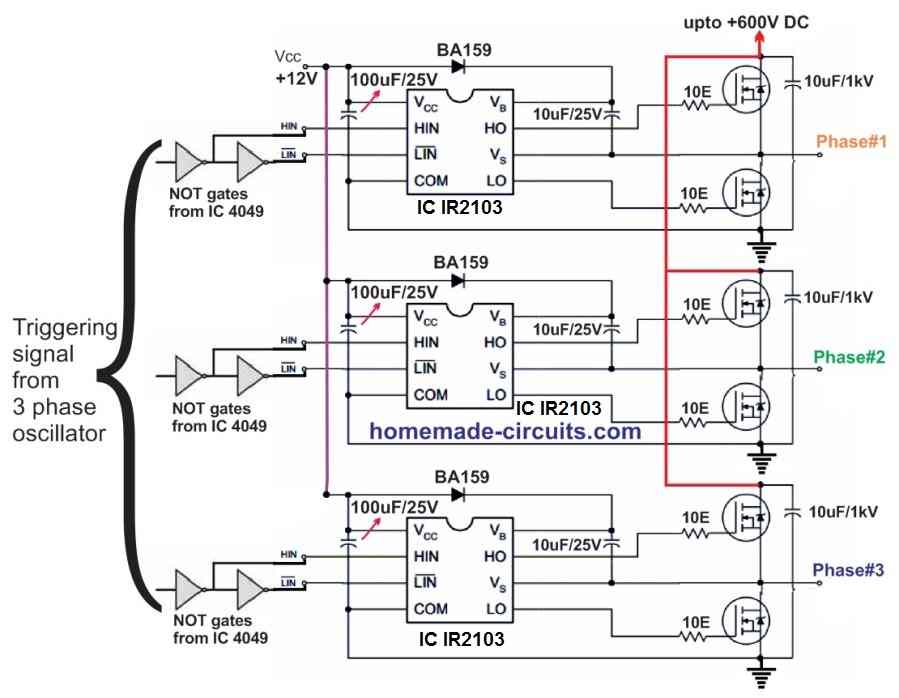
In the following 3 phase inverter diagram, remember the HIN, LIN pinouts must be fed with alternating pulses, which can be done using NOT gates from the IC 4049, or simply using a BJT BC547 stage.

In the above 3 phase generator circuit (second last diagram) using a sine wave doesn't make sense because the 4049 would ultimately convert it into square waves, and moreover the driver ICs in the last design employ digital ICs which will not respond to sine waves.
Therefore a better idea is to use a 3 phase square wave signal generator for feeding the last driver stage.
You may refer the article which explains how to make a 3 phase solar inverter circuit for understanding the 3 phase signal generator stage functioning and implementation details.
Using IC IR2103
A relatively simpler version of the above 3 phase inverter circuit can be studied below, using the IC IR2103 half bridge driver ICS. This version lacks the shut down feature, therefore if you do not wish to incorporate the shut down feature, you can try the following simpler design.
Simplifying the Above Designs
In the above explained 3-phase inverter circuit, the 3-phase generator stage looks unnecessarily complex, and therefore I decided to look for an alternative easier option for replacing this specific section.
After some searching I found the following interesting 3 phase generator circuit which looks pretty easy and and straightforward with its settings.
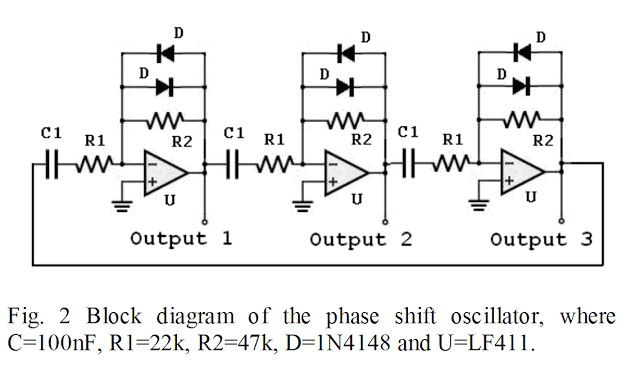
Therefore now you can simply replace the earlier explained IC 4047 and the opamp section entirely and integrate this design with HIN, LIN inputs f the 3 phase driver circuit.
But remember you will have to still use the N1----N6 gates between this new circuit and the full bridge driver circuit.
Making a Solar 3 Phase Inverter Circuit
So far we have learned how to make a basic 3 phase inverter circuit, now we'll see how a solar inverter with a 3 phase output can be built using very ordinary ICs and passive components.
The concept is basically the same, I have just changed the 3 phase generator stage for the application.
Inverter Basic Requirement
For acquiring a 3 phase AC output from any single phase or a DC source we would require three fundamental circuit stages:
- A 3 phase generator or processor circuit
- A 3 phase driver power stage circuit.
- A boost converter circuit
- Solar Panel (appropriately Rated)
To learn how to match a solar panel with battery and inverter, you can read the following tutorial:
Calculate solar Panels for Inverters
One good example may be studied in this article which explains a simple 3 phase inverter circuit
In the present design we too incorporate these three basic stages, let's first learn regarding the 3 phase generator processor circuit from the following discussion:
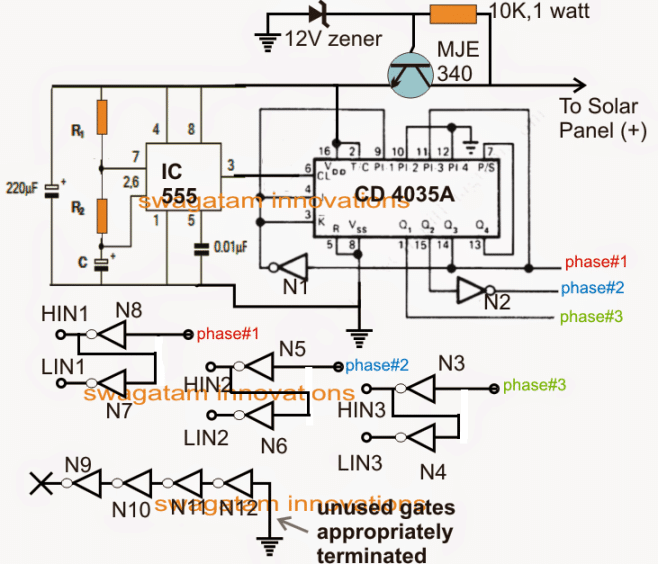
How it Works
The diagram above shows the basic processor circuit which looks complex but actually it's not. The circuit is made up of three sections, the IC 555 which determines the 3 phase frequency (50 Hz or 60 Hz), the IC 4035 which splits the frequency into the required 3 phases separated by a phase angle of 120 degrees.
R1, R2 and C must be appropriately selected for acquiring a 50 Hz or 60 Hz frequency at 50% duty cycle.
8 numbers NOT gates from N3 to N8 can be seen incorporated simply for splitting the generated three phases into pairs of high and low logic outputs.
These NOT gates may be acquired from two 4049 ICs.
These pairs of high and low outputs across the shown NOT gates become essential for feeding our next 3 phase driver power stage.
The following explanation details the solar 3 phase power mosfet driver circuit
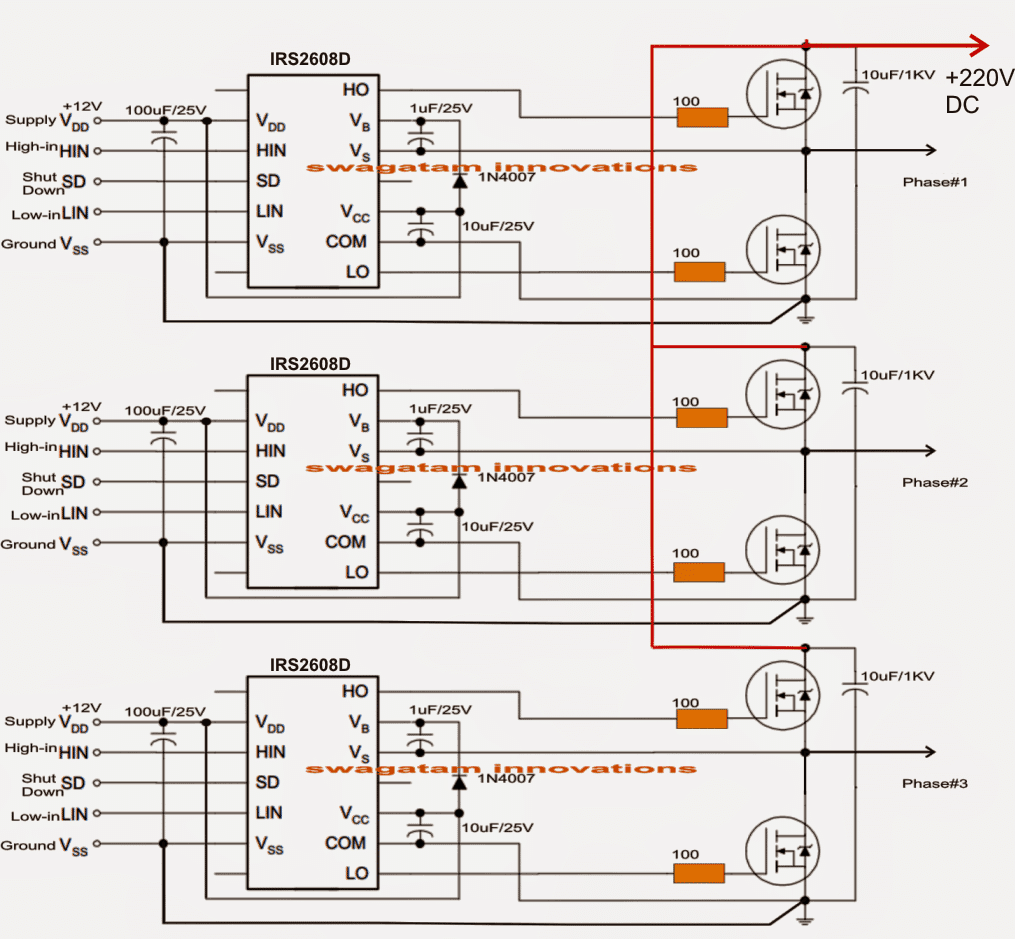
Note: The shut down pin must be connected to the ground line if not used, otherwise the circuit will not work
As may be seen in the above figure, this section is built across 3 separate half bridge driver ICs using IRS2608 which are specialized for driving high side and low side mosfet pairs.
The configuration looks quite straightforward, thanks to this highly sophisticated driver IC from International rectifier.
Each IC stage has its own HIN (high In) and LIN (low In) input pins and also their respective supply Vcc/ground pins.
All the Vcc are required to be joined together and connected with the 12V supply line of the first circuit (pin4/8 of IC555), so that all the circuit stages become accessible to the 12V supply derived from the solar panel.
Similarly all the ground pins and lines must be made into a common rail.
The HIN and LIN should be joined with the outputs generated from the NOT gates as specified in the second diagram.
The above arrangement takes care of the 3 phase processing and amplification, however since the 3 phase output should be at the mains level and a solar panel could be rated at a maximum of 60V, we must have an arrangement that would enable boosting this low 60 volts solar panel to the required 220V or 120V level.
Using IC 555 Based Flyback Buck/Boost Converter
This can be easily implemented through a simple 555 IC based boost converter circuit as may be studied below:
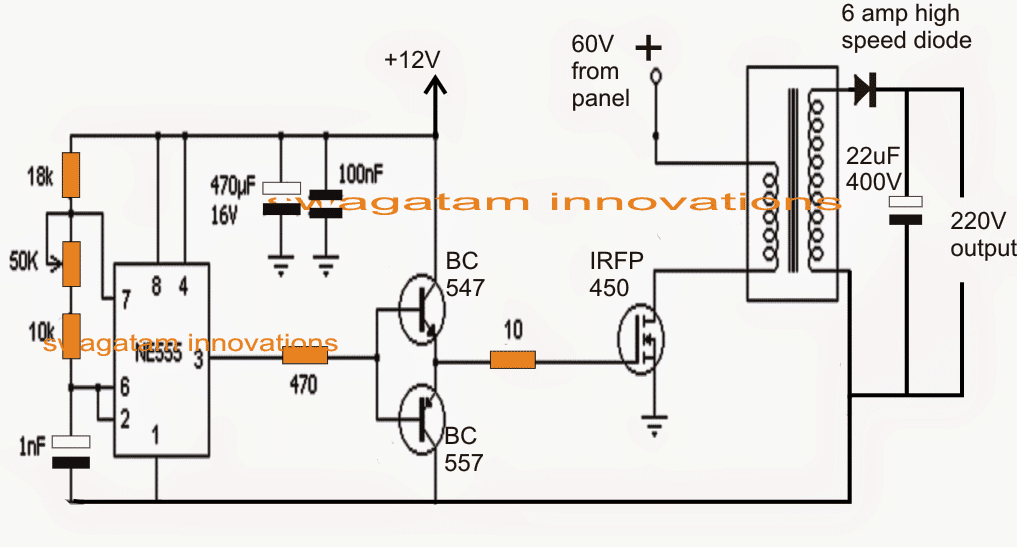
Again, the shown configuration of the 60V to 220V boost converter looks not so difficult, and can be constructed using very ordinary components.
The IC 555 is configured as an astable with a frequency of approximately 20 to 50 kHz. This frequency is fed to the gate of a switching mosfet via a push pull BJT stage.
The heart of the boost circuit is formed with the help of a compact ferrite core transformer which receives the driving frequency from the mosfet and converter the 60V input into the required 220V output.
This 220V DC is finally attached with the previously explained mosfet driver stage across the drains of the 3 phase mosfets for achieving the 220V 3 phase output.
The boost converter transformer can be built on any suitable EE core/bobbin assembly using 1mm 50 turns primary (two 0.5mm bifilar magnet wire in parallel), and secondary using o.5 mm magnet wire with 200 turns


Questions & Answers
Hi Swagatam,
thank you for your nice article. There is a small mistake at IR2103 buffers, their inputs Hin amd Lin should be simply connected together, because Lin is already inverted in the IC. I am going to try your solution to drive the motor of a turbomolecular pump.
Hey Igor, thanks, but no you cannot connect the HIN, LIN together…although LIN has internal inversion logic, HIN and LIN should not be directly tied together. Proper complementary signals must be externally generated to ensure safe switching and to avoid shoot-through in the MOSFETs. Sure, you can try it, let me know if you face any issues…
Hi Swagatam,
I tested your circuit with 4035 + IR2103 and HIN, LIN tied together and it works perfectly. My turbopump revvs up to 61000 rpm with this circuit. Although the mistake had to be corrected, I found your schematic very helpful, thank you!
Igor.
You are most welcome Igor, I am glad your circuit is working and you found the above article helpful, please keep up the good work…
Look at Fig. 1 in the datasheet, if the signals _LIN_ and HIN are tied together, then only one output transistor is open at any time. If the inputs are drived alternatively to each other, the output transistors remain boch closed (protective feature).
Please see this internal block diagram:
https://www.homemade-circuits.com/wp-content/uploads/2026/04/IR2103-functional-block-diagram.jpg
What dampens the energy at the +and-igbt common ends
Yes, in pin 6, the duty cycle can be changed, but the three phases do not have a sinusoidal signal. I asked if a signal with a frequency of 5-10khz can be applied to the outputs of the three phases before the igbt drivers.
To get sine wave output, you can consider chopping the low side devices with SPWM, as explained in the following article:
https://www.homemade-circuits.com/convert-any-h-bridge-inverter-to-sine-wave-h-bridge-inverter/
Hello, can you please tell me if a PWM signal can be applied to the CD4035 inverter to have a sinusoidal output signal similar to the single-phase PWM circuit? Thank you.
The duty cycle of the PWM can be varied at its pin#6…
Hello, I want to make an invertor to drive 380 V, 10 KW motor. Can you help me abouth it? Thank you so much.
Please provide the full specifications of your requirement, i will try to help!
I want to 10 KW DC/AC inverter. It has 96 V DC input, 380 V Ac output. This will works to drive 10 KW AC motor with 96 V Batary. And also I will use motor driver. So this conver dosn’t need to control motor speed or direction. Just it should be 96 V DC to 380 V AC 10KW inverter. Thank you for help
Let me figure out the circuit, I will let you know soon.
Hello, this last three-phase generator circuit needs a +/- source or a simple source, and if the frequency can be varied
Hi, A single supply should also work according to me, dual supply may not be required..
sIR,
CAN WE VARY THE FREQUENCY OF THIS OSCILLATOR FROM 0 TO 50HZ AND THIS CIRCUIT BE USED AS A
AC DRIVE TO DRIVE 3 PHASE 440V MOTORS?
Deepak,
Varying the frequency will not vary the motor speed, to vary the motor speed you must vary the PWM at the input side of the NOT gates.
sir, you have explained the inverter circuits in a simple easy to understand manner. My sincere appreciations to you. My question is , to run a 10 KW, 210 volts, 3 phase PMAC motor of electric car, what would be the open circuit voltage of the battery power pack .
further, instead of MOSFET, can I use IGBT transistors.
Thank you Vijay, glad you found the post helpful.
For a 210AC motor the DC bus voltage for the 3 phase inverter will be exactly the same, that is 210V. Yes, MOSFETS can be replaced with IGBTs.
Good day
Thank you for your update on the input to the IC4049 side. This seems simpler. I can however not see where to connect the source voltage to the updated circuit and what the source should be. I am referring to the section “simplifying the above designs” could you perhaps indicate the source on the same sketch ?
Kind Regards
Anton Koch
Hi, The inputs of the NOT gates must be connected to the oscillator circuit which produces the 3 phase signals.
For example in the following circuit, the output 1, output2, output3 will go to the inputs of the NOTs gates sequentially.
https://www.homemade-circuits.com/wp-content/uploads/2013/09/oscillator.png
No problem that part is clear. My question is with regard to the voltage source for the oscillator. I would like to know where to connect the source voltage for the oscillator circuit I understand the output and the working of the circuit just need clarity on the input power side.
The 12V DC will go to the power supply inputs of the oscillator circuit and the H-bridge driver IC. The power supply connections for the opamps will depend on which opamp you have selected. For example, for the IC LM324 the supply will be across pin11(-) and pin4(+)
For the power supply you can use a capacitive 12V power supply or a smps 12V adapter.
it’s working in inverter 3 phase refrigerator compressor operate.???
Since it is a square wave design it might not be suitable for compressors.
Hi thanks for the post. What is the use of HV capacitors? What would happen if I omit them?
The HV capacitors are for controlling the switching high voltage spikes and protect the MOSFETs.
Thanks
Hello Swagatam,
Wht is the output rating of the circuit. I want to use it for driving a 220 V, 60 w 3 phase brushless motor. May I know if the fuse or other safety device for protection is required.
Thanks.
Vijay Sonawane
Hello Vijay,
The output power will depend on the specifications of the MOSFETs. The MOSFET rating can be selected in accordance with the power of the load. You can add a fuse in series with your output load.
Well explained article.
With the availability of so many advanced ICs, can’t it be made around a single IC signal generator and control circuit and another single IC for MOSFET. In short every thing built around just two chips.
Thank you very much. So far I haven’t come across any 3 phase driver IC having a built-in 3 phase generator. If you have any ideas please do let us know about it.
Dear Swagatam
Instead of the 4047, can I use the 50 hz 555 oscillator to directly drive the lm324 thee phase generator?
Hi Richard,
You can use 555 oscillator but the NPN/PNP transistors will be still required.
Maybe it’s possible to make sine inverter using IRS20957 (used in audio amplifier, class D)
Hi Sir, I am constantly studying your projects, I like them. They are explained in a simple and easy way. I don’t have that much experience but I have learned a lot from reading your articles, thank you for that. I want to make VFD to drive 3 phsae motor from single phase 230 VAC for 5Hp three phase motor in our farm. So which of your projects should be referred to? I would be very grateful if you could help me with this. – Sanika
Thank you Sanika, I am Glad you found my posts helpful.
However, presently i do not have a properly tested 3 phase VFD circuit with me, so it is not possible for me to solve your problem.
In near future, if I happen to get this circuit I will surely inform you about it.
Good Morning sir,
I studied below mentioned circuit.In that I have confusion about 10uf/1kv capacitor. Please it would be good if you could explain to me and what kind of it? Polarised or non-polarise?
Have a good day .
thank you Sir.
https://www.homemade-circuits.com/wp-content/uploads/2013/10/3-phase-inverter-with-parts.png
Hello Sanika,
I would recommend using a non-polar capacitor, which would work better than a polarized one.
Sorry Sir to distrub you again,
Please which capacitor ( 10uf/1kv product name just like 104/105) available in market? I searched a lot of but I confused to select.I want check all material availablity in market and after that I will be going to make it so please help for the same issue.
Awaiting for your positive response.
Thanking you Sir.
No problem Sanika!
If you are having difficulty in getting a single 10uF/1kV capacitor, you can try 10nos of 1uF/1KV in parallel, or 5nos or 2uF/1KV in parallel.
R/Sir,
I have 10uf / 500v capacitor, so how can do? Please suggest me.
OK, in that case you will need 4 of these capacitors. Make two series connections each having 2nos of 10uF/500V capacitors then connect these two series strings in parallel.
Est ce que ce circuit correspond pour le variateur de vitesse moteur asynchrone triphasé
Any 3 phase motor should work with this inverter.