In the following post I have explained a very simple circuit idea which can be used for controlling a motor's rotational direction i.e. for moving it either clockwise or anticlockwise through alternate miss calls from your cell phone.
The Circuit Concept
I have already discussed a novel cell phone controlled remote switch circuit where the unit can be used for switching an electrical gadget through the users cell phone. The user just has to call the remote system which responds to the blank calls and generates the required alternate switching of the connected gadget.
The same circuit has been used here also, the output is appropriately modified such that now the unit becomes suitable for toggling the rotation of a DC motor.
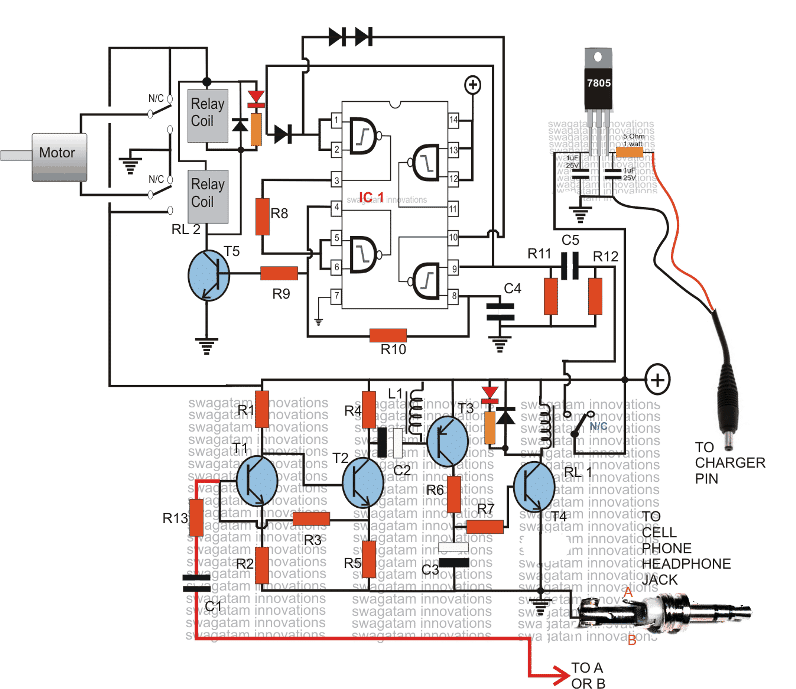
The circuit shown below can be used for controlling a motor rotational direction, let's try to understand it's functioning details:
The lower section of the diagram consisting of T1, T2, T3 and T4 along with the associated components forms a simple high gain audio amplifier circuit.
This circuit is used for amplifying the ringtone generated by the attached modem cell phone unit.
How it Works
The modem cell phone handset is an ordinary NOKIA 1280 cell phone which is permanently integrated with this circuit.
The above modem cell phone uses a prepaid SIM card and thus it becomes a self contained receiver module.
When this modem cell phone is called by the owner's cell phone, its ringtone activates and gets amplified by the above explained tone amplifier stage.
The amplified signal becomes powerful enough to triggers the relay RL1.
This relay holds or remains activated as long as the call stays connected, and breaks when the call is disconnected.
RL1's N/O contact is supplied with a 12v trigger to the adjoining stage which is a FLIP/FLOP stage, made by using four NAND gates from the IC 4093.
With every alternate missed calls from the owner's cell phone, the modem cell phone signals the tone amplifier, which activates RL1, and RL1 in turn flips or flops the IC1 circuit.
The output of the flip flop is connected with a relay driver circuit which is attached with two relays RL2 in parallel. You may use a single DPDT relay also for better convenience.
The contacts of the relays are configured in such a manner that flipping them produces opposite movements for the motor that's integrated to them.
The mains supply to the relay and the motor is taken from RL1, which means the motor flips with every subsequent "missed calls" and remains activated until the call stays connected, and then halts.
The circuit can be modified in many different ways as per the users specifications.
The modem cell phone should be appropriately assigned with a particular continuous ringtone while the default ringtone should be assigned to "empty", tis will make the unit immune to unknown numbers or wrong numbers, and the owner will be the sole controller of the attached circuit and the motors.
Parts List
All resistors are 1/4w 5% CFR unless otherwise stated.
- R1 = 22k
- R2 = 220 OHMS
- R3,R11,R12 = 100K
- R4,R6,R7,R9 = 4.7K
- R5 = 1K,
- R8 = 2.2M
- C1,C4,C5 = 0.22uF DISC TYPE
- C2,C3 = 100uF/25V
- T1,T2,T4,T5 = BC 547B
- T3 = BC557 B
- ALL DIODES = 1N4148
- IC1 = 4093
- RL1 = RELAY 12V/400 OHMS SPDT
- RL2 = Relay DPDT 12V/400 ohms
- L1 = small buzzer coil, small choke or similar.
- JACK = 3.5mm AUDIO JACK
- CELL PHONE MODEM = NOKIA 1280


Questions & Answers
what is the rating of the motor could be operated by this circuit
Hi looking for an phone that can activate large motor please advise
It depends on the relay contact rating, in the above diagram any motor up to 500 watts can be used
12 v battery ,, there’s an few motor 2 on wheels 2 on steering, 1 on hydraulic pump for arm,, and 1 on grab attachments light motor,, it has lights and cameras
Sorry, currently I do not have this circuit that would control motors through mobile phone commands.
Sir I want to make you help me
For that may I know your contact number
Sir I want to make a wireless 3 phase mobile starter for agricultural purpose ….and I'll use for projects also…Sir plz…give me its ckt ingo and its ckt components details…..and how to design it
Pankaj, you can do it with an Arduino circuit as shown below:
https://www.homemade-circuits.com/2017/04/gsm-water-pump-controller-with-call.html
replace the relay with a TPTT or triple contact relay for the 3 phase control
Sir I need only motor on and off circuit board
Price tell me which bank transfer
Thank you sir
Rasek, sorry I don't sell materials in this website, but i may start soon…
can u please say me how to connect DPDT relay in this circuit ……. I dont know how to connect DPDT relay…. can u please explain about it
.
RL2 RELAY 15SEC KE BAAD OFF HOTA HAI
Hello sir
1st miss call dene ke baad relay quickly on hota hai but 2nd miss call dene ke baad 15sec.ke baad relay off hota hai
R12/C5 ka joint ko manually positive par bar bar touch kar ke deknho, RL2 ON/OFF hota hai ki…
kaun sa relay RL1 ki RL2
R9 aur R7 ke series mein LED fix karo, yeh batayega kaun sa transistor ON reh jata hai
Ok
can i use 1 12v battery to power the circuit
yes you can
is it the same if i want to trigger the motor using phone's alarm?
yes it's possible…., but how can you trigger the alarm through a missed call??
how about using 555 in bistable mode?
555 bistable will require two relays….
it will require relays, we have only one one relay in the above design
Sir. Can I build this circuit by replacing cd4093 with ne555. Is there any way to modify it so that I can use a available part ne555.
Shiva, IC555 cannot be used as a flip flop…it can be toggled ON for sometime but after that it will switch OFF automatically.
Is this circuit can be available in market?
hi.. How can i use above circuit to start and stop small dc motor.. where do i connect motor? do i need any other additional components? can any other phone can be used other than nokia 1280. Thank you..
thanks, so you mean to say that you are not able to figure out how to make the relay contacts operate a motor?? I am sorry then you must first learn all the basics and then come back here, because this project could be far too complex for any any newcomer.
the relay contact has to operate from N/C to N/O for the motor to work…
Hi. Thanks for clearing confusion. I did as u said but it dint work. I have connected positive 12v supply to one end of dc motor and other end of dc motor to relays normally open terminal and I have grounded the common terminal of relay is this the correct connection? And how can I debug my circuit?
without DC input how would the motor get its supply??
the polarity can be anyway round, depends which way you want the motor to rotate anticlockwise or clockwise.
Hi. Is dc input is mandatory? Or can I directly connect two wires of motors to normally open pin and common pin relay will that work? If not any polarity is to be taken care while connecting dc input and motor. Thanks in advance
Hi, you just have to replace the "AC input" with a DC input and the "load" with your motor
hi. i have checked the above link you specified but i am bit confused where and how to connect dc motor it would be very useful if you could tell me that. Because i am confused with the AC main supply in that circuit and load because dc motor does not require any ac supply as per my knowledge. if you could tel me in very perticular where to connect the motor. Thanks in advance.
Hi, you can refer to the following article for your specific application
https://www.homemade-circuits.com/2012/01/how-to-build-gsm-based-cell-phone.html
no modifications would be required.
you can use other cellphone also which may have identical features to the recommended NOKIA phone
i need , 0 to 100 pounds adjust string tension dc12v motor control circuit.please sir.
Thanks you very much, I want control my water pump ( motor) in my farm can it possible that this circuit,
yes that's possible
Ok …Thank you so much sir…
Ok Sir..thank you…
And if we give missed call for switching OFF the AC motor ,then will it fully stop or continue its rotation in opposite direction…?
It will fully stop the motor.
Sir, I mean to say how to select components that is capacitors, relays,resistors,transistors,IC etc…
all are standard parts, nothing is specially rated..for example all resistors are 1/4 watt, all capacitors are as per 12V supply etc….only the TPTT relay will need to be rated as per the motor current specs.
Thank you sir…And one more question is that, Is there any design basis for this circuit?
If yes, then can you tell me that in detail with design steps also?
Plz send me on my email- swatilife123@gmail.com
Swati, sorry I did not understand what you meant by design basis….you will have to replace RL2 with a 3 contact relay or a TPTT relay in the above circuit for controlling a 3 phase motor.
Hello Sir…I want to switch ON & OFF AC 3 phase motor…
Is this circuit suitable for my requirement?
And if there are any changes in this circuit ….
Plz tell me as early as possible…
Hello Swati, yes the above circuit can be used for the purpose, the upper two relays will need to be replaced with a single relay having three sets of contacts which can be then wired across the three wires of the motor and the AC inputs
Hello Sir…I want to switch on & off AC 3 phase motor with every subsequent missed calls. Is this circuit suitable for my requirement?
And if there are any changes in the circuit..
Plz tell me as early as possible….
Sir please upload a block diagram of control a lamp by missed call aystem
Sir I want Controlling Motor with a Cell Phone -ful Circuit Diagram
Please explain the application clearly, elaborately and in good English….