• Skip to main content
  • Skip to primary sidebar

Homemade Circuit Projects

Need circuit help? Post them in the comments! I've answered over 50,000!

Blog | Categories | About | Contact | Calculators-online
You are here: Home / Datasheets and Components / Unijunction Transistor (UJT) 2N2646 Datasheet

DIY Circuits | Learn Basics | Arduino Coding

Unijunction Transistor (UJT) 2N2646 Datasheet

Last Updated on June 8, 2024 by Swagatam Leave a Comment

The 2N2646 is a type of Unijunction Transistor (UJT), which is commonly used in various oscillator based electronic circuit application.

The following paragraphs provide the datasheet and the main specifications of the device:

Pin Configuration:

The following diagram shows the pinout configuration of the UJT 2N2646.
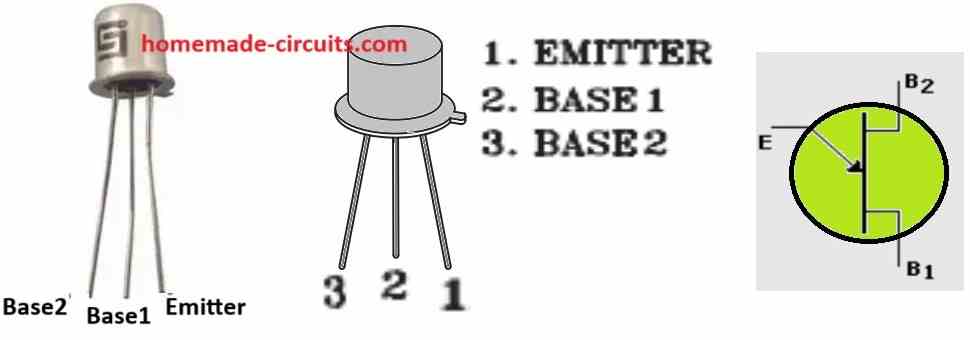
UJT 2N2646 pinout details
  • Pin 1 (Emitter): This pin is typically connected to the positive power supply voltage (Vcc).
  • Pin 2 (Base1): This is the control pin for the UJT. Its voltage determines the switching behavior of the device
  • Pin 3 (Base2): This pin is usually connected to ground or with a biasing resistor, towards ground.

General Characteristics:

  • Type: Unijunction Transistor (UJT)
  • Material: Silicon
  • Package: Typically TO-18 (although may vary, depending on manufacturer)
  • Number of Pins: 3 (Emitter, Base 1, Base 2)

Electrical Specifications:

  • Base Voltage (Vbb): 35V (maximum)
  • Emitter Reverse Voltage (Vbe): 30V (maximum)
  • Repetitive Peak Forward Current (If): 2A (maximum)
  • Peak Emitter Current (IE): 1 µA (maximum)
  • Valley Current (Iv): 6mA (typical)
  • Power Dissipation (Pd): 300mW (maximum)
  • Operating Temperature Range: 65°C to 125°C

Advantages and Disadvantages

  • Advantages: This UJT is easy to configure with minimum numberof external components. It is low cost. And good for triggering applications and requires low trigger current.
  • Disadvantages: The UJT may not be suitable for high-frequency applications, limited current handling capabilities.

Common Applications and Connections:

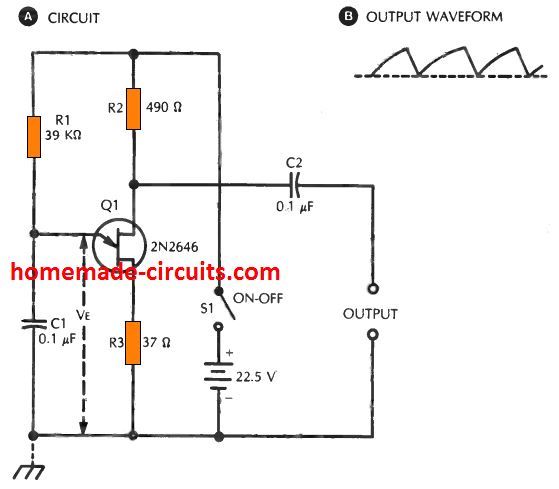
  1. Relaxation Oscillator

This is a popular application in which, the UJT generates a periodic output pulse train. Here's a basic setup:

  • Connect Base 1 (Pin 1) to the power supply (Vcc).
  • Connect a resistor (R1) between the Emitter (Pin 2) and the power supply.
  • Connect a capacitor (C1) between the Emitter (Pin 2) and ground.
  • Connect Base 2 (Pin 3) to ground.

The values of R1 and C1 determine the oscillation frequency. You can find online resources or circuit diagrams with specific component values for relaxation oscillators using the 2N2646.

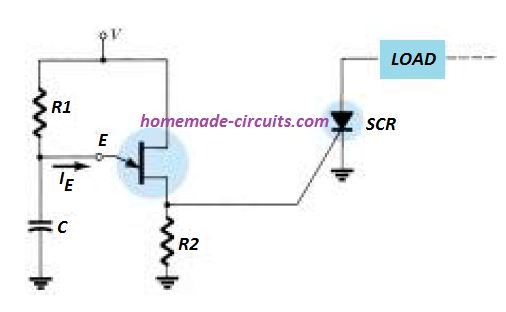
  1. SCR Trigger Circuit:

In this application, the UJT acts as a trigger for a Silicon Controlled Rectifier (SCR). The workingexplanation is given as follows:

  • The UJT acts as a voltage-controlled switch.
  • By applying a voltage pulse to the Emitter (Pin 2), you can trigger the UJT, which in turn triggers the SCR.

The specific connections will involve additional components, for example like resistors and SCR itself. You must Refer to SCR trigger circuit diagrams for detailed configurations.

References: Datasheet

You'll also like:

  • IC 4049 Datasheet, Pinout Function, Application
  • 2n3904transistorspecsdatasheetpinout 12N3904 Datasheet [40V, 200 mA NPN Transistor]
  • positive feedback hysteresisComparator Datasheet Parameters
  • lm321IC LM321 Datasheet – IC 741 Equivalent

Filed Under: Datasheets and Components Tagged With: 2N2646, Datasheet, Transistor, UJT, Unijunction

About Swagatam

I am an electronics engineer and doing practical hands-on work from more than 15 years now. Building real circuits, testing them and also making PCB layouts by myself. I really love doing all these things like inventing something new, designing electronics and also helping other people like hobby guys who want to make their own cool circuits at home.

And that is the main reason why I started this website homemade-circuits.com, to share different types of circuit ideas..

If you are having any kind of doubt or question related to circuits then just write down your question in the comment box below, I am like always checking, so I guarantee I will reply you for sure!

Previous Post: « IC LM358 Datasheet and Specifications
Next Post: Automatic Door Controller Circuit Diagram using a Single Push-Button »

Reader Interactions

Need Help? Please Leave a Comment! We value your input—Kindly keep it relevant to the above topic! Cancel reply

Your email address will not be published. Required fields are marked *

Primary Sidebar

circuit simulator image

Subscribe to get New Circuits in your Email

Categories

  • Arduino Projects (95)
  • Audio and Amplifier Projects (133)
  • Automation Projects (18)
  • Automobile Electronics (103)
  • Battery Charger Circuits (87)
  • Datasheets and Components (109)
  • Electronics Theory (149)
  • Energy from Magnets (27)
  • Games and Sports Projects (11)
  • Grid and 3-Phase (20)
  • Health related Projects (27)
  • Home Electrical Circuits (13)
  • Indicator Circuits (16)
  • Inverter Circuits (95)
  • Lamps and Lights (159)
  • Meters and Testers (71)
  • Mini Projects (28)
  • Motor Controller (68)
  • Oscillator Circuits (28)
  • Pets and Pests (15)
  • Power Supply Circuits (91)
  • Remote Control Circuits (50)
  • Renewable Energy (12)
  • Security and Alarm (64)
  • Sensors and Detectors (106)
  • SMPS and Converters (34)
  • Solar Controller Circuits (60)
  • Temperature Controllers (43)
  • Timer and Delay Relay (49)
  • Voltage Control and Protection (42)
  • Water Controller (37)
  • Wireless Circuits (31)

Other Links

  • Privacy Policy
  • Cookie Policy
  • Disclaimer
  • Copyright
  • Videos
  • Sitemap

People also Search

555 Circuits | 741 Circuits | LM324 Circuits | LM338 Circuits | 4017 Circuits | Ultrasonic Projects | SMPS Projects | Christmas Projects | MOSFETs | Radio Circuits | Laser Circuits | PIR Projects |

Social Profiles

  • Twitter
  • YouTube
  • Instagram
  • Pinterest
  • My Facebook-Page
  • Stack Exchange
  • Linkedin

Recent Comments

  • Swagatam on Simplest Full Bridge Inverter Circuit
  • Swagatam on Inverter LC Filter Calculator
  • Majaha Masuku on Simplest Full Bridge Inverter Circuit
  • Srecko Kovacevic on Inverter LC Filter Calculator
  • Swagatam on How to Make Dog Barking Preventer Circuit using High Frequency Deterrence

© 2026 · Swagatam Innovations