The article provides a detailed explanation regarding the various voltage regulator wiring configurations used in motorcycles. The article was submitted by Mr. Abu-Hafss.
Technical Specifications
After working on different voltage regulators, I feel to share my findings on your blog so that other people may also get benefit. Please insert the diagrams appropriately in the article. I will update further by providing examples of each type.
Thanks and regards
Abu-Hafss
UNDERSTANDING WIRING OF MOTORCYCLE VOLTAGE REGULATORS
Motorcycles are usually equipped with permanent magnet AC generators. The magnitude of the voltage produced by these generators depends upon the RPM of the engine. Despite these generators are specifically designed to produce about 13-15VAC at high RPMs, they do require a voltage regulator to provide a safe voltage for battery charging and for the electrical system. These generators could have single-phase or a three-phase winding. No matter the winding is single-phase or three-phase; all voltage regulator units have two parts i.e. Rectifier Section and Voltage Regulator Section. Here, we will only discuss various types of voltage regulators and not their internal circuits.
VOLTAGE REGULATORS FOR SINGLE-PHASE GENERATORS
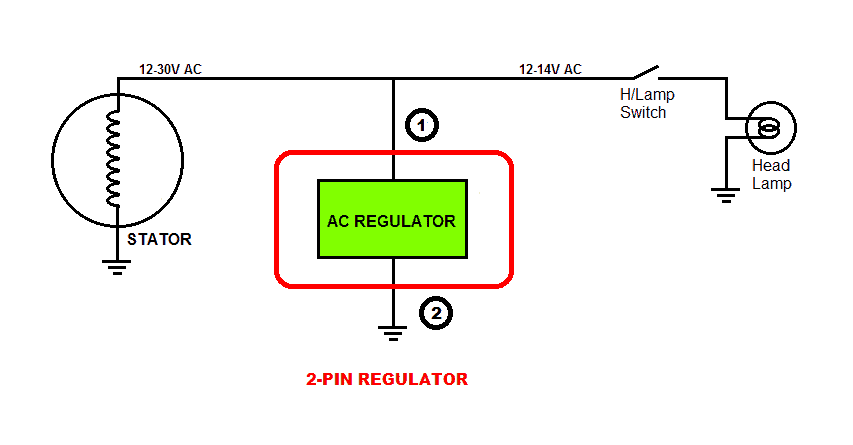
1) 2-pin Regulator: This type may be found on some small bicycles which do not have battery and only have Head Lamp & Tail Lamp. Since the incandescent bulbs work well on AC voltage, there is no rectifier section in this type of regulator. The circuit inside the unit regulates the AC voltage coming from the generator to 13.5 – 14 VAC for the bulbs. This regulator is basically an AC voltage regulator.
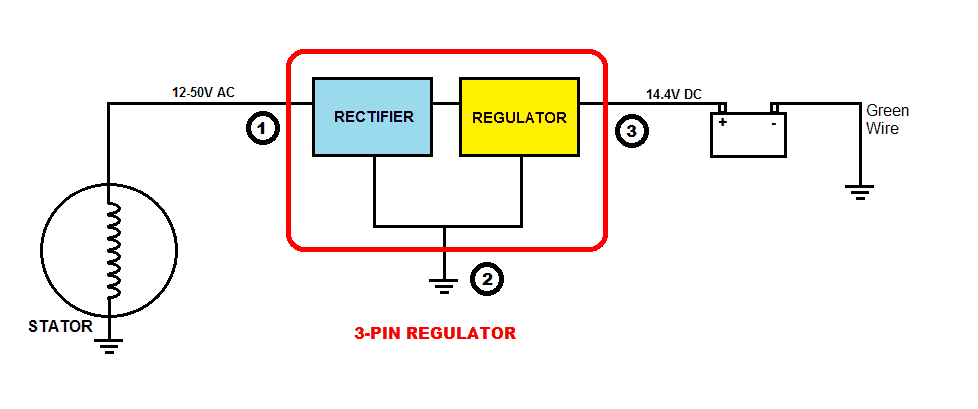
2) 3-pin Regulator: This type may be found on some motorcycles. In this system, we see that one end of the winding is grounded to the chassis of the bike, which is connected to the negative terminal of the battery. The other end of the winding supplies AC voltage to the rectifier section which converts it to DC voltage. Then it enters the Regulator section which maintains the output to an ideal 14.4V for charging a 12V battery (or 7.2V for a 6V battery) and powering the electrical system.
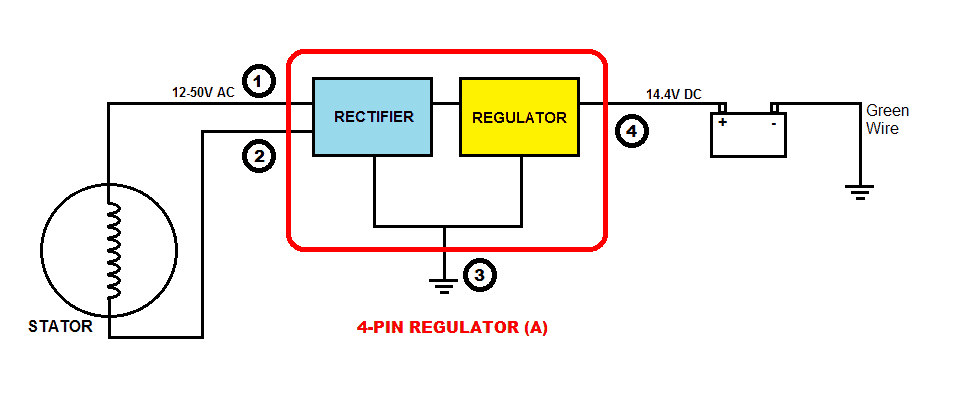
3) 4-pin Regulator (A): This type may be found on some motorcycles. In this system, both the ends of the winding go to the Rectifier section which converts AC to DC voltage and then the Regulator section regulates to 14.4V as discussed above.
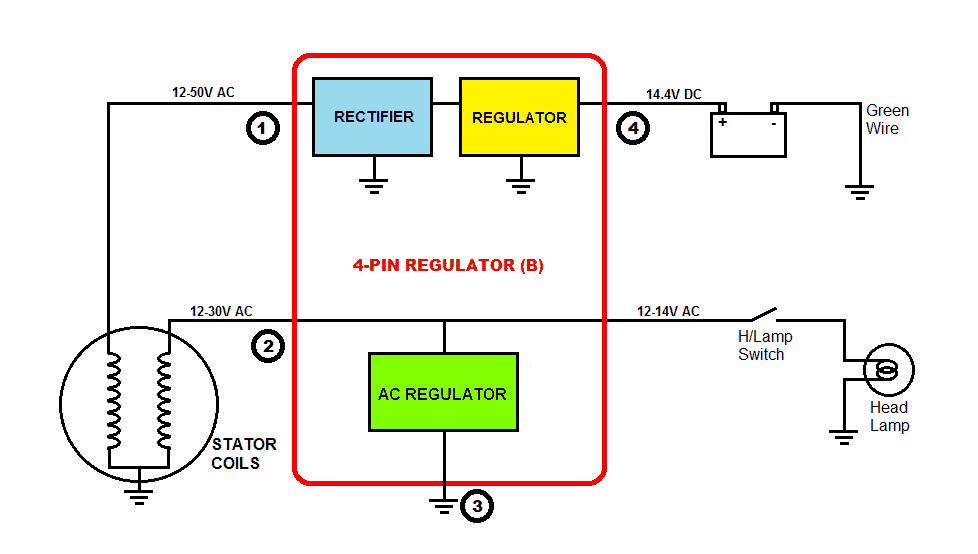
4) 4-pin Regulator (B): This is the most common type found on motorcycles with single-phase winding. In this system, the stator has dual windings. One supplies power for charging the battery and for the electrical system. The other supplies power exclusively for the Head Lamps and the Tail Lamps. This type of regulator unit is basically a combination of 3-pin Regulator and 2-pin Regulator. The 3-pin Regulator section provides 14.4V DC for the battery and the 2-pn Regulator provides 13.5 – 14V AC for the Lamps.
VOLTAGE REGULATORS FOR THREE-PHASE GENERATORS
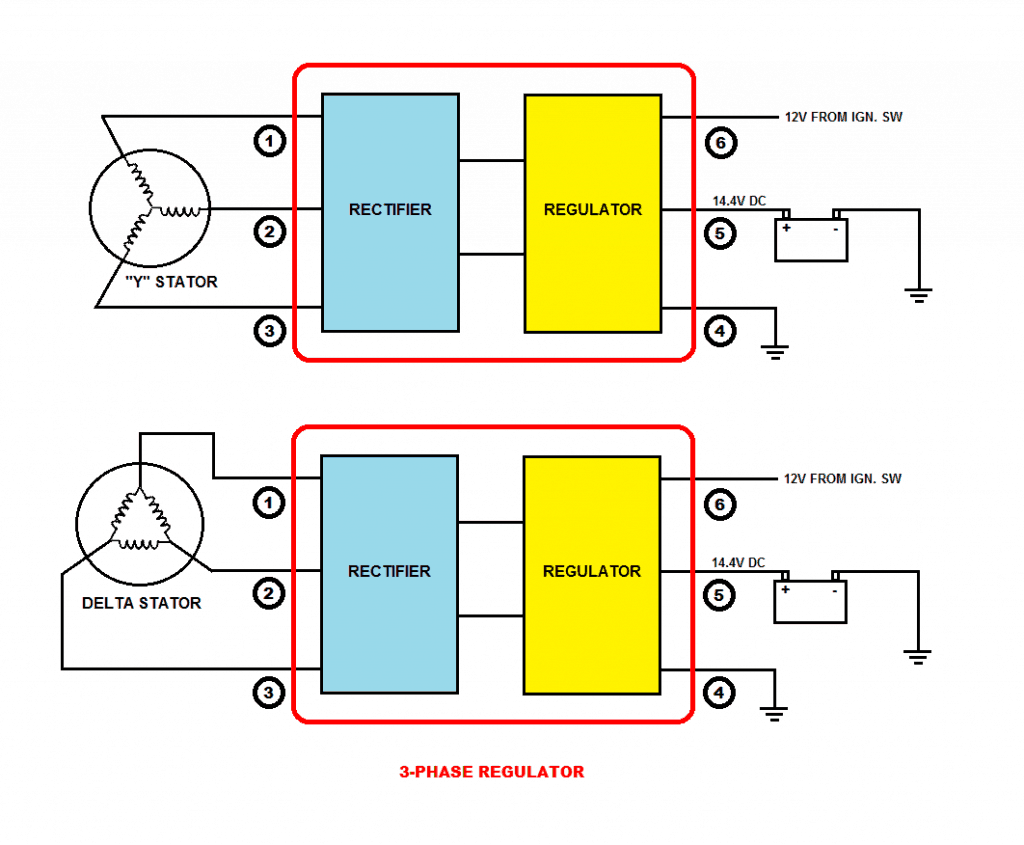
Three-phase windings are two types i.e. Y-type and Delta type.
The working principle of a regulator for three-phase generator is the same as 4-pin Regulator (A), but of course, the internal circuitry would be quite different.
An example of such 3-phase regulator can be seen in the article: motorcycle shunt regulator circuit using SCR
.


Comments
Great description! I have a 2001 Yamaha WR250F, it has no battery, but does have a factory headlight, taillight/brake light. It just relies on the stator a 2 wire and regulator/rectifier for 12 a 12 volt system. The other day while riding, my son told me that my lights had quit working, it still ran fine. Upon testing the stator the lighting coil shows an open circuit on the ohmmeter, and same when testing the diode(s) in the regulator rectifier. What could have caused such a failure? Once again, your web site really helped explain the circuit design of my motorcycle.
Hi, Thanks for your compliments!
Is your alternator also blown, in that case it could be due to high current shunting by the load, and over current situation, and that is why the lights are also blown.
In that case you strictly require a good regulator for your vehicle alternator and the load.
I have a 1980 Honda C70 motorcycle which has a 6 v system. It has a small component rectifier and does not have a voltage regulator. Recently, the system blew all the bulbs out. Put a new battery in and is measuring a bit over 6v at idle Ann up to 7.4v at higher rpm’s. Any advice as to what the issue might be would be greatly appreciated.
Thank you
It could have happened due to a sudden voltage spike from the alternator. You can add the following simple regulator with your rectifier output, and protect all the electrical equipment:
https://www.homemade-circuits.com/wp-content/uploads/2021/11/single-transistor-voltage-regulator.jpg
I am interested in your simple regulator for a similar problem. I have a Honda XL125s with a 6volt system. It has a rectifier only, no regulator. The battery boils dry in a few hundred miles. The charging coil is not earthed but both ends go to the rectifier. I have checked the coil and diodes according to workshop manual. All in spec. However, at high revs the output to the battery is 9.1volt. Manual gives this as normal spec. I would like this to be regulated to 7.2 volts. Can I use the above simple regulator or does it need to be changed because my input voltage is higher? Or would just adding a wire wound resistor do?
I think you can simply use an LM338 based regulator, provided the output DC from the rectifier does not exceed 30V.
You can configure the IC as per the following circuit. You can tweak the 5k preset to get 7.2V output, or if you want to replace the preset with a fixed resistor then you can calculate it using this software:
https://www.homemade-circuits.com/wp-content/uploads/2012/04/LM338basicadjustablepowersupplycircuitdiagram.png
Thank you. This helps me heaps.
You are welcome!
My motorcycles use voltage regulators for three-phase generators. I installed LED headlights for it, but when they got on the station, the lights flashed. Can you help me
Please explain the issue elaborately.
In short, the regulator short-circuits the generator coil?
That’s how shunting regulators work.
Hello, just want to know please can you help me? I have a generator with two wires (yellow, black red) and a 2-pin regulator. As far as I know, yellow is responsible for lighting. Can I connect the yellow wire directly to the head light switch? Or should I connect the yellow wire to the regulator and then to the head light switch?
Hi, If you are sure about the yellow then you can connect it with the headlight. If the alternator max voltage is much higher than the headlight specifications, then you may have to use a regulator in the middle.
hello..can you make a regulator diagram for headlight
Hi, please provide the specifications of your headlight, I will try to solve it for you…
12v 35w
You can try this circuit:
https://www.homemade-circuits.com/wp-content/uploads/2024/09/motorcycle-headlamp-current-limiter-circuit.jpg
Thankyou sir..success always for you
Thank you Roby, You are most welcome!
Thank you! Is it possible to do this, connect the yellow wire to the input of the head light switch and connect the outgoing red wire to the regulator and other consumers?
I am not sure about the headlight switch configuration, so cannot suggest regarding this. If you can tell me the switch wiring details then I maybe i can comment.
Currently working on an antique motorcycle( Yamaha DT 400) and a working voltage regulator circuit is all that’s standing in the way of the project being finished. It’s 6v with only a rectifier on the charging side and AC on the headlight circuit. Both put out 18v Thanks for this content. This content helps guys like me. Only thing left is to find the right parts as this bike came with no regulators from the factory.
Thank you for your kind feedback. Appreciate it very much. Glad you found the post helpful.
I have installed an unnamed cc110 engine, made in China, the challenge is to burn the lights, its rectifier is 4pin and I also don’t use a battery. What should I do so that the lights don’t burn.
You will need to install a voltage controller circuit so that your lights do not burn due to high voltage from the alternator.
I have another proplems, within 2 weeks I used 4 plugs and 2 cdi 5pins also are failed my engine is 110cc engine starter.I kick until my legs get tired but the motorcycle does not start. I don’t know what the problem is exactly
I think you must take the help of a qualified automobile mechanic, only he will be able to solve your problem.
Can you please tell me which wires would run to what on a 8 wire regulator rectifier? Thanks.
Sorry, I have no idea about an 8 wire regulator unit.
Hi, is there a way to find out which 4-pin regulator (A or B) I have using a multimeter? Thanks
Hi, you can the output voltage with a multimeter but the input will need to be fed with a 12V AC source.
hi there,just wanna know please if you could help me out,outboard 3 phase regulator rectifier for a suzuki DF50..how to connect the rectifier to my stator,no harness plug,could i connect the 3 phase side as i want to or there is a sequence to it?
The three inputs of the rectifier does not have any polarity, you can connect any way round with your motorcycle’s 3 phase AC source.
How can an overvoltage protection circuit (capacitor and relay with warning light) be added to this type of circuit for single phase PM stator at 32A 12V?
You can use the following type of shunt regulator for a constant output voltage:
https://www.homemade-circuits.com/wp-content/uploads/2019/07/shunt-3.png
The 3k3 and 4k7 resistors can be tweaked for fixing the desired output voltage.
Good Morning
1981 dt175 with cdi magneto .
Need a circuit diagram to built a voltage regulator for this bike.
output voltage is 6v
Hi, you can try the second last circuit from the following article:
https://www.homemade-circuits.com/motorcycle-full-wave-shunt-regulator/
I converted a 6v electrical system of my father’s 1997 Honda xl125s to 12v. I used a 8 poles (1 for primary, 7 poles for ac) which is producing 60 acv tops around 6000 rpm. I used a 12v regulator/rectifier for converting the fluctuating ac from stator to dcv which is wired directly to my 12v gel battery. This regulator comes in 5 wires (yellow:pink for ac, red:green for dc output, black for the variable dc voltage measurement connected to the black wire which is routed to ignition switch). Stator ground is floating. Full wave.
Using a multimeter, I test the charging leads attached to the battery terminals and it reads 14.4v, as soon as I test the leads dismounted from the battery using multimeter, the dcv reading is only 2-3 dcv.
I also have a Honda XL, although mine is an XL250S. I observed a similar thing when fitting a 12V regulator/rectifier to my old 6V circuit. The stator open circuit voltage measures 50-60VAC and with the reg/rec fitted, the reg/rec open circuit DC output measures only 4 – 5 VDC. I have several 12V reg/rec and have swapped the units to see if they are faulty, but each gives a similar result. This leaves me quite perplexed! Can anybody clarify why this is the case?
I am wondering if there is a way to rectify and transform the output of a motorcycle lighting coil rated at nominal 6V AC to provide enough voltage to charge a 12V battery.
I have an off-road motorcycle that was produced with a headlight and tail light. The lighting coil serves only those two bulbs with 6V AC. I am adding LED turn signals, an LED brake light, and horn, all rated at 12V, to make the motorcycle road legal. My intention is to power those items from a 12V battery and I would like it to charge while the engine is running.
This site is an amazing wealth of knowledge and I appreciate the clear explanations and generous assistance from all the authors.
Thank you, and I am glad you liked this site.
To increase a 6V supply to 12V you will require a boost converter circuit. You can try the following circuit for boosting 6V to 12V
https://www.homemade-circuits.com/wp-content/uploads/2022/06/laptop-battery-charger.jpg
The circuit was designed for boosting 12V to 24V but you can use it for your purpose also by replacing the zener diode with a 12V zener diode.
Hi Swagatam,
I have acquired a late ’80’s Yamaha 2 stroke 125cc future classic in a few pieces and the wiring loom and all seem components to be intact except for the combined regulator/rectifier unit where the input connector has been cut off(the output side of the regulator/rectifier unit is intact). The bike uses a delta stator and sadly all 3 input wires are the same colour, thus my primary question is whether each input wire must uniquely match a stator(or at least its output on the wiring loom) or if they can be randomly connected?
Robert
Hi Robert, since the output from the alternator would be AC, the wires do not need to have polarities, they can be randomly connected to a regulator unit.
on my 72 Suzuki TS185 which had 6 volt ckt but changed now to 12 volt full wave 4 wire, RR after lifting the ground off the charge coil. it is working well producing a regulated voltage. In place of the 6V flood wet cell battery , I have put in a 10 cell Nicad pack, which does get charged but I wonder about providing a proper charge current. how can I regulate the current going to the battery?
You can simply do it by adding a suitably calculated resistor in series with the positive line, as explained in the second concept under this post:
https://www.homemade-circuits.com/simple-ni-cd-battery-charger-circuit/
Hello, I am working on an 80’s scooter that has precisely the setup you describe in item no. 4 (4pin regulator B) I intend to provide rectified and filtered current to the lighting circuit in order to use led headlights. I was told a 4diode full wave rectifier and a capacitor to act as a stabilizer was the simplest (and cheapest) way to go. Am I on the right track? can you provide me with specs for the items to buy? thank you so much.
Hello, using a single diode is probably the cheapest way of making an automobile rectifier. However for improved performance and charging you can use a bridge rectifier configuration for the regulator.
You can construct it using 4 numbers of 6A4 diodes. Although the filter capacitor is never needed for charging a battery through this type of regulator, you can use one rated at 1000uF/50V
Sorry – that was a ’78 Kawi Twin, not an ’83 – I am working on two bikes at once.
I think the year is important, because the generator/R/R changed in ’79 on this series.
Thanks again,
Frank
You are welcome Fastfrank. According to me your assumptions are perfectly correct, and you can connect the two AC inputs from the generator to any of the two yellow wires of the Rectifier/Regulator. This should yield a 12V full wave rectified DC across the RED/BLACK wires of the R/R