The 5 simple dry run protector circuits presented here shows simple methods by which insufficient water conditions inside an underground tank can be sensed without introducing probes inside the underground tank, and thus preventing any possibility of motor dry running. The circuit also incorporates an overhead water overflow control feature.
The idea was requested by one of the interested readers of this blog.
Technical Specifications
Do you have any idea of how to sense dry run motor by checking at the overhead tank inlet without checking at the underground tank since it takes more work in getting the wire from underground to motor place.
My requirement is motor should go off if no water is flowing at the tank inlet. Also motor should not off initially since it will take at least 5 seconds to push the water at the tank inlet.
My requirement is to switch off the motor when motor is not able to pump the water. This may be due to water level become less than certain threshold in the underground tank Or pump has malfunction.
My preference is not linking any wire from the underground tank to the circuit. My preference would be sensing the water flow in the overhead tank inlet. Hope you understood my requirement.
I would like to switch on the motor manually. If we replace the buzzer with a relay, then motor will be switched off immediately upon switching on motor,since it will few seconds for water to flow on the tank inlet.
We need to provide some time delay to sense the water flow at the tank inlet to avoid this problem. but I am not sure how to introduce a delay. Please help me on this.
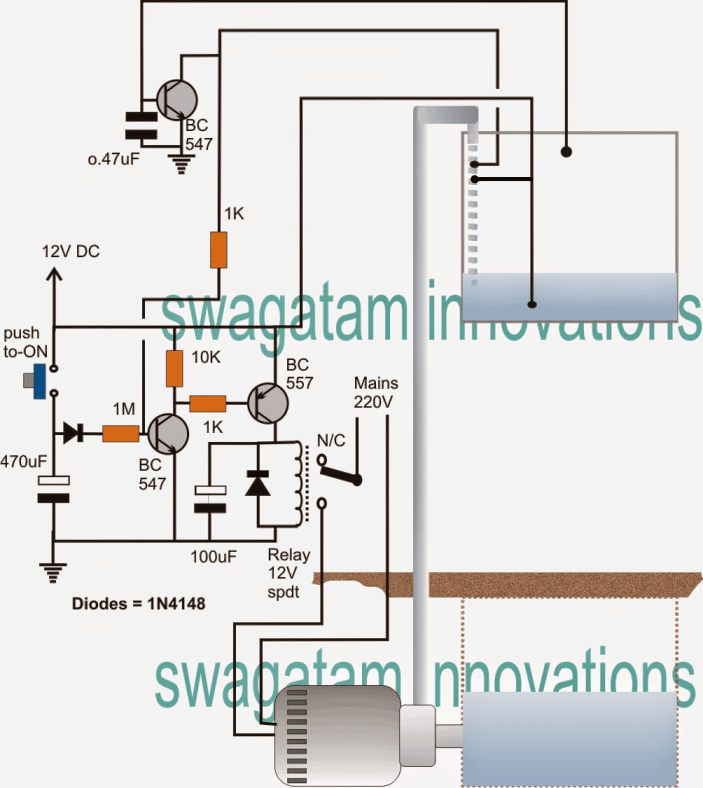
Design #1
The circuit of the proposed underground water pump motor dry run protector can be understood with the help of the following details:
The circuit is powered with a 12V AC/DC adapter.
When the push-button is pressed momentarily, the BC547 transistor along with the BC557 relay driver stage is switched ON.
The 470uF capacitor and the 1M resistor forms a time delay network and locks the entire relay driver stage for some predetermined delay after the push button is released.
This delay interval can be adjusted by experimenting with the 470uF capacitor and/or the 1M resistor.
As soon as the relay activates, the motor is switched ON which instantly starts pulling water in the overhead tank.
The moment water inside the overhead tank pipe connects with its residual water, the submerged probe which is the positive probe gets linked with the probe that's introduced at the mouth of the pipe. This enables voltage from the lower probe to reach the base of the relevant BC547 transistor via the water, and the 1K resistor.
The above action now latches the relay driver stage such that even after the time delay lapses, the relay holds and sustains the operation.
Now the motor halts only under two conditions:
1) If the water level reaches the overflowing level of the overhead tank wherein the positive potential from the lower probe gets connected with the probe that's connected with the base of the upper BC547 transistor.
The condition switches ON the upper BC547 which instantly breaks the relay driver stage latch and the motor stops.
2) If the water inside the underground tank dries out, which obviously stops the water link inside the overhead tank pipe and breaks the relay driver latch.
An Automatic version of the above sump motor controller with dry run protection system may be witnessed below:
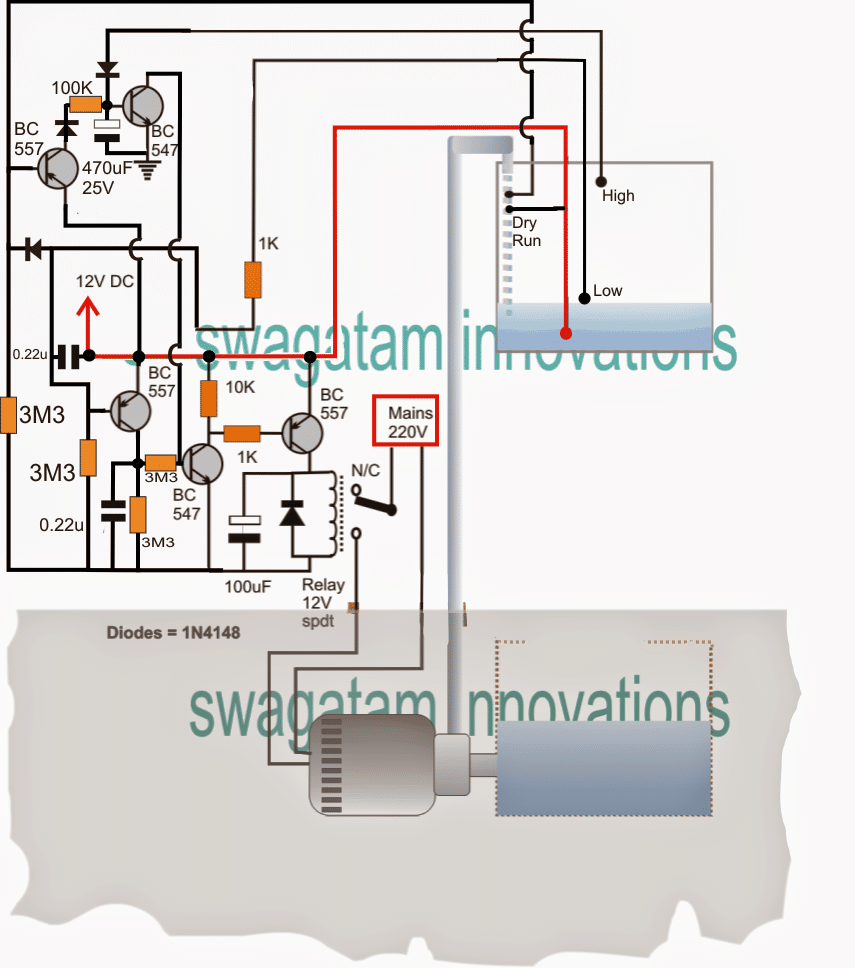
Using Logic Gates: Design #2
A fully automatic version can be also built using 6 NOT gates from the IC 4049 as shown below, this configuration can be expected to work much more accurately than the above transistorized version of the automatic underground submersible water pump dry run protection circuit.
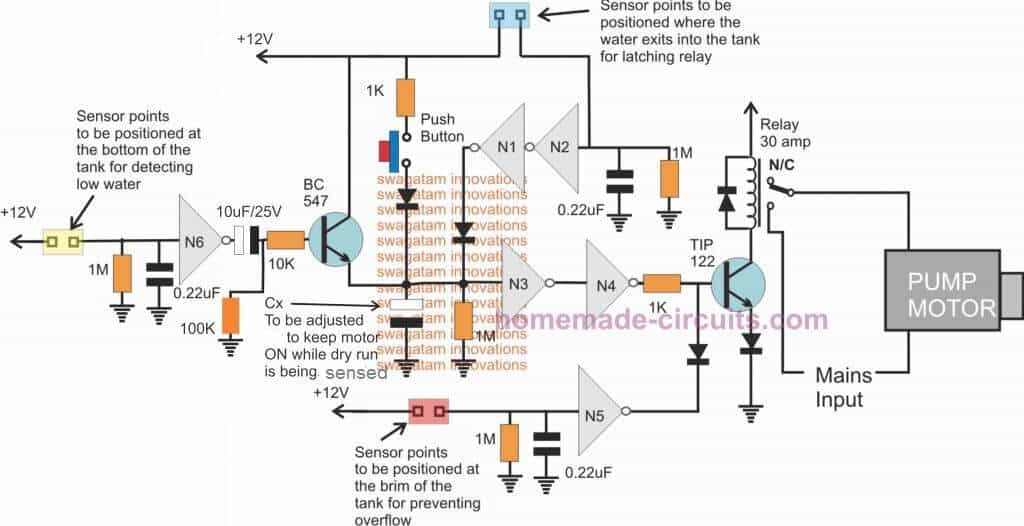
Feedback from Mr. Prashant Zingade
Hello Swagatam,
How are you? Your Idea and logic are awesome. hats-off to you. I tried IC4049 version, It is working fine except one issue.(I done one modification base on your previous design and it is working now).
I am facing one issue in IC version like when we put it on auto mode, dry run function is not working. Please see attached simulated video file.
Case 1: I observe If water level reach below bottom level relay will on pump but it fail to sense dry run and pump will continue to on.
Case 2: In manual operation it works perfectly. Excuse for any typo.
Warm Regard
Prashant P Zingade
Solving the Circuit Problem
Hello Prashant,
Yes you are right.
To correct the situation we will need to connect the output of N6 to the base of the BC547 through a capacitor, you can try connecting a 10uF here.
Negative of the capacitor will go towards the base.
But the problem is, this operation will activate the system only once, and if water is not detected then the system will switch OFF the relay and remain switched OFF permanently until it is activated manually using the switch, and until the yellow sensor comes in contact with water yet again. Regards.
Update
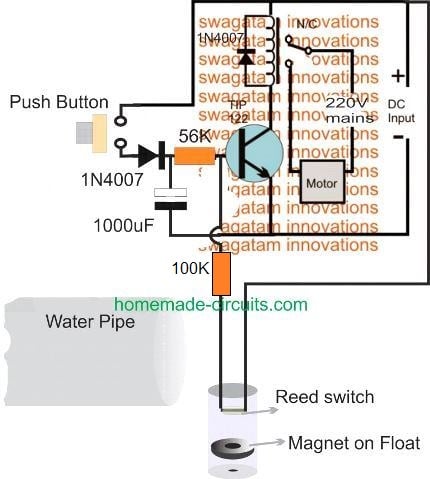
Dry Run Protection for Motor Reed Switch: Design#3
The following diagram shows an effective dry run protection that can be added to the pump motor, in cases where water is unavailable in the tank and no water flows out from the pipe outlet.
Here the push-button is initially pressed to start the motor.
The 1000uF capacitor and the 56k resistor acts like a delay off timer and keeps the transistor switch ON even after the push button is released so that the motor keeps running for a few seconds.
During this time water can be expected to flow out from the pipe outlet, and this will fill up the small container introduced near the mouth of the hose pipe. This container can be seen having a float magnet and a reed switch relay arranged inside.
As soon as water starts filling inside the container the float magnet quickly rises at the top and reaches at a close proximity to the reed relay, latching it ON. The reed relay now feeds a positive voltage to the base of the transistor ensuring that the transistor gets latched up and keeps the motor running.
However in an absence of water, the reed relay feedback is unable to turn ON, which causes the motor to shut down once the delay OFF time elapses after the predetermined amount of delay.
Dry Run Protection without Reed Switch and Magnet
If you are not interested to use a reed switch or a magnetic float sensor arrangement, you can simplify the above design as indicated in the following diagram:
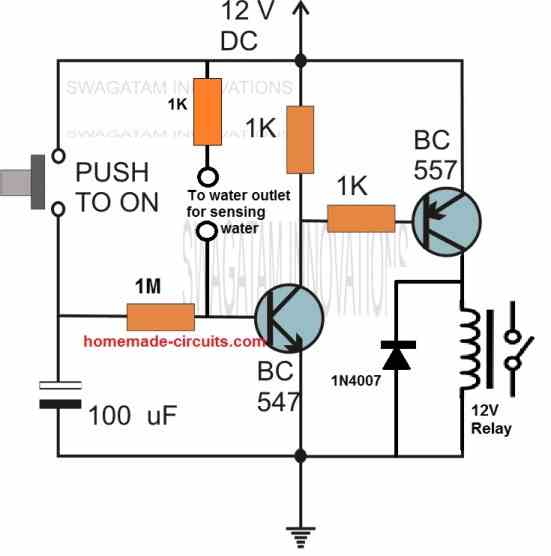
When the push button is pressed BC547 and the BC557 conduct to operate the relay. The relay switches ON the connected pump motor. The pump motor begins attempting to pump water through the pipe.
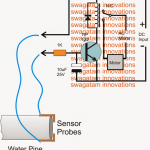
If water is available, it flows through the pipe outlet and bridges the positive supply with the base of BC547. This causes the whole circuit to latch through the water contact, so that the pump keeps pumping water continuously.
However, in a situation where water is dry or unavailable, no water is able to feed the base of the BC547. Therefore BC547 remains switched ON only for a period determined by the charge on the 100uF capacitor.
The 100uF capacitor and the 1 M resistor decides for how much time the BC547, the BC557, the relay and pump motor can remain switched ON.
As soon as the above time elapses, the circuit automatically switches OFF itself and the pump motor and saves the motor from burning due to a dry run situation.
Current Sensed Dry Run Protector Circuit: Design #4
In the above ideas the circuits mostly depend on detection of water which makes the designs a little outdated and cumbersome.
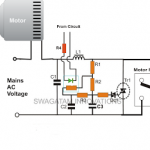
The following idea unlike the above depends on load sensing or current sensing for executing the dry run protection feature.Thus it is contactless, and does not rely on having a direct contact with the motor or water.
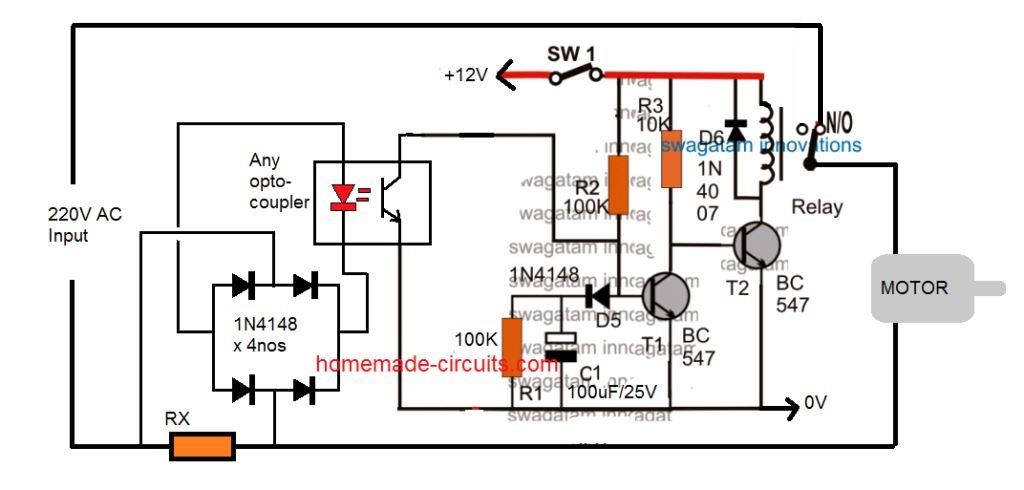
Here, the two transistors along with the associated components form a simple delay ON timer circuit. When SW1 is switched ON, the transistor T1 remains switched OFF because of C1 which initially grounds the base drive of T1 coming via R2, while C1 charges.
This keeps T2 switched ON and the relay also switches ON. The N/O of the relay switches ON the pump motor. Depending on the value of C1, the motor is allowed to run for sometime. In case there's no water, the motor runs unloaded with relatively low current passing through RX. Due to this RX is unable to develop sufficient potential across itself, which in turn keeps the opto-coupler LED switch OFF. This allows C1 to get charged fully unhindered during the stipulated period.
As soon as C1 is fully charged T1 switches ON, and this switches OFF T2 and also the relay. The motor is finally shut off protecting it from a dry run situation.
On the contrary suppose the motor gets the normal supply of water, and starts pumping it normally, this instantly loads the motor causing it to consume more current.
As per the calculated value of the resistor Rx, this develops sufficient voltage across it to switch ON the LED of the opto-coupler. Once the opto is activated C1 is inhibited from charging, and the delay ON timer is disabled. The relay now continues to supply the 220V to the motor allowing it to run as long as water is available.
Another Simple Motor Dry Run Protector Circuit: Design #5
Here;s yet another idea which explains a very simple overflow controller circuit which is able to implement and restrict overhead water overflow as well as dry running of the pump motor.
The idea was requested by Mr. S.R. Paranjape.
Technical Specifications
I came across your site while searching for Timer circuit. I am very surprised by seeing how much one individual can do!
I refer to your write up of Friday 20, 2012.
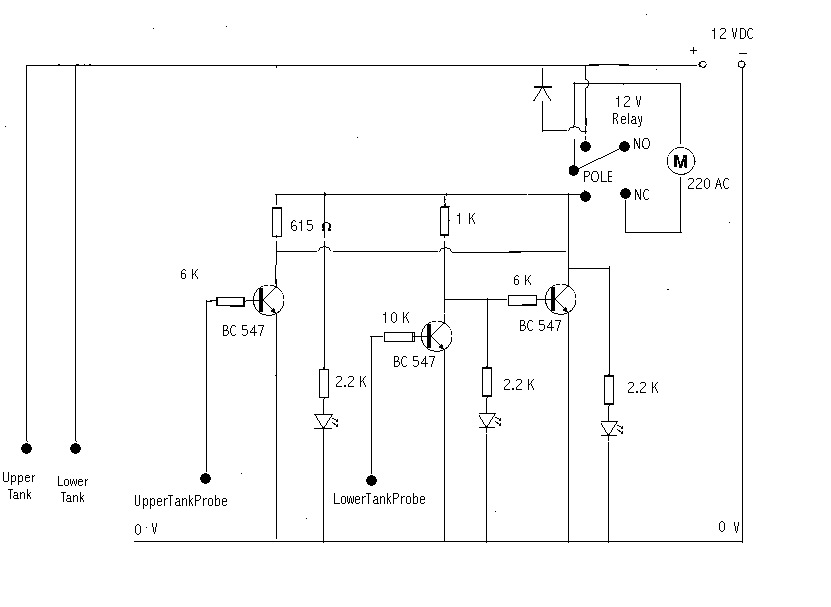
I have a similar problem. I have a designed a circuit, which appears to work on breadboard.I want to start pumping only if there is a need in upper tank and lower tank has enough water. Further if water in lower tank goes below certain level while pumping, the pumping should stop.
I am trying to find a way for satisfying my last condition.
I want to start this circuit manually and when the circuit stops pumping action, it should also nullify my start action. This will stop the total operation of filling the upper tank.
Somehow I feel that combination of two relays( outside the circuit) in ON/Off part of total project should work. I am unable to figure how so far.
The above drawing may express what I want.Project/circuit is powered by the outer source. The output(that is used to stop umping) from the circuit should open the outer source, which was activated manually.
I hope you will excuse me in taking this root to pose my problem. If you find merit in my problem, you are welcome to put it on your blog.
I am attaching the circuit that I have devised.
As an introduction to myself- I am senior person(age 75 years) and has taken this as hobby to use my time interestingly.I was Professor of Statistics, University of Pune.
I enjoy reading your projects.
Thanking you
S.R.Paranjape
.bmp)
The Design
I appreciate the effort from Mr. S.R. Paranjpe, however the above design may not be correct due to many different reasons.
The correct version is shown below (please click to enlarge), the circuit functioning may be understood with the help of the following points:
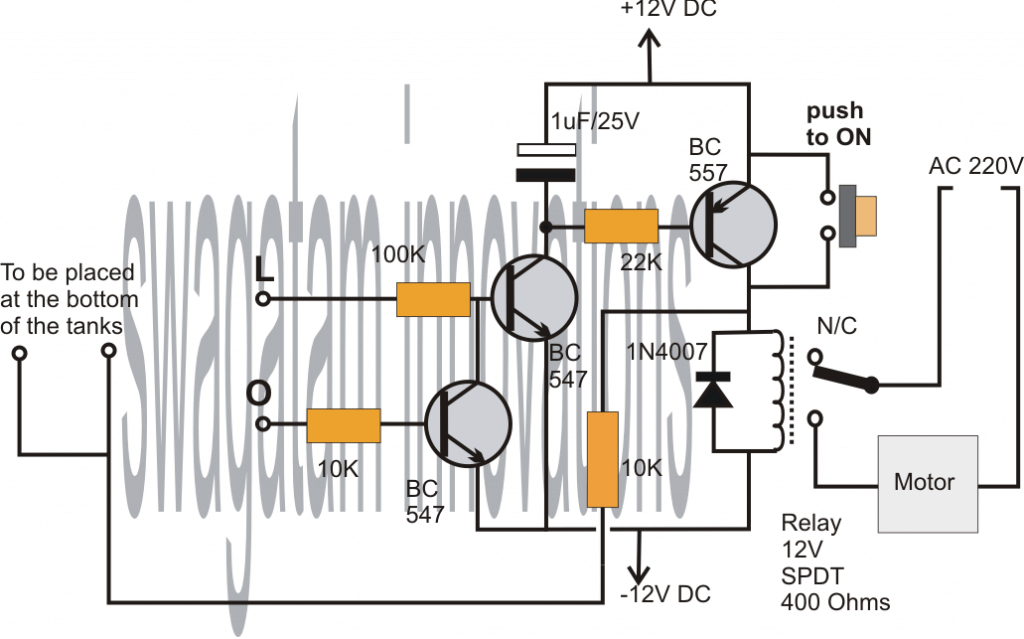
The point "L" is positioned at some desired point inside the lower tank, which determines the tanks lower water level at which the motor is in the permitted zone of operation.
The terminal "O" is fixed at the topmost level of the upper tank or the overhead tank at which the motor should halt and stop filling the upper tank.
The basic switch ON sensing is done by the central NPN transistor whose base is connected to point "L", while the switch OFF action is performed by the lower NPN transistor whose base is connected to point "O".
However the above operations cannot initiate until the water itself is supplied with a positive potential or voltage.
A push-button switch has been included as requested for facilitating the required manual start function.
On pressing the given push button momentarily, allows a positive potential to enter the tank water via the push button contacts.
Assuming the lower tank level to be above the point "L" allows the above voltage to reach the base of the central transistor via the water, which instantly triggers the central transistor into conduction.
This triggering of the central transistor switches ON the relay driver stage along with the the motor, and it also latches the relay driver transistor such that now even if the push button is released sustains the operation of the circuit and the motor.
In the above latched situation, the motor halts under two conditions: either the water level goes below the point "L" or if the water is pumped until the overhead tanks upper limit is reached, that is at point"O"
With the first condition, the voltage from the relay driver collector is inhibited from reaching point "L" breaking the latch and the motor operation.
With the second condition, the lower BC547 gets triggered and breaks the latch by grounding the central transistors base.
Thus the overhead water level controller circuit is allowed to remain operational only as long as the water level is at or above point "L" or is below point "O", and also, the initialization is solely dependent on the pressing of the given push button.
IC 555 Dry run protection circuit
The dry run protection can be added to an existing IC 555 based controller circuit, a shown below:
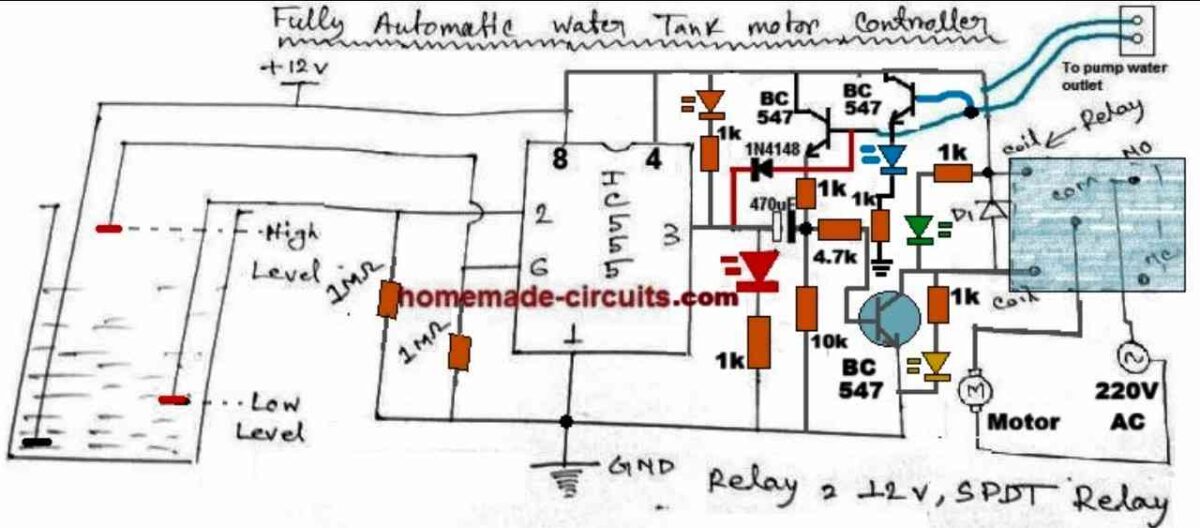
The dry run function in the above design works in the following manner:
When the water level goes below the "low level" probe, causes the positive potential to be removed from pin#2 of the IC. This in turn causes pin#2 to go low, which instantly turns pi#3 high.
This high signal passes through the 470uF capacitor swithing ON the relay driver stage, and the pump motor is switched ON.
The relay driver and the pump remains switched ON only as long as the 470 uF charges, this may be for around 3 to 5 seconds.
Within this time span, if the pumps starts drawing water will allow the water sensor connected with the blue wires to be bridged by the pumped water.
The associated BC547 will now get the base bias and begin conducting, bypassing the 470 uF capacitor. This will enable the relay driver BC547 to conduct freely until the full tank level is reached.
On the other hand, if suppose there's no water, and the pump runs dry, will be unable to bias the upper BC547, and eventually the 470 uF will be charged full blocking any further base current to the relay driver stage. Due to this relay will be switched OFF preventing the dry run condition.


Comments
Hello sir
Hello Dhananjay,
for your specific application you can try something like this, and customize it as desired:
https://www.homemade-circuits.com/wp-content/uploads/2025/02/dry-run.jpg
Respected Sir ,
May you be healthy and motivated.
After a long time I am sending you this query, please excuse me for that.
Sir my query is about the mentioned dry run circuit which you had designed for me. Can I connect 10k resistance in place of 1k ohm what changes will there in functioning of circuit?
also can I change all 1k with 10k resistance. Issue of power consumption is also there as the circuit going to operate 24 x 7.
Please help me.
Thank you Dhananjay, In the following diagram, you can use 10k in place of 1k, but only for the water outlet pipe I would recommend using a 1k. Also in place of 100uF, try 220uF and in place of 470k try 100k:
https://www.homemade-circuits.com/wp-content/uploads/2025/02/dry-run.jpg
In that case you can increase the trigger capacitor value to 4.7uF.
Sir
What is the purpose of negative switch on trigger?
You will have to activate the relay for some moment of time so that the motor can run and detect water. For this momentarily switching ON of the motor this triggering will be required. After triggering if the water is detected by the dry run probes then the transistor will “latch” and the motor will continue to run as long as water remains available…and then switch OFF automatically once water stops coming…
Respected Sir,
That’s great of you sir you had specially designed for me.
Grounding momentarily will work or will have to give negative voltage at that point.
I can ground it continuously as I had connected it to relay of motor on.
You are welcome Dhananjay,
Yes, it just needs to be grounded and afterwards removed.
You can connect it with the collector of T1 in your attached diagram
Hello sir
I think diagram was not attached.
I think the diagram was not attached.
Are you referring to this diagram which you had sent previously?:
https://www.homemade-circuits.com/wp-content/uploads/2025/02/IMG_20250204_131739-1738655347.9607-scaled-e1738671850777.jpg
Respected Sir
Dhananjay Shah here with my few questions.
1) can I use D type flipflop in place of 555 ic ? NE555 Used in bistable state.
2) can I rely on transistor BC557/BC337/BD140 for over voltage trip as it requires fastest switching speed?
3) will my product compete with microprocessor controlled units?
4) I found that TRIAC switching speed is fastest ever but can it will operate heavy pump motors, for example I think of using BTA16 & BT139 for high speed switching?
Please guide me.
Hi Dhananjay,
Maybe D type flipflop will also work, but we don’t need it in this application. We need SR flip flop here which is being fulfilled nicely by the 555 IC.
If you want fast switching over-voltage cut off then you must go for a comparator based design.
It depends on how many features the microprocessor based design provides and its cost?
Yes, triacs can handle heavy load efficiently, BT169 might not be good enough, try BTA41 instead.
Respected Sir
Here i came up with a link you first see to it.
https://electronics.stackexchange.com/questions/660406/using-triac-on-both-live-and-neutral-sides
Here it is clearly mentioned that triacs are not that helpful in dual switching which i am intersted in case of emergency especially such as over voltage.
Your second suggetion was to use op amp for fast switching but relay has mechanical parts to move and that is its delay problem.
And as per the suggestions given in link it suggest that you require a decent cooling system for using triac at heavy duty switching,
Please help
Hello Dhananjay,
Relays can operate in less than 20ms, which is fast and can be used to protect loads from over-voltage situations, but relays cannot be used for protecting against short circuits.
Yes
In the right corner top side the bc547 is connected to relay.
Ok, let me check it….
Sir
The transistor BC547 is connected to a relay for shutdown of motor.
But the connection of bc557 refered in your dryrun circuit is attached to Vcc via a water flow. Whereas I want to connect it to ground using bc547 with 2.2 meg ohm resistance connected to Vcc and not to ground.
Dhananjay,
Yes I have understood the requirement, but still aa diagram of the whole thing would make my job easier.
Your diagram is still not uploaded. Make sure your diagram is in jpef, or png and below 2MB, so please reduce the image size and compress it before sending.
Or you can upload it to some other online site and provide the link here, I will check it out.
The circuit diagram is attached herewith theis is modified to your dryrun circuit and the new change is that I want to connect bc547 in place of bc557 with 3.3mohm resistance connect to supply and not to ground else circuit will be as it is.
Respected sir
I had used your water level controller circuit of triac control one. But I want to add a dry run sensor to that circuit but the problem is that the common terminal is ground and not Vcc. All your dryrun circuits are working on Vcc as common as I connect the circuit thd main led and other circuit is not working as the Vcc from dry run and ground common which is alredy in tank gets connected through water.
Can I use Bc547 in place of BC 557 and modify the circuit, will it work?
Please help
Hello Dhananjay,
In your design where do you want to connect the BC547 collector of the attached diagram? To make the attached circuit respond to negative common, we will have to change both the transistors, that is why I want to know where the collector of the BC547 is going in your design….
hi sir,
I have tested the circuit with motor in that I faced an issue. when I touch upper BC547 Base wire thru the hand motor started jerking and when water touched upper transistor base wire not the terminal then also motor started jerking. I think induction is more how to overcome this?
Hi Sathish,
please try connecting a 0.22uF, or a 0.47uF between the base and the ground of the upper BC547 and check the results….
hi sir,
i have tried the given LED indication circuit everything but updates required on below.
1. when no water flow detected the green LED taking long time turn off but relay turned off early it should be same time.
2.when tank full at high level indicator organe LED only to be turned but for me yellow and orange both are turning on. Yellow to be turned off only when is turned off not all at high level indication l.
Hi Sathish,
With reference to this diagram, here are the possible solutions for your questions:
1) Please connect a 3V zener diode or a 6V zener diode in series with the green LED, anode of the zener diode will be towards the collector of the lower BC547.
2) The only solution for this to remove the yellow LED entirely, because it is not serving any purpose.
hi sir,
As per new diagram when no water flow then yellow LED turned on but at the same time high level sense RED LED also turned on. This is not expected in our dry run scenario.
Sathish, yes that’s the correct response from the LEDs in the following diagram:
https://www.homemade-circuits.com/wp-content/uploads/2024/09/555-water-level-controller-with-dry-run-protection-and-LED-indications.jpg
The yellow LED indicates that the relay has been turned OFF (because there’s no water detected by the dry-run sensor and the 470uF is fully charged)
The RED LED indicates that although the relay is turned OFF, the water in the tank is below the LOW level.
Hi,
Update: After 4 months of usage, I’m pleased to report that the 555 dry run protection circuit is working perfectly without any issues. I’d like to extend my gratitude for the prompt response and making this project a success.
Thank you for the update Satish, Glad to know the circuit is working successfully for the last 4 months. All the best to you.
hi sir,
pls share the updated diagram url or specify the article section because am unable to find it.
thanks
Sure, here is the URL of the new diagram:
https://www.homemade-circuits.com/wp-content/uploads/2024/09/555-water-level-controller-with-dry-run-protection-and-LED-indications.jpg
I have assembled the design 1 circuit where in the timer is controlled by 1M resistor and 470micro farad capacitor. It takes long time to to de energize the relay. My requirement is only 10seconds. This i have resolved by connecting 18k resistor in parallel with the capacitor. The other problem is the relay voltage is gradually fading and at particular voltage the relay is cut off. Pl suggest how fading of relay can be avoided and cut off should take place instantaneously.
Thanks for the explanation. The transistor Bc 547 base is getting very good positive feedback through water out let pipe sensor and getting immediate latch. When there is discontinuity of water the realy de energize immediately and no problem. If you assume a situation after pressing the push button motor starts and no water then relay is held for few seconds and de energize due to absence of positive feedback through water. Such de energizing is only happening gradually may be due gradual discharge of timer capacitor 470mfarad. This weak opening may create arcing of rela relay contact as 230v motor is connected. Hope made the issue clear.
Ok, now I understand what you are trying to say.
In that case the only way to ensure that the relay deactivates sharply is to put an LM393 comparator IC or a 741 opamp IC between the two transistors.
Let me know if you are able to configure it yourself or not.
Yes I can configure. The situation I have told may be a rare case. I will try as per circuit and difficulty if any I will go as per your suggestions. Thanks for your guidance please.
Ok, great, let me know if you have any issues with the implementation…
Thank you sir
Hi, thanks for trying the first circuit.
The relay voltage will get weaker and ultimately turn off if the BC547 near the push-button does not remain latched by the feedback voltage coming from the header tank water flow from the pipe. In the first diagram you can see the feedback voltage coming from the header tank to the base of the BC547 through a 1k resistor.
Please verify whether the BC547 base is getting this feedback voltage or not.
To ensure that the relay trips off quickly when the header tank is full, please attach the positive supply probe close to the upper sensor probe of the tank. Keep the positive supply probe at around 1 inch distance from the upper probe.
That’s great Sathish,
Glad it is working now!
Please check the updated diagram in the above article, I have added all the necessary LED indicators in it, you can keep or remove them as you want.
hi sir,
Thanks for your efforts and timely reply.
This worked perfectly, including dry run protection. I need to add two more LEDs apart from the existing. I can take the existing circuit LED-1 for motor On. Same like that, I need another LED-2 for the motor off. And LED-3 for dry run if motor on but there is no water flow, then in case LED-3 is on. Each LED’s to be worked on their specific function.
hi Sir,
Relay not turned on for few seconds also it’s completely not working. after install the upper BC547 water controller working fine concern is water flow sensor not working. any other circuit for 555 ic circuit for flow sensor.
No problem Sathish, i will make sure you succeed with this project.
Please try the following modifications in the design:
https://www.homemade-circuits.com/wp-content/uploads/2024/09/simple-555-water-level-cut-off-circuit-design.jpg
I have done the following modifications in this design:
1) added a 10k on the negative side of the 470uF capacitor so that iit can discharge effectively whenever pin#3 of the IC turns low (when water high level is detected)
2) moved the 1k resistor from the collector of the upper BC547 to the emitter of the upper BC547, to ensure proper safety for the transistor.
3) connected the anode of the 1N4148 to the base of the upper Bc547 to ensure effective turn off for the transistor whenever high water level is detected and pin#3 of the IC turns low.
4) Reduced the lower BC547 base resistor to 4.7k to enhance the turn ON capability of the transistor and the relay.
Let me know how it works….
hi sir,
after changing the IC low level and high level along with flow sensor working now. But what happen when water flow is there capacitor keep on charging and discharging during the time low level and high level working perfectly. when no flow is there capacitor got charged full and relay the turned off. But the problem here is capacitor is not allowing relay to turn on even in low level as next attempt i tried with power off and on also still not worked after short the capacitor manually allowing relay to on. Any solution on this.
hi sir,
what is the recommended capacitor voltage ? for 470uf.
Satish, short circuit the 470uF capacitor terminals and check again, if still it doesn’t work then something may be wrong with your circuit.
You must first make the circuit work without the upper BC547, once the low level, full level detections work normally only after that we can proceed with the dry run integration.
So, now, do you mean when the low water level is detected the relay is turned ON for a few seconds and turned off, right? Please let me know…
hi sir,
correct as you said after removed the upper BC547 no supply to relay. what could the issue any idea?
Hi Sathish, if the 555 operating voltage is 12V then the capacitor voltages can be 25V.
That should not happen, because once the 470uF capacitor charges up, it will cut off the base bias for the BC547 and turn off the relay.
Please remove the dry run (upper BC547 section) completely and check again, if the motor keeps running then the problem could be with the 470uF capacitor at pin#3 of the IC 555, let me know how it goes…
hi,
i have tried 555 IC controller low/high level detection working perfectly but when no water flow still motor remains on. but it should off when no water flow right.