In this post I have explained how to make a simple sine wave inverter using bubba oscillator sine wave generator. The idea ws requested by Mr. Ritwik Naudiyal.
Technical Specifications
I am a 4th year B.Tech Student Electrical Eng.
We are trying to make pure wave sine wave inverter using PWM and bubba oscillator for our Final project, also along with it a battery charging and auto cut off circuit would be needed
We want the inverter to work for day to day purposes. We would be grateful to you if u can give a working circuit fr this.
thank You!
Circuit Diagram
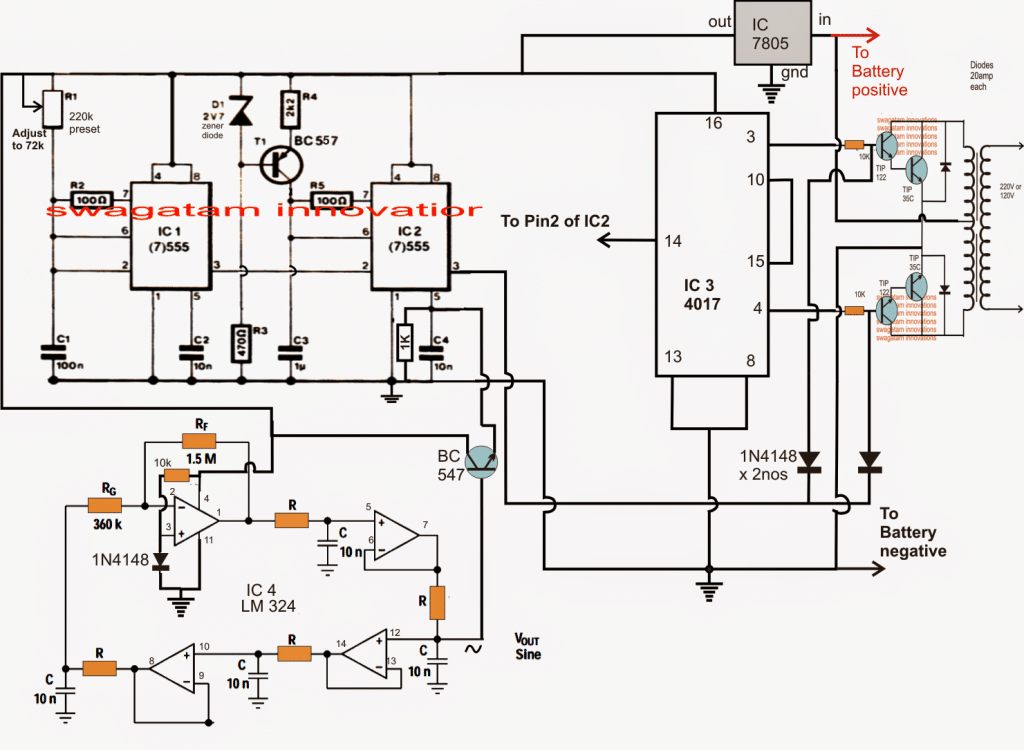
NOTE: Please use a Darlingtton pair for the BC547 connected with pin#5 of IC2 for efficient PWM conversion.
The Design
The proposed sine wave inverter using bubba oscillator may be understood with the help of the following points:
The stage comprising two 555 ICs are configured as PWM generators where IC1 forms a square pulse generator for the PWMs while IC2 forms the monostable PWM generator with respect to the modulation input applied at its pin5.
The sine wave modulation input at pin5 of IC2 is ahieved with the help of a bubba oscillator created by using four opamps from the IC LM324.
The generated sine wave pulses are fixed at precise 50 Hz and fed to pin5 of IC2 via a BJT common collector for further processing.
The 50 Hz Formula
The 50 Hz for the bubba oscillator is set by selecting R precisely with the help of the following formula:
f = 1/2(3.14)RC
IC2 compares the sine wave modulations at its pin5 with the square pulses at its pin2 and generates an equivalent PWM waveform at its pin3.
The flip flop stage reqired for switching the power stage is configured through a single IC 4017 whose outputs are appropriately integarted with the two high gain high current power BJT stage formed by Darlington TIP122 and TIP35.
The pin14 of the 4017 is clocked at around 200 Hz via pin3 of IC1 in order to achieve a 50 HZ switching across the power transistors.
The PWM modulation of the above 50 Hz switching is implemented with the help of the two 1N4148 diodes connected across the bases of the tIP122 and are switched in accordance with the PWM from pin3 of IC1
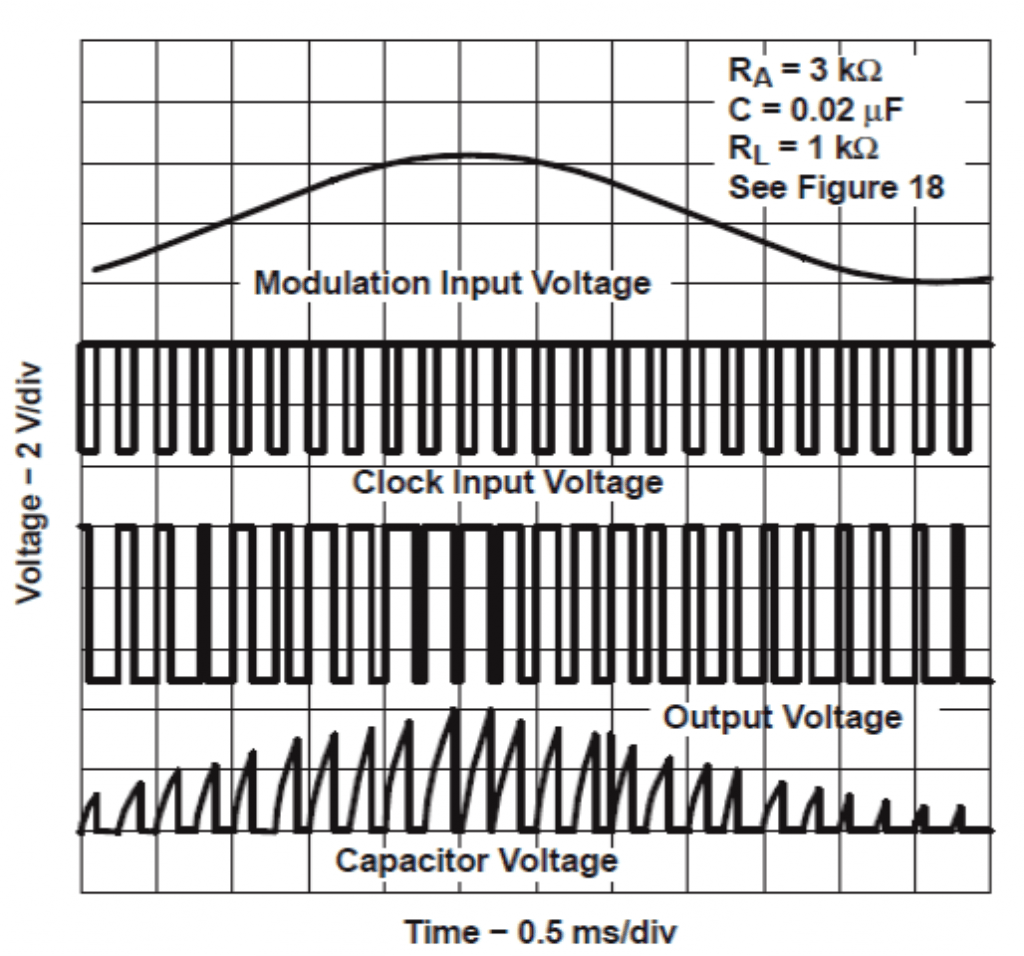
Assumed waveforms of the PWMs may be referred in the following image:
Waveform Bubba Oscillator


Comments
ok thanks, I always wondered if an H-bridge couldnt be done with 4 N channel Fets instead of 2 N channel and 2 P channels… i that link I sent its actaully 4 N channels I dnt know if you have designs like that so I wanted to share so you could try it or prbably you already have designs like that.
thanks, yes I already have simpler versions of H-bridge inverters, using n-channel mosfets, moreover the design which you sent will require to be programmed and require a hex code etc.
Question, If I was to parallel the FETS on this inverter (https://www.dropbox.com/s/lguvjql77xn4af8/INVERTER.jpg?dl=0) would it just be gate to gate, source to source and drain to drain on each side, using an extra 10 ohm resistor at the gate of each FET?
preferably the gates must have there own 10 ohm resistors, the resistor ends could then be connected in parallel….source and drain can be connected directly in parallel across each other
Ok thanks, and the anode goes to the source and the cathode goes to the drain
yes that's right
question: I always see you use a diode across output fets or transistors to protect them from the back emf from transformers but if I was to parallel the output fets would I need to use 2 diodes for each pair of Fet or would I just use 2 diodes
I think a single equivalent diode across any one of the parallel mosfets would do the job, moreover diodes are not designed to work in parallel due to their unequal forward voltage specs.
sir the output voltage of this inverter circuit is 220v ac?
if your transformer rating is below 6amp then you can use 6amp diodes
for 6amp current you can use 2N3055 transistors…
sir,one,more question. can I use a 6A diode as a power transistor protector from back EMF?
and what power transistor could I used other than that of TIP35?
thanks in advance.
yes that's right
sir what should be the the value of the 20amp diodes that used to protect the power transistor from back EMF?
it was not mentioned above.
i have already asked the electronics store that are available here but there is no 20amp rating diode but only a 6amp diode that is available… so sir can i use 6amp diode ibstead of 20amp for the above circuit design?
Angelous, you can just specify 20 amp rating to the dealer, he will provide you the right one….
sir its me again In VM planning to simulate this circuit. but i have a question regarding the power transistor above. is the 4 transistor abount need heatsink and it is okay to place the 4 power transistor together in just one heatsink?
yes these transistors all will need large heatsinks..
sir i have tried to solve the 50hz frequency for the bubba oscillator using the formula that you have disscused above by the use of 10k ohms R and a 0.3 C and i convert it into a 0.000003F but the result is really far from the desired frequency which is the result is only 0.0471.
can you please show me on how to solve it may be the error was from my own solving.
Angelous, you'll have to solve it yourself, because I hardly find time to answer the comments…
hi sir its me again,
sit what is the wattage value of all resistors that are used in the above inverter circuit design? could the 1/4 watt, 5% tolerance resistors can use in this design?
yes will do…
sir what is the advantage of the bubba oscillator compared to the other sine wave generator and what is it's disadvantages?
Angelous, all sine wave oscillators are good…but bubba is more balanced and stable
sir can you please give me an example on how to calculate the output wattage for the inverter?
I would be grateful for your response.
thank you.
yes that's correct!
so sir do you mean that the output wattage or power of an inverter in your design is depend on a trafo voltage rating and amp rating… even if you add more power transistor there will no effect on the output wattage…
The transformer will accept and produce power only within its rated value, it will not accept anything above this regardless of how much the battery or the mosfet are pushing….however the battery voltage must match the trafo voltage otherwise the trafo will burn……also the load should not be beyond the trafo rating or else the trafo might again get damaged..
thanks sir
what about if thw power transistor are adding more to above inverter how to calculate the output wattage together with ouput wattagw of the trafo.
Angelous, always multiply the trafo winding voltage rating with its current rating….for example if the trafo is 12-0-12/10amp rated, then 12 x 10 = 120 watts
Hi Again,
I'm trying to gain an understanding of how this circuit works so I can develop a test plan for it once I build it. How can I configure the IC4017 to generate a 60 Hz switching for the power transistors? Also, I'm a little confused how the sine wave from the bubba oscillator makes it's way to the transformer. I understand that the 4017 switches between the transistors, and the oscillator creates a sine wave, but the in-between steps are a little confusing to me still.
Thank you!
Austin
…the complex bubba circuit is actually not required…it can simply replaced by any easier triangle wave generator circuit.
Hi,
three basic components are required for creating sine equivalent PWMs, viz : an opamp, a relatively fast triangle wave, and a relatively slower triangle wave (or a sinewave)…
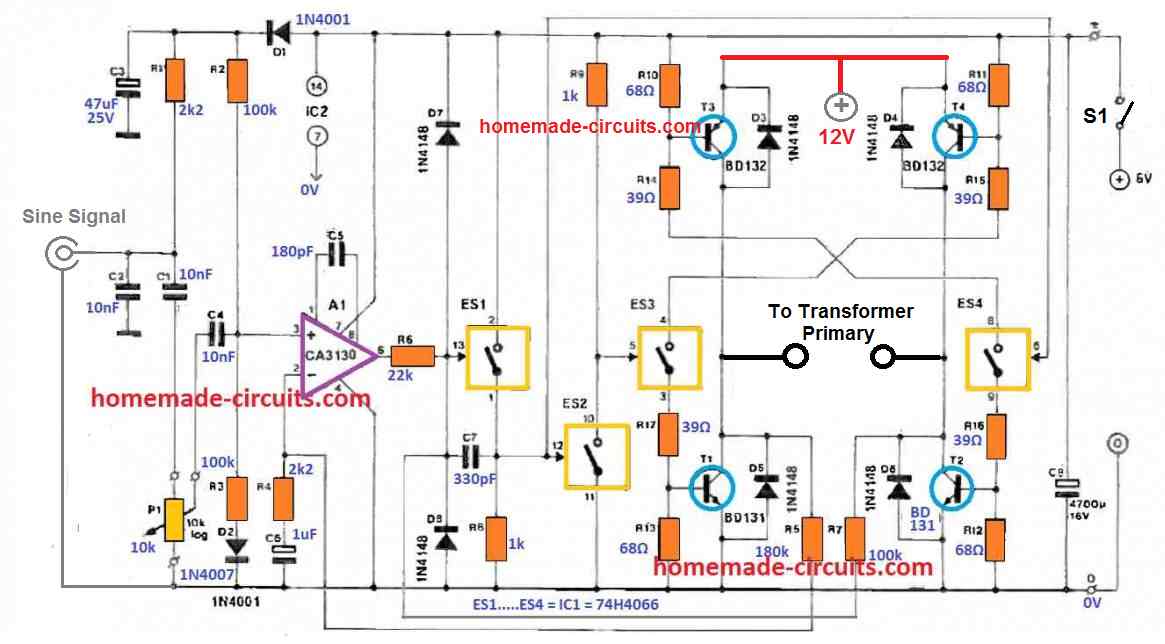
https://www.homemade-circuits.com/2015/07/how-to-generate-sinewave-pwm.html
when these two signals are fed across the inputs of an opamp, the resultant at the output produces the required SPWMs.
here the IC2 becomes the opamp (comparator), pin7 and pin5 becomes its two inputs….fast triangle waves are generated and fed at its pin7 with the help of the square waves through IC1 at IC2 pin#2, and with the help of the associated R/C components at pin#7 of IC2.
Slow sine waves are achieved through the Bubba circuit and fed to pin#5 of IC2 via the BC547 emitter follower.
the fast triangle waves at pin#7 and slow sine waves at pin#5 of IC2 are compared internally and an equivalent PWM sine waves corresponding to the bubba output is generated at pin#3 of IC2.
this PWM is fed at the base of the transistors forcing them to conduct as per the PWM duty cycle, which are in turn are induced across the trafo winding with the same pattern.
The square wave frequency from IC1 which is fed at pin2 of IC2 is not crucial, and a little here and there does not make a difference therefore we dimension this frequency such that it serves two purpose simultaneously, it modulates the IC2 triangle waves and also feeds the 4017 input to help it to create a frequency at 50Hz or 60 Hz…for 50Hz we tune IC1 to generate 4 x 50 = 200Hz…for 60Hz, it would be 4x 60 = 240 Hz.
The preset associated with IC1 could be adjusted to achieve this frequency…the value 4 is found by counting the number of sequencing pinouts of the IC 4017
This is very helpful for my senior project, so thank you! You explained it in simple terms that are easy to understand, and I appreciate that. My question is: How much power can this circuit provide safely?
they serve different functions.
TIP35 can handle 25 x 100 = 2500 watts with sufficient heatsinking.
TIP122 can handle 5 x 100 = 500 watts if sufficiently heatsinked.
However in this design, TIP122s are positioned only for handling the base current of TIP35 and have no direct connection with the load, so no issues, everything is correctly configured…
Thank you!!
One last question. The TIP35C's are rated at 120W but the TIP122's are rated at 2W. Should I switch out the TIP122's for more TIP35C's or do they serve a different function?
other parts can be as is, no mods required
that's correct, and of course the battery AH is also important, which should be around 5 times more the inverter consumption.
if the batt is 12V, then 75/12 = 6.25…and 6.25 x 5 = 31 AH approximately
So for example,
If I need a 75 Watt inverter, I just need to make sure my transformer is rated for at least that much power, and the MOSFET's should be rated for 75 Watts as well? No higher power resistors or other components would be required?
Thank you!
thanks,
power of an inverter will be always equal or proportional to the transformer wattage and the AH rating of the battery, provided the mosfets are adequately rated
hello sir,
what is the value of R in the LM324 IC for the circuit above?
hello Timilehin, you'll have to calculate it with the help of the given formula.
Down by ic4 there are 4 resistors without value, should they be 22k for 50hz?
you will need to calculate it using the given formula, C will be in farads in the formula
I've tried the RC-filtered output generates sine 4017 wive. then be input LM324, LM324 and the output of a square wave instead of a sine wave. if the sine wave input to the LM324, LM324 whether the output sine wave?
it will be a PWM sine wave not a pure sine wave…
Good day,
Thanks for sharing the circuit to us. There is no batt voltage indicated, does it mean we can use any batt voltage such as 12v x 4batt (in series) = 48v? Does IC 7805 control DC voltage for the generator circuit? This sine wave inverter, does it mean pure sine wave inverter, as per waveform diagram above?
Thank a lot for explanation.
Good day, since the 7805 can tolerate only upto 35V, this voltage cannot be exceeded, however if an alternative method of stabilizing the voltage to the ICs is employed such as a common collector transistor stage, then probably upto 80V can be used in this circuit
What is the use of the last stage in the in the circuit,which uses the TIPs and the diodes in parallel?
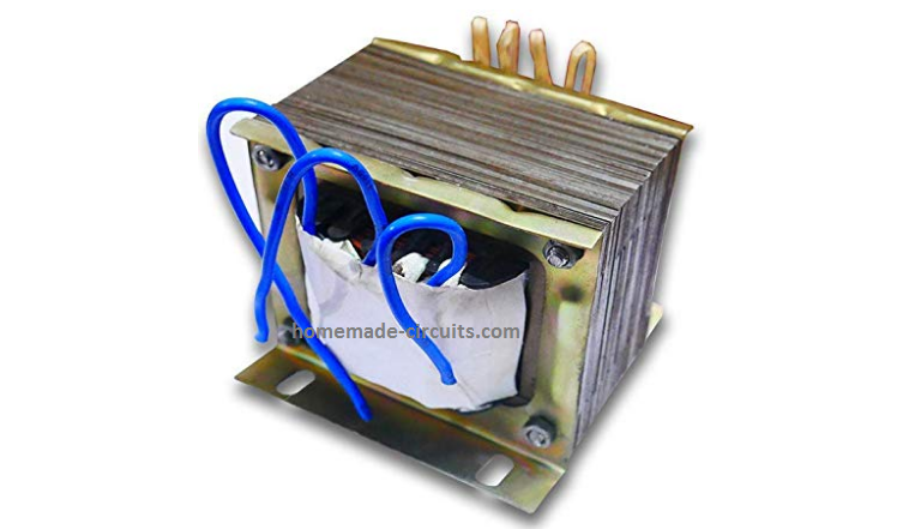
What is the specification of the tranformer?
Is the value of R 3.2 M for 50 Hz??
sorry use 0.3uF for C….converting it into farad gives 0.000003F
therefore F = 1/2*3.14*10000*0.000003 = around 50 Hz
Hello Vivek, try 10k for R and 0.03uF for C
Hello sir, thanx a lot for giving us the circuit for inverter.
I tried to simulate the circuit . I am not able to figure out how the value of R and C has been decided for frequency 50hz. As 50hz is not coming for 22k and 10n
according to the formula mentioned in the aforesaid comments!
Please explain it a bit sir, we have an evaluation for this circuit
the TIP transistors are for converting the PWM into high current oscillations so that the transformer primary can be induced with this for the required conversion…diodes are for protecting the transistors from transformer primary reverse back EMF
R should be 22k according to me…
The value of R for 50 Hz is very large when 10 n is used?
C will need to be converted to Farad before calculating….
ello sir, thanks for the previous help in our major project. We have our evaluation on 20th. We need the stage wise functioning of the Sine-wave inverter using bubba-oscillator. Functioning of each circuit used like 4017, reasons of using this IC,why the connection has been made??Sir plz explain the circuit…we will be realy grateful to you https://3.bp.blogspot.com/…/bubba%2Boscillator%2Bsine%2Bwav…
Hello Ritwik, If possible I'll try to update it…in my free time.