Here's a simple triac timer circuit which can be used for switching ON a particular device after a predetermined time, set through the given pot or the variable resistor.
The shown circuit diagram of a simple triac timer can be understood by referring to the following explanation:
How it Works
The left hand side section comprising the IC 4060 becomes the basic delay generator stage. As we all know, the IC 4060 is an extremely versatile time delay generator chip which has a built in oscillator for the required fundamental timing clocks.
The components connected at the pin#9,10 and 11 form the time delay determining parts of the IC.
Precisely, the resistor at pin#10 and the capacitor at pin#9 are responsible for fixing the delay period and may be adjusted for acquiring the required predetermined switching output.
This IC has 10 discrete outputs which produce delays or oscillation periods which are twice to the previous pinout in the order.
Here pin#3 produces the largest delay, followed by pin#2 and then pin#1 and so on as per the specified pinout order. So suppose pin#3 produces delay interval of 1 minute, then pin#2 would produce the same at an interval of 30 seconds, pin#1 at 15 seconds and so on.
Since pin#3 is specified with the highest time interval, we use this pinout as the output.
Therefore suppose we set the RC at pin#9 and 10 with a maximum delay of 2 hours, pin#3 would be assigned to generate alternately changing ON/OFF pulses, having equal delay intervals of 2 hours, meaning initially the output would be OFF for 2 hours, then ON for next 2 hours and so on as long as its powered.
The above explains the IC 4060 configuration, now I have explained about the triac configuration.
As we can see, the output pin#3 is directly connected to the gate of the triac, while the triac A1 and A2 are terminated with the load and the other specified parameters.
When power is first switched ON, C3 at pin#12 of the IC4060 makes sure that the timing count initiates right from zero by resetting pin#12 with a short pulse.
The output pin#3 now initiates with a logic zero output while the IC internal timer starts counting.
Due to the logic zero, the triac stays switched OFF initially along with the load.
Once the predetermined delay interval lapses, pin#3 instantly becomes high, triggering the triac and the load.
The diode connected across pin#3 and pin#11 plays an important function of latching the IC counting process.
If this diode is removed, the counting process will continue and after 2 hours the triac will be again become switched OFF, and this procedure will go on repeating every after 2 hours.
The diode shuts off this operation, and lathes the IC to the ON position permanently.
The above situation provides us with another interesting application of the proposed circuit, by removing the diode we can convert the above circuit into an AC lamp flasher circuit, the flashing rate being set by the RC components.
Also note that irrespective of the RC parts you have the option of selecting/connecting the remaining outputs of the IC with the triac gate for getting a diverse range of time delays.
Circuit Diagram for Delay ON Timer
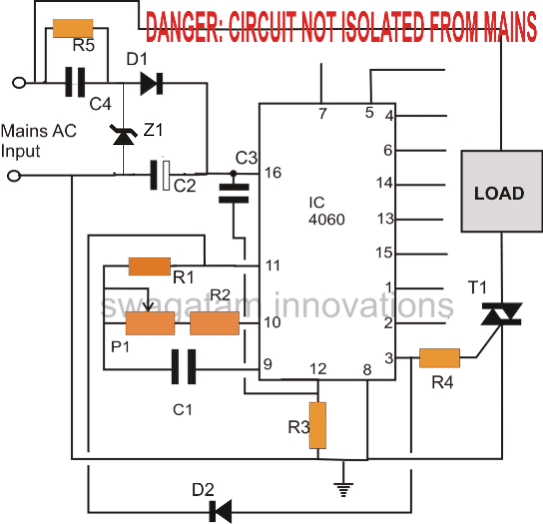
The above triac controlled timer circuit becomes suitable for applications which requires a delay switch ON.
For applications which require a delay switch OFF meaning in cases where a load needs to be switched off after a predetermined time interval, the above circuit can be modified as given below:
Circuit Diagram for Delay OFF Timer
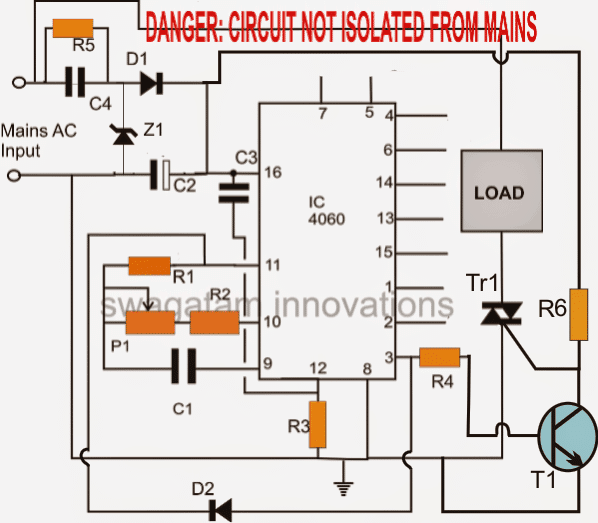
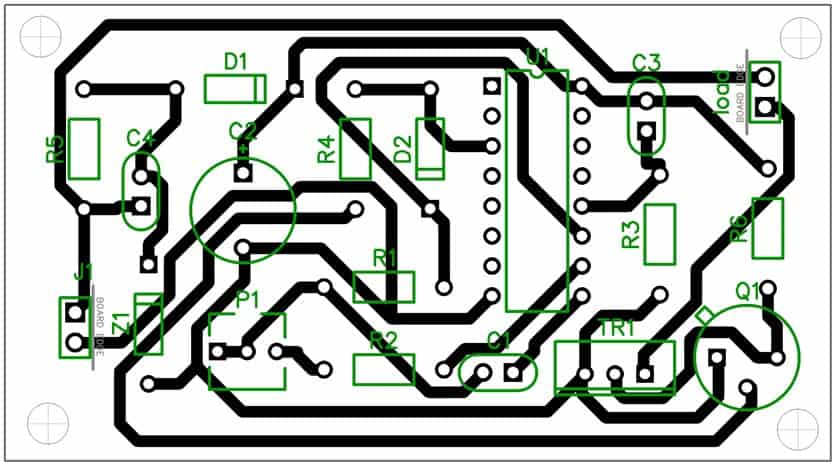
PCB Layout
Parts list for the above simple triac timer circuit
- R1 = 2M2
- R3 = 100K
- R2, R4, R6 = 1K
- R5 = 1M
- C1 = 1uF/25V (must be non-polar, use more in parallel for higher delays)
- C3 = 0.1uF disc
- C2 = 100uF/25V
- C4 = 0.33uF/400V
- Z1 = 15V 1watt zener
- Tr1 = BT136
- T1 = BC547
- D1, D2 = 1N4007
- P1 = 1M pot
Using a Transformer DC Supply
The above simple timer circuit can be also built using a transformer DC supply, as shown below:
All diodes are 1N4007, and the relay is 12V/400 ohm, 10 amp
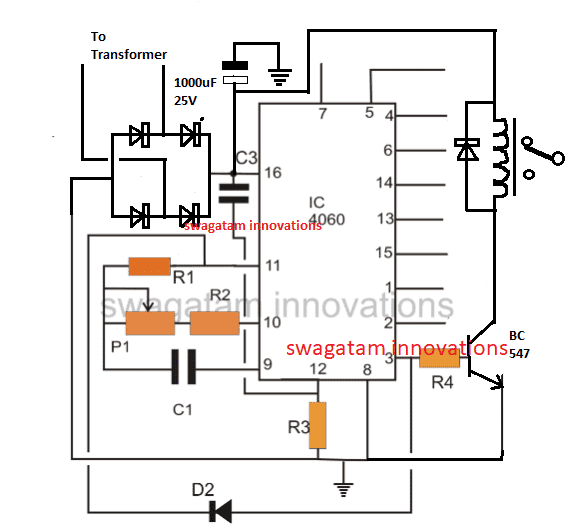


Questions & Answers
Mr Swagatam, thank you very much first of all.
I need a timer, that every 12 hours starts a 3 volt motor and can be reset (mechanically) to start the cycle again.
Is your first circuit suitable for this purpose? What are the R and C values for 12 hours?
(It is for a fish feeder)
I greet you gratefully.
You are welcome Mr. Rafael, 12 hours is a pretty long duration, therefore the timer should be also a long duration type.
You can try the second diagram from the following article:
https://www.homemade-circuits.com/how-to-make-long-duration-timer-circuit/
Muchísimas gracias por la respuesta!! probaré, agradecido.
Mr Swagatam, could you please publish circuit diagram for temp controlled soldering iron 12v dc or 230v ac
Thank you Rajesh, you can find some related info in the following link:
https://www.homemade-circuits.com/?s=soldering+iron
Alternatively you can use the 317 IC based regulator for controlling the 12V soldering iron
And use a triac dimmer circuit for controlling a 230V soldering iron
Hi!
I want to assemble the circuit at home. Where can I buy the PCB and components?
You can assemble on a piece of strip board or any general purpose board, PCB is not required for a prototype building.
Hi Dear,
Is there any triac circuit which can turn on/off appliances by cutting off mains and neutral both wires.
I know circuits which works by switching devices by cutting off only one wire i.e Phase wire and neutral stays conneted.
But sometime i can’t confirm the correct polarity of ac input to triac.
can you help ?
Hi, it can be tricky to use separate triacs across both LiVE/Neutral, but may be SSR could be used.
Hi mr swagatam..nice timer circuit..
Ive creat few dc timer circuit for my phone charger, im interesting with your ac timer, on my dc timer ive used 555 but Vin is not same with Vout, i try with BJC and its same result, than ive try with z44 smd and all smd for another components and its was great result to reach same V/I in out for time that i want (maks 3 hour)..but my problem is i need big Caps (4400uf) and its size too big for me..can you help me to resize the circuit or another tiny timer circuit?..any help would be great..keep the good works
Hi mr swagatam..thank for your kindness..i forgot to ask you about the out put..is it same V&I output from the input?..because ive try another circuit on youtube and its not same on V&I. Hopely u can help me to choose from one of your lot of awesome circuits.
I need :
V =4.5v to 12v (same in&out)
I = >5amp
Small size componenents (no relay/transformer)
Time duration = 1-3 hour.
Once again thank you.
Hi Indira, yes, no doubt the output from a 4060 IC will be almost equal to the supply connected across its Vcc and ground (5V to 32V max).
The current will depend on the transistor rating that is used at the output of the 4060.
yes 1 to 3 hours can be easily achieved with great accuracy
Thank you Indira,
A 555 IC cannot be used for getting long duration timings with smaller capacitors. According to me using a single IC 4060 will do the job for you, with much smaller capacitor such 10uF (10nos of non-polar 1uF in parallel) and a 3M3 resistor.
Alternatively you can combine IC 555 with IC 4017 for the same results.
An example design is shown in the following link using IC 4060 and IC4017. You can replace the IC 4060 with IC 555.
https://www.homemade-circuits.com/how-to-make-long-duration-timer-circuit/
thaks for your kindness mr swag..hoppely it works as i need..keep the awesome works..
Thanks
It’s my pleasure Indira!
Hello Mr. Swagatam, I have used the concept of your first circuit with a 555 to switch on and off my hot glue gun, 60W/230V, in order to reduce the high temp of silicone. Few secs ON and few secs OFF (dimmer didn’t help). I have an issue though. It burns the gate resistor 1K no matter of the resistors wattage. I use BTA16 700B triac that I have handy for the test. Any help would be appreciated.
Hello Than, the first circuit uses a IC 4060, so I am not sure which circuit you are referring to.
The 1K should never burn, because the triac gate will consume not more than 50mA, which can never burn a higher watt resistor.
Make sure the input supply is restricted to 12V for your circuit.
hello, you can use a monostable 555 IC circuit and connect its pin#3 to a triac in the same manner as shown in the first circuit above,
this set up will allow you to get the required delay as soon as the pin#2 of the IC is grounded via a push button
What is the p1 value
can be a 1M
it's a potentiometer
Ideal ccts. Design.
????
Checked out the circuit as suggested by you. Looks perfect for my application. One query- what is the value of potentiometer P1?
you will have to verify it practically or you can do the given formula here:
https://www.homemade-circuits.com/2012/01/how-to-make-simple-versatile-timer.html
C will be in Farads
Ok. What will be the min and max delay time for 100K pot?
OK that's great, P1 can be a 100k pot, will depend on the time delay requirement
Hello,
I made the circuit (the second one with transistor). Did actually somebody made and test this circuit? Without transistor the circuit works great, but with transistor I can not get the result. It only switch the load (40W lamp) on and after while when it should go off nothing happen. Even on pin 3 on IC there is no rising voltage. Have someone a solution? I have only one change T1 is BC183C and not BC547. Thank you for answer. Regards Kitchi
….a 100uF/25V capacitor across collector/emitter of T1 might solve the issue…
OK no problem but normally there should not be any kind of flickering, unless something's incorrect in the connections, or the parts.
Hello. It takes some time sorry, Increasing C2 is not helping, increasing C4 is increasing power voltage more than 15V so Zener diode is limiting the voltage and I thing this is not good because it might be burned someday and the circuit may be damaged. And a little flickering is still there. I think that on the ventilator it won't be so disturbing as on the lamp. I thing I can live with that 🙂 .Thanks for help.
try increasing the value of C2 to may be a 1000uF/25V…this will most probably solve the flickering issue….if that doesn't help increase the value of C4 to 0.47uF/400V
Hello, suddenly it works. Maybe there was a poor contact. Only one question more. When powering on and the load is on the load (light bulb 20W) is flickering for a 5-10 seconds and volt-meter also is showing ups and downs of the voltage on bulb (very quickly like 2 ups and downs per second) and after 10 seconds bulb is on normally like it should be-no flickering. Could it be defect triac (it is brand new) or voltage at the gate is not ok at startup? Kind regards Kitchi
both the circuits should work equally well.
BC183 is OK and can be used.
connect a LED in series with the emitter of the transistor or in series its base…when this light up, the triac must go OFF, and vice versa,
this LED will indicate whether or not your transistor is switching correctly.
If the LED is not responding ON/OFF or if its permanently ON or OFF would indicate a faulty transistor or wrongly connected transistor..or a faulty IC
Can I able to set 10s delay by using this ic 4060. In our college we did amicrocontroller based automatic bell one day we face a problem that relay stay in Nc position due to this bell rang for long period of time until we turned on the supply. In order over come this we have planned to add some extra time ic that even if the relay fails to operate the bell should be turn off after the 10s time delay. Can I use this circuit for it
this circuit may not be exactly suitable, you can try a 555 monostable configuration.
Sorry i'm a little confuse. Once and for all. Let me rephrase my question. What should i use for c1? a. 2-.68uf/50v mylar in parallel, or b. 1uf/50v?, what polarity of this capacitor should be connected to pin 9 of ic4060?
you can use any value, any type for C1, but it needs to be non-polar.
higher values will give higher timing delays
In your reply last Sept.20, you said 50v is enough for c1 (in the parts list it is 25v. i doesn't matter anyway,right?). My question is: what polarity of c1 should be connected to pin 9 of ic4060?
I'm sorry but i'm confused on your statement on what is the value of c1. Once and for all please kindly specify the value and/or rating of it? You said 50v would be enough for C1, at 1uf? What polarity should be connected to ic4060?
the voltage rating needs to be twice that of the supply volatge, as a rule of thumb…higher voltage rating will not do any harm.
when it's non-polar, there's no restriction to polarity, it can be connected anyway round.
Going back to c1 issue. Finally, it is a 1uf/50v electrolytic capacitor, right? Polarity please? What polarity should be connected to pin9 of ic4060?
C1 can be of any value, but it needs to be strictly non-polar…you can use many 0.68uF capacitors in parallel if non-polar 1uF is difficult to obtain.
higher values will give higher timing periods
Can i substitute the 1M pot with a fix value resistor? If your answer yes, what value would it be? I just wanted a simple 2 hours off and 2 hours on timer circuit.
yes you can….first insert any random value like 220K, and check after how many minutes the pin3 becomes high….once you get the result you can simply calculate other resistor values for any other desired timing through cross multiplication.
If i use two .68uf in parallel, will you specify a 250v value of it?
I am sorry i confused it with the input cap…actually for C4,
50V would be just enough for C1
no…both should be 400V
Therefore c1(1uf/25v) is a mylar. Can i just simply use .68uf(volt please) in replacement for the 1uf/25v? What do you mean use 'it in parallel?' and what is the value of the p1?
C1 can be any type of non-polar capacitor….you can put two 0.68uF or two 0.47uF capacitors in parallel to substitute the shown 1uF capacitor
P1 can be a 1M pot
I'm sorry, but the value of c1 is 1uf/25v. It does have a polarity right?
C1 can be of any value, but it needs to be strictly non-polar…you can use many 0.68uF capacitors in parallel for the same
Dear Swagatam,
Kindly indicate the polarity in every electrolytic capacitor in the simple triac timer circuit. I cannot proceed further to the condtruction of the said project. Please.
Regards,
Ruben
Dear Ruben,
except C2 all are non-polar caps…and the white bar of C2 indicates the positive.
Thank you! I'm more confident to build the timer circuit.
Dear Swagatam,
Hope you're fine.
I'm trying to build an egg incubator and i'd like to incorpoprate your simple triac timer switch into it. However, the triac circuit did not the input voltage. is it 110v or 220v? i need a 220v circuit. Please advise. I'm sorry for being naive about this.
Thank you for being patient in answering the questions being asked by the readers. i also learn from them. Keep up the good works Sir! Hats off!
Regards,
Ruben
Dear Ruben,
most 1amp triacs are normally rated at 400V minimum…so you can use the shown circuit with 220V safely…so there's nothing to worry about.
Thanks!
Would a 50V ceramic be OK for C1? I'm having difficulty finding a 25V 1uF…
It will do, no issues
Is it not possible that if we used an electrolytic capacitor for C2, that it would be in danger from the AC during abnormal operation?
Dearest Tom, R5 = 1/4 watt
D1, Z1 makes sure that the C2 is subjected to a pure DC, so it won't be affected by the AC factor
Dearest Swagatam,
Recommended Wattage rating of R5? Everything else looks like 1/4 Watt should be fine, yes?
Hi Swagatam,
can you add a circuit after the Aircon OFF the Electric Fan will be automatic ON.
Thanks In advance
Hi Rolf,
I'll try to design it soon and post it in my blog
Thank you sir I.ll be waiting. Sir kindly let me know how to use the ic DB106 I mean connection.
Mujahid, the bridge has symbols printed on its body, please refer to the following image, you can easily connect the pinouts by looking at the markings:
Dear sir would you like to give a short detail about PTC fuse and Varistor and specially How they are wired. Thank you.
Dear Mujahid,
Varistors are always connected parallel to the mains input supply terminals of the circuit which needs protection, PTCs also are wired identically, not sure though, I'll try to present a post explaining these components soon.
how can we make this circuit as digital countdown timer? I mean adding LCD in this.
you can use a small digital clock, and integrate the seconds pulse to pin11 of the IC as clock input
R1, R2, P1, C1 won't be required then.
What is the exact part number for ic 4060? It is a 14 stage binary counter right?
It can be of any brand or prefix, the 4060 number is only important.
Actually sir I want to know the magic of diodes IN4148 in 18 led chaser circuit you have configured. It seems interesting to know. I tried to understand but in vain.please help me I want to connect more 4017 ICs.
…as soon as i get some free time i'll try to explain it elaborately.
yes, it's the biasing condition of the diodes with reference to their connection with the relevant 4017 outputs which render them into a conducting or non-conducting states which in turn blocks or unblocks the relevant IC sequencing actions…..
Sir I read the post( 18 led chaser circuit) thoroughly you recommended but I couldn't understand how the first ic sequence remains off untill the second ic has completed its output. I want to understand it and connect more ics so it would be very kind of you to explain it further.
Mujahid, I'll study and refresh my memory about the circuit functioning and let you know how it could be done…
Sir is it possible if I use two or more ICs 4017 when 1st IC completes its sequential output it should stop completely and the SECOND IC(4017) should start its sequential output and when SECOND IC completes its sequential output it should stop completely then 3rd IC (4017) should start its sequential output and when 3rd ic has completed its sequential output it should stop completely and this cycle should start from the first ic and so on.
I have one such circuit using two 4017 ICs, I think more can be cascaded in the same manner for getting any desired number of sequences, you can see the example here:
https://www.homemade-circuits.com/2011/12/how-to-make-18-led-light-chaser-circuit.html
I did as you recommended it is working nicely. I am very thankful to you.sir kindly tell me what zener diode bias means
it could mean biasing a device though a voltage specified at or by the zener voltage.
Sir I made a circuit consisting of ic 4017 and ic 555 its working well as all output at ic 4017 work in sequence but the problem is that when the circuit is switched on every time the sequence does not start from pin 3. While I want the sequence to start from pin 3 whenever the circuit is switched on. How is it possible? Please help.
connect the pin15 of the IC to ground via a 100k resistor and connect a 0.1uF capacitor from positive to pin15….this will correct the issue.
Sir in above ckt calculated timing is much varig from practically gatting.
When triac is on voltage at IC is 11 volt and when it gets off voltage at ic becomes 6 to 7 volt. As transistor makes the collector ground at which we connect vcc through 1 k resister,
Voltage gets drop.
timing will depend on the values and setting of P1, R2, C1, make these exactly equal for getting identical timings.
Sir but I am getting different time for two same circuit. One is @4 min and another one is @5:30 min.
Please help me out. What should be the problem.
I interchange the ic as well.
let it drop, the load will activate even at 6/7 volts.
Sir I meed 12 min on time and 4 min off time.
Then again 12 min on and 4 min off.
Until the get power off.
Sarang, you can try the following circuit:
https://www.homemade-circuits.com/2012/04/how-to-make-simple-programmable-timer.html
Sir , how do you select values of r5 and c4.
What are the calculation behind these values
please see the parts list for the values.
Sir if i want to stop the ic after specific number of ON and OFF cycle then what i should do? I need only 3 cycles. I have made this circuit when three cycles complete I cut this circuit with a timer circuit via a relay. Now I don.t want to use the relay.tell me an easy way to use the above circuit for specific number of ON AND OFF cycle.
Sir what is use of D2.
Value of R6 is ?
correction: pin7 of 4017 will connect with pin11 of 4060.
you will have to use a 4017 IC and connect it in the following manner:
remove D2 from the above circuit
connect pin14 of 4017 to pin3 of 4060
pin15 of 4017 to pin11 of 4060
pin8, 13 of 4017 to ground
pin16 of 4017 to positive
pin15 of 4017 to ground via 1m resistor
0.1uF capacitor from positive to pin15 of 4017
for indications connect LEDs with series 1k resistor to pins3,2,4 and ground of 4017
In the proximity circuit the photo diode BP104 is specifically for infrared light source or this one is same as other photo diode?i
Mujahid you can modify the following circuit as per your application requirement:
https://www.homemade-circuits.com/2013/03/simple-reliable-infrared-ir-remote.html
Sir can you help me in making a proximity circuit for water tape I need a simple circuit. I tried to make it with the help of infrared receiver found in a computer mouse but it.s not responding well as I need it.
A photo diode or a photo transistor is triggered by infrared light only or they can be triggered by any light like sun light or any other bulb. Please explain about photo transistor and photo diode. Thank you
it can be triggered by any light source that's why we use a pulsed light while using it as a detector in a circuit, the receiver responds only when the PD receives the pulsed signal from the specified transmitter and other light sources are ignored
Dear sir my question is regarding one of your explained circuit that is proximity circuit. If an IR led and BP104 and a npn transistor and a relay is configured in such a way when the beam of IR led is reflected and falls on photo diode and it triggers the transistor and the transistor gets saturated thus operating the relay for the time as long as the reflected beam falls on photo diode. I mean to know that with these few components it possible to make a simple proximity circuit. Thank you.
Yes it's possible.
Yes it's possible.
A mobile set under continuous charging as you have configured one in the cell phone operated bell circuit will be ok? I mean overcharging won't damage the cell phone?
every cell phone has an inbuilt over charge shut off feature, so it's safe.
Sir if i use the above circuit as flasher using the Triac bt136 how much load it can carry.thank you.
300 watts
sir i have made the above circuit it working well but i want to drive a 12 volt relay what transistor should i use to drive it
you can use a BC547 transistor
That.s very kind of you. Actually sir I don.t know much about electronics but this is your help that I.'ve made a mobile operated relay circuit that.s a bit different from yours. And there.s one to operate the generator automatic start and shut down. That.s all great. I read your blogs regularly. Sir I!ve difficulty in understanding the terminology of electronics.would you help me.
You can ask questions whenever you have doubts about any particular circuit, I'll answer those, and gradually you will learn the different aspects of the subject.
"The higher the capacitance the higher voltage drops."Sir is my understanding about voltage dropper capacitor( capacitor used in place of a transformer to drop voltage) is correct or not?
no i's incorrect, first of all it's not voltage but current that's dropped, higher capacitance means higher current and vice versa.
With the above circuit is it possible that its On Off cycle repeats only 3 times, after 3 times its ON OFF cycle should stop permanently.
it can set in multiples of 2, like 2 times ON/OFF, 4 times ON/OFF, but not 3 times or 5 times etc.
Let me explain my question in a better way.I need a timer circuit only not any changeover I want to operate the above circuit with both mains(using an adaptor)and a battery simultaneously. My purpose of using two different supplies simultaneously is to operate the circuit even when the mains is unavailable. In case of the unavailability of mains the battery will operate the circuit but the problem is to keep the battery safe from charging of mains supply. Can I use a diode in battery supply?
OK, yes you can operate the timer circuit through mains and 12V battery as well, for preventing the battery from receiving the 12V DC from the adapter you can use a blocking diode as correctly suggested by you.
Sir I want to know a very important point is it possible to power the above circuit with both mains and a battery as well in a way in which the battery should not charged with the mains supply.actually I need to power the circuit when mains is unavailable.the battery should remain safe from charging.thank you
Do you need a timer circuit or just a mains changeover relay for switching the battery ON/OFF?
If your need is a timer circuit then you can use the above circuit with both mains and battery also.
Preferably use a 12V DC adapter for mains operation of the circuit instead of the capacitive power supply.
Actually I mean to know can I operate a circuit of 12v 20mA with a 12v 200Ah battery ? I don.t want to charge the battery.
yes you can operate a 12v 20ma circuit with a 12v 200ah battery
Sir kindly let me know why this zener diode has been used in the above circuit?
In a few circuit whenever tried to connect zener diode it gets hot why does it happen so?
zener is used so that C4 can operate correctly….with a 0.33uF for C4 here, the zener will not become hot.
A circuit needs 12 volt and 20mA. Will this effect the circuit if it is connected to a 12 volt 200Amp battery? What happens if the required volt remains the same and amperes are increased to the circuit?
12v 200AH batery cannot be charged with a 20ma supply.
Sir I would like to know a few questions
can we use all or some of the outputs of the above explained ic at the same time?
Can a relay be directly connected to an ic without any transisor. Thanks a lot
Yes you can use any desired number of outputs simultaneously, but they should never be interconnected directly.
Relay cannot be used directly with CMOS devices since their output have very low current, not specified for driving loads like relay etc.
Thank you sir . That's one I was really looking for. I made it successfully and working well. Can any thing be connected to this circuit to protect it? Kindly let me know what are the main point which we should note down from a transistor data sheet regarding any transisor. Thank you.
Hi Mujahid,
In transistor datasheet you should only look for the maximum breakdown voltage that it can handle across its collector/emitter and also the breakdown current across these terminals
sir can i use half rectifier circuit to charge 200amp battery
you can try the 4060 timer circuit that's given in the above article, replace the triac with a transistor/relay driver stage and adjust the pot for getting the desired timing
use a 12V adapter to power the circuit.
Sir I need a circuit in which i can operate a 12 volt dc relay . On switching the relay should remain ON for 5 seconds and after 5 seconds the relay should go OFF for 5 seconds and after 5 seconds it should turn on for for 5 seconds again.his cycle should continue untill supply to the circuit is disconnected.
yes you can do it.
which number of triac is 40amps to 100amps
A digital meter will always show some DC content in AC, and vice versa,
which is nothing to worry about…the thing to note is that the triac's MT1 and MT2 are connected with the mains AC so the load will get only mains AC unless the triac faulty…
Hi, with 10K it should not flicker because the first transistor is supposed work require very little current for turning off the triac driver transistor.
anyway, if it's working for you, it's fine!
using pin#3 will allow 3 times more delay than pin#1.
if you connect the load with the triac as shown in the diagram, then the load will get a pure AC, and no DC, because the triac is connected only with the AC, and there cannot be any DC here.
I hope you have included C3 in the design and the 100K at pin#12, these are for ensuring a reset action each time power is switched OFF.
Try increasing the value of C3 to 1uF, and check the response
In the last diagram, introduce another BJT stage in between R4 and the base of the existing BC547, in the following manner.
disconnect R4 from the existing transistor's base.
Take another BC547, connect its base to R4, emitter to ground, connect a 10K resistor from its collector to positive.
Now connect the base of the previous transistor with the collector of this new transistor….that's all.
Hi, 4060 will not produce more than 15mA, so you may have to employ a transistor stage for switching ON the triac….you can try the second circuit which is designed as a delay-OFF timer
BTA41/600
sir can this carry load of 3000watt to 5000watt
may be, if a 40 amp triac is used
Thanks very much! I appreciate your valuable input.
The HV capacitor needs a clean discharge path so I'll stick to your suggestion. Thanks for that!
During negative cycles C4 would get discharged through R5 and the cycle would continue, I would like to check it practically and then I'll put my comment back here.
Putting the zener immediately after C4 is not a bad idea but in the above condition also the circuit should work..let me check it.
did you understand the function of the zener here?
everything is perfect in the circuit, nothing needs to be changed
Hello Miguel,
you can use the above circuit,just replace the triac with a transistor/relay stage.
You can power it with a 12v ac/dc adapter instead of the transfomerless power supply.
Time delay will not be affected at supply voltages between 5V and 15V.
Yes it will work with a DC adapter also.
you can use a standard transistor/relay driver stage in place of the triac.
the voltage should be a fixed type around 12V or at the selected relay voltage, if it's fluctuating too widely then I am afraid the relay will not respond at the lower voltages, using a converter will make the circuit very complicated.
you will have to adjust the RC components for setting the preferred time interval.
thanks for ur suggestion Mr. Swagatam…
Using ne555 is my next plan for applying this feature. But I doubt :
1. can the IC ne555 be supplied with transformatorless power suply ?
2. can the IC ne555 drive the SCR gate for subtituting mechanical relay ?
3. can I replace the capasitor c1 with larger to make a delayed switching…?
so I want to try to make it…
thank a lot
thankyou
Hi Mbah,
Yes all the points you have are possible with the shown circuit
Hallo Mr. Swagatam
I have build a dark sensor to switch on the CFL lamp 220 volt. I just build one with a simple SCR sensor. But if the LDR is getting dark or getting bright, the CFL got flicked for several time. so I have an idea to make a delayed switch on. So if LDR getting dark the lamp is not ON immediately, but the lamp is ON for several minutes after ldr getting dark and vice versa if LDR getting bright.
would you have a suggestion about it ?
THANKS
Hi mbah,
your circuit cannot be upgraded, for getting improved results you may have to utilize better designs as shown here:
easy-electronic-circuits.blogspot.in/2013/07/simple-light-activated-switch-using.html