A 50 watt inverter circuit might look quite trivial, but it can serve some useful purposes to you. When outdoors, this small power house can be used for operating small electronic gadgets, soldering iron, table top radios, incandescent lights, fans etc.
Let’s learn 2 homemade 50 watt inverter circuit designs, beginning with a brief description regarding the circuit diagram and its functioning:
Design#1: How it Works
The first 50 W circuit may be understood with the following points:
Referring to the figure below, transistors T1 and T2 along with the other R1, R2, R3 R4, C1 and C2 together form a simple astable multivibrator (AMV) circuit.
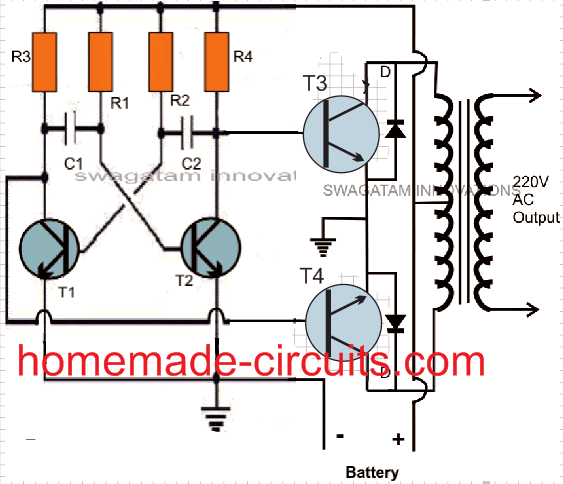
A transistor multivibrator circuit basically is composed of two symmetrical half stages, here its formed by the left and the right hand side transistor stages which conduct in tandem or in simple words the left and the right stages conduct alternately in a kind of a perpetual “motion”, generating a continuous flip flop action.
The above action is responsible of creating the required oscillations for our inverter circuit. The frequency of the oscillation is directly proportional to the values of the capacitors or/and the resistors at the base of each transistor.
Lowering the values of the capacitors increases the frequency while increasing the values of the resistors decreases the frequency and vice versa. Here the values are chosen so as to produce a stable frequency of 50 Hz.
Readers, who wish to alter the frequency to 60 Hz, may easily do it by just changing the capacitor values appropriately.
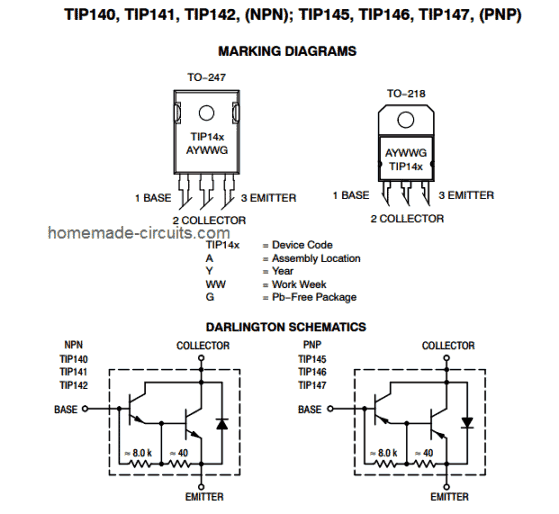
Transistors T3 and T4 are placed at the two output arms of the AMV circuit. These are high gain; high current Darlington paired transistors, used as the output devices for the present configuration.
The frequency from the AMV is fed to the base of T3 and T4 alternately which in turn switch the transformer secondary winding, dumping the entire battery power in the transformer winding.
This results in a fast magnetic induction switching across the transformer windings, resulting the required the mains voltage at the output of the transformer.
Parts Required
You will require the following components for making this 50 watt homemade inverter circuit:
| Component | Value |
|---|---|
| R1, R2 | 100K |
| R3, R4 | 330 Ohms |
| R5, R6 | 470 Ohms, 2 Watt |
| R7, R8 | 22 Ohms, 5 Watt |
| C1, C2 | 0.22 uF, Ceramic Disc |
| D1, D2 | 1N5402 or 1N5408 |
| T1, T2 | 8050 |
| T3, T4 | TIP142 |
General purpose PCB = cut into the desired size, approximately 5 by 4 inches should suffice.
Battery: 12 volts, Current not less than 10 AH.
Transformer = 9 – 0 – 9 volts, 5 Amps, Output winding may be 220 V or 120 volts as per your country specifications
Sundries: Metallic box, fuse holder, connecting cords, sockets etc
Testing and Setting Up the Circuit
After you finish making the above explained simple inverter circuit, you may do the testing of the unit in the following manner:
Initially do not connect the transformer or battery to the circuit.
Using a small DC power supply power the circuit.
If everything is done rightly, the circuit should start oscillating at the rated frequency of 50 Hz.
You can check this by connecting the prods of a frequency meter across T3’s or T4’s collector and the ground. The positive of the prod should go to the collector of the transistor.
If you don’t own a frequency meter, never mind, you do a rough checking by connecting a headphone pin across the above explained terminals of the circuit. If you hear a loud humming sound, will prove that your circuit is generating the required frequency output.
Now it’s time to integrate the battery and the transformer to the above circuit.
Connect everything as shown in the figure.
Connect a 40 watt incandescent lamp at the output of the transformer. And switch ON the battery to the circuit.
The bulb will immediately come ON brightly…..your homemade 50 watt inverter is ready and may be used as desired by for powering many small appliances whenever required.
Design#2: 50 Watt Mosfet Inverter Circuit
The circuit explained above involved power transistors now let's see how the same concept may be utilized with mosfets making the configuration much easier and straightforward, yet more robust and powerful.
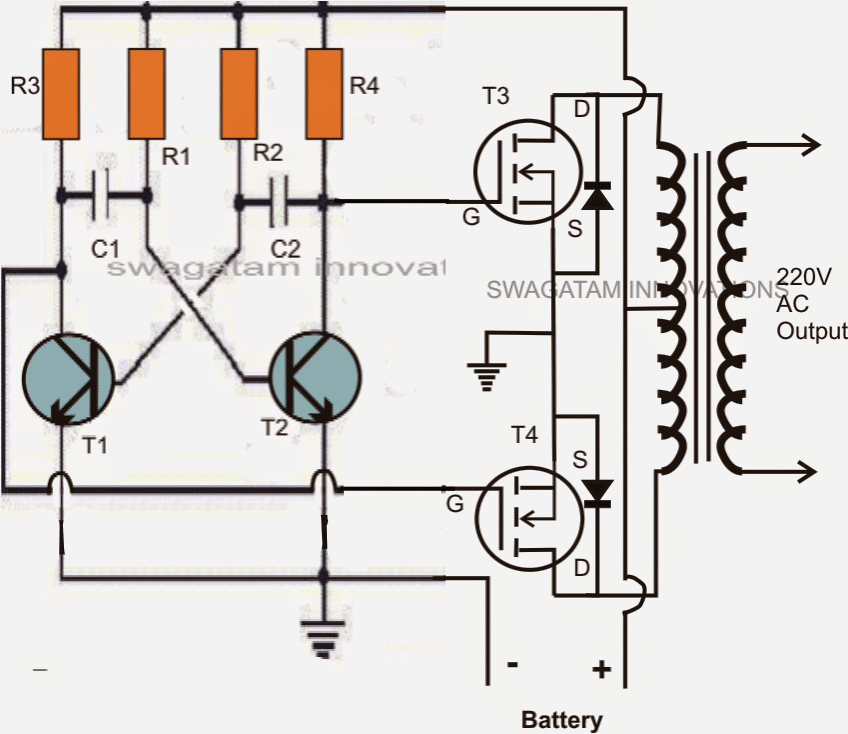
Rest of the stages are pretty much the same, in the earlier circuit we saw the involvement of a transistor based astable multivibrator for the generation of the required 50 Hz oscillations, here too we have incorporated a transitor operated AMV.
The earlier circuit had a couple of 2N3055 transistors at the output and as we all know driving power transistors efficiently requires proportionate amount of base drive, relative to the load current, because transistors depend on current drive rather than voltage drive, in contrast to mosfets.
Meaning, as the proposed load becomes higher, the base resistance of the relevant output transistor also gets dimensioned accordingly for enabling optimal amount of current to the base of the transistors,
Due to this obligation, in the previous design a additional driver stage had to be incorporated for facilitating better drive current to the 2N3055 transistors.
However when it comes to mosfets, this necessity becomes completely insignificant.
As can be seen in the given diagram, the AMV stage is instantly preceded by the relevant gates of the mosfets, because mosfets have very high input resistance, which means the AMV transistors wouldn't be unnecessarily loaded and therefore the frequency from the AMVwouldn't be distorted due to the integration of the power devices.
The mosfets are alternately switched, which in turn switches the battery voltage/current inside the secondary winding of the transformer.
The output of the transformer gets saturated delivering the expected 220V to the connected loads.
Parts List
| Component | Value |
|---|---|
| R1, R2 | 27K |
| R3, R4 | 220 Ohms |
| C1, C2 | 0.47uF/100V, metallized |
| T1, T2 | BC547 |
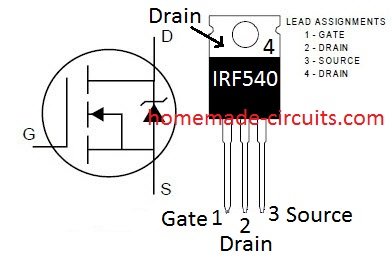
| T3, T4 | Any 30V, 10A N-channel MOSFET or a couple of IRF540 |
| Diodes | 1N5402 or any 3A rectifier diode |
Transformer = 9-0-9V, 8 amp
Battery = 12V,10AH
Video showing the Testing process of the 50 watt inverter circuit:




Comments
respected sir,
i need one help, i draw the your circuit from proteus softwre and how to check output from your circuit
Hi sribasu,
The battery wattage , mosfet and transformer ampere rating decides the output wattage of inverter.
I already developed such MOSFET based square wave inverters. But they ate capable of driving at most 5 watts CFL. Is there a way to improve the oitput wattage of these inverters? Which component in this circuit actially drives the wattage rating of this inverter?
the mosfet and transformer wattage are primarily responsible for the power delivery, not forgetting the battery AH which ensures that the load is able to run at the rated maximum power without dropping the voltage.
On the post which I have commented on.
Hi sir can I use zener 4148 diode as safety diode and can I then operate inverter as online UPS (not using computer using for inverter purpose)
which circuit, the above 50 watt inverter on this page??…1N4148 cannot be used, you must use a 3 amp diode as mentioned in the article.
I'm saying about this circut. Please reply fast.
which circuit are you inferring to??
Can u pls provide me a simple 50Hz square wave to sine wave converter circuit..
you can check out this
https://www.homemade-circuits.com/2013/04/how-to-modify-square-wave-inverter-into.html
As I can seen from your circuit this a astable multivibrator with MOSFET …can you tell us what's the use of MOSFET in this circuit ??? Please explain in detail …
it converts the low current astable pulses into high current induction inside the connected trafo winding
hai swagatam sir,
if we are using 2 CFL bulb by this Inverter circuit with 12v 10AH battery then till how much the bulb will glow.
I have 12-0-12 , 3A transformer and I'm interested in only to glow a 10W blub ..and I have only 5Volt 1.5A supply ..can I make a inverter with those specifications????
And what's the role of transformer current rating for example I have 3 A transformer .. does that mean It will work only above 3 A battery supply or something else please explain it .. thanks in advance
the 3A is the maximum current producing or handling limit of the transformer, it has nothing with the battery current, rather it is related to the load current which must not exceed 2A.
Will this circuit work when I apply 5V and 1.5A battery and my transformer is 12-0-12 , 3A ..I want to glow only 10W blub ..will it work ????
No it won't, the battery and the trafo rating must be similar.
Hey I want to make 10W inverter so what will be the battery and transformer ratings for this ???
Btw I have 12-0-12 3A transformer so please tell me suitable battery for this to glow only 10W blub
with a 12V /3a trafo you can use a 12V / 7AH battery
I'm beginner please tell me what's is the meaning of 9-0-9 and 12-0-12 please explain this in detail
that's 3 wire outputs from the transformer primary winding, when 220V is applied from the other side…these 3 wires on the other side will produce 9V-and-9V between the central 0V wire and the outer two wires, hence it's termed as 9-0-9, or similarly 12-0-12 when it's 12V
Sir it wasn't in your blogs, and I search for it now, but I couldn't see it.
Sir could you help me with one charging circuit that has battery full cut off feature.
If my transfo rated 20A, and the outertaps are 7.2 convine together to get 14.4, when the battery AH is 200 what circuit is suitable for this project?
thanks for your kind help.
Aminu, you can try the second circuit from the following link
https://www.homemade-circuits.com/2011/12/how-to-make-simple-low-battery-voltage.html
Thanks very much Sir.
My next queations are on the charging circuit and the componets like diodes and relays currents.
Assume I want to use 200ah battery, what value of the diodes and relays is needed when the tranfo is 20A.
Also, I can see in most of the charging circuit, the charging resistors is 10watt bigger, so an I go ahead with it or it needs to be change to biggest like 15watts to above.
thank you Sir.
Aminu, for 200 AH battery the diodes and relay contacts will need to be rated at 30 to 40amps
which charginh resistor are you referring to, please provide the link
Good day Sir,
Sir based on this post, I have an Idea of using 7.2-0-7.2 transformer, removed from 350va ups. So if I use the outertap of tranfo i.e 7.2+7.2 It will give 14.4v which can charge 12v battery with bigger AH. But, I dont have any skill on how to buit it like the one on this post, and what charging circuit is suitable for the tranfo and the battery.
Always, your help is highly appreciated.
Thanks a lot.
Good day Aminu,
For lead acid battery the recommended charging current should be 1/10th of its AH rating.
the type of charger will depend on your choice, it could be automatic, or manual as you prefer.
I have posted battery charger circuit designs, you can refer to those for more help
https://www.homemade-circuits.com/search/label/Battery%20Charger
12 x 5 = 60 watt in ideal condition, but practically it could be only 40 watts
Sir, can you please tell me that how many watts the circuit can deliver if I use mosfet 3205 and a 12-0-12 5amp transformer and I am using a 12v 7.6ah battery.2 And how much watts will be delivered if I use mosfet irfz44n with the same battery and transformer. I am not using any diodes in my circuit. The circuit can deliver 40watts. If I am using irf 540n
Hi Abhishek, the oscillator is only for generating the frequency, it has no role in the power delivery of the inverter, neither will it get affected by the battery type or its current as long as its operating voltage is not exceeded
only the transformer and the battery determine for the actual power output capacity…the fets must be rated to handle this power so that they don't burn out
Hi sir, as sunil solanki asked " solankiApril 18, 2013 at 11:32 AM
Sir,
i want to know that, the load capacity of inverte depend on which component in inverter circuit. Please tell" and you answered " transformer rating, mosfet rating and battery rating" so I want to ask that what about the transistors used in oscillator circuit? Will they remain same and in good condition on applying a tubular battery like mains inverter used for home ? And if I am not using safety dioddes
Dear sir,
i want circuit design for flyback microinverter 230AC single phase
Dear Elan, please provide more info regarding its specs…
Sir i am Prem. Sir can i connect a 12volt 2amps solar panel instead of a 12volt 10Ah battery.
Will it work…
Aravindh, 2 amp is quite low, and will produce not more than 20 watts at the output.
Hi Swagatam,
Thanks for this useful circuit. I have a 7Ah battery and a 12-0-12 4A Step Down transformer. I want to use the transformer in reverse, just like how you did. Could you please tell me what are the adjustments required in the circuit, in order to make it work with the above 2 parts?
And what will be the output power of this circuit? Is it 12×4=48 Watts or lesser?
Great! Thanks for the information.
Hi Sribasu, you won't have to change anything, and may use the same design with your battery and the mentioned transformer.
However the transformer should be ideally 9-0-9V for a 12V battery, in order to be able to generate around 260V initially with a fully charged battery…
with a 12V trafo, the initial voltage could be around 220V and drop to 190V as the battery discharges.
the output max wattage will be 48 watt in ideal situations, and if your trafo is true 4 amps rated otherwise you shouldn't expect more than 30 watts from the system.
sir do u have circuit for 12v to 350v smps converter!??
you can try the following concept with some modifications:
https://www.homemade-circuits.com/2013/03/how-to-convert-12v-dc-to-220v-ac-using.html
Thanks sir
sir
i want to run a cooling fan with intervals, for mosfet.
can you suggest such a circuit??
arun, you can use an IC 555 astable circuit and connect a small PC fan directly across its pin3 and ground, and set the RC components for switching it with the required time delays
Ok Sir,
Am happy to hear this Sir.
Again, It will be better if You could develop the one that can provide stable output voltage even with the 88% load.
Say, the invarter can produce 500 watts and the load is alteast 420 watts, while the output volt can not change from 220v.
My best regard Sir!
Aminu, actually I already have the design posted in my blog, you can check it out here:
https://www.homemade-circuits.com/2012/02/how-to-build-simplest-modified-sine.html
Sir I have gone through this blog throughly and I have some question as follows:
1. If we apply 2200uf/25 to above voltage, does this give us smooth power and prevent buzzzz sound from transfor?
as mentioned by the commenter Arun.
2. I heard u suggested the use of IC 555 to modify this circuit fron squear to sine wave. So, pin3 from ic555 is the output to the Gates of mosfets through 1N4148 diod, right? Sir is there no any other component to add here? Unlike in this post:
http://www.www.homemade-circuits.com/2013/04/how-to-modify-square-wave-inverter-into.html?m=1
3. How can I calculate the resistor's value if the caps is changed to above or below 2A474j cap?
Thank you very much Sir…
And I think this circuit mayb sinple for me than the one I mention in this comment, if it has no BC557/BC547 parts.
Morning Sir,
This is Aminu again.
Sir, is there any possible modification on the above circuit to get modified sinewave output?
Or, any other simple and few components ciecuit available for modified sinewave?
Thanks for your kind and helpful work.
Good morning Aminu,
you can add a 4017 IC in the middle of the T2 collector and mosfet stage…if possible I'll try to update the design soon.
Aminu, normally a high value capacitor is used across the battery terminals to cancel high frequency disturbances, so that helps to get a cleaner output
2) the T5/T6 circuit could be replaced with 555 circuit for achieving the same.
3) you may have to study transistor AMV formula for knowing this, it can be easily found online.
if pwm is used then you will need the 547/557 stage for preventing mosfet heating up
Sir
I've modified the circuit board
and put a 2200uf 25V capacitor
across the supply.
Now is working perfectly…
No heat no hizzing sonud.
thank you so much
That's amazing Arun, keep up the good work,
thanks for updating!!
you r right sir.
the legs of mosfet were short with its heat sink.i did'nt noticed it.
i'll try this until geting a good result.
Oh My goodness..
I set up the circuit and it worked for a few seconds and every components became tooooo hot. within 5 second The mosfet crashed and R3 broke .
All connenctions had burn away.
Sir
the components which I've used ,
R1,R2=140k
R3,R4=220ohm
C1,C2=2A104J
T2,T1=BC547
T3,T4=IRFZ44
Trans. 12-0-12 ,5 A
And a 12V 9Ah battery
Then…
what should I do sir??
arun, everything cannot burn that's impossible unless something's severely wrong in your circuit connections.
change the 220 ohms with 1K, and I hope you have the mosfets mounted on good heatsinks, if not then put them on.
after this everything must run perfectly.
thank you sir
ma unfortune!
sir i did'nt get c1& c2( .47uf).
Is that proper with capacitor 2A104J & 140K instead of 27k?
is that a genuine idea?
plz rply me !
yes, it's genuine and a standard principle.
first of all ,thank you for your valuable advice & direction.
sir
am going to fix 474J 63v cappacitor for C1&C2 .
is gonna make any problem?
no problems, you can go ahead with it.
Sir
What should I do with the Earth indicated points on the above circuit???
the earth is just the battery negative, nothing more.
sir
am Arun.
could you plz show me an image of 0.47uF/100V metallized capacitor?
I went to retailer and asked for 474J 100V capacitor,but he did'nt heard understand for what am asking for!
hope you may help me
you can use other values also for C1/C2 such as 0.1uF which is five times less than 047uF, but that would mean you will need to increase the 27k values five times more, that's equal to around 140K
arun, you can use any standard ceramic 0.47uF capacitor, the given specification is not critical.
Thank you so much sir
thanks alot for the reply.one more question,why is it that such transformer of the same wattage that i use powers the cpu and monitor in a ups and usaid mine even cnt power a 100watt bulb. secondly pls can u post the modified sine wave of the above circut.thanks again
thank you alot greatful
just upgrade the trafo, that's all
thanks for the help.really greatful.sori another question to go.pls if i want to upgrade to aroun 350watt of the aboove circuit what are the modifications to make.thanks again
CPUs and monitors are designed to work with low voltages also, since these have SMPS which are assigned to work even at as low as 100V.
the modified design can be seen here:
https://www.homemade-circuits.com/2013/04/how-to-modify-square-wave-inverter-into.html
hello sir.i have a problem with an inverter and would love u to help me out. i built a square wave inverter with ic cd4047 i use irf3205 fets at d output.i used four irf3205 two on each side.couldnt get a 12v-0-12v transformer so i used a 16v-0-16v transformer rated around 4amp i power d inverter with a 12v 75ah car battery.my problem now is am geting above 250v ac and anytime i connect a 60-100watt filament bulb it may not glow or when it glows it dim and the voltage drops to around 100v ac.pls help tanks
Hello Mayokun,
first of all the transformer voltage should be always lower than the battery voltage…for a 12V, it could be around 9-0-9V, secondly a 4 amp trafo as in your case will be able to produce:
4 x 12 = 36 watt in most ideal conditions…so expecting a 100 watt is no good
use a 9-0-9 or a 12-0-12V trafo rated at at least 10 to 15 amps for illuminating a 100 watt brightly
Plz send me
Pure sinewave inverter design for grid synchronization for home inverter with 500watt
Hi sir, I want to ask you a question regarding the IC CD4047. My question is that, what number of mosfets can the IC Cd4047 drive? i.e. What is the maximum output power(WATTS) I can get if I use Cd4047 inverter circuit? Waiting for your reply sir.
Thank you very much for your help sir.
4047 IC is the ideal IC to start with, other ICs are relatively complex to configure
Thanks for the help sir. Can you please suggest an IC number as I want to build a circuit that can drive loads upto 1000watt. I am going to use IRF 3205 mosfets.
Hi Purna, you can use any desired number of mosfets with this IC or any similar IC and get any desired power output from the inverter transformer.
the transformer and the battery decide the power (wattage), not the IC, the IC is only for the initiating the mosfets as per the set frequency.
Hello,
Is it requred to use 12-0-12v transformer or it could be with only two wires?
And also why is used 3 wires primar?
Thank you in advance.
BR
Hi, yes a center tap trafo is necessary here since the circuit uses a push pull type of topology, two wire trafo will not work here.
the primary center tap is used to connect with the battery
for a 12V batt the trafo primary must be rated at 9-0-9V, that is, slightly lower than the battery voltage
hi sir i am a new comer here i want to know that r1 r2 has 27 kohm values each?
also for r3 r4 r5 r6?
ur respnse will be highly appreciated.
thank you
Hi Prateek, it's given in the parts list below the diagram, yes R1/R2 = 27K ohms
rest are 470 ohms
Hi! This is samar i want to ask you about this circuit that can i use mylar or electrolyrtic capacitor instead of metallized and the second thing is that can i take 30 watts load from 12-0-12, 3amp transformer rating. thanks in advance. waiting for your kind reply.
hello if your transformer is getting hot, it means either the transformer is faulty or the inverter is not oscillating.
First make sure the junction of R4/R5 is generating the required 50 Hz frequency, confirm this by keeping the transformer disconnected…
if this is OK, it would indicate a possible fault in the transformer
Hello! i want to ask you about a inverter circuit i made an inverter
circuit by follow this circuit diagram but when i connected 12-0-12, 1
ampere transformer it cant converting to 220volt and transformer is
heated can plz tell me about the problem and i got 12,12 volt from
mosfet transitor can you plz explain?
Hi, yes mylar or electrolytic caps can be used, if the trafo is truly rated at 3 amps then 30 amps can be expected from it.
hi sir. Shall i use npn transistor (2n3904) in oscillation stage with reverse polarity.
you can use it in the correct polarity, matching with the shown BC547 poarity
hi swagatam,
Well i stated you that i am making an inverter.
my actual goal of making an inverter, which can actually able to power big devices like tv or computer of 300 watts from low power consuming devices like 12 volt adapters. i know is bit of impossible idea?
but i thought that first we need to connect an 14 volt strictly regulated current and voltage adapter to the mains. And we will connect the output to the battery of 12 volt for charging and after charging we will take up an 800VA inverter and connect it to the battery, leaving the mains adapter switched on as it is. Simultaneously we will switch the inverter on and give out the load. it will usually draws current from adapter only. but if the load increases, the battery act as an supplier. as i stated that battery should be charged first and then should be connected to the inverter. and this is something adding a wire in between the mains and the load. can you tell me if there is any possibility of this design?
I read an common inverter design, there is always a backup like system where mains are either connected directly to the load or they are backed up by an battery if there is mains failure.
can we also replace battery with ultra or super caps following my design?
please please reply.
advance thankx
Hi Shadab,
What you are assuming is incorrect and therefore will not work, 300 watts means 300/12 = 25amps, you will need an adapter capable of providing 25amps for relieving the battery from the load…..
thanks for the answer!!!
what modifications will I make to obtain 200 watt ?
500 watts ?
sine wave?
the above circuit will give 200watt easily, for sine wave again you will have to employ a 555 IC and diode network at the gates of the mosfets.
hi sir
this srinivas
ihave a doubt can i use irf3205 mosfet with circuit and ihave a 600 va computer ups transformer is 12-0-12
please suggest me
thank & regards
Hi Srinivas,
Yes you can use the mosfet with the mentioned transformer.
i desing the ckt but its not working….. wht i do sir…….????
Hello Sadi,
Yes heatsink is necessary if the devices are getting hot, use a size which keeps the mosfets reasonably cool.
Helo Sadi,
I am not able to identify any potential threat that might be causing damage to the mosfets, however during transition periods there may be a chance of the mosfets conducting simultaneously for a split second, although quite unlikely it's better to tackle it also.
put zener diodes in series with the emitters of the BC547 transistors, anode to ground and cathode to emitter. zener value can be anything between 3 and 9v.
Don't worry about the transistor biasing voltage because here it would be continuously changing from positive to negative vice versa due to the oscillating nature of the circuit…..assuming that you have built the AMV correctly.
If your PCB layout is correct as per the diagram then it would definitely work
Hello Sadi,
That's great news.
For resistive loads such as bulbs, the frequency isn't important, even for CFLs this won't be a problem.
Yes Sadi, I know that but since I am not able to figure out any other potential issue in the design,so I am assuming it to be the possible cause of your mosfet damage.
Also connect 1K resistors across collector/emitter of T1/T2, that might help control transients.
Hello Sadi,
I think the mosfets might have got damaged due to the absence of flyback diodes across D and S of the mosfets, I'll update the diagram, please add it in your circuit accordingly.
That's cool Sadi,
Yes it will work, please refer to this post:
https://www.homemade-circuits.com/2013/04/how-to-modify-square-wave-inverter-into.html
use a 12V/5amp transformer and a 12V 10AH battery for getting higher current outputs
Hi Sadi,
You can use 12-0-12V trafo, but you will need a fully charged battery upto 14V for acquiring the required 230V output from it.
Hello Sadi,
Just type "smart automatic charger" in the above search box, you will find your circuit there.
you can try any closely rated trafo…
yes you can do it.
You can added more number of mosfets by directly connecting their gates, drains and sources parallel with the existing mosfets, just make sure that each mosfet has it's own separate resistors similar to R5/R6, drains and sources can be directly joined in parallel…the resistor ends can be joined with transistor collectors as done with the existing mosfets.
All mosfet numbers should be exactly identical
Sir,
Actually this is the time to Upgrade this particular circuit with above mention features to make it NEW and secondly, searching for this features individually on the blog is wastage of time, if found, the connections should be logically correct and this is very time consuming…what do you say ???
Regards,