A Fence charger or energizer is an equipment which is used for charging(electrifying) a fence or a boundary in order to protect the inside premise from human or animal interventions.
Since these boundaries are mostly of large fields and parks, are normally away from the main cities, and powering them through some renewable option becomes more suitable than from utility grids which may become difficult to acquire in such remote areas.
The circuit of a solar electric fence charger explained here does not depend on traditional power source for operating, rather gets it 24/7 from a self sustained solar power conversion set up.The circuit is very simple to understand.
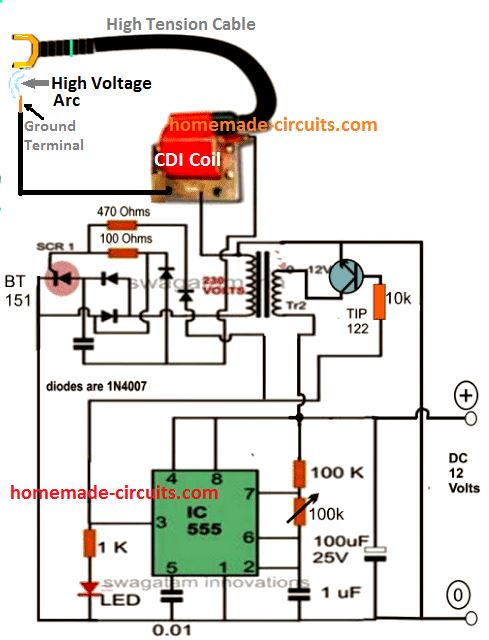
The fence charger circuit is basically a switching circuit which involves a few diodes and a high voltage capacitor.
How the Circuits Works
The diodes are used for rectifying the AC from a small step up transformer so that it gets stored inside the high voltage capacitor.
When this voltage reaches a particular threshold, the SCR fires and discharges the entire stored voltage inside the capacitor.
The above discharging of the capacitor is done or rather dumped inside the primary section of an automobile ignition coil.
The sudden dumping of the above high voltage inside the ignition coils primary, steps up the surge into several thousands of volts into the secondary winding of the ignition coil.
This stepped up voltage is used for energizing the fences or the boundaries appropriately.
However the above operations requires an AC input at the levels of around 100 to 220volts.
This voltage is generated by suitably processing the input DC from a solar panel set up.
The voltage from the solar panel is first controlled to a suitable level and then it's used for operating a triggering circuit.
The triggering circuit consists of a IC 555 oscillator which switches the voltage obtained from the solar panel controller into the transformers input, so that the output from the transformer generates the required 220V AC for powering the ignition circuit.
The solar panel output also charges a small 12V/7AH battery so that the power can be used after dusk, when sun energy is not available.
Parts List
- 10k, 100k, 1k 1/4 watt 5% = 1 each
- 470 ohms, 100 ohms 1/2 watt 5% = 1 each
- preset 100k = 1no
- Capacitor 1uF/25V, 100uF/25V electrolytic - 1 each
- Capacitpr 0.01uF disc ceramic = 1 no
- Capacitor 105/400V PPC = 1no, near the SCR
Semiconductors
- 1N4007 = 4 nos,
- IC 555 = 1no
- LED red 5mm = 1no
- Transistor TIP122 = 1no
- SCR BT151 = 1no
- Transformer = 0-12V/220V 1 amp
- Ignition Coil from 2-wheeler or 3-wheeler
The above circuit can be powered through the following solar panel current controlled battery charger circuit:
For complete explanation of the circuit please refer this solar voltage regulator circuit.
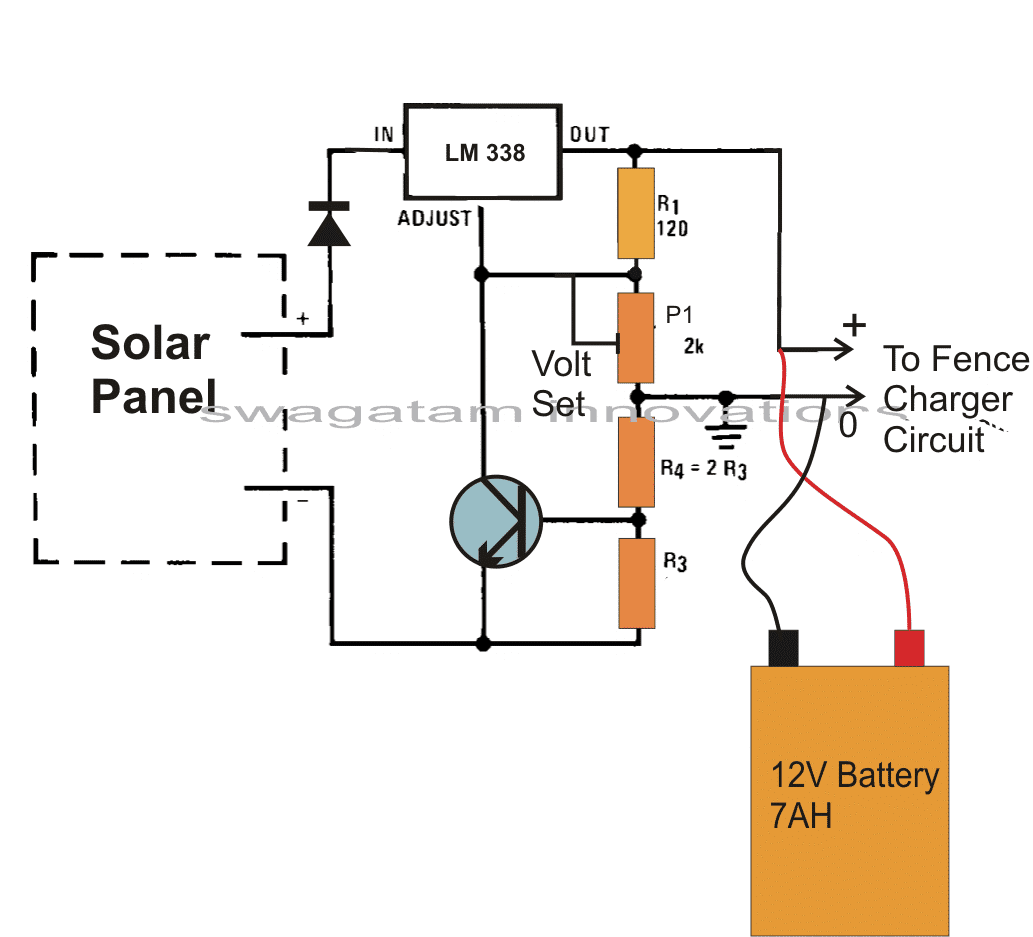
Parts List
- R1 = 120 ohms
- P1 = 10k pot (not 2k)
- R4 = replace with link
- R3 = 0.6 ohm 1 watt
- Transistor BC547 = 1no
- IC LM338 = 1no
- Diode 1N5408 = 1no
- Solar Panel = 16 V / 2 amp
- Battery 12 V 7 Ah
Fence Charger using a Stand-alone Inverter
Video clip showing the working details of the fence charger circuit. The video basically highlights the strength of the sparks generated by the CDI coil and how effectively this can be used when integrated with a farm fence.


Comments
Dear
r u recd my last file?
Dear
thanks for reply
Actually i need solution for this design. i say sorry for jpg & now sending u pdf.
i need more output power , so for that may i choose 50mfd/440 Cap? & change T1 data with MOSFET also?
pl guide me .
https://www.homemade-circuits.com/wp-content/uploads/2026/06/ferrite-core-cdi-circuit.jpg
Nitesh,
Increasing C3 value will not help, in fact it might do the opposite….instead you must increase the voltage rather than the capacitance. See that chain of Zener diodes, ZD2 —-to ZD6. They are 120V zeners that cut off the charging when it hits a certain limit. If you add another small Zener diode in series to that string, it will let the capacitor charge to a higher voltage. But make sure to keep the maximum voltage under 400V because that C3 capacitor is rated for 450V….
Also, try using a larger ferrite core for T1 that can handle more magnetic energy without saturating, or change the windings.
Increase the secondary winding turns and also use a thicker wire, or use 2…3 strands of thinner wires together to make one thick wire.
Or if you want to keep the same winding, just decrease the primary side winding little bit.
Also, try tuning the MOSFET bias network (R2, VR1, R4) to ensure Q2 turns on sharply and push more raw power to the high-voltage side.
Dear
What is the value of zener connect in series with ZD2 toZD6?
My ferrite is ETD34 with Lp =135mh @6.25 ohms , Ls=820uH @0.09 ohms .
What this DCR do? is effect on power or just control loss of primary side wattage? suppose if i decrease primary side inductance with big core ETD39 then it give some effect on output power?
i have all DSO voltage of Drain , Gate & Cap charging .May i sent it ?
second instead of IRF840 & may i choose some big current rating with high Bvdss then does it good choice? because now my gate voltage is max 6 v.
May be Mosfet is not full on?
Nitesh…..Add small Zener like twenty four volt in the string. It will increase capacitor voltage nicely but keeps it safe so it wont burst.
You mixed up the coil readings. High ohms is output side and low ohms is input side. Low resistance means less heat so wire thickness is not your problem here.
Yes, use the bigger ETD39 core and make input turns less. Big core holds more power without locking up, so capacitor will charge super fast at high speeds.
Your six volt gate voltage is very bad. That MOSFET is only half open, making it hot and blocking power.
Bigger transistor is good idea but first fix the circuit to give at least full 12V to the gate.
i need to understand C3 charging time ? Because it 25mfd/450 ( i cancelled 33mfd) . And due to 5 zener in series of 120 v then zener loop only conduct 120×5= 600 v. Then how can Q2 ( IRF840) became off? Need to understand roll of R6(100K) & D4(M7)also..I understand Mosfet On time but less clear C3 charging time with MOS off. So if i add 24v zener extra then charging time increase or decrease?
Dear….C3 does not charge during one long MOSFET OFF period. Instead the ferrite converter keeps switching Q2 ON and OFF thousands of times per second. Every time Q2 turns OFF, then magnetic field inside T1 collapses and produces a high-voltage pulse which passes through D6 and D7 and adds a little more charge into C3. So the C3 gets charged by thousands of small energy pulses….
The five 120 V zeners are not directly connected across C3, otherwise the regulator would wait until around 600 V before acting. Instead… the voltage from C3 is sampled and scaled through the resistor and diode network, so the zeners begin conducting when C3 reaches the intended operating voltage.
R16 (100K) mainly limits the current into the sensing network and isolates the high-voltage capacitor from the regulator section. D4 (M7) allows the sensing current to flow in one direction and prevents unwanted reverse current paths.
If an additional 24 V zener is connected in series with the existing zener chain then regulation threshold will increase. As a result… C3 will charge to a higher voltage and the charging time will become longer because more energy must get stored in the capacitor before the oscillator can get turned off.
Clear..
The voltage from C3 is sampled and scaled through which Resistor & Diode. Give me value of designator.
How can R16 (100K) mainly limits the current into the sensing network , with secondary side negative voltage or positive voltage bcz after R16 there is D4 & reverse direction. so path not clear
in short feed back loop with c3 charge ref not proper clear
if i ++ gate voltage of mosfet then it proper switch but due to that what acutely happened, output power increase?
i connect zd1 (4739) . May i ++ this value for ++ gate voltage ? my system volt is 12v. so what max value i choose for zd1?
i am giving some file for better ref with gate volt 6v .at that time c3 wave, drain wave, gate wave
does it show spike at drain & gate side? if yes then possible to rectify?
https://www.transfernow.net/dl/20260623yol15mrg/DCj1060i
The C3 voltage is mainly sensed through this path:
C3 (+) >> ZD6-ZD2 chain >> R14 (100K) >> D3 >> R1 (10K) >> Q1 base.
R13 (10K) gives the return path to ground and also helps to bias the sensing circuit. R16 (100K) and D4 (M7) are not the main divider for sensing C3 voltage. They are more related with the transformer secondary feedback and isolation network and help to block unwanted reverse current paths.
From your waveform, we see the gate voltage looks around 6 V. The IRF840 generally likes around 10 V to 12 V at its gate for proper switching. At only 6 V the MOSFET may not turn ON completely, so its ON resistance becomes higher, it may become warmer, and less power gets transferred to the transformer.
Increasing the gate voltage may improve switching efficiency and allow more energy to go into the transformer which can charge C3 faster and may increase the output power. But… the gate voltage should not go beyond the maximum VGS rating of ±20 V.
The 9.1 V zener ZD1 (1N4739) is mainly there for clamping and protecting the MOSFET gate voltage. For a 12 V supply, trying a 10 V or 12 V zener may improve the gate drive but increasing it too much is not advisable.
The drain waveform does show some switching spikes which are normally seen in flyback converters. The gate waveform also looks a little noisy. These spikes can be reduced maybe by improving the snubber network, using a better transformer winding layout, keeping wiring short and making sure that the drain clamp zener is working properly.
Many things clear,execpt
The C3 voltage is mainly sensed through this path:
C3 (+) >> ZD6-ZD2 chain >> R14 (100K) >> D3 >> R1 (10K) >> Q1 base.
But zener rating in 120v each ,so total 600v .
so at which point or time it start to sense? ,bcz c3 value is 450 max. & .while mosfet cycle continue in between ( at that time ) C3 reach up to 650v or 700v & control last 450v? this is not clear in depth.so give brief explain.
I think there is some aspect that is not correctly identified in the schematic.
I do not think C3 is charging to 650 V or 700 V and then being regulated back to 450 V. If that were happening, then 450 V capacitor would be under severe stress and could get damaged.
The best way to verify this is to directly measure the DC voltage across C3 during operation. If the measured voltage is only around 250 V to 350 V, then the 600 V zener threshold theory cannot be correct and there is likely some mistake in the zener value identification or schematic interpretation.
Dear
i will update shortly & again verify Coil input & output side both L & R
Thanks
Dear
yes feedback sense zener is 120v each. & when i choose c3 value is 25mFD/450v .This is ac capacitor which we generallly choose in motor. so may be it DC voltage is diff. it goes up to 600v. & run up to long time. i have less idea for current .
Now today i am fit 50mFD/450 cap & cut one zener then my zener loop total voltage is 480v & now C3 accross volatage is 500v.& when i change R13 value from 10k to 20k then my C3 also get good charge with some idea time also then dischage. THis result is good for me. & i am satisfied.
u give me good support for understand & clerity.
Now whole ckt consume 600 ma & i need 1A without change C3 ideal on & off time so what to do? may i low primary turn?
OK, that sounds great.
Yes decrease the primary winding turns slightly, and also don’t forget to increase the gate voltage of the MOSFET to 12V…
Ok. will do Primary winding less . with 50mfd/440v i see C3 charge @500 v which i need & little bit idea time ( horizontal time ) & then C3 discharge with R13 is 20k at gate volate 5v max with 9.1z But when i fed 12v zener my gate voltage ++ but that idea time gone out.so i need idea time must. Second when that idea time occures ,mosfet is on Or off?
i show u that idea time line in attached graph.
https://www.homemade-circuits.com/wp-content/uploads/2026/06/cdi-capacitor-waveform.jpg
Ok.will check with 2 channel DSO for ideal time mosfet is on or off
I think the “idle time” you marked is most likely the interval after the energy transfer is completed and before the next switching cycle starts. It is probably not the MOSFET ON time.
When you use a 12 V zener, the gate drive becomes stronger, so the IRF840 transfers more energy per cycle and the idle time may reduce or disappear. This is not necessarily a problem.
To confirm whether the MOSFET is ON or OFF during that interval, you will need to compare the gate waveform and this waveform simultaneously using two oscilloscope channels.
Also, if C3 is reaching around 500 V, please be careful because that is already above the 440 V capacitor rating.
Yes, I saw it but the diagram is too large and unclear, so I found it difficult to understand it.
Instead of going with such complex circuit, why not use the above SCR based simple design which is 100% tested.
Do you have a layout of a circuit board for these designs?
Solar Powered Fence Charger Circuit
Sorry, I do not have a PCB layout for this project…
Hey Swagatan,
I’m planning to use the first circuit to protect a hive from bears.
– The output cap is a ”PPC”, what is it? Could an electrolytic capacitor be used instead?
– I’ve read that you need about 1 joule to deter bear. Using the formula W=0.5 CVsquare and 220V, I get the need for a 41 uF capacitor. Is it still safe for human beings? It is too much in general in your opinion? It seems like a big upgrade from the 1uF capacitor.
– Should I increase the value of the output cap, do I need to increase the watt of the 100 and 470 ohm resistor?
– From what I have read about IC555 and calculated, this circuit give about 4,8 pulses per second, am I right? I need to increase the value of the resistors and cap at the right of the IC to diminish the pulse frequency?
Thanks for your help.
Hi Jean,
The output cap should be specifically a PPC or MKT. You can search online with the phrase PPC capacitor, you will be able to get an exact idea regarding its type.
I am not sure about how much joule would be required, but the output from this generator is around 27 kV enough to kill a human being within minutes, so it should be enough to scare away any wild beast, even an elephant, according to me.
So no changes would be required in the existing circuit.
In the 555 circuit you can adjust the 100K pot to get the required ON/OFF timing, yes it will produce 4.8 Hz with the existing parts, which can be reduced by increasing the value of the 1uF capacitor, which can be an electrolytic capacitor
Thanks for your fast answer Swagatam.
Let’s say I’d want to energize more than a 100m of fence, what change would I need to do to the circuit?
I think for 100 meter coverage you can can build 10 such units and install them after every 10 meters. This will ensure uniform voltage range across the entire 100 meter area. Using a single powerful unit may not be good, since the voltage level might not be uniform across the full 100 meter distance.
You say the ignition coil is from a two or three wheeler. Does this mean that a normal 4wheel car ignition coil cannot/should not be used?
All ignition coils will work, but 2 wheeler coils are cheaper and have modest amount of current which may be suitable for fence charger application
Thank you!!
Where can I get the circuit board to make the fence charger??
Sorry PCB will need to be made to order
hello mr Swagatam. thank you for the work youre doing. i request you to help me with the list of components used in making the solar electric fence energizer
Hello aguma, I have updated the parts list in the article
Hello Swagatam,
Thank you for sharing.
Do you possibly have a circuit to test the output voltage of the coil to the fence, preferably a circuit that uses high bright LED’s?
Hi Swagatam,
Thank you for your reply.
Your suggestion to use a resistive divider with 1Mohm resistors sounds promising, if you have the time would you care show how you would go about calculating a divider to measure the output voltage, (20KV), of your fence charger for example? I am also a little confused how a voltmeter or digital multimeter can measure the voltage when the maximum scale is 1000V DC.
Your assistance would be appreciated
Hi Tracer, The formula is:
Vout = Vin (R2 / R1 + R2)
Where is Vout is the meter voltage reading
Vin is the required high voltage value.
R1 is the high resistance value which can be 1M
R2 is the low resistance value which can be 10K.
R1 must be at the + side of the high voltage supply, R2 on the – side.
Meter should be connected across R2
Meter scale can be any lower DC range
Hi Swagatam,
Thank you for the information you have provided, however I really don’t really understand what you are trying to say to help me find a solution. As I am dealing with High voltages I will keep on searching until I can find a safe solution to prevent damage to my test equipment and myself. I do appreciate your attempt to help
Hello Tracer,
an LED will not give any useful information. Instead you can put a resistive divider using a series 1M/10K resistor, and connect a DC voltmeter across the 10K. The result will be 100 times smaller than the output voltage, and therefore can be multiplied with 100
I wholeheartily thank you that you are doing a great job.
I have a problem that I want secure 2km agriculture farm but this circuit cover only 100 meter.
What machine parts will I change that cover such a ( 2km ) large area?
You are most welcome!,
for increasing the range, I think you only have to upgrade the ignition coil specs…you can try a car ignition coil instead of the shown motorcycle coil
You are welcome Sidhesh, you can use 2N3055 also, no problem with that… since the current is low for this circuit I preferred using smaller transistors like TIP31,,,,
Thank you very much sir , Ur great ,
Sir here instead of 2n3055 u mentioned tip31c is it same or different? Cos I have 2n3055
…I have updated the diagram, you can check it out.
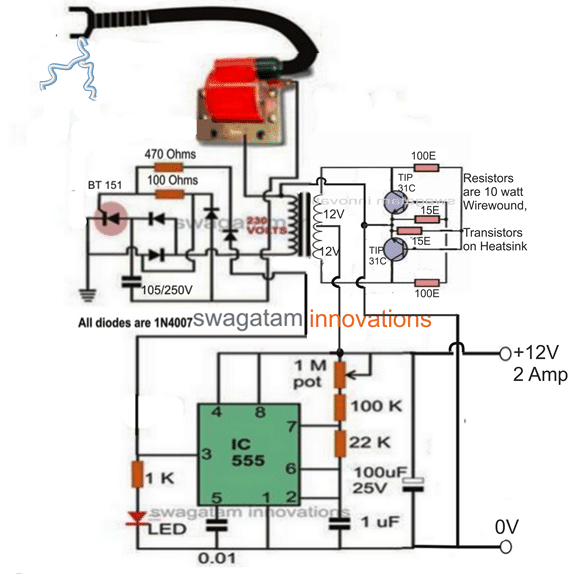
Sidhesh, the IC 555 will be required only to trigger the SCR, the inverter circuit can work independently, and will not require the IC 555 assistance…TIP122 will also be not required now.
I’ll try to update the design soon…
Hi sir it will be great if you could explain with the daigram , (now don’t have to use tip 122 ?)
Last part of scr , capacitor , n 100ohm resistor will remain same or change ???
N what if i connect output of if 555 to the input of invertor circuit
Hi sir , I have completed the simple invertor circuit n it’s working , I have connected 10watt bulb n it’s glowing , it’s working fine , but my main concern is for fencing , pls tell now what should I do next
Or is the differenct step up transformation
Or can I try with other invertor circuit of 45w output by giving input from the same circuit of urs only in place of transformar and rest as it is
Sorry it’s O/p 12v 300ma
Hi sir I have done as u said but nothing change , but when I’m disconnect transformar tip is not getting heated up it remain cool I think there might be ptblom with the transform r ,
On transfrmr it is written as
07337100
I/p: ac 240v 50hz
I/p : 12v 300ma
Eng EI-350343
Or should I change the tranform r
Hi Sidhesh, you can now build the CDI stage and configure it with the output of the inverter, for pulsing the SCR stage you will need a separate IC 555 astable circuit whose pin#3 will need to be configured with the SCr gate via a 1K resistor, and make sure to connect all the grounds together, you must connect the CdI ground, IC 555 power supply ground together, thi power supply can also be used for powering the inverter. If possible I’ll draw the design and update in the article…
I hope you have connected the 12V side with the TIP?? if yes then it should have worked
Sidhesh, you are having difficulty with the IC 555 stage, you can try the following circuit, eliminate the entire IC 555 stage and replace it with this circuit. Don’t use TIP122 use any non-Darlington power transistor NPN
https://www.homemade-circuits.com/2012/02/how-to-make-simplest-inverter-circuit.html